
How Dynamix Interpretation via Console
Maintain Optimal Levels of Security with Testing
Research from Gartner
Predicts 2019: IT Operations
This year’s predictions focus on how infrastructure and operations leaders must adopt new technologies to gain customer experience insights, respond quickly to new application requirements, and scale effectively in order to meet digital business demands.
Key Findings
- Demands on application release orchestration tools are increasing, as they enable organizations to deliver business value efficiently.
- Artificial intelligence for operations (AIOps) platforms and digital experience monitoring tools are beginning to deliver capabilities that enhance — or in some cases partially replace — separate traditional monitoring tools.
- The traditional approach to equating service uptime with IT operations success is increasingly insufficient in measuring what is critical by business leaders.
Recommendations
To meet current and future requirements for infrastructure, operations and cloud management initiatives, infrastructure and operations leaders should:
- Simplify application release orchestration adoption and speed time to value by prioritizing ease of integration with currently used development systems and traditional IT operations management tooling as evaluation criteria.
- Create a common basis for coordination between phases in the DevOps continuum by implementing an AIOps platform.
- Exploit the analytical power of AIOps by embracing data science skills within IT operations teams to effectively support digital businesses.
- Create a more dynamic monitoring strategy by establishing frequent reviews with business leaders to identify value-based metrics.
- Relegate monitoring for IT efficiency as a secondary goal, especially as the enterprise starts adopting cloud-native architectures (container orchestration platforms, for example).
Strategic Planning Assumptions
By 2023, 75% of applications will be released by a release orchestration tool to meet developer productivity release cadence.
By 2023, 40% of DevOps teams will augment application and infrastructure monitoring tools with AIOps platform capabilities.
In 2023, large enterprise exclusive use of artificial intelligence for IT operations and digital experience monitoring tools to monitor modern applications and infrastructure will rise from 5% in 2018 to 30%.
By 2023, monitoring practices that rely on the “uptime” metric will inhibit 90% of transformation initiatives due to its disengagement with the customer in an increasingly cloud-native IT environment.
Analysis
Strategic long-term IT operations planning is focused on the operations requirements associated with digital business and “cloud first” strategies. The dynamic nature of digital business infrastructures is pressuring infrastructure and operations (I&O) organizations to support rapid application change and dynamic infrastructure scalability, and provide insights to help the business better understand customer application experience. The continuous change and feedback loops needed for digitalization will change organizations’ monitoring, automation, service management and organizational strategies (see Figure 1).
Figure 1. Monitoring and Automation Will Drive IT Operations in 2019
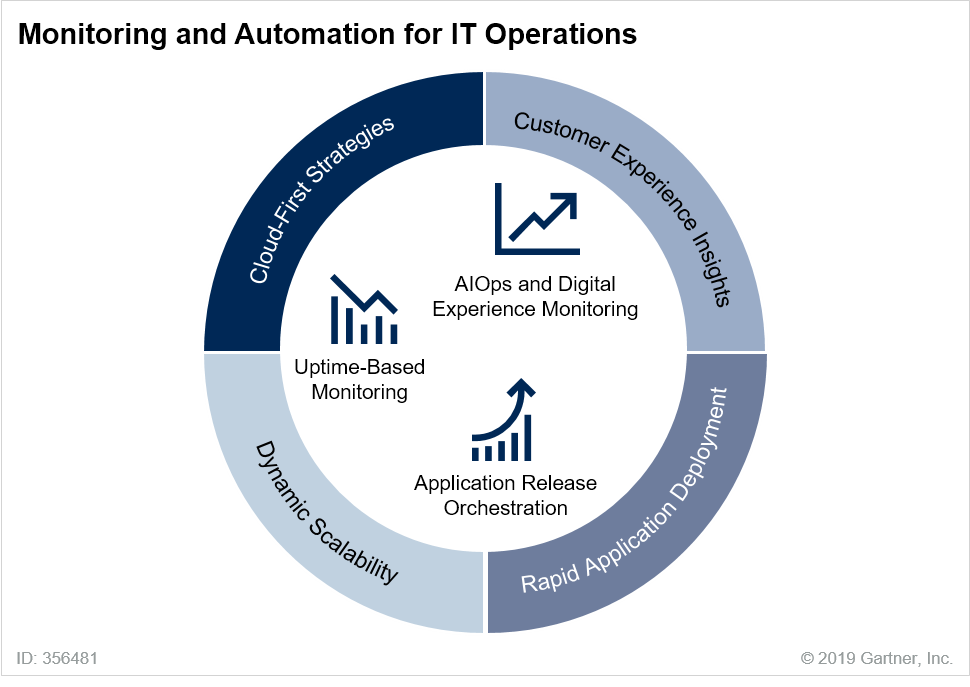
AIOps = artificial intelligence for operations
Source: Gartner (February 2019)
What You Need to Know
This year’s top predictions in IT operations focus closely on monitoring and automation. While the predictions are largely about new technology adoption (application release orchestration and artificial intelligence for operations), we also provide guidance on what organizations need to do in terms of strategy, people and process to make these technologies successful.
Strategic Planning Assumptions
Strategic Planning Assumption: By 2023, 75% of applications will be released by a release orchestration tool to meet developer productivity release cadence. Analysis by: Christopher Little Key Findings:There is a growing demand to use application release orchestration solutions to:
- Serve as the framework and integration point for a useful feedback loop for analyzing and informing development and operational activities, using context and data from deployment, release, and other operational activities and tools, such as application performance monitoring (APM), IT service management (ITSM) and AIOps.
- Serve as a replacement or alternative to ITSM-based change and release management tooling in support of modern release management activities.
- Successfully scale multiple, existing CD pipelines that rely on heavily scripted, extended CI/build orchestration (including Jenkins, Hudson, Ant, TFS and TeamCity) and CCA tools.
- Define, automate, orchestrate and manage multiple release pipelines across their supporting toolchains.
- Provide visibility, orchestration and management capabilities across multiple container, container orchestration and container management systems.
- Comprehensively support, automate and orchestrate environment management requirements (including automated provisioning, configuration, data management, drift detection, request management and availability management), particularly in support of test automation and quality efforts.
- Support complex, comprehensive release/service transition/change management requirements often requiring integration with project and portfolio, change, service and configuration management systems.
- Provide a “chain of custody” for all code, artifacts and actions across release activities.
- Automate and orchestrate the release of off-the-shelf applications and their components.
Market Implications:
The application release orchestration solution market reached an estimated $282.6 million in 2017, up from $205.5 million in 2016. Gartner predicts that the market will continue to grow at an estimated compound annual growth rate of 14% through 2022.
Demand that new applications and features be delivered more rapidly to support business agility continues to drive investment in continual delivery DevOps’ initiatives.
In particular, DevOps-ready (application release orchestration and composite content application) tools are recognized as providing the enterprise with capabilities required to successfully manage release activities (in the form of a “variable, dynamic, minimally viable process”):
- Across the entire life cycle of hundreds of applications with delivery pipelines that …
- Depend on multiple supporting toolchains and toolchain components that …
- Themselves span multiple technology generations, teams and cultures, without introducing additional speed-killing complexity.
Recommendations:
- Prioritize ease of use by multiple stakeholder types and skill sets, where growing application complexity and scale requirements will result in increasingly diverse release requirements.
- Simplify adoption and reduce time to value by evaluating the ease of integration with currently used development systems and traditional IT operations management tooling.
Strategic Planning Assumption: By 2023, 40% of DevOps teams will augment application and infrastructure monitoring tools with AIOps platform capabilities.
Analysis by: Manju Bhat
Key Findings:
- AIOps platforms enable the creation of positive feedback loops across different phases of the DevOps life cycle using intelligent automation, analytics and monitoring of applications and infrastructure.
- AIOps-enabled toolsets enhance security in DevOps. They detect anomalies in application performance and discover unusual patterns in user behavior based on the data they consume.
- Examples of data sources and data formats include historical data, streaming data, log files, network data, availability and performance metrics and human readable documents (using natural language processing).
Market Implications:
AIOps platforms are currently deployed for event correlation in application and infrastructure availability and performance monitoring. However, with the convergence of development and operational roles, and the emergence of new responsibilities (such as site reliability engineering) AIOps platforms will serve as “insight engines” across a range of DevOps functions.
AIOps could be used for site reliability engineering to incrementally automate the process that requires manual remediation and thus scale DevOps. In addition, DevOps teams can incorporate AIOps to automate the staging, configuration and approval process as part of the preproduction activities before an application is considered production ready.
AIOps investments will be crucial to augment distinct stages of the DevOps life cycle — namely “plan,” “create,” “verify,” “release,” “configure” and “monitor.” One of the unique advantages of adapting insights from the AIOps platform to the DevOps model is that the analytics based on monitoring data can be fed to enhance the product in the subsequent “plan,” “create” and “verify” phases generating a positive feedback loop.
A positive feedback loop is the cycle of continuous improvement that results from consuming data from a downstream process (production monitoring) to improve an upstream process (quality assurance/coding).
Insights gathered from log data, when combined with service desk information, lead to new automated acceptance test plans (in the “verify” phase) and improved user experience for handling error conditions (during the “plan” and “create” phases). In addition, continuous delivery creates the need to correlate the impact of data signals (for example, spikes in memory or CPU use, or interrupted network connections in a Kubernetes cluster) with the deployment of a new microservice. Monitoring tools will eventually use machine learning capabilities for event correlation.
The integrated nature of the tooling improves the management of monitoring functions, but this also calls for new skills as organizations move away from existing single-purpose tools. Furthermore, the continuous monitoring (of network and log data, for example) and analytics capabilities (including anomaly detection and pattern discovery) in AIOps platforms will allow the integration of security into DevOps, thus enabling secure DevOps. This will lead to increased overlap between the security information and event management and AIOps markets with features such as event correlation and alert filtering assuming high priority.
Recommendations:
- Create a positive feedback loop in the DevOps pipeline by implementing an AIOps platform to extract insights from continuous monitoring of contextual information — in both preproduction and production — and feeding it back to the “planning,” “creation” and “verification” phases.
- Eliminate strict silos between operations and security teams by extending the use of AIOps platforms for security analytics to improve metrics — such as mean time to detect (MTTD) and mean time to repair (MTTR) — that are common to both teams.
Strategic Planning Assumption: In 2023, large enterprise exclusive use of artificial intelligence for IT operations and digital experience monitoring tools to monitor modern applications and infrastructure will rise from 5% in 2018 to 30%.
Analysis by: Charley Rich
Key Findings:
- IT environments are increasingly ephemeral, modular and volatile, making it difficult for today’s domain-specific monitoring tools to present a unified, cross-domain understanding of performance.
- Performing end-user experience monitoring on a per-application basis leads to a fragmented, difficult-to-improve customer relationship with the business.
- Machine learning promises much. However, without data science skills, it will be difficult for I&O leaders to realize that promise beyond the basic use cases of event correlation and anomaly detection.
Near-Term Flag:
By 2020, 90% of traditional, domain-specific event correlation and analysis tools will fail to provide accurate monitoring and root cause analysis, leading to high costs, and low productivity from excessive false positives.
Market Implications:
AIOps platforms and digital experience monitoring tools are beginning to deliver automated capabilities that enhance — or in some cases partially replace — separate APM, IT infrastructure monitoring (ITIM) or network performance monitoring and diagnostics (NPMD) tools. It will become the automated intelligence that provides pervasive, cross-domain analysis, triage and remediation for problems. Via its ability to automatically initiate actions using run book automation and application release orchestration. AIOps will become the “missing link” making an automated IT operations management toolchain possible, and eventually lead to a “self driving” IT Operations.
Recommendations:
- Provide a cohesive performance analysis across multiple IT domains by using monitoring technologies to capture and filter data, and then forward it up to a supervisory AIOps platform for consolidated, cross-domain analysis.
- Deliver a consolidated understanding of digital experience across services by funneling per-application user experience metrics to the supervisory AIOps platform for cross-service analysis.
- Exploit the analytical power of AIOps to support digital businesses effectively by embracing data science as a key skill within IT operations teams.
Strategic Planning Assumption: By 2023, monitoring practices that rely on the “uptime” metric will inhibit 90% of transformation initiatives due to its disengagement with the customer in an increasingly cloud-native IT environment.
Analysis by: Pankaj Prasad
Key Findings:
- I&O leaders have focused on availability as the primary metric of a successful IT operations organization, with a higher number of nines (99.9% to 99.999% availability) being projected as a mark of maturity. This has resulted in prioritizing IT resources like compute, network and storage over business objectives.
- Monitoring practices have been slow to respond to the rapid changes like adoption of new architectures (for example, container orchestration systems) that require a major shift away from a resource-availability approach, and toward a platform-scalability approach.
- Very few IT organizations have started developing reports indicating IT’s impact on business through a mix of metrics that includes digital experience monitoring and application-level rather than element-level KPIs.
Market Implications:
IT architectures are evolving away from being highly modular and dynamic, and toward being increasingly resilient. This creates an opportunity for I&O leaders to deliver more value by aligning with organizational goals. This is a clear shift away from being internally focused on IT resource availability, which creates a silo mentality based on perceived ownership of resources like storage, compute and network.
A system that is available for 100% of time during a reporting period, but that provides an inconsistent response time to the actual users, is bound to negatively impact the business.
I&O leaders need to align with business leaders regarding the metrics that convey impact of IT on the business. This means, bringing in data from multiple sources that include a mix of monitoring tools for infrastructure, network and application visibility. Digital experience management will provide the crucial customer-centric data when designing dashboards for business leaders. The next step involves deriving context in the form of impact on customers based on the diverse data sources through service mapping. This enables conveying impact at the level of one or more applications grouped logically in an identifiable service. This also enables closer collaboration with business leaders because of the abstraction from the lower layers of the IT architecture, and the closer proximity of a service to the consumer of the service.
Emerging technologies like AIOps platforms can help jump-start the I&O team’s efforts to consolidate data from multiple sources, and further enrich it with customer-centric insights. Whatever the approach, the best of technologies will fail to impress business leaders if it is reactive in nature, and a proactive monitoring practice that goes beyond availability is needed.
Recommendations:- Measure the performance of services rather than monitoring at a device level by modeling IT service maps as a first step, to enhance customer experience.
- Create a more dynamic monitoring strategy by establishing frequent reviews with business leaders and socializing the secondary goal of monitoring for IT efficiency as the enterprise starts adopting cloud-native architectures (container orchestration platforms, for example).
- Adopt AIOps using an incremental approach starting with historical data, and progress to the use of streaming data, before adding business-relevant context.
- Measure and report customer-centric metrics with the objective of enhancing customer engagement. For example, average time spent by a user on a certain application and/or cart, converts or abandons.
A Look Back
In response to your requests, we are taking a look back at some key predictions from previous years. We have intentionally selected predictions from opposite ends of the scale — one where we were wholly or largely on target, as well as one we missed.
On Target: 2013 Prediction — By 2015, 75% of large enterprises will have more than four diverse automation technologies within their IT management portfolio, up from less than 20% in 2013.
The rationale behind this prediction was that enterprise IT infrastructures would continue to become more complex, consisting of public and private cloud-based resources, and the high rate of change would preclude initiatives to simplify the I&O infrastructure and the automation of tasks in managing it.
This not only came true, but the rate of change has greatly accelerated through the more recent push to digitalization, which 90% of CEOs now consider to be a priority. This drive toward increased digitalization spawned DevOps initiatives that require fundamentally different automation technologies. DevOps toolchains, constructed from stand-alone tools that are designed to solve a particular problem, have led to tool proliferation. For example, in our application release orchestration prediction above, organizations often used existing ITSM tools to manage change and release activities, but are increasingly using application release orchestration tools that are more appropriate for DevOps activities.
While organizations are attempting to deal with tool fragmentation through approaches like DevOps orchestration, the proliferation of tools (and the skills required to use them) is still very much an issue. It has led to increased costs, fragmentation of skills, and an erosion of governance, among other issues. We’re finding that organizations are staffing automation architects and creating automation teams that are tasked with prioritizing and delivering new automation standardizing toolsets, and working to increase the automation skills within the I&O organization along with the DevOps product teams.
Missed: 2014 Prediction — Although machine learning skills are currently expensive and hard to come by, by 2018 they will be mainstream application development skills.
This 2014 prediction looked at the impact and pervasiveness of machine learning (ML) to IT operations. Our bullishness on the availability of machine learning skills was driven by our belief that AI and ML would be critical to observing high-volume, high-volatility, and highly heterogeneous big data platforms and services. We also expected the impact of machine learning to go beyond the mere understanding of system performance, and to pervade across all of IT operations. The thinking was that ML would become such a foundational IT operations capability that the technologies underpinned by machine learning and the skills required to use them would be mainstream by 2018.
Machine learning, it turned out, was dramatically different from earlier programming paradigms in that it required knowledge of data science. Since application developers had no prior background in data science, it introduced a dependency on data scientists to create ML models. Because the skills required to build and train ML models are radically different to traditional coding practices (in that they are required to develop desktop, web and mobile applications), developers could not leverage and repurpose their existing programming skills. The fundamental difference boils down to “treating data as code.”
Machine learning requires massive amounts of compute in addition to massive datasets — thus making public clouds a preferred platform for building and deploying AI applications. Organizations that were unable to harness public clouds due to regulatory or data sovereignty reasons impeded the development of in-house ML skills. As organizations adopt SaaS applications, the barriers to harnessing cloud capabilities that automate the creation of ML models, for example, Google Cloud AutoML, are lowered.