

Welcome
According to Gartner's report, 'The End of the Waterfall as We Know It', in 2015 waterfall methods were employed on 56% of development efforts. Gartner continues on to say that waterfall methods, when used in the traditional, project-based manner, are inconsistent and risky. With Agile methodologies and DevOps on the rise however, enterprises will need to reduce development cycle times significantly. In order to succeed in this endeavor, they will be required to do less manual testing and more automated testing.
What can we do to improve this? Which methodology is championing its way to the top?
Tricentis helps enterprises adopt agile methodologies by giving them the tools to achieve automation rates of over 90%. Our integrated software testing solution, Tosca Testsuite, offers a unique Model-based Test Automation and Test Case Design approach, encompassing risk-based testing, exploratory testing, test data management, service virtualization, and more.
Join the conversation on continuous testing at our software test conference, Accelerate 2016! You can register here.
Gerd Weishaar
VP or Product Management, Tricentis

- The End of the Waterfall as We Know It
- Matthew Hotle | Nathan Wilson
- 29 January 2016
Traditional waterfall methods remain the leading delivery vehicle for organizations, despite inconsistent delivery results. This research helps application leaders uncover the advantages of agile, iterative or incremental project delivery.
Key Challenges
- Traditional waterfall practices result in inconsistent delivery results.
- The longer the project's duration, the more requirements change and results vary.
- Waterfall projects carry significant risk of change through to the testing phases of the project.
Recommendations
Application leaders:
- Transition from traditional waterfall methods to agile, iterative or incremental delivery methods where possible.
- Constrain projects where waterfall must be used to less than 90 days.
- Put in place stringent risk management and project review processes if duration constraints are not possible.
Introduction
Waterfall development processes remain the most commonly used methods in client organizations. According to Gartner's IT Key Metrics Data, waterfall methods were employed on 56% of development efforts in 2015, with iterative methods used in 21% and agile in 23%. These numbers vary slightly over the past three years, and actually show a bump in 2015 for waterfall compared to the previous two years. (There is, of course, selection bias here, since only certain organizations do formal benchmarks. Via inquiries, conference one-on-ones and client visits, we believe that agile – including lean and Kanban – may be under-represented here.) The same data shows that 39% of projects have a duration of less than three months, and that 20% of projects exceed a year in duration. It's no wonder to us, therefore, that according to the same research, the success of delivery was somewhat less than impressive. Only 60% of projects were completed on time, and only 71% finished on budget. The average schedule variance was 23%, and the average budget variance was approximately 16%.
At first glance, this may not seem particularly dispiriting (although for some it is). However, nine-month planned projects that actually take 11 to complete can be more disruptive to an organization's resource and demand management processes than might be expected. In addition, the numbers above are averages. They don't reflect the long-tail outliers, which can have immediate and dire consequences for businesses, and quite often for application leaders and CIOs (as in, employment-related dire consequences).
Tricentis
From Waterfall to Agile means more Automation (and less Manual)
According to Gartner, enterprises should transition from traditional waterfall methods to agile, iterative, or incremental delivery methods where possible. This means that modern testing tools, like Tosca Testsuite, are essential to help you make a successful transition to agile
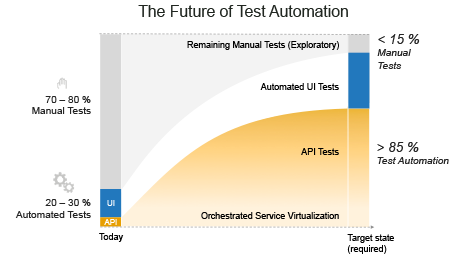
Source: Tricentis
The future of agile methodology spells a dramatic increase in enterprise test automation rates, simply because automation is imperative. It serves to support the accelerated pace needed for agile development. Enterprises will also begin to use 'shift left' to their advantage, placing testing efforts earlier in the production cycle. For Tricentis, this means helping you to test your API layers earlier on in development, and using Service Virtualization to simulate complex and interconnected landscapes. Ultimately, automation is necessary in order to keep moving at an accelerated agile pace and developers will need all the help they can get to keep up. This means testing tools like Tosca Testsuite will help today's developers by transforming manual testers into automation specialists, enabling enterprises to be agile and test continuously.
Webinar: Waterfall vs. Agile Showdown
Is the trendy Agile testing everything it boasts to be?
Is Waterfall testing really such a broken system?
Learn the reasons behind the rivalry so that, by the end of the webinar, you can make an informed decision as to which methodology you think is best.


