SAP S/4HANA is Not a “Migration” Project – What IT Leaders Need to Know
Research from Gartner
What Customers Need to Know When Considering a Move to S/4HANA – 2018 Update
Gartner has seen significant interest in the adoption of SAP S/4HANA. Application leaders looking to transform their ERP should use Gartner’s updated best practices to decide if, when and how they should plan to adopt S/4HANA.
Key Challenges
- Convincing business cases: S/4HANA adoption is gaining momentum, but many application leaders continue to struggle to identify business value and build a compelling business case for adoption.
- Roadmap: The complexity of the SAP S/4HANA roadmap, lack of clarity in industry-supported functions, and the range of deployment options available (both on-premises and SaaS) mean that customers must spend more time selecting what is best for them, given that SAP has stated that the future is cloud.
- Vertical functionality: Although there are significant common functional capabilities between the two products (ECC and S/4HANA), moving to S/4HANA involves changes to vertical industry functionality and business processes.
- Deployment flexibility and complexity: While SAP offers S/4HANA SaaS with private and public options, SAP customers who decided to adopt S/4HANA on-premises will continue to deal with the complexity of upkeeping the infrastructure upgrade and the increase in support costs.
Recommendations
For application leaders responsible for postmodern ERP strategies and SAP solutions:
- Assess whether S/4HANA is a strategic fit for your organization by performing a high-level benefit analysis, assessing your readiness and determining your preferred adoption model.
- Assess the functional capabilities of S/4HANA that pertain to you by using SAP’s Transformation Navigator and SAP’s Readiness Assessment.
- Address industry-specific requirements, and streamline implementation by engaging SAP’s Digital Business Services and third-party service providers.
- Prepare for a smooth transition to S/4HANA by first cleaning up your production database, reviewing existing custom code and evaluating delivery alternatives.
Strategic Planning Assumptions
By 2020, at least 35% of SAP ERP clients will be running one or more functional modules of SAP S/4HANA.
Through 2020, 80% of organizations conducting a “lift-and-shift” migration of internal business applications from their own data centers to cloud will not achieve meaningful cost savings.
Introduction
Since its premier in February 2015, S/4HANA continues to be SAP’s most significant and strategic solution since the release of SAP R/3 in 1992. Powered by SAP HANA in-memory database management system (IMDBMS), SAP’s proprietary in-memory computing technology, S/4HANA has a hybrid transactional/analytical processing (HTAP) architecture that enables real-time analytics, while live transaction data can be processed without the need to run Business Warehouse or Data Warehouse in parallel.
ERP suites will be greatly impacted by technology in the next several years. Gartner’s research has shown that, by 2025, 60% of human tasks will be automated, and speech and image recognition technology will be at 97% accuracy versus human rate at 94.1%. With the advancements in technology, enterprises are expected to drive the demand for running smarter operational processes through the ability to identify deficiencies as quickly as finding the solutions to address them. It is estimated that overall spending in investment for machine learning (ML)/artificial intelligence (AI) will reach at least $57 billion in Enterprise Machine Learning by 2021.1 In this context, SAP introduced S/4HANA as the intelligent ERP at the core of the Intelligent Enterprise during SAPPHIRE NOW 2018.
Moving to automated software testing requires the adoption of best practices such as behavior-driven development (BDD), developing with testability in mind, and continuous integration and testing. They are key elements to improving the overall development process. Many Gartner clients consider the procurement of tools as a primary step in transitioning from manual testing to test automation, but building automated tests is a complex process and can't be simplified solely by acquiring the required tools for automation. When done well, the merits of test automation are irrefutable, but when done badly, AD teams can end up wasting time, effort and money. This research outlines eight things to consider when preparing for test automation initiatives (see Figure 1). The following recommendations will increase your likelihood of succeeding in adopting test automation as an integral part of your development and testing approach.
S/4HANA is key to SAP’s continued success as a leading enterprise application software provider. SAP R/3 and its successors, SAP ERP 5.0 and 6.0, have been the most widely deployed ERP software in the last 20 years, supporting many large-scale and mission-critical deployments. SAP needs S/4HANA to become a similar enterprise foundation for the next 20 years to ensure its continued success in a very dynamic ERP market.
SAP is making progress against its goal to shift all clients to S/4HANA. Table 1 provides Gartner’s estimate on the number of live S/4HANA customers to date and SAP claimed that it will have 3,000 to 5,000 SAP ERP customers live by the beginning of 2019. Although that is an aggressive goal, it demonstrates that S/4HANA adoption is picking up steam. This number does not include 600 more cloud customers (40% net new) added in SAP’s 2Q earnings, which brings the estimated number of S/4HANA Cloud customers to around 750.
Table 1. Gartner’s Estimations for the Number of S/4HANA Customers in 2Q18
S/4HANA |
1Q17 |
2Q17 |
3Q17 |
4Q17 |
1Q18 |
2Q18 |
Sales |
5,800 |
6,300 |
6,900 |
7,900 |
8,300 |
8,900 |
Projects underway |
2,700 |
2,500 |
2,900 |
2,500 |
3,000 |
2,900 |
In production |
700 |
850 |
1,150 |
1,500 |
1,600 |
1,900 |
Percentage of ERP |
1Q17 |
2Q17 |
3Q17 |
4Q17 |
1Q18 |
2Q18 |
Sales |
17% |
18% |
20% |
23% |
24% |
25% |
Projects underway |
8% |
7% |
8% |
7% |
9% |
8% |
In production |
2% |
2% |
3% |
4% |
5% |
5% |
Source: Gartner (October 2018)
SAP S/4HANA is SAP’s long-term strategic solution. The company announced that it would prolong mainstream maintenance of SAP Business Suite on all databases until at least 2025. It is clear that SAP expects all existing users to move to S/4HANA on-premises or SaaS. SAP is still delivering enhancements for ECC 6.0 (as seen in the company’s current roadmaps2), but it is Gartner’s opinion that major investments and innovations will be delivered through S/4HANA. Consequently, if your organization views SAP as a strategic partner, you need to plan to adopt S/4HANA before 2025.
Gartner predicts that there will be a tsunami of S/4HANA adoption between 2021 and 2023, which could drive up the implementation cost as skilled resources are scarce. SAP customers may be at risk if they recruit less-experienced talent, as this could result in unsuccessful implementation programs.
It is critical to understand that, even if your company decides not to adopt S/4HANA immediately, you still have to consider the changes imminent with S/4HANA – including for all your current work on your existing ECC landscape – in order to not add further technical debt. For example, continuing to add customizations to your current ECC landscape will further complicate your migration approach and certainly increase project costs.
This research note summarizes Gartner’s overall advice regarding S/4HANA in order to help you determine how to start and what to evaluate in order to select the lowest-risk approach. We would not recommend that it is read from start to finish in a single sitting. Instead, we advise using this research in a modular fashion as follows.
Existing SAP ERP users that have limited S/4HANA knowledge
Focus on these best practices first:
- Review our Analysis section for a quick overview of S/4HANA and the Gartner’s S/4HANA Benefits Assessment Framework.
- Perform a high-level benefit analysis to decide if S/4HANA and the model company adoption has a role in your ERP strategy. Also determine what your adoption model will be, which could be a combination of S/4HANA, SAP SaaS, or any other SaaS vendors.
- Refer to Gartner’s note, “You Are Not ‘Doing ERP’: How CIOs Can Successfully Present Their ERP Strategy to the Board,” to explore how to present to the board in a way that shifts the perception of ERP from legacy transactional technology to digital business enabler, and to determine whether S/4HANA has a role to play.
Once you are familiar with these best practices, review the remaining best practices to help your company identify the right strategy to prepare to adopt S/4HANA.
Existing SAP ERP users that have reasonable knowledge of S/4HANA
Focus on these best practices first:
- Use the SAP Transformation Navigator and SAP Readiness Check to evaluate the current and future capability of S/4HANA. Leverage this finding to evaluate your adoption timetable.
- Engage with SAP through Premium Engagement or third-party providers to identify functional differences between S/4HANA and your current SAP ERP deployment. Then decide which of the S/4HANA adoption approaches is the most appropriate to your organization and migration objectives (Greenfield, Brownfield, Transformation or Bluefield).
- Perform a high-level benefit analysis to decide if S/4HANA and the Model Company adoption has a role in your ERP strategy. Also determine what your adoption model will be, which could be a combination of S/4HANA, SAP SaaS, or any other SaaS vendors.
Use the first part of the document as reference material. Once you have read these best practices, move on to:
- Establish the key project considerations and business gaps needed to support the transition to S/4HANA that may be addressed via app extensions versus custom development.
Existing SAP ERP users that have decided to adopt S/4HANA and are planning a migration project
Focus on these best practices first:
- Engage with SAP through Premium Engagement or third-party providers to identify functional differences between S/4HANA and your current SAP ERP deployment. Then decide which of the S/4HANA adoption approaches is the most appropriate for your organization and migration objectives (Greenfield, Brownfield, Transformation or Bluefield).
- Perform a high-level benefit analysis to decide if S/4HANA and the Model Company adoption (see SAP Model Company3) has a role in your ERP strategy. Also determine what your adoption model will be, which could be a combination of S/4HANA, SAP SaaS, or any other SaaS vendors.
- Establish the key project considerations and business gaps needed to support the transition to S/4HANA that may be addressed via app extensions versus custom development.
Potential new users of SAP considering S/4HANA
Focus on:
- Perform a high-level benefit analysis to decide if S/4HANA and the Model Company adoption has a role in your ERP strategy. Also determine what your adoption model will be, which could be a combination of S/4HANA, SAP SaaS, or any other SaaS vendors.
Existing SAP ERP users that have decided to prolong the life of Business Suite beyond the 2025 deadline before adopting S/4HANA:
Focus on:
- See our explanation of the No Plans to Adopt approach in the Assess the Strategic Fit of S/4HANA for Your Organization section.
Analysis
SAP S/4HANA is a new-generation ERP solution that is optimized for SAP HANA IMDBMS. It is not a completely new solution because its starting point was SAP Business Suite powered by SAP HANA (commonly known as “Business Suite on HANA” or “BSoH”). BSoH was initially released in early 2013 and gave users the choice of running all SAP Business Suite functionality (including ERP) on the HANA IMDBMS. SAP still supported and developed its Business Suite applications for third-party databases, because it wanted to allow BSoH to be consumed in a “nondisruptive” manner and offer users choice.
BSoH offered some potential advantages over Business Suite on third-party databases, such as improved processing speeds and real-time analytics, but the functionality was generally equivalent across all database versions. This changed in 2014 when SAP introduced the first functional capabilities that were optimized purely for the HANA IMDBMS and therefore only available with BSoH. This was the first release of Simple Finance version 1503, which had a simplified data architecture for the financial accounting (FI) and controlling (CO) modules, along with new Fiori applications and some new functional capabilities. Simple Finance could be purchased and installed in a BSoH environment as an add-on. The last version of Simple Finance is 1605 and this version will reach end of life in 2021.
In February 2015, SAP significantly shifted its strategy when it announced SAP S/4HANA. This was a departure from the multiple-database strategy implemented in its Business Suite applications. SAP created a new code line from BSoH so that it could focus on building the data architecture and functionality specifically for in-memory computing. SAP S/4HANA (or SAP Business Suite 4 SAP HANA to give it its full name) was therefore only available on the HANA IMDBMS and was licensed as a new product, meaning that additional license fees would be payable for existing Business Suite customers that wanted to move to S/4HANA. The additional license fee for S/4HANA is relatively small, and the ERP user fees are unchanged (existing ERP user licenses are carried forward into the S/4HANA license).
All existing SAP Business Suite users need to analyze the impact of S/4HANA on their ERP strategies and SAP investments. Gartner’s advice is do not wait and perform this analysis now. Many application leaders are tempted to ignore SAP S/4HANA “until it is mature” because understanding its impact is complex. This is the wrong approach because any additional investments made in current SAP deployments will be impacted by future plans regarding S/4HANA. Application leaders must ensure that the business has a clear strategic direction agreed for S/4HANA adoption roadmap before making any further investments in its current SAP ERP landscape.
S/4HANA is a new product line that is a technical and functional evolution from BSoH. The main development principles behind S/4HANA are as follows:
- Simplification and consolidation of the database schema: This has removed physical database tables that are no longer required in an in-memory system. The IMC capabilities of HANA mean that aggregate tables and materialized views (required for efficient processing in a relational architecture) can be removed. The reduction in the number of tables can be significant (for example, 28 were removed as part of the simplification of materials management).
- Deployment of the SAP Fiori user experience: This has taken SAP time to deliver, but there are now more than 7,800 Fiori applications available for the S/4HANA 1709 release. SAP has applied Fiori design principles to areas that still use the previous user experience technologies (such as WebGUI and Web Dynpro).
- Delivery of new functional capabilities that are optimized for in-memory computing: This is where there will be significant functional divergence from Business Suite functionality over time. Examples are SAP Cash Management (a new product for group-level cash management and forecasting), and real-time, multidimensional Profitability Analysis (CO-PA), which uses a combination of the revised database architecture, new data model attributes and Fiori applications.
S/4HANA will evolve to include integration to other SAP SaaS solutions such as SAP Customer Experience (CX) Solutions. SAP is working on a capability that will deliver intelligence in interface content advisory mapping to reduce the manual workload during a S/4HANA transition. The amount of development work required by SAP to fully realize the vision of S/4HANA is significant and, at the time of preparing this research, was still in progress. It is Gartner’s opinion that it will take between three and five years for SAP to complete the majority of this work. Application leaders must, therefore, understand how S/4HANA has evolved (and will continue to evolve) in order to assess the maturity of the different versions and deployment options.
S/4HANA Enterprise Management and S/4HANA Cloud are both developed from the same code line, but have different functional scopes because the S/4HANA Cloud editions have a full Fiori user experience. There are one retired and two updated primary variants of S/4HANA in the market at the time of preparing this research:
- Retired S/4HANA Finance: Originally called Simple Finance, this is effectively BSoH with the simplified architecture applied to FI and CO only. It has a separate release cycle from S/4HANA Cloud and S/4HANA. SAP describes this as an “interim architecture” and has announced that S/4HANA Finance 1605 was the last release, after which it would not be further developed. It will be supported until 2021, and it is possible to migrate to S/4HANA from S/4HANA Finance using SAP Maintenance Planner and Software Update Manager. There are no additional licenses required for this migration.
- Updated S/4HANA Cloud: The version available at the time of preparing this research is 1808. S/4HANA Cloud has come a long way to now feature most functional scopes in the areas listed in Table 2.
Table 2. Functional Areas Covered in S/4HANA Cloud
| Functional Areas |
|---|
| Asset Management |
| Enterprise Portfolio and Project Management |
| Finance Research and Development |
| Intelligence Analytics |
| Inventory Management |
| Machine Learning |
| Manufacturing |
| Predefined Integration |
| Quality Management |
| Research and Development |
| Sales |
| SAP Copilot – Natural Language Interaction (ML/AI) |
| Sourcing and Procurement |
| Variant Configuration |
Source: Gartner (October 2018)
These are configurable SaaS solutions licensed on a subscription basis with no code customization allowed, although they can be extended using SAP Cloud Platform. There are typically quarterly releases of all cloud editions.
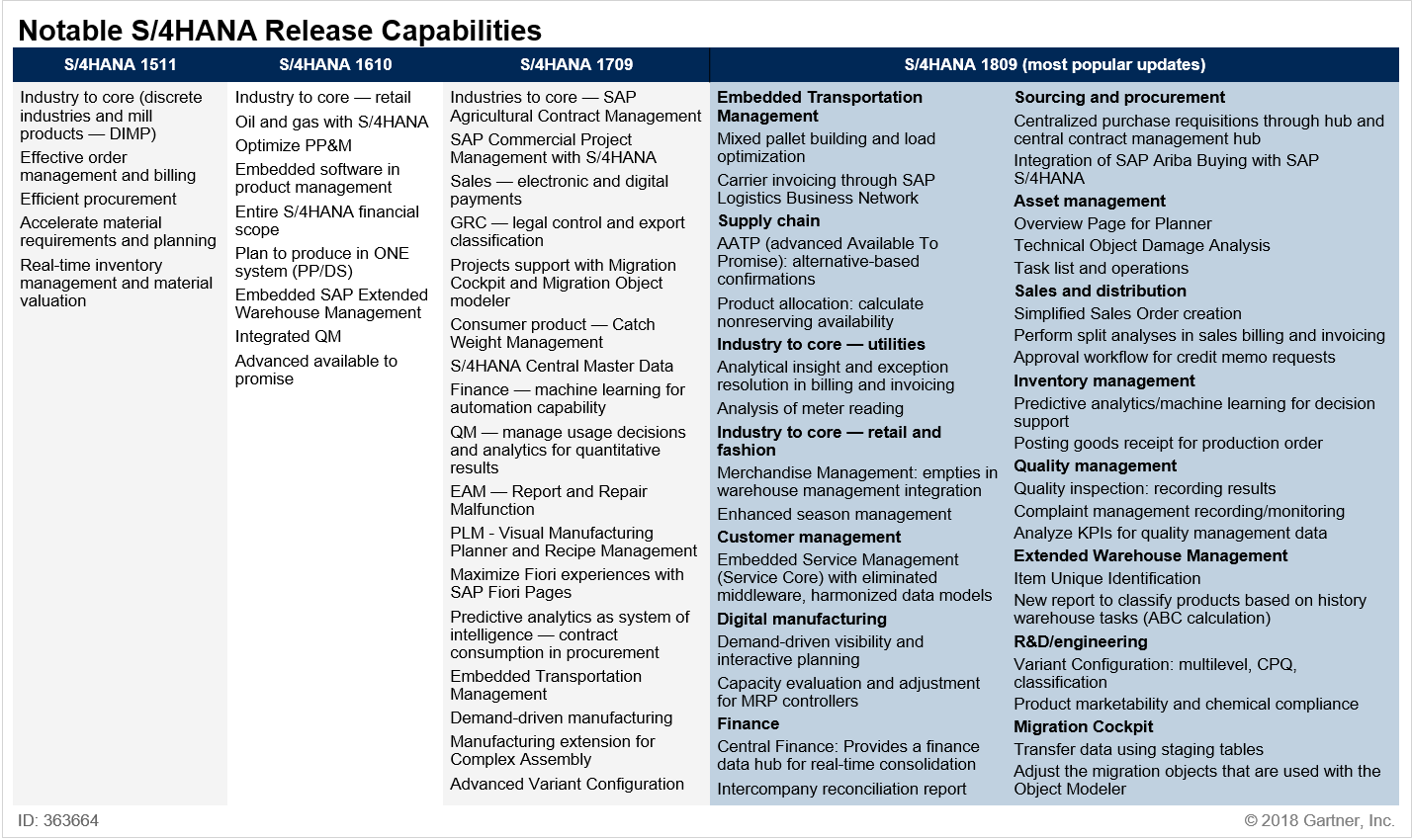
- Updated S/4HANA Enterprise Management: This is the on-premises variant of S/4HANA that contains SAP’s definition4 of core ERP functionality. There has been simplification across all functional areas, but in each release there will be further simplification and also new IMC-optimized functional capabilities. So far, there have been three releases: S/4HANA Enterprise Management 1511, S/4HANA 1610 and S/4HANA 1709 (see Figure 1 for changes in 1709). The next 1809 version is scheduled to release in September 2018 (Gartner will update the capability of 1809 once the official announcement is made). Each release has its own life cycle, typically with two or three “feature pack stacks” prior to the next release, followed by “support pack stacks” once the next release is available. Users do not have to move from one release of S/4HANA on-premises to the next (for example, from 1610 to 1709) immediately after a new release is available. However, for existing 1511 or 1610 customers running on SAP HANA IMDBMS 1.X, they will have to perform a DB upgrade to HANA IMDBMS 2.0 in order to upgrade to 1709.
Figure 1. Notable S/4HANA Release Capabilities
Source: Gartner (October 2018)
In addition, it is also possible to deploy S/4HANA in the SAP HANA Enterprise Cloud a scalable and secure, privately managed cloud environment delivered by SAP. Users can opt for either a perpetual license model (where each deployment can be customized) or a subscription-based model (where case customization of the deployment is not permitted). This is different from the S/4HANA Cloud editions because the deployments run on dedicated hardware rather than in a shared public cloud environment. However, for many SAP customers, this is “cloudy enough” because it moves infrastructure and hardware out of their own data centers.
There are also a number of S/4HANA managed cloud service offerings from SAP partners in addition to HEC.
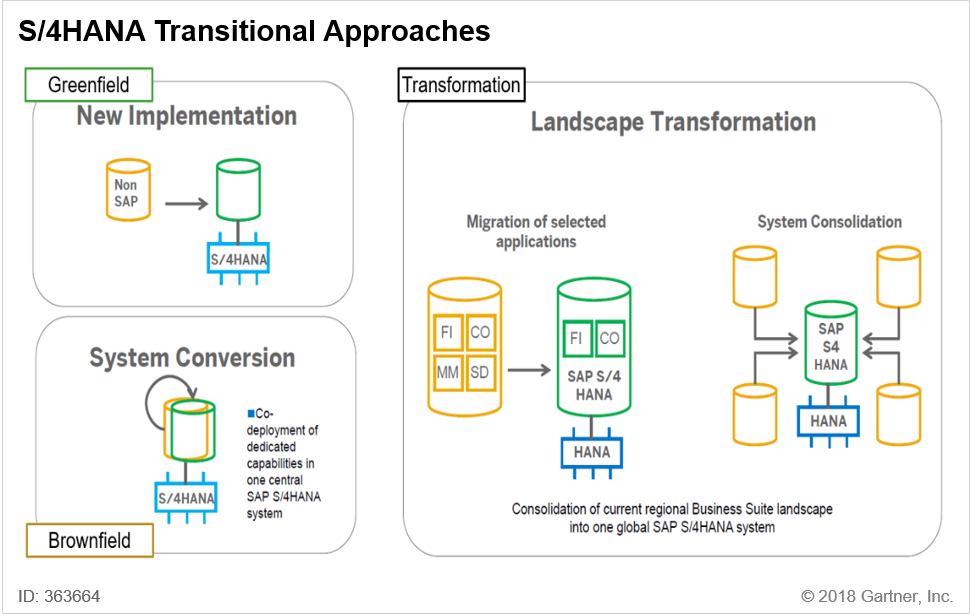
In “Best Practices in Planning for SAP S/4HANA – 2017 Update,” Gartner referred to three types of SAP transitional approaches, as depicted in Figure 2.
Figure 2. S/4HANA Transitional Approaches
Source: Gartner (October 2018)
As of 2018, there is an emerging approach unofficially known as Bluefield migration (also known as Shell Conversion/Harmonization). Gartner expects that this method will combine with various SAP service provider’s tools to bring an optimized and quicker way to upgrade Business Suite to S/4HANA. This approach works by creating an empty target system (a shell) using Business Suite client (no data), and then using these tools to upgrade this target system to S/4HANA. It performs any transformation activities as needed before the final data migration and cutover phase. This approach provides a nondestructive migration from source to target system, enabling system consolidation, split, upgrade or harmonization at the same time. It also makes it possible to perform a big-bang migration through the automation of data and business processes pretesting. As ML/AI requires a large amount of data to process, the Greenfield and Brownfield approaches will cause customers to lose data. Bluefield, on the other hand, provides a promising methodology whereby customers can potentially keep all of their data to harness and maximize the power of S/4HANA sooner.
Assess Whether S/4HANA Is a Strategic Fit for Your Organization
Many of SAP’s customers are, or will be shortly, at a crossroads where they need to decide on their ERP strategy. This includes determining if SAP is the appropriate strategic partner for their ERP solution and, if so, which S/4HANA deployment option to choose. Critical to this decision is a high-level cost-benefit analysis to determine your direction.
There are many factors that should be considered in this step. S/4HANA is a transformational shift for SAP and its users. It is based on in-memory computing, real-time processes and real-time analytics. It is also quite a departure from the legacy SAP Business Suite, where relational database design typically limited real-time capabilities, and often called for the reliance on additional tools – from SAP as well as third-party vendors. This is not only a next-generation SAP improvement, but can also be seen in new solutions from many of SAP’s prime competitors.
Gartner has defined six categories of potential benefits that S/4HANA can deliver, based on our own analysis and growing evidence from reference customers:
- Performance improvements: The IMC platform of S/4HANA means that existing application processes should run faster and, in some cases, the performance improvements can be dramatic, with long-running process execution reduced from many hours to minutes, or even seconds.
- Real-time analytics: The combination of IMC technology and the hybrid transaction/analytical processing (HTAP) architecture of S/4HANA means that analytics can be performed in real time on transaction data (instead of extracting data to a separate instance of SAP Business Warehouse or other data warehouse platform). Also, the processing power of the IMC platform means that forecasts and simulations can be run in real time against large volumes of transaction data, something that is not possible with traditional relational architectures. The HANA IMDBMS technology includes predictive analytic algorithms (the Predictive Analytics Library), which are being leveraged by the S/4HANA product developers.
- Impact of the simplified architecture and associated Fiori applications: The architectural changes in S/4HANA both simplify the data schema and, in some areas, change the way existing functionality is used. For example, the new Universal Journal table in financials removes the need for reconciliation between the various ledgers in SAP financials, and should simplify month-end financial close processes. It also enables profitability analysis at lower levels of granularity through new and customizable derivation rules for profitability characteristics. Each release of S/4HANA delivers more architectural changes (for example, 1511 and 1610 have delivered real-time inventory valuation and accelerated material requirements planning).
S/4HANA includes Fiori applications that only work with the simplified architecture. These include transaction processing applications, fact sheets (these display KPI tiles and allow further drill-down) and packaged analytics applications. These are mostly role-based and could deliver improvements in how users process transactions and access information. Each release of S/4HANA includes new Fiori applications of all types. - Benefits of new S/4HANA functionality: SAP has already released several new functional capabilities that are unique to S/4HANA; for example, SAP Cash Management, Central Finance (see Note 1) and a version of SAP Business Planning and Consolidation that is optimized for S/4HANA. So far, these new capabilities have been focused on the finance domain, but it is likely that SAP will release new solutions that impact other domains in the future. Any assessment of potential S/4HANA benefits should include the impact of these new capabilities, but they may require additional licenses, so it is important to check licensing requirements with SAP.
- IT benefits: There will be a reduction in database size because of the simplified data architecture. There may also be some simplification of the IT landscape (for example, the need for SAP Business Warehouse may be reduced or even eliminated through the use of real-time analytics).
- Potential for enabling new ways of doing business: The combination of performance improvements, real-time analytics, the simplified architecture and new functionality being delivered in S/4HANA could enable significant process innovation. For example, running complex “time-bound” processes in minutes or seconds rather than hours, coupled with real-time predictive simulation and forecasting capabilities, means S/4HANA could become a real-time business management system rather than a transaction-processing system based on daily, weekly and monthly cycles. However, this may be challenging because business leaders will have to rethink and change established ways of working to realize this potential.
These benefits are summarized in the benefits assessment framework (shown in Table 3), along with associated actions.
Table 3. Gartner’s S/4HANA Benefits Assessment Framework
| Impact | Potential Benefits | Actions |
|---|---|---|
| Performance improvements |
|
|
| Real-time analytics |
|
|
| Simplified architecture and Fiori applications |
|
|
| New functionality |
|
|
| IT benefits |
|
|
| Potential business transformation |
|
|
ERP = enterprise resource planning; HTAP = hybrid transactional/analytical processing; IMC = in-memory computing
Source: Gartner (October 2018)
The benefit analysis does not need to go into great depth at this stage. The goal is to engage key business users to identify the level of “excitement” that S/4HANA creates in terms of potential benefits, and to use that to decide on your adoption category.
Gartner has found that using this benefits framework in client interactions quickly highlights if there are (or are not) significant potential benefits that could provide the foundation for a compelling business case and detailed cost-benefit analysis in the future. CIOs and application leaders should not try to build a business case for S/4HANA adoption without engaging business users early in the process.
There are other key factors that should be considered if you are looking to move to S/4HANA or you are considering solutions from other vendors. We have included observations about S/4HANA that you should investigate to determine if these could potentially benefit you.
In our research through client inquiries and Magic Quadrant reference surveys, we have observed certain patterns how SAP customers perceive and react to S/4HANA adoption. We have distilled these down to three categories of SAP customers/prospects:
- Strategic adopter: The strategic adopter has bought into the SAP platform and/or intelligent story, and sees SAP as critical to their operations. This type of organization has seen the benefits of SAP and believes that following SAP to new technology platforms is strategically critical for the future of their enterprise. They would view moving to S/4HANA as an opportunity to deliver significant new benefits, especially to enable new ways of doing business in the short term (within two to three years or sooner). They would target S/4HANA to replace their older ECC deployment that is no longer fit for purpose. If they have multiple instances of ECC deployed, they would consider S/4HANA Enterprise Management or S/4HANA Cloud for a potentially “staggered” rollout, focusing on learning from implementing this new technology in smaller units first.
- Tactical adopter: The tactical adopter sees the potential benefits of S/4HANA, but may not see these as being significant in the short term. This could be a customer with a complex SAP landscape (multiple instances) that eventually wants to move to the S/4HANA Cloud solution versus the on-premises version. However, not all of the industry-specific components are yet available. They do, however, regard SAP as a strategic long-term partner, so it is a question of timing (when, not if).
- No plans to adopt: This type of organization is typically unconvinced about the potential benefits and views this as a technology shift forced on them by SAP so that it can upcharge its customers. The organization mainly uses SAP as a system of record. It may ringfence its ERP solution or consider minor upgrades to stay current, but will not consider wholesale changes at this point. It may be unsure about whether to stay with SAP in the future. In the meantime, the organization will augment its ECC solution with additional (mainly cloud-based) tools from third-party vendors (as well as SAP Leonardo to maximize the existing investment) for best-in-class functionality. Another option is to save money for future ERP investment by leveraging third-party maintenance support like Rimini Street or Spinnaker.
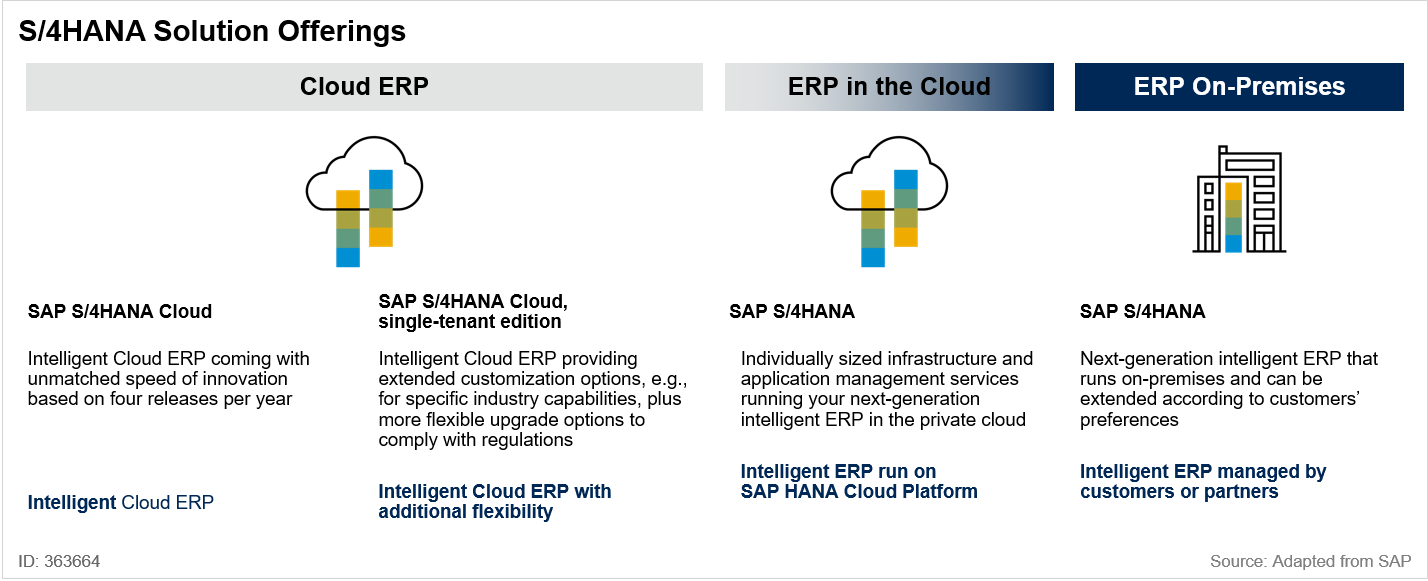
When considering S4/HANA, there are multiple deployments that are available. There are essentially two main S4/HANA solutions:
- S/4HANA Enterprise Management (hosted on-premises, IaaS, or AMS)
- S/4HANA Cloud (pure SaaS with development of extensions using SAP PaaS, no custom development)
Figure 3 further breaks down these options.
Figure 3. S/4HANA Solution Offerings
Source: Adapted from SAP
In addition to the above, an organization may also choose an enterprise management solution that is hosted by SAP or may choose to have it hosted by a third party. As there are several deployment options, it is often not clear which direction customers are ultimately interested in or are targeting. SAP has made a clear statement that the future direction for itself is S/4HANA Cloud. However, there are currently a limited number of verticals available for implementation or stand-alone core financials deployment void of industry-specificity. We believe that digital technologies such as AI, ML, robotic process automation (RPA) and blockchain will mainly be offered as cloud-only deployments, thus requiring a hybrid approach by those ultimately selecting the S/4HANA Enterprise Management approach in the future. While SAP has stated that the code base for the two main deployments are the same, we have found differences, including in the approaches and solutions for financial planning and analysis, and financial consolidations. For example, SAP Business Planning and Consolidation [BPC] is only available on-premises, while the S/4HANA Cloud solution relies on SAP BusinessObjects Business Intelligence suite and a new solution, Group Reporting.
Recommendations:
- Perform a cost-benefit analysis on the value proposition of moving to a new ERP solution. Understand the benefits of changing to a new technology for ERP, and how it will affect your business processes, as well as your IT and end users.
- Understand the type of organization you are – a Strategic Adopter, Tactical Adopter, or No Plans to Adopt – and develop migration strategies that fit your character.
- Assign a proof of concept (POC) project and architect solution baseline to monitor and keep up with SAP’s (or any other vendor for that matter) roadmap, and to be aware of when specific functional and industry components will be available either on-premises or in the cloud.
- Understand and prepare for the eventual move to a cloud ERP. You may choose an interim move to an on-premises solution now, but most ERP application leader’s strategic direction will be the cloud in the next five to eight years.
- Evaluate the differences in on-premises versus cloud capabilities, including industry verticals, as key inputs into your product migration/upgrade approach. Assess the Functional Capabilities of S/4HANA
One of the first questions asked by enterprises considering the migration from an existing SAP ECC to S/4HANA is related to what types of functionalities are present (or not) in S/4HANA versus their SAP ECC deployment. As part of the discovery initiative, SAP offers two free-of-charge applications that can work as a starting point.
Transformation Navigator
Since May 2017, SAP has offered a self-service tool called Transformation Navigator, which was created to help SAP customers start building a business-driven functionality roadmap based on how they operate within their SAP ECC instances. Based on the currently used products, the application gives guidance on what SAP’s recommended products are, highlights their business value, and details the transition to SAP S/4HANA and other recommended products. It is important to understand that this is an SAP-centered vision. Therefore, it focuses on providing guidance on how those functionalities are fulfilled by S/4HANA and other SAP solutions (such as C/4HANA, SuccessFactors and others). However, a spreadsheet-based output of the application allows for offline modelling of migrations from and to third-party products alongside SAP product transition scenarios.
The tool requires basic input, which includes currently used products (which can be extracted through Solution Manager) and more detailed system information for complex products like SAP ERP or SAP SCM. A feature called Usage Pre-population can import information about the usage of those complex products with one click, and makes the transition guidance simpler and faster. In addition, the Time Slider functionality shows a timeline of upcoming changes in SAP’s product recommendations as new features become available in S/4HANA or other products. It lets you identify the best point in time for the migration by, for example, showing when an ERP capability you are using will becomes available in S/4HANA. For the business value part, the selection of value drivers is required, which are linked to and derived from the list of recommended products. Not all the input requested is mandatory, so you can create a product transition scenario without providing input for the value part (for example, you don’t have to select business value drivers or aspirations to for a technical comparison). The resulting report includes (see Note 1 for links to sample reports available from SAP’s website) suggestions tailored to these inputs. Examples include:
- High-level capability gaps and matches between SAP ECC and S/4HANA Enterprise Management/Cloud editions (or other SAP apps) – Section 2.2, Capabilities of Recommended Products versus Current Products on the Business Guide Report.
- Transition guidance from your current capabilities to the S/4HANA suggested capabilities/products, with suggested transition methods (conversion, process transformation and others) – Section 2.1, Guidance on Your Current Product on the Technical Guide Report.
- Mapping between current SAP products and recommended products licensing models – Section 2.3, Licenses and Subscriptions for Your Target Product on Your Transformation Guide Report.
As of the publication of this note, there are free resources available to understand how the application works and how to operate it (see Note 1).
Readiness Check
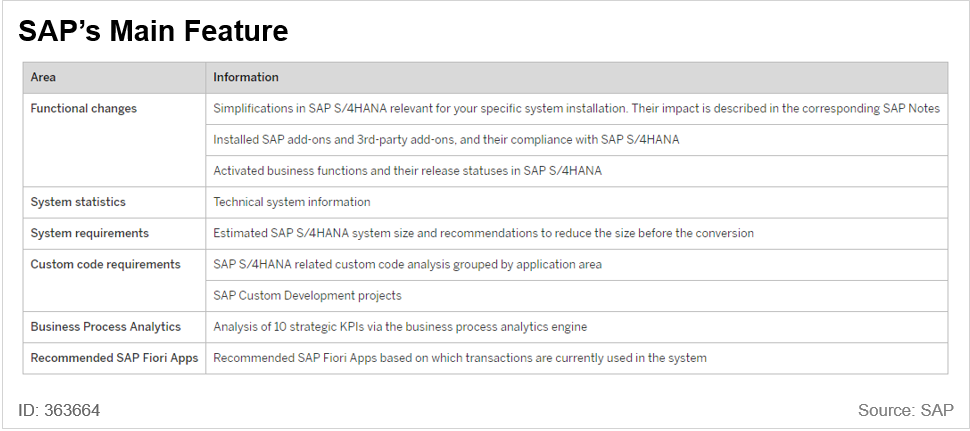
Along with Transformation Navigator, SAP is also offering an application called Readiness Check that provides a more technical-driven analysis of an SAP environment. This enables a rough analysis of the potential technical changes required to work with S/4HANA.
Figure 4 describes the main features according to SAP.
Figure 4. SAP’s Main Features
Source: SAP
Readiness Check helps customers understand what business areas may be more affected by the several process simplification changes in S/4HANA (functional changes), as well as the compatibility of existing add-on features with S/4HANA (including industry solution features).
Overall Comments on SAP Transformation Navigator and Readiness Check
Expectations should be set in regard to the type of results these applications will generate. Customers should understand that these are applications provided by SAP – therefore, a lift-and-shift full SAP approach will be provided, although this is only one of the potential scenarios in a postmodern ERP strategy. Only part of the results may be valid to build the organization’s future roadmap, depending on your desired future ERP applications architecture, but it can work as a starting point to analyze what can (or cannot) be supported by S/4HANA.
The usage of such applications will require a valid and active S-User ID. Therefore, customers who may not be under active yearly maintenance contracts with SAP (for example, customers who may have opted to adopt third-party support) may not be able to access this application.
Considering that the end results are dependent on the different release versions of S/4HANA (of the several non-S/4 products recommended), customers should expect different results depending on when the scenario is simulated. This may also allow companies to evaluate the evolution of the application features, to analyze when certain key features may now be considered part of the published roadmaps of S/4HANA.
Recommendations:
- Have a postmodern ERP strategy set of principles to support the interpretation of the results. Your company may not need all the applications suggested by these tools, nor may the suggested applications be the best-suited in terms of functional fitness, compared to other offerings in the market.
- Do not assume that all the applications suggested as solutions will provide out-of-the-box integration among themselves. Beware that some industry specific-functions will still need to be developed to enhance features that are unique and not yet commoditized.
- Use these results as an input for your to-be architecture exercise, not as a final architecture goal, unless your ERP strategy points toward a full-fledged SAP application approach.
- Understand the licensing options and potential implications for your business case by using “Toolkit: Negotiate On-Premises SAP Software Contracts to Optimize Pricing, Terms and Conditions.” Ask Gartner analysts about the considerations to keep in mind for the existing models, including the ones that enable migration of existing licenses to new SAP applications.
Address Industry-Specific Requirements and Streamline Implementation by Engaging SAP’s DBS and Third-Party Service Providers
SAP DBS, the professional services arm of SAP, often works in conjunction with its services partners to implement S/4HANA. SAP DBS has been very active and is currently building a more robust portfolio to deliver innovations to clients post S/4HANA go-live and provide production support. With involvement in more than 3,200 S/4HANA engagements in various capacities, SAP DBS has built assets to improve and accelerate implementation. As SAP stated, it is not using DBS to compete with SAP system integrators. The business support activities below demonstrate how DBS can help to contribute to the success of the S/4HANA journey outside of the system integrator’s role:
- Project Success – DBS will provide SAP Value Assurance, SAP Innovation and Advisory Services, SAP Advanced Deployment, and SAP Model Company design to customers. A model company is a prepackaged, ready-to-use, end-to-end reference solution, tailored to an industry or line of business. SAP service providers will be responsible for delivering the implementation/deployment while SAP DBS plays the role of the enterprise architect and solution architect, and monitors the project’s progress postimplementation.
- Continuous Success – DBS provides ongoing maintenance support via SAP Preferred Success and SAP Enterprise Support.
- Premium Success – SAP MaxAttention.
SAP is not the only one that developed preconfigured business or industry-specific solutions like SAP Model Company. Service providers, using their deep industry experience, have augmented SAP Model Company through extensions and custom development to make deployment of S/4HANA faster and quickly tailorable to the customer’s specific industries processes. Accenture, EY and IBM, for example, are developing industry enhancements built on SAP Cloud Platform. Deloitte, Capgemini and Wipro are replatforming their preconfigured solutions onto S/4HANA.
In regard to tools and accelerators for assessment and migration, Cognizant, Tata Consultancy Services and others have developed new tools, or made their current tools compatible with S/4HANA, to accelerate migration and implementation. Atos partners with Inventy to benchmark customers’ performance against their peers and predict the business case for S/4HANA migration, with a 72-hour turnaround time. LTI has an S/4HANA Smart Analyzer tool that, within two weeks, is able to show the client the process and system impacts of migrating to S/4HANA, including risks and benefits expected, and technical information on custom objects. Infosys has developed HANA Code Migration Optimization tool to redevelop customers’ custom development objects in S/4HANA with up to 80% accuracy. All of this information is used as inputs to create the business case and migration roadmap. Service providers that do not have their own tools should look to partner with companies such as smartShift Technologies and SNP.
Recommendations:
- Clarify the value of service expected from SAP DBS. Don’t just use this service as an insurance policy for your S/4HANA transition.
- Use Gartner’s “Magic Quadrant for SAP Application Services, Worldwide” and “Critical Capabilities for SAP Application Services, Worldwide” to assess which SAP service providers have deep industry experience and are better suited for your operational needs.
- Monitor the success rate of using specialized approaches, such as the Bluefield approach, to optimize your S/4HANA migration. There are huge potential benefits to keeping your custom development and historical data, which most SAP service providers are looking to perfect.
- Do not ignore small SAP service providers. Gartner’s interaction with these vendors have shown that some of them have successfully implemented new S/4HANA capabilities, like central finance, while bigger vendors have not.
Prepare for a Smooth Transition to S/4HANA
Gartner has identified a number of key considerations for existing SAP Business Suite users planning a transition to S/4HANA based on discussions with early adopters, SAP product management teams, assessments of SAP’s new deployment methodology, and various SAP partners.
The next generation of SAP ASAP (Accelerated SAP) is Activate methodology. See Table 4 for the use cases where SAP Activate can be leveraged to deploy S/4HANA.
Table 4. Use Cases for Leveraging SAP Activate
| New Implementation | System Conversion | Landscape Transformation | ||
|---|---|---|---|---|
| Scenario Characteristics
Target Audience |
Data migration to S/4HANA | Technical conversion from SAP ERP to SAP S/4HANA | S/4HANA and ECC running in parallel to consolidate or carve out. | |
| New or existing customers | Existing customers | New or existing customers | ||
| Deployment Options | ||||
| SAP Activate | SAP Best Practices (model company) | Yes | Migration and cloud integration | Migration and cloud integration, ready-to-run business process based on use cases |
| SAP Activate Methodology | Yes | Yes | Yes | |
| SAP Guided Configuration | Yes | No | Applicable if ready-to-run business processes are used | |
Source: Gartner (October 2018)
Key considerations for existing SAP customers looking to migrate to S4HANA include:
- Clean up your production database through careful data deletion and archiving. This will help reduce both new HANA hardware costs and planned system downtime. The SAP Data Volume Management work center within SAP Solution Manager 7.2 can be used to identify the largest data tables in source SAP ERP systems.
- Review all existing custom Advanced Business Application Programming (ABAP) code on your SAP ERP system, and remove any custom code that is no longer being used. Adjust all actively used custom code to be fully HANA compliant. The Custom Code Check Tool (or a third-party equivalent) can be used to provide an overview of how the current solution’s scope and custom code matches (or does not match) the scope and data structure of S/4HANA Enterprise Management.
- S/4HANA includes new Fiori user interfaces and applications. Based on SAP’s original recommendation, a separate Fiori Front-end Server (Netweaver Gateway) Server is required. For large deployments, this will mean additional development, test and production systems. However, SAP has since updated its recommendation to advise customers to deploy Fiori Front-end Server with S/4HANA as a co-deployment model.
- SAP has developed Maintenance Planner (this is how they collect system data for SAP Readiness Check), a cloud-based tool used to plan all technical activities for this type of conversion project. This replaces the Maintenance Optimizer in Solution Manager. Maintenance Planner checks the system for business functions, industry solutions and add-ons to ensure there is a valid path for the S/4HANA conversion. If there is no valid path, the conversion is prevented. Maintenance Planner is used in conjunction with Software Update Manager and a database migration option (if the conversion includes migration to the HANA IMDBMS) to manage the technical system conversion to S/4HANA. The Software Update Manager tool is familiar to most Basis operations teams, but nevertheless plan to do at least three to five test conversions.
- Consider using the SAP Activate “innovation adoption framework” (when this is available) for conversions and transformations to trial and review new S/4HANA business process functionality. This includes a reference industry solution of S/4HANA, with selected business processes preconfigured with sample data. Activate also includes a testing tool and associated test data management.
- Create S/4HANA training and development plans for business analysts, superusers, functional analysts, developers, SAP Security teams and SAP Basis technical teams.
Prospective SAP users considering an ERP deployment should evaluate S/4HANA as the preferred solution, because SAP ECC is clearly no longer strategic for SAP. New adoptions of the S/4HANA Enterprise Management on-premises 1610 and 1709 releases have been successful, and the S/4HANA on-premises 1809 release is likely to gain wider adoption among existing SAP users.
New SAP users will need to choose between the following options:
- S/4HANA release deployed on-premises in their own data center.
- S/4HANA release deployed in the privately managed HANA Enterprise Cloud (HEC) (or a similar partner-hosted offering).
- S/4HANA Cloud with a SaaS deployment option.
The choice between S/4HANA and S/4HANA Cloud depends on the functional requirements and cloud strategy of each organization. Gartner is increasingly seeing organizations adopting a “cloud-first” strategy, while many service-centric organizations are moving core ERP capabilities like finance to SaaS environments when replacing outdated or legacy applications. These organizations may be attracted to S/4HANA Cloud, but they will have to ensure that the narrower functional scope of these offerings compared to S/4HANA releases meets their functional needs. They will also need to adopt the standardized business processes that such a SaaS deployment enforces.
At the time this research was published, SAP allows customers to transport their own ABAP codes into the environment as part of the SAP S/4HANA SaaS private option offering. Also, for additional cost, SAP will take over the integration and regression testing as part of its SaaS release cycle. This option is not the same as allowing customers to modify the core ABAP codes. Instead, it allows them to add their own independent objects and programs.
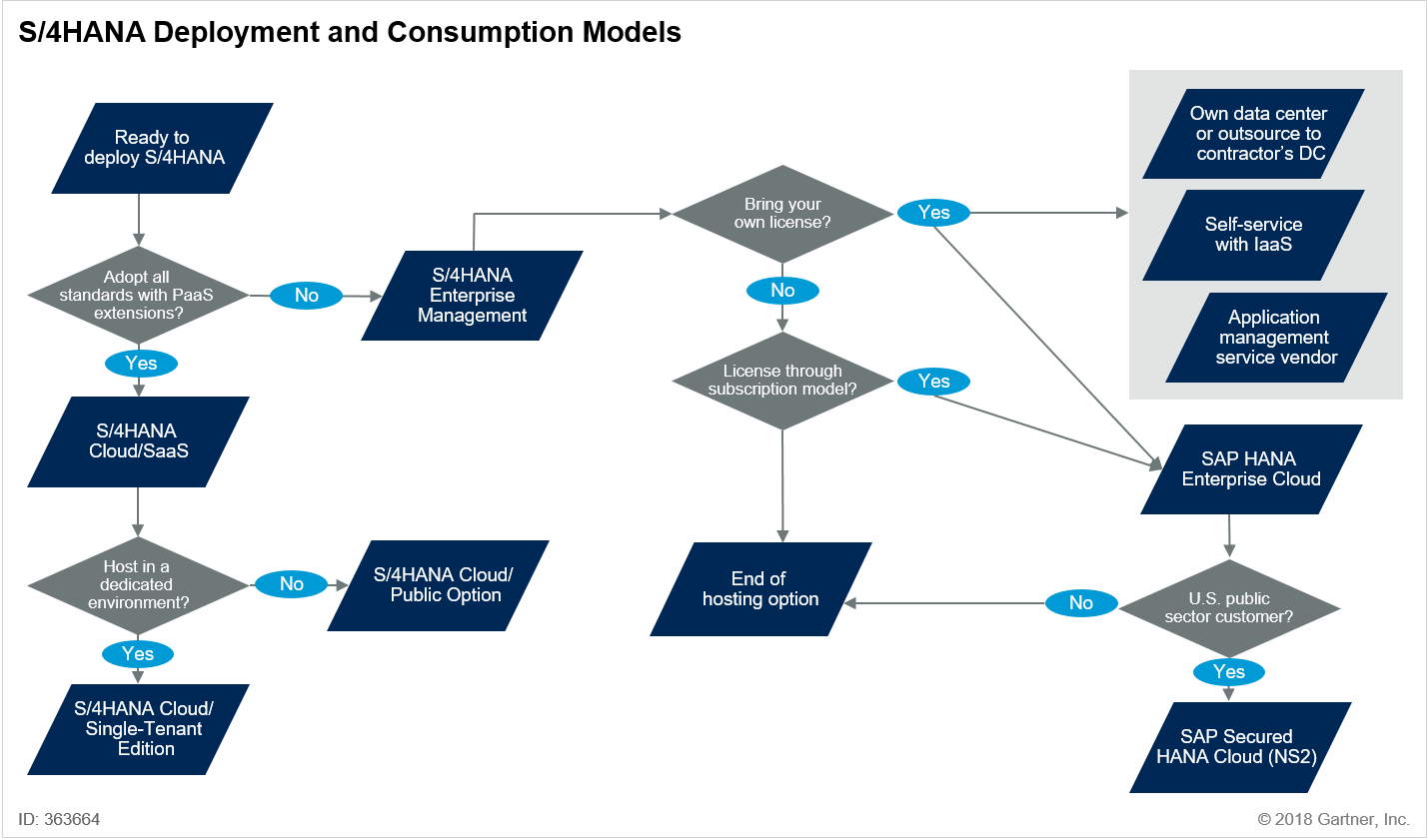
Figure 5 depicts the decision-flow chart for deploying S/4HANA.
Figure 5. S/4HANA Deployment and Consumption Models
Source: Gartner (October 2018)
Organizations that want the full scope of ERP capabilities in S/4HANA, coupled with the ability to customize the solution to meet their unique differentiating needs, are more likely to adopt S/4HANA Enterprise Management or S/4HANA Cloud single-tenant edition. Gartner recommends that such organizations adopt the current on-premises release, although they should always check references and any release restrictions regarding functional capabilities (such as industry capabilities).
Prospective users that do not want to adopt S/4HANA Cloud, but would prefer not to implement the technology to run S/4HANA in their own data centers, should consider a range of cloud-based hosting models, including SAP’s own HEC offering. These will provide some of the benefits of cloud without delivering the full potential benefits of SaaS.
Recommendations:
- Evaluate the latest release of S/4HANA (deployed on-premises or in a private managed cloud) or S/4HANA Cloud with solutions (extensions) from SAP’s competitors. Consider prior releases or S/4HANA Finance only if there are functional gaps in the latest release.
- Evaluate SAP Model Company or explore the option of working with SAP Innovation Business Services to build the features that the current release of S/4HANA is lacking. That way these features can potentially become standards for future releases and save you from managing them as custom developments.
- In addition to adopting the preconfigured SAP Model Company, customers should also examine industry-specific preconfigured templates from SAP service providers that specialize in various industries like oil and gas, retail, pharmaceutical, discrete and process manufacturing, or CPG. These templates are available at an additional cost from SAP partners. SAP has indicated strict guidelines and change management processes in order for these add-on solutions to be up-to-date before each SAP S/4HANA Enterprise Management or S/4HANA Cloud release.
- Evaluate S/4HANA Cloud if you are looking for a SaaS solution, but be aware that these solutions are very early in their life cycles compared to most competitor alternatives. This will likely change over the course of 2019 because S/4HANA Cloud is a strategic initiative for SAP. Also, for organizations with less than 1,500 employees evaluating SaaS ERP capabilities, SAP recommends its Business ByDesign solution rather than S/4HANA Cloud.
Note 1
SAP Central Finance
SAP Central Finance is a way of deploying SAP S/4HANA so that it acts as a centralized repository for financial transactions from SAP and non-SAP finance systems. The accounting entities in existing systems are mapped to one common set of master data in the central system. Postings are then replicated in real time – using SAP Landscape Transformation (SLT) replication server – to the Central Finance system. This then acts as a “superledger” across all other systems, enabling the real-time analytics and new functionality in S/4HANA to be used on the combined transaction data. The replicated transaction data can also include cost objects (such as production orders), and these can be mapped at varying levels of granularity.
The concept of Central Finance is also appealing to larger, more-complex SAP user organizations that have multiple ECC instances, and also other non-SAP ERP systems. However, it does introduce additional complexity and cost because Central Finance requires installation of a dedicated instance of S/4HANA, and replicates transaction data to the new instance. There will also be additional licensing costs. SAP customers can leverage existing ERP licenses for the underlying finance functionalities, but a separate license is required for Central Finance-specific functions and features, as well as SLT. Central Finance is not a “lite” finance-system-only installation, or a form of financial consolidation system that works on summarized data. It requires a full deployment of S/4HANA 1610 or later to provide the Central Finance capabilities, and is only available on-premises, or through SAP HANA Enterprise Cloud, which is a form of on-premises hosted in an IaaS through an Application Management Service model or a hyper-scale IaaS provider.
Central Finance is also being considered by some organizations as a way of moving to S/4HANA in a phased approach, rather than a “big bang” replacement. A Central Finance S/4HANA instance will be deployed alongside an existing SAP ECC instance and the Central Finance S/4HANA instance will be used as the corporate finance system by replicating accounting data from the existing instance. This allows the organization to realize the benefits of S/4HANA in the finance domain in a nondisruptive manner. At some point in the future, system conversion will be used to move other business processes to the S/4HANA instance to replace the existing ECC instance. This allows a phased transition rather than a “big-bang” migration, although it does mean that, in the short term, costs will increase as two ERP deployments will be run side by side.
Central Finance is an innovative use of IMC to deliver new ways of deploying and using the financial capabilities of S/4HANA. However, at the time of preparing this research, SAP was unable to provide any live references for Gartner to speak with that supported any of the potential use cases described above (although SAP did state that it is live on Central Finance in its own organization). It is Gartner’s opinion that Central Finance should, therefore, be approached with some caution and appropriate risk mitigation, at least during 2018 and 2019, as strategic adopters go live.
Note 2
SAP Transformation Navigator in a Nutshell
SAP Transformation Navigator Sample Report
www.sap.com/documents/2017/09/5cb6dab6-d47c-0010-82c7-eda71af511fa.html
SAP Transformation Navigator access (requires active S-ID user)
www.sap.com/transformationnavigator
SAP Readiness Check – “How to” references
www.help.sap.com/viewer/p/SAP_READINESS_CHECK
Note 3
SAP HCM On-Premises Option for SAP S/4HANA
ECC customers running HR and Payroll can either install or configure the SAP compatibility packs to integrate ECC HR to S/4HANA (support will end by 2025) or adopt SuccessFactors for HCM. However, SAP has announced that a new on-premises HCM option that rus in parallel to S/4HANA will be available by 2023. Gartner recommends that customers who are not looking to migrate to S/4HANA until after 2023 should hold out for this solution. However, for those net new customers or strategic adopters, you should move on and select either SuccessFactors or another HCM solution to continue with your digital transformation.
Source: Gartner Research Note G00363664, Duy Nguyen, John Van Decker, Denis Torii, 8 October 2018
Evidence
1 “Roundup of Machine Learning Forecasts and Market Estimates, 2018,” Forbes.
2 “SAP Road Maps,” SAP.
3 “SAP Model Company,” SAP
4 “What Is ERP?” SAP.