
Choosing the Right Conversational AI Platform
The constant evolution of tools and solutions that deliver conversational artificial intelligence make it difficult to identify and select the optimal type of solution to meet an enterprise’s needs. Choosing the best approach allows software engineering leaders to simplify the decision process.
Overview
Key Findings
- The range of conversational implementation approaches in the chatbot market can be categorized as toolkits allowing custom solutions, platform-based offerings and targeted service offerings.
- A toolkit approach enables a high degree of customization, which is desirable for integrating conversational capabilities within other business applications. Toolkits are good for organizations with unique business, end-user or integration requirements.
- A platform-based approach provides centralized operations and conversational management while covering a broad range of use cases, from simple to complex. However, these platforms require greater effort to implement if prebuilt chatbots are not provided.
- Targeted services or point-solution providers focus on an industry-specific use case or a particular requirement, such as adding a conversational interface to an existing enterprise application or addressing a specific end-user requirement (like channel or language support). They are easy to integrate and quick to deploy, but are difficult to customize.
Recommendations
Application and software engineering leaders responsible for defining a next-generation, artificial-intelligence-based conversational solution should:
- Choose the conversational solution that best suits their use cases by evaluating the relative merits of toolkits, platform-based approaches and targeted service approaches.
- Ensure the required capabilities are provided. These can significantly reduce development time, improve application flow quality, and reduce operating and maintenance costs.
- Mitigate the risks and pitfalls of conversational-platform implementation by addressing potential problem sources during the planning stage.
Introduction
Chatbots and virtual assistants help users with repeatable tasks by enabling conversational user interfaces (UIs) to drive natural language interactions. Chatbots use semantic and deep learning models, natural language processing, prediction models, recommendations and personalization to interact with people via voice or text. Increasingly, they automate business processes and workflows. Chatbots are typically trained from examples, and tuned with human-in-the-loop (HITL) supervised learning. Chatbots can be deployed in simple as well as complex use cases.
Evaluating vendors that provide chatbots that use conversational artificial intelligence (AI) is difficult. Gartner believes there are a few thousand vendors in this market. These include myriad smaller, niche vendors; large-enterprise application vendors; and mega cloud AI vendors.
Vendors continually improve their chatbot and conversational platforms by:
- Improving underlying services, such as better natural language understanding (NLU) related services, developing domain-specific language models, advancing analytics options, improving conversational flow design tools, expanding end-user channel support, and enabling ongoing chatbot application tuning.
- Adding capabilities such as built-in knowledge-base (KB) management, expanded business application and back-end integrations, additional prebuilt channel integrations, expanded language support and prebuilt conversations.
- Broadening the implementation and administration approach from a toolkit or custom-build approach to a conversational platform approach that incorporates both no-code options and advanced API and component-level NLP replacement.
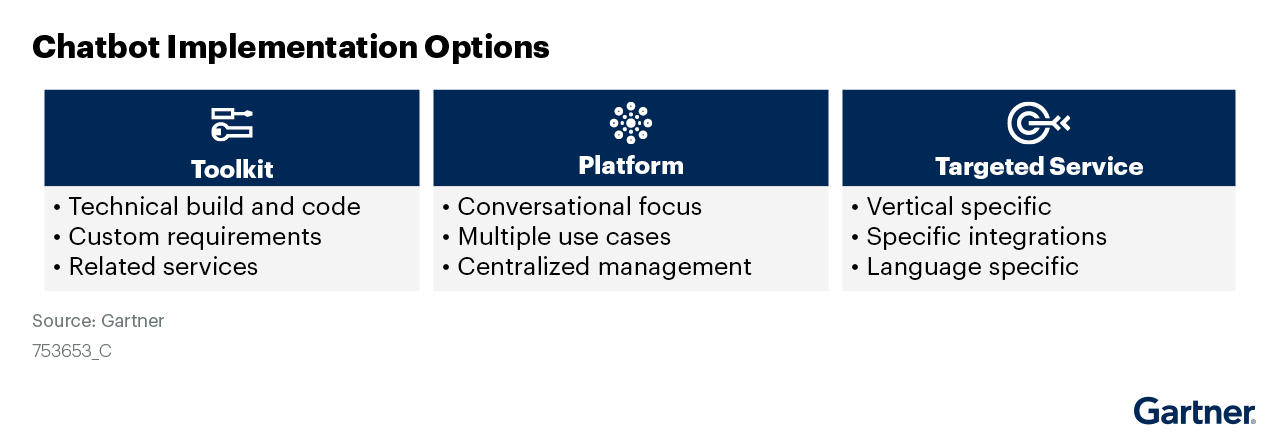
Enterprise conversational solutions span three implementation options, requiring decision makers to develop an overall market understanding and a consistent evaluation approach. As illustrated in Figure 1, the three implementation options are toolkits, platforms and targeted services.
Figure 1: Chatbot Implementation Options
Analysis
Identify the Right Platform for Your Organization
Each implementation option is best suited for different types of requirements. Making the right choice requires software engineering leaders to identify the approach that meets the needs of the organization.
The first step in doing that is learning what each type does:
- Toolkit: This approach uses a framework of services or SDKs to build conversational platforms and chatbot solutions. It is suitable when deep technical customization capabilities are required. Gartner recommends this approach when addressing unique business, end-user or integration requirements. Custom solutions built using a toolkit require significant skills, time and effort. Examples include Amazon Lex, Rasa and Microsoft Azure Bot framework.
- Platform: Platform-based solutions lead with a configuration, low-code, administrator GUI-type implementation and maintenance approach for chatbot deployments. These platforms offer coding capabilities for additional customization (such as SDKs), but their strength is ease of use, access to multiple chatbot-building capabilities and a growing set of templates for prebuilt chatbot starting points. Their advantage is the breadth of applications that can be built, from simple no-code options to custom solutions built with SDKs and APIs. These latter applications require significant skills, time and effort. Examples include Kore, Cognigy and OneReach.ai.
- Targeted service: These solutions focus on a particular vertical, use case or requirement. One advantage of targeted services is the ease of integration with the underlying application when they are built on top of an existing enterprise application solution. A second advantage is they typically offer rapid deployment due to the focus on a particular use case, such as human resources, IT service desk or sales enablement. However, service-oriented solutions are often difficult to customize. If you need a flexible solution, this approach is not the best choice. Examples include Salesforce Einstein Bot, ServiceNow Virtual Agent and Oracle Digital Assistant.
Ensure You Get the Capabilities You Require
The merger of contact center and digital service teams offers an opportunity to address disparities in the customer service experience, fostering best practices from both teams and eliminating negative experiences. Retraining will form an important part of this transition, and will help map out the new skills required for existing and new starters.
To choose the right solution, you must identify your requirements and the capabilities needed to address them. All three types of solutions work in the same way. A UI is used to capture either voice or text input, which is processed and passed along to be handled. The flow determines the next step.
Typically, the flow is based on identifying the intent of the user via NLU. Once the user’s need has been identified, and the actions to fulfill that request have been executed, a response to the user is generated. In some cases, this then leads to additional interactions with the user. (A detailed architecture is described in Architecture of Conversational AI Platforms.)
Below is an overview of the key capabilities areas of conversational platforms and some of the key capabilities to be considered when selecting a solution. Application and software engineering leaders responsible for defining a next-generation, artificial-intelligence-based conversational solution should review these as they develop their plans. Not all projects will require all capabilities, nonetheless planners should be aware of the functionality areas and considerations.
Channel integration: This functionality allows the platform to engage with voice, text and multimodal channels, like phones, browsers, email or messaging applications. Integrating with live-agent chat services is also a capability to consider.
Key considerations: single chatbot optimized for multiple channels; accurate voice interactions in all languages required.
Application building and testing: This includes the design, build and test functionality needed to deliver tools to build chatbot applications and the supporting conversation and workflows. Leading platforms support no-code, graphical design tools, and APIs; intent and entity definition identifying and maintenance tools; and version management, test tools and testing metrics.
Key considerations: primary and secondary chatbot architectures; channel-based personalization; prototyping; and sentiment analysis.
Prebuilt chatbot component: Prebuilt capabilities are vendor-provided accelerators or assets to improve the time to develop as well as the quality of chatbots being built. These can span a broad range of functionality, including reusable content, common or domain-specific dialogue flows, and language models.
Key considerations: prebuilt small talk, domain-specific predefined intents and entities, prebuilt integration connectors.
Application integration: Most chatbots require some form of integration. For instance, with CRM systems and databases, as well as other knowledge sources and business applications, integrating with live-chat applications or routing applications is necessary.
Key considerations: level of personalization, insight engine integration, RPA, payment gateway, commerce and prediction engine integrations.
Data integration: Solutions must support a wide range of options for ingesting and exporting data from the platform, with API calls being the most common. At a minimum, they must have the ability to import or export entities, intents, and conversational flow, as well as integrate with data and web sources.
Key considerations: knowledge mapping; DBMS and data lake integration; supported languages; language detection; and customizable configuration of synonyms, terms and phrases.
Natural language understanding: This function parses incoming information and extracts elements like intents and entities, and analyzes associated sentiment.
Key considerations: third-party NLU support, contextual intent understanding and negative intents.
Response generation: This function creates the output message and/or action, and transmits it to the appropriate channel. In most cases, the response is predefined sentences based on slots in a template. Advanced capabilities are nascent.
Key considerations: generation of customized responses that can incorporate external data, generation of answers with a compound response.
Management: Function provides tools and services to manage content and workflows of chatbots. This includes managing conversation and interaction and their history and logs; publishing releases; And managing, correcting and updating the utterances, and mapping missed utterances to existing intents.
Key considerations: role-based management, agent-in-the-loop training, journey analytics and A/B testing.
Reporting and analytics: Solutions must provide managers with visualization of users, flow and interaction metrics for the chatbots. The function can include GUI-type dashboards and programmatic capabilities and requires integrations with data and visualization tools. Solutions must offer a strong set of predefined functionality.
Key considerations: custom reports, language-related learning stats and sample metrics.
Platform administration and security: These functions offer the ability to manage platform access, user accounts and security. This is often done via an administration console.
Key considerations: high-availability, SLAs, response times for conversations and voice functions; compliance requirements, PII content; and data intrusion.
Avoid Risks and Pitfalls
When evaluating and implementing chatbot solutions, application and software engineering leaders should avoid common pitfalls. Taking a platform approach that offers a range of tools and supports both simple and complex use cases can reduce some of the risk. But there are still important steps to take.
Avoid big-bang, complex projects. Avoid investing in an overly complex solution that will be costly to implement and maintain. Mitigate the risk of overinvestment by starting with small use cases. Expand conversational flow and capabilities as you identify usage patterns and how your user base interacts with your chatbots, and user adoption grows.
Disaggregate design and planning of initiatives from the data and underlying technology. Plan to fail fast as part of the learning process. Avoid long-term contracts because the chatbot market is saturated and will consolidate. Additionally, the technology is evolving rapidly, and better solutions and tools will be available in several years. What will remain longer term are your use cases, flow designs, journey definitions, business requirements and training data.
Consider a centralized platform for managing multiple implementations. Creating a unified user interface is complicated and costly when leveraging multiple chatbot solutions. Their reliance on NLP and its underlying data models makes it difficult and costly to aggregate disparate chatbot implementations. Use a centralized platform for implementing multiple chatbots with similar use cases to gain operational efficiencies.
Account for the difficulty of implementing conversational technology. Natural language understanding adds significant complexity to chatbot implementation and maintenance. Conversation design and UX design often require significant trial and error, ideally based on real-life engagements. Training natural language services requires a large, diverse set of data, including utterance, intent, and entity definition and synonym content. Plan your chatbot implementation around available data sources, and include your testing cycles early and often. Platforms are improving, abstracting some of the complexity and making it easier to build and maintain chatbots. These advances are making their way into leading solutions. Leverage these as available to improve the implementation and maintenance process and reduce risk.
Ensure conversations meet the high expectations of customers and employees. Poor conversation experiences erode customer and employee trust. Additionally, people will avoid using them. Leverage the conversational platform’s capabilities and tools to design and continuously monitor solutions. Initially, correctly selected use cases allow you to leverage simple methods and yet result in high adoption. More complex chatbot capabilities can be added to deployments, including those involving CRM, ERP and personalization.
Evidence
Adapted from Guidance Framework for Evaluating Conversational AI Platforms and Solution Criteria for Enterprise Conversational AI Platforms.
