Automation Outcomes, Not Just Automation Rates
How to judge an automation program’s success through overall business impact
The False Focus on STP
How targeting business outcomes creates a clearer vision for automation success
As automation continues to proliferate throughout countless enterprises, effective measurement of success is vital. But automation leaders often wear metaphoric blinders. By focusing on measuring straight-through processing (STP), the frequency of transactions that go end-to-end with no human touch, some go so far as to equate automation success with maximized STP. When pursuing new areas to automate, their narrowed vision of automation success is reduced to a simple question: “What’s the STP?”
Granted, this question and its underlying metric have some merit. People wanting to adopt and scale automation all want to automate well. Unfortunately, what STP-focused leaders don’t realize is that an exclusive pursuit of this one metric can lead them astray. Yes, it can be a useful indicator, but without consideration of the business impact and organizational context of automation, STP alone can be a meaningless figure, while other metrics provide smarter targets. Further, in looking at new areas to automate, staying fixated here may mean overlooking more impactful opportunities.
Think Better Transport, Not Faster Horses

Figure 1. The “horsey horseless” early automobile design included a wooden horse head.
Early innovation in personal transport is often discussed by the saying that if customers were asked what they wanted, they would have requested “faster horses.” Similarly with business process automation, when people equate automation success with STP, they are falling in a trap of a common perception — conflating the means (the horse; automation) and the ends (faster; STP) — while missing out on the overall opportunity (better transport, stronger organizations).
Successful early automobile innovators understood that progressing transportation was not about improving the horse1 but, instead, re-thinking the overall problem and finding a better way to transport people which also could actually go faster than a horse!
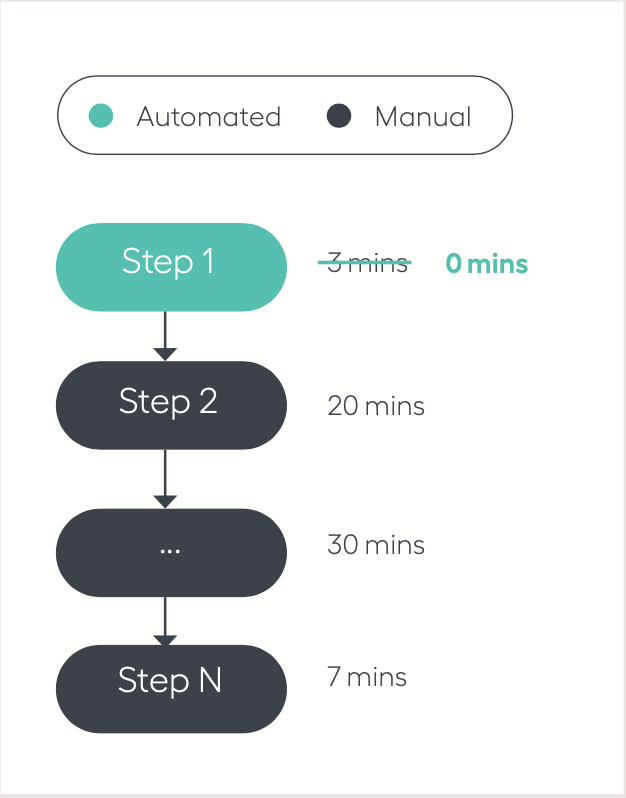
Figure 2. Example of a process where achieving high STP within one step does not actually result in significant improvement overall.
STP can be an indicator of success, but it needs business context. Is 90% STP good? Probably not if the automation in question only replaces one weekly task that takes a person 3 minutes. Wouldn’t 95% automation be better? Maybe, but not if the scope of that automation was a small piece of an end-to-end process which otherwise remains highly manual. Both these scenarios claim high STP and automation but will have limited impact.
STP is most useful in uncomplicated scenarios. With automations that focus purely on structured data (e.g., databases, consistent Excel formats, templated documents), rules are typically defined. These rules can cover a certain number of transactions — business goals may set that number at 60% or 80% — and thus, STP can reflect some success. But when complexity increases — whether because of a larger scope with multiple tasks, or the inclusion of unstructured data (or both!) — STP offers less insight. With each added task, likelihood increases that a transaction will be stopped from going straight through. This is even likelier with probabilistic decisions as offered by machine learning.
In days past, it may have been safe to “start small” with automation and spotlight high STP to prove progress. But accurately measuring success now means understanding the context and complexity of solutions.
Measuring the Value of Automation with Outcomes, not STP
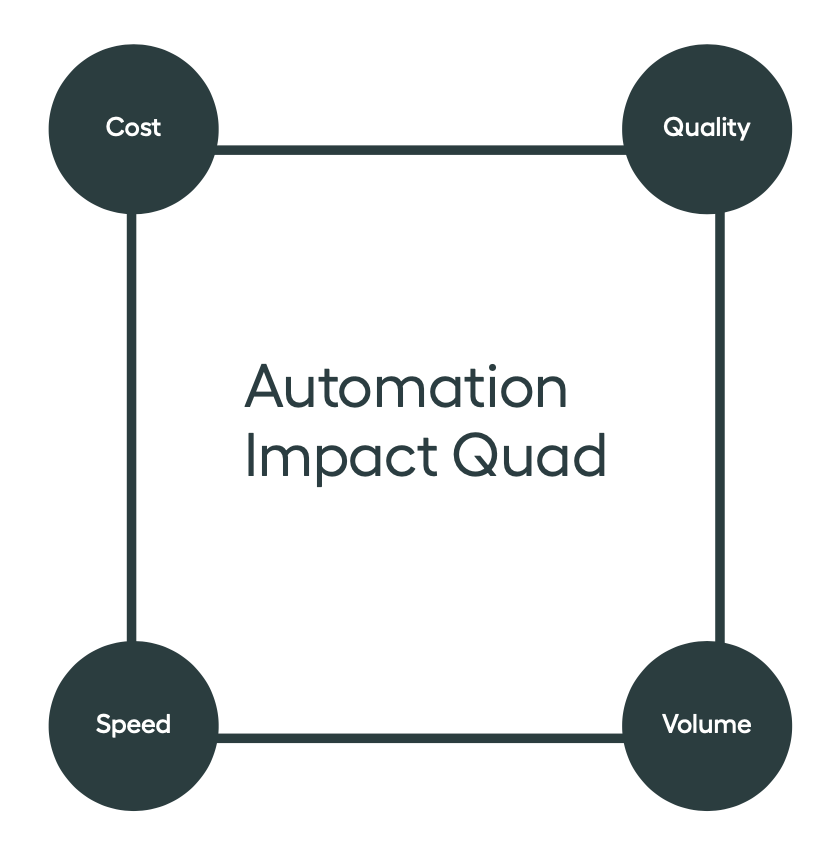
Figure 3. As compared to the standard “Project Management Triangle” of scope, cost and time, automation success can be measured in cost, quality, speed and volume (of tasks or data points) handled.
Automation’s impact is best measured through real business outcomes. A simple way to approach this is inspired by the Project Management Triangle2. We can call it an Automation Impact Quad:
- Cost: reduction of manual effort
- Quality: increased accuracy, compliance
- Speed: faster throughput
- Volume: increased capacity
Successful automations enhance at least one of these four outcomes, if not all of them. For example, Carter Bank & Trust3 has emphasized tracking its multi-million-dollar cost savings, but Deutsche Bank4 has emphasized its reductions in handling time and manual effort. Tim McCarthy, SVP of Global Operations at TransUnion5, is even more bold — not only considering these basic outcomes, but also the next-level impacts of customer and employee experience. STP can help enhance outcome areas, but they also may be positively impacted without any STP.
We want to improve our process efficiency, reduce costs and better scale our growth while also improving customer experience. However, the ability to reduce costs and better manage increasing customer expectations with automation can also be thought of as favorable outcomes in pursuit of a larger goal, employee happiness.

The analyst community strongly advocates connecting with greater business outcomes. In the other report in this newsletter, Gartner addresses automation success metrics directly: “Misaligned metrics can stop any hyperautomation project and make it hard to build the business case for the next one. To combat this, bank, investment and insurance CIOs need to use metrics aligned to the business outcome.” Examples of these metrics include efficiency: time saved; operations: adherence to SLAs; sustainability: improved compliance; revenue: revenue growth; and employee engagement: augmented staff. Noticeably absent? STP! Gartner includes the metric percent automated, but STP is just one way of tracking automation percentage; others include automated data fields and reduction of manual touch points. So, yes, automation levels are important, but to Gartner, success is more about outcomes and impact.
And it’s not just Gartner. Forrester6 took a look at best practices for Automation Centers of Excellence (COEs) and clearly stated, “All successful [automation] programs have a strong tie to the business.” But they admit that COEs have a tendency to “ignore strategic benefits” like customer experience, even though “the COE needs these benefits, and they’re real. Metrics can capture improved resolution time in the contact center, the value of reduced errors, or the lower risk of compliance issues.”
Everest7 also emphasizes the need to look beyond STP. Their list of key benefits to automation solutions are grouped under operational, cost, and business impact areas, emphasizing turnaround times, cost reduction, and increased customer satisfaction — relegating STP to a secondary point.
So, successful automation leaders and top automation analysts agree: Automation success is more than just STP.
Focus on Business Impact from the Outset
Like one of Stephen Covey’s seven successful habits8, automation success starts by beginning with the end in mind. According to the Gartner metrics report mentioned earlier, automation progress should define success metrics at the start of each automation project, leveraging a SMART format (i.e., specific, measurable, attainable, relevant and time-based), while consulting with affected employees throughout the process.
Like any tech implementation, this type of planning can be an initial step to kick off automation implementations. But wouldn’t it be nice if this wasn’t considered extra upfront planning, and instead is just the best way to automate? To have a prescriptive path to success that specifies the expected business impact? Where proven metrics are pre-defined and already visualized in pre-existing dashboards? Where the automation solutions generating these analytics are pre-built, including tested integrations with enterprise tools, pre- calibrated data enrichment methods, and pre-trained machine learning models? Well, great news: This isn’t only possible but proven.9 And this method is easily described through two of the many pre-built automation solutions from WorkFusion: Adverse Media Monitoring and KYC Docs.
Example 1: Adverse Media Monitoring
Automating Adverse Media Monitoring10 has a high impact — typically over 70% reduction in manual effort — but 0% STP for most implementations. Yes, 0% STP! At its core, this approach to screening for negative news is often implemented in such a way that analysts still review every search. But they are greatly assisted by automation before and after that one manual step in the process, resulting in very high impact from a lot of automation, yet small STP.
In this use case, automation retrieves news articles from news engines such as Google News or LexisNexis, analyzes and prioritizes news for relevance, and generates a narrative report itemizing all its steps.
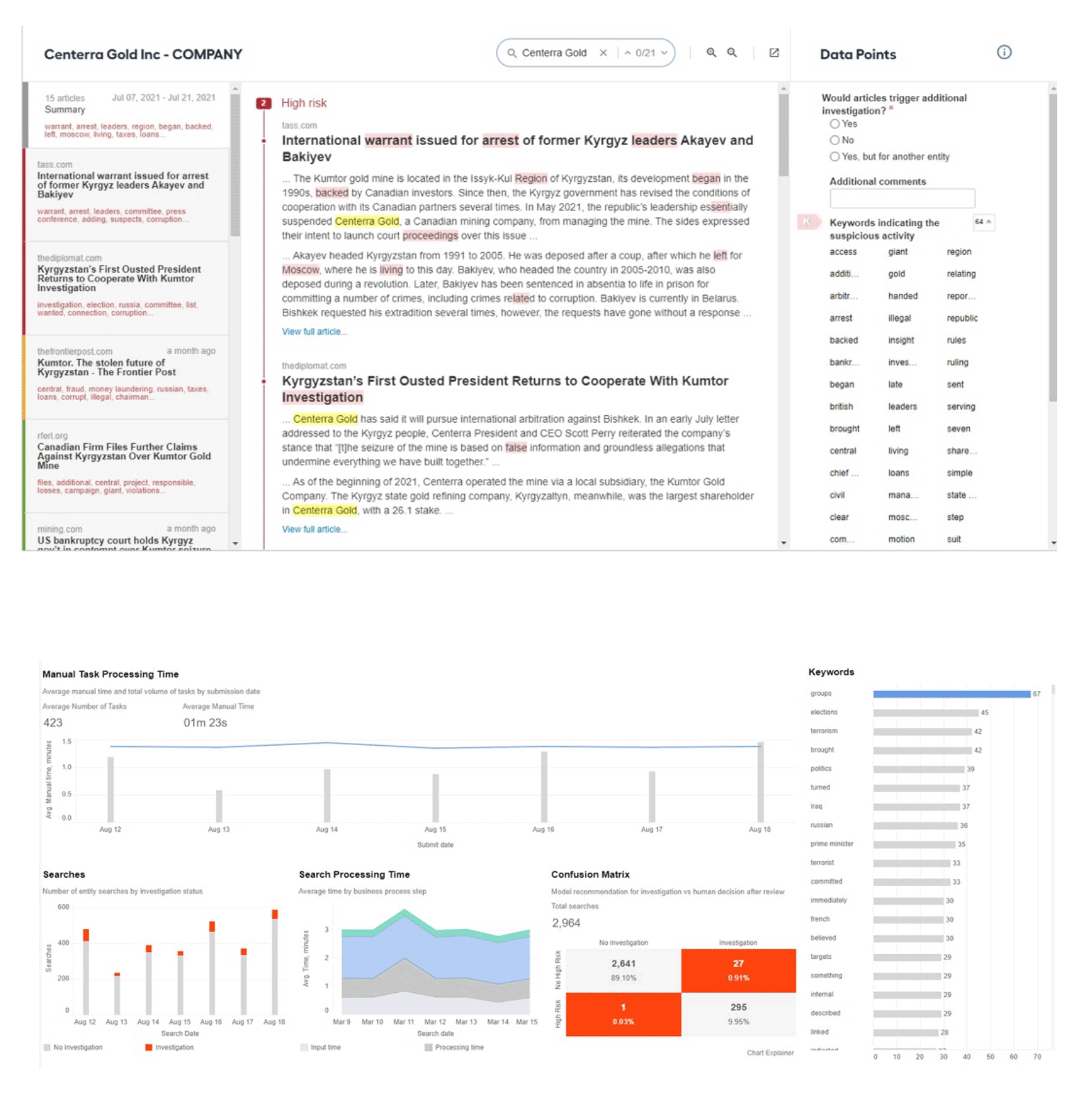
Figure 4. Automation assists the negative news search by making it much faster and more comprehensive, but analyst participation is still necessary. Despite that, with Intelligent Automation, the analytics dashboard shows how the process is improved considerably to meet business goals.
The actual decision as to whether this entity is a risk is typically performed by an analyst. Before automation, those same analysts would execute all the work manually: 20–30 minutes per search. With automation in place: only 2–3 minutes. If desired, especially regarding lower-risk entities, even this step could be set to be automated so that STP is actually achieved. But due to regulatory and compliance purposes, the non-STP option often is preferred.
Example 2: Corporate Account Opening
Considering automation for Account Opening of Corporate Accounts11 is another way to analyze the importance of outcomes for evaluating success, as it often results in 20–25x faster turnaround times. In opening these types of accounts, adherence to timely Service Level Agreements (SLAs) is considered highly valuable.
This process requires multiple steps, so automation approaches may focus on those with the most straightforward solutions — such as moving files and data from one system to another. Although this can have high levels of STP and may save time within the process, automation here may not have an impact on key business metrics like SLA.
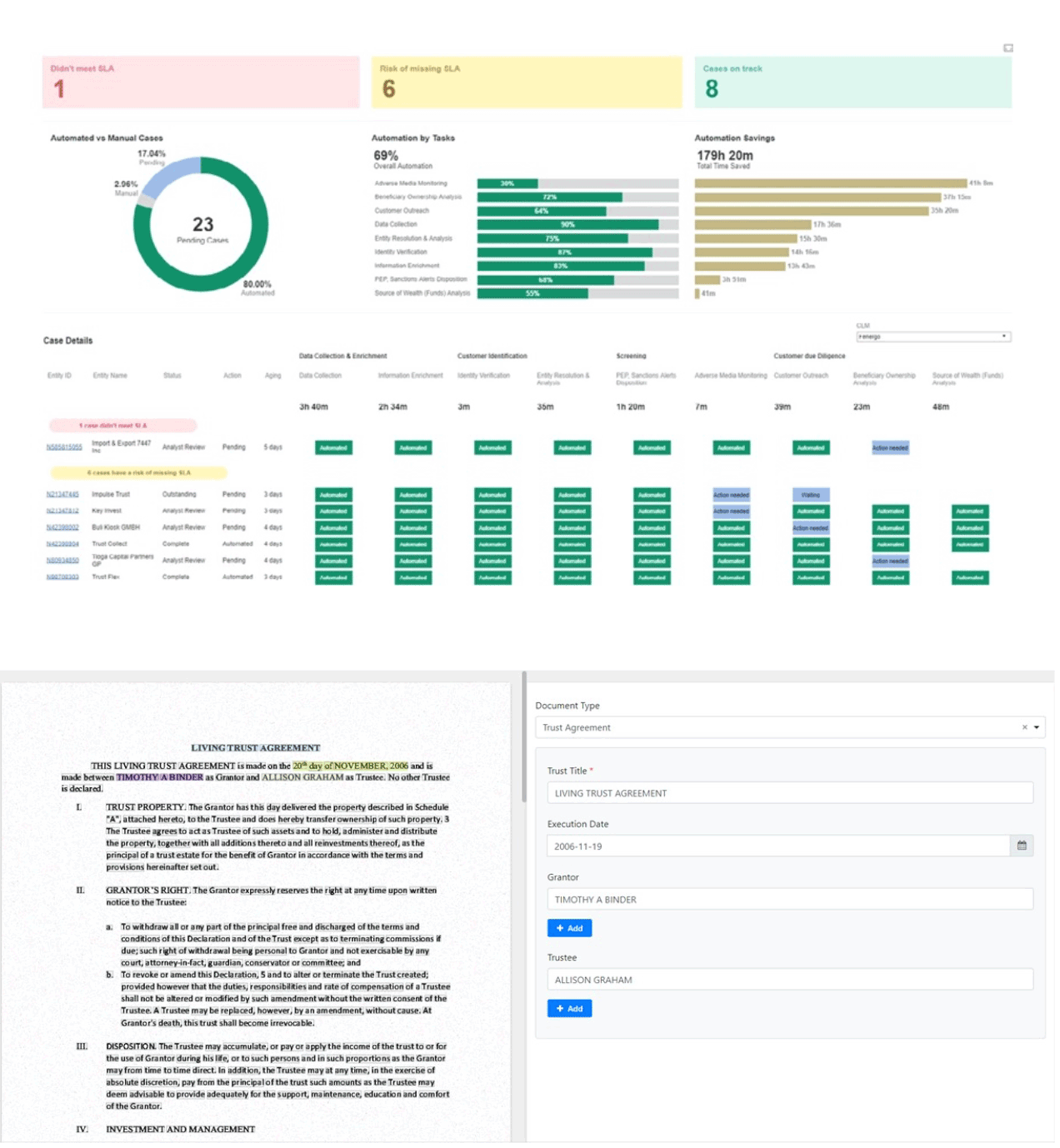
Figure 5. When ingesting and classifying documents is automated, Account Opening due diligence can happen much faster. The analytics dashboard shows how the automated process meets SLAs per prioritized business goals.
Greater business impact in this process comes from automating the most advanced tasks: the ones that involve complex unstructured documents or managing communication with customers across different channels. These tasks require extracting, classifying, and comparing data in various levels of documentation, like articles of incorporation, identity cards, and trust agreements. For example, if an entity has provided a trust agreement, a beneficial ownership form, and two passports, about 20–40 data elements must be identified and validated. If automation can handle the majority of data and highlight the few pieces it can’t finalize, that lets analysts step in and quickly resolve the issue. Such an action takes mere seconds, a significant improvement over the many minutes analysts would spend with no automation in place.
Tracking success here should focus on SLAs and metrics that help express value, such as total effort and time savings. For SLAs, that means easily identifying what’s on-track, what’s at risk, and what has already breached targets — including tasks caught in a work queue or otherwise pausing processing.
Automation Outcomes Over Activities
Just as early success with transportation didn’t rely on faster horses, automation success doesn’t necessarily mean pursuing more STP. Business outcomes should be the measure of progress. When considering metrics, keep in mind how in Adverse Media Monitoring, STP often stands at 0% while reduction of manual effort is over 70%. In Account Opening, SLAs set the standards.
It’s time to take off those blinders that maintain a focus on STP, to see the automation journey ahead more clearly.
1 See “Horsey Horseless”: https://en.wikipedia.org/wiki/Horsey_Horseless
2 Project Management Triangle: Cost, Time, and Scope as indicators of Quality https:// en.wikipedia.org/wiki/Project_management_triangle
3 American Banker, “Community banks get on board with bots” https://www.workfusion.com/wp-content/uploads/2020/11/American-Banker-Carter-Bank.pdf
4 Deutsche Bank accelerates CLM with Intelligent Automation https://www.workfusion.com/ wp-content/uploads/2021/07/WorkFusion-DB-Case-Study.pdf, part of https://www.workfusion.com/customer-stories/deutsche-bank
5 Webinar featuring TransUnion: “Developing Your Capability with Intelligent Automation to Supercharge Your Team” https://www.workfusion.com/webinars/developing-your-capability-intelligent-automation-to-supercharge-your-team
6 Forrester, “Best Practices for Automation Strike Teams” https://www.forrester.com/report/Best-Practices-For-Automation-Strike-Teams/RES164499
7 Everest, “Intelligent Document Processing (IDP) Playbook 2021” https://www2.everestgrp.com/reportaction/EGR-2021-38-R-4400/Marketing
8 Covey, Steven. (1989) The 7 Habits of Highly Successful People. Free Press
9 See WorkFusion customer stories, including Deutsche Bank, TransUnion, and Carter Bank & Trust: https://www.workfusion.com/customer-stories
10 WorkFusion’s Adverse Media Monitoring Solution: https://start.workfusion.com/use-case/adverse-media-monitoring
11 WorkFusion’s Account Opening Solution: https://start.workfusion.com/use-case/new-accounts
Source: WorkFusion — Kyle Hoback, Nicki Willi, Vasil Remeniuk, 16 September 2021
Without consideration of the business impact and organizational context of automation, STP alone can be a meaningless figure.
Successful early automobile innovators understood that progressing transportation was not about improving the horse but, instead, re-thinking the overall problem and finding a better way to transport people.
Automation’s impact is best measured through real business outcomes: Cost, Quality, Speed, Volume
Successful automation leaders and top analysts agree: Automation success is more than just STP.
Take off those blinders that maintain a focus on STP to see the automation journey ahead more clearly.