Leader’s Guide to the Future of Work
How new technologies will change how people connect with each other and serve customers tomorrow
Research from Gartner
How We Will Work in 2028
Intelligent software and AI-powered robots will join humans at work by 2028. CIOs must anticipate how trends in business, society, technology and information will converge to change where, when, why and with whom we will work in a digital business.
Key Challenges
- "We Working" will eliminate much of middle management.
- Constant upskilling and employee digital dexterity will outweigh tenure and experience.
- Extreme work choice will blur boundaries, businesses and buddies.
- Smart machines will be our co-workers.
- Purpose and passion must continue to be a priority.
- Work-life balance challenges will reveal a new dark side.
Recommendations
CIOs seeking to master the dynamics of leadership, culture and people during the next decade should:
- Go to the extreme and be daring. Unconventional approaches will be true to a greater degree than not, then lead a new vision of how people will work in and around the business. Don't stop supervision, skilling and access at the perimeter of the organization. The future worker will not.
- Create a 10-year scenario for "We Working." Assume that people will enter and exit through ever-changing networks of people both inside and outside the enterprise.
- Prepare for the killer combo – people + technology. Investigate how AI, smart software and robots will enrich and invigorate work strategy. Workforce digital dexterity will drive competitive advantage.
- Build a message that resonates. Passion, purpose and balance will intensify as anchors for our work and prosperity. Master the message.
Introduction
"We always overestimate the change that will occur in the next two years and underestimate the change that will occur in the next 10. Don't let yourself be lulled into inaction."
Bill Gates
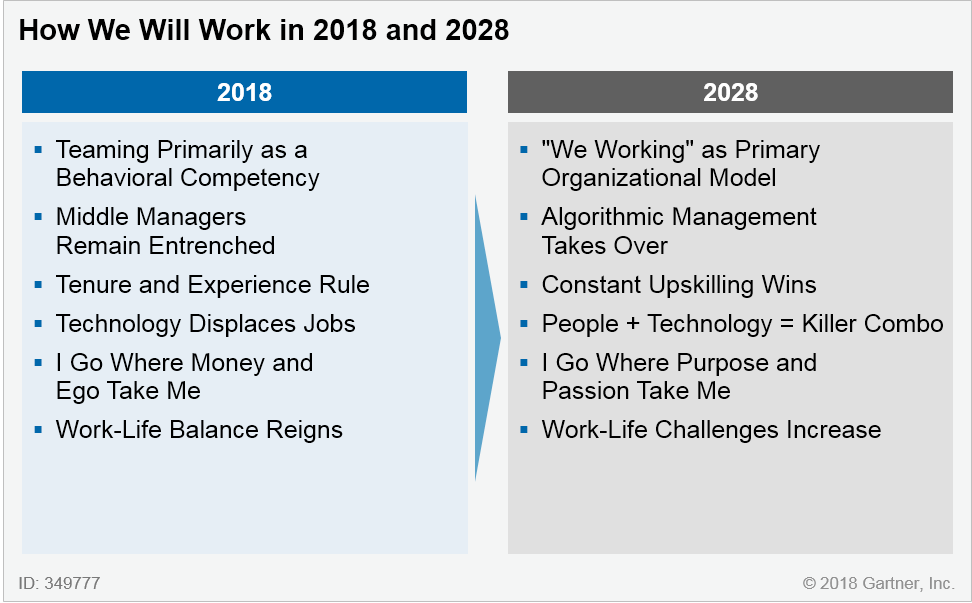
How will we work in the future? According to the World Economic Forum's 2016 report, "The Future of Jobs," 44% of global business and HR executives identify changing work environments and flexible working arrangements as the biggest demographic and socioeconomic driver of change across industries.1 For the next 10 years at least, work will revolve around human beings, with artificial intelligence (AI) and smart machines augmenting human aptitude and capabilities and raising questions around people's worth and fit-for-future. The digital component of most jobs will rapidly accelerate, putting a premium on workforce digital dexterity – the ability and desire to use new and existing technologies for better business outcomes. Social developments, digital business, consumer behaviors and emerging technologies will drive six planning assumptions that characterize work in 2028 (see Figure 1).
In this research, we outline six assertions for work in 2028 and offer advice for CIOs on how to ride those assertions to greater business and personal success. We base our assertions on the synthesis of hundreds of conversations with clients, on primary and secondary research, on secondary sources and on an informal survey of Gartner analysts from around the globe.
Figure 1. Assumptions: How We Work in 2018 and 2028
Source: Gartner (February 2018)
Analysis
Assumption 1: "We Working" Will Eliminate Much of Middle Management
Algorithms and the "We Working" philosophy will reduce the number of middle manager roles needed in most organizations and eliminate them in some. We will gravitate toward work and organizations that accelerate "We Working" – a work philosophy that depends on ensembles of autonomous and high-performing teams fulfilling crucial outcomes. Work will revolve around portfolios of diversified roles and skills performed in teams that dynamically resize and reform. The trust among We Working teammates will dovetail with the rise of algorithmic management to reduce the need for middle managers. As a result, the remaining middle managers will have a narrower span of control.
By 2028, We Working will be a proven model to orchestrate talents and expertise to achieve critical outcomes. It will become the de facto organizational operating model, tapping both internal and external talent. How will We Working in 2028 differ from teams in 2018? The difference lies in scale and maturity:
- In 2018, teams form as loosely federated groups of people, pulled together in an ad hoc fashion or by reporting structure. In these cases, teaming is recognized more as a behavioral competency (such as team spirit and collaboration) than as a legitimate organizational principle.
- In 2028, the complexity and scale of business objectives will demand the involvement and orchestration of brainpower and expertise across organizational boundaries and borders in ways more intricate than in 2018. We Working will take the concept of teaming and industrialize it, removing the casualness and converting it into a source of excellence.
We Working ensembles will be self-guided, quickly reconfigured, fluid, distributed and fueled by a combination of autonomy, alignment via talent matching algorithms, and trust. Businesses and institutions will be forced to turn their traditional individual performance perspective upside down in the face of fewer people working in discrete business processes. What's more, the rise of algorithmic management – manifest in what Gartner calls robobosses – will challenge expectations about what human managers should do to assemble teams and enable them to perform effectively.
We will need fewer people managers as many of the management tasks such as collecting data, supervising actions and ensuring compliance will be completed by algorithms or robobosses. People managers will focus their time on people-related activities that require intuition, empathy and interpersonal communication.
We Working will not be about a corporate value called "teamwork." It will be about deliberately designing small and flexible teams as the predominant approach toward fluctuating workloads, shrinking time frames, and intense flurries of information exchange and coordination. We Working will elevate teaming from art to science, from haphazard to systematic. The demand for high-performance teaming will be strong: Already, more than four in 10 high school students in the U.S. want to work in businesses that emphasize teams, according to National Society of High School Scholars' Millennial Career Survey.2 By 2028, those students will move into the workforce and be team leaders and influencers, potentially driving the organizational innovation that remains so elusive in 2018. We Working will encourage people to gravitate toward small teams that form, converge, act and dismantle as work and assignments change.
The leadership style for We Working looks like the style used by Scrum Masters as they lead agile development.
The Scrum Master Role
In agile development, the Scrum Master acts as a coach and process expert, guiding the team to ever-higher levels of cohesiveness, self-organization and performance. While a team's deliverable is the product, a Scrum Master's deliverables include both the team itself and other deliverables that equate to a certain number of points. The Scrum Master guides or coaches the team through a sprint, helping everyone understand the Scrum process and embrace its values, ensuring that the Scrum is being conducted properly. A key role of the Scrum Master is to eliminate things that get in the way of the team's progress and to coach or guide the team through the accelerated process.
We Working leaders will supportively "orchestrate the ensemble" using a servant-leader approach. They will facilitate the team's collaboration, coach team members to reach their goals and help them overcome obstacles. Organizations will support We Work professionals by using roboboss capabilities to conduct management tasks like career pathing, compensation and benefits discussions, and performance management. We Working leaders will use human qualities of empathy and interpersonal communications to excel at change leadership by engaging, inspiring and motivating individual professionals.
CIO recommendations:
- CIOs should use Scrum Master principles to develop We Working leaders who anticipate and remove obstacles to team progress and coach the We Working team to high performance.
- Work with HR leaders to invest in algorithms that identify worker skills and competencies, and modify worker profile tools to display portfolios of work rather than job titles.
- CIOs must rethink human capital management (HCM) technologies to keep pace with talent demands and realities.
Assumption 2: Constant Upskilling and Employee Digital Dexterity Will Outweigh Tenure and Experience
"The illiterate of the 21st century will not be those who cannot read and write, but those who cannot learn, unlearn and relearn."
Alvin Toffler
The digital economy will demand new ideas, new information and new business models that continually expand, combine and morph into new ideas, new ventures and new businesses. Over the past several years, the demand for digital skills has grown by 60%. Employees will be challenged to constantly upgrade their digital dexterity to keep pace with always-evolving SaaS applications, the rapid diffusion of AI services and a strong need for complex problem solving in nonroutine work.
The World Economic Forum ranks complex problem solving at the top of its core skill sets across all industries. Moreover, it expects cognitive abilities to experience the greatest growth. People at the center of the rapid morphing – change-ready leaders and eager contributors – will not look backward for a solution. They will apply creativity, critical thinking and constant digital upskilling to complex problem solving.
The U.S. Census Bureau says that nonroutine work has grown from 40% of occupations in 1975 to 60% in 2013.3 Given that trajectory, the proportion will likely pass 65% by 2028. Said simply, by 2028, more than two out of three jobs will likely be defined as nonroutine. Most nonroutine work, moreover, is considered cognitive, meaning it requires expertise in complex critical thinking. Nonroutine cognitive work traverses uncharted territory, new activities and unprecedented challenges. With nonroutine work, your job is to come in every day and figure out what your job is and how to do it. It has no playbook and no precedent – but it is clear that it will require extensive data literacy, algorithmic thinking and extensive real-time collaborative skills.
To meet the rise in nonroutine cognitive work, adult education and higher education will raise their game. A growing proportion of jobs will require college education and training beyond high school, a proportion climbing steadily from 59% in 2010 to 65% in 2020, according to the Georgetown Public Policy Institute.4 Each of us will need to build a consistent program that helps workers learn, unlearn and relearn digital skills. Fortunately, new education providers such as Udacity and Udemy will bridge the gap between accredited curriculum and nanodegree programs to satisfy the fast-changing needs of business, information and technology.
Equally important, we, as lifelong learners, will use all-in-one platforms focused on new and emerging areas of technology and business to connect with learning-content builders, assessment providers, and mentors and coaches. In fact, respondents to the 2017 Gartner digital workplace survey indicated that they prefer just-in-time learning like short videos or text explanations and online self-paced courses over formal traditional classroom training.
Nonroutine cognitive work will be where most high-value work is performed by 2028. Artisanlike jobs will emerge. The expense of sending your workers to formal education to develop nonroutine skills can be quite costly and time-consuming. Leadership at all levels must embrace and require a continuous learning climate. Knowledge acquisition, sharing and dissemination across the organization must become a part of the day-to-day operations of the enterprise. The organization must provide an array of learning resources, tools, access and time devoted to gathering knowledge and using that knowledge to improve individuals as well as areas where it is needed in the organization. Providing cognitive workers access to just-in-time learning or learning when needed is an important part of meeting the needs of the nontraditional worker.
Professionals who embrace continuous learning and improvement of digital skills will excel beyond the achievements of colleagues with greater tenure or experience. These professionals utilize the ability to learn new concepts and techniques but also are able to "unlearn" existing or outdated concepts/methods/tasks that may have been successful but are no longer applicable to the world of We Working.
CIO recommendations:
- Make workforce digital dexterity a key part of the IT charter.
- Become a champion for lifelong learning for yourself and for the enterprise by utilizing just-in-time, short learning bits that provide immediate information and skills development, especially for cognitive workers.
- Start to experiment with boot camps, nanodegree programs, consumerized learning, and competitions and hackathons. CIOs have almost nothing to lose in trying out nontraditional programs and channels to anticipate making work at your firm a learning experience for those with a growth mindset.
Assumption 3: Extreme Work Choices Will Blur Boundaries, Businesses and Buddies
Digital business, built on vast networks and ecosystems, will increase the distribution of work across communities of people and across businesses globally. By 2028, the consumerized "pull" mindset will have such a hold that the 20th-century "push" mindset will seem ancient. We will take control of our work, our environments and our collaborators. Already, more than three of us out of 10 spent at least 80% of our time working remotely in 2017, according to Gallup's State of the American Workplace report, and the trend is rising.5 We will personalize the information, sources and tools we need where and when we need them, without restriction. Tensions will emerge as work traverses borders, as security imbalances surface, as We Working creates patchworks of preferences and as each of us customizes our work options.
We will be likely to work in businesses in every continent. In fact, 95% of the participants in Fortune's survey of the world's most admired companies identify the quest for talent in different markets at the top of their agenda.6 We could possibly move in the direction of working and speaking with team members across languages, borders and cultures, using avatars, language software, conversational interfaces and real-time dialect translation to translate and interpret with almost no loss of context or meaning. Regional norms will still play a huge part in the usage of such technologies.
The allure of freelancing and the gig economy will intensify as our personal workplaces travel with us for specific purposes, but few of us will be able to count on work simply coming to us. Many of us will be "microtaskers," fulfilling small and specific assignments through talent and marketplace platforms, similar to Amazon Mechanical Turk or Task Rabbit today. We will have to think up new ways to generate value, tap into new We Working ensembles, and market the output or outcome to ventures, companies and causes. One emerging trend is the establishment of working pods – groups of workers that move from one organization to another. Leaders bring along their previous management teams to duplicate previous successes in new organizations. Social and personal connections are just as important if not more as opportunities for career advancement.
Since most of us by 2028 will be rating everyone and everything around us (and being rated, too), we will rate our buddies or work colleagues on trust, competence and ethical behavior much as people rate buyers and sellers on purchasing platforms. Ratings will serve as a proxy for trust and competence in a system where people may not know one another.
CIO recommendations:
- CIOs must take action to identify the impact on the organizational values and culture while leading the continuous ebb and flow of new/transitioning talent.
- Strategically minded CIOs will play a key role in using technology and information to build a hybrid workplace – physical and virtual – that embraces work styles of all people, not just those who are permanently employed or who have high digital dexterity. CIOs will need to be clear about critical roles, which need longer-term continuity and organizational knowledge, and distinguish them from other roles that may be filled by more transient talent.
Assumption 4: Smart Machines Will Be Our Co-workers
AI, consumer technology, internet-based applications and tons of computing power in smaller devices will change where and how we work.
Smart machines will become smarter and more ubiquitous, doing not only what was previously reserved for humans, but also what was thought to be impossible for machines. By 2028, we will move beyond pure automation, which a McKinsey Global Institute study suggests will target predictable physical work, data processing and data collection.7 Each of us will develop a personal toolkit of virtual doppelgangers – artificially intelligent software and devices that fulfill aspects of our personal or team-based activities Many of us, as high-performing workers, will recognize that we can achieve more by distributing our tasks among the smart machines, software, apps and avatars in our personal portfolios, in effect creating virtual doppelgangers (or virtual counterparts) of ourselves. Making them work will be personal infrastructures that enable us to carry our personal workplaces with us using cloud communities, open applications and personal virtual assistants.
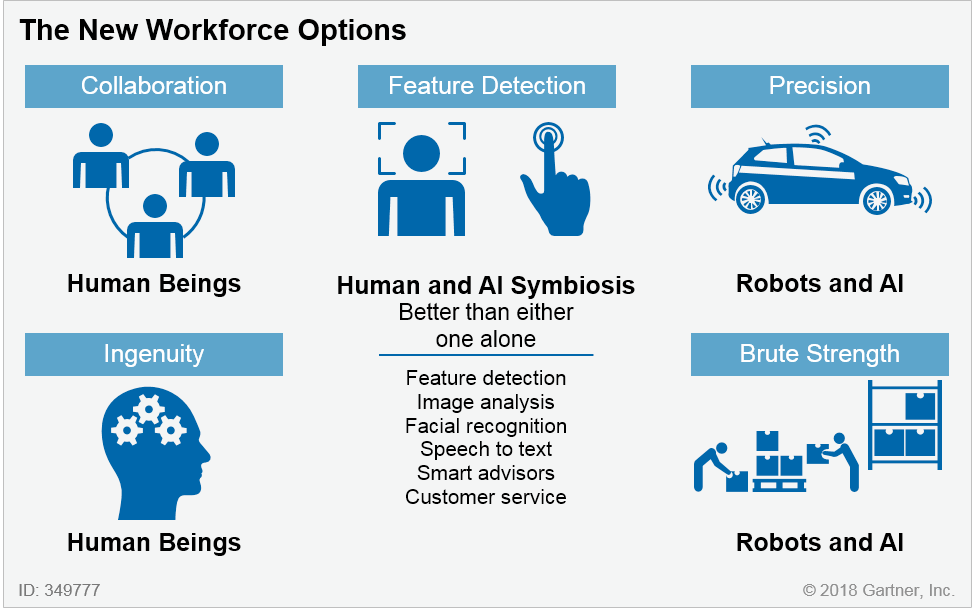
By 2028, extreme digital dexterity will be the modus operandi for how we will work. Personal technology ingenuity will be the cost of admission. We will excel at synthesizing dynamic points of views, creating scenarios on the fly, and applying technology ingeniously to new challenges. What's more, because the work and tools of 2028 will be in our hands, we will leap over technical literacy for corporate applications and move swiftly toward the deftness and imagination required to bring new media, information, devices and resources to bear on problem solving, challenges and projects. Personal digital dexterity will enable us to use AI in our teams and projects without waiting for businesses and institutions to figure it out or to pay for it (see Figure 2).
Figure 2. The New Workforce Options: Human Beings, AI, Robots
Source: Gartner (February 2018)
Artificial intelligence and personal technology ingenuity will extend expertise, skills and performance. Driven by our digital dexterity, we will share consumerized toolboxes with our We Working ensembles to tackle business challenges, share mind maps, advance hypotheses and share customer challenges. Moreover, people's involvement in expertise ecosystems, peer networks, social communities, and horizontal links between people and parties will increase Socratic debate and resolution of "wicked problems."
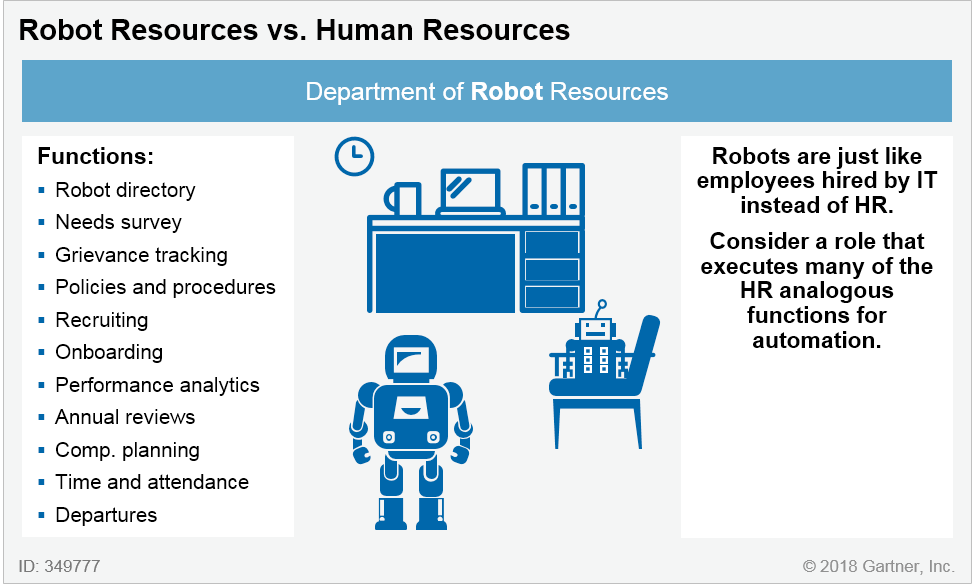
By 2028, departments of "robot resources" will begin to rival "human resources." Many of the same functions, from recruiting to performance reviews, will be applied (see "Maverick* Research: To Avoid Working for Robots, Make Robots Work for Your Organization" and Figure 3).
Figure 3. Robot Resources vs. Human Resources
Source: Gartner (February 2018)
CIO recommendations:
- Experiment with artificial intelligence and machine learning to see how they can be applied to daily activities and enhance complex problem solving, or free up time for both.
- Challenge high performers to create and share AI tools or personalized portfolios of apps, tools and smart technology to raise the bar for extreme digital dexterity.
- Treat robots as workers hired by IT instead of HR; create a robot and AI center of excellence modeled on HR.
Assumption 5: We Will Work for Purpose and Passion, Not Just Money
We will seek work that challenges us, peers who stimulate us and purpose that drives us. Many of us will bypass the corporate world and experiment with independent work and socially responsible ventures to meet those personal drivers. By 2028, our social graphs – which represent our connections and relationships in online social networks – will ignite our involvement and encourage our contributions to social innovation and equitability. According to the National Society of High School Scholars, almost six in 10 high-school students spend their time now volunteering in areas such as education, health, social justice and the environment, and in mitigating poverty and hunger.8 Their commitment will not go away: Nearly one in two plan to work with businesses and institutions that demonstrate corporate social responsibility. The timing will be good. Aaron Hurst, author of the book "The Purpose Economy," suggests that we are on the verge of an economic revolution driven by having meaning, or purpose, through our work, through challenges and growth as individuals, and through strong relationships with those around us.9
By 2028, we will be decades beyond the work dreams of our parents and grandparents. We will become deliberate in shaping and shifting our careers in a meaningful direction. Our impact and value will be tied to our mission, our purpose and our passion. Meaning will drive commitment. Moreover, because personal tech toolkits are within reach of our personal wallets, we will use them to apply our energy earlier in our lives toward things that matter. Instead of waiting for the age of retirement, we will apply ourselves more fervently to solve social challenges that cannot afford to wait. Businesses and institutions will make themselves attractive not solely by money, but by offering us an opportunity to make a socially meaningful impact through our work.
CIO recommendations:
- Make what people do resonate personally. Communicate to continuously connect the work of your team to the overall organizational goals, and to social impact if applicable. Weave in personal stories, experiences and successes to demonstrate commitment and drive engagement. Communicate in a way that people can relate to. In the words of poet Maya Angelou: "I've learned that people will forget what you said, people will forget what you did, but people will never forget how you made them feel."
- CIOs should also be mindful of preserving organizational values and cultural context while leading the ebb and flow of talent as the business requires.
- Strategically minded CIOs will play a key role in using technology and information to build a hybrid workplace – physical and virtual – that embraces work styles of all people, not just of those who are permanently employed or who have high digital dexterity. CIOs will need to be clear about critical roles, which need longer term continuity and organizational knowledge as distinct from other roles which may be filled by more transient talent.
Assumption 6: Work-Life Challenges Will Reveal a Dark Side
Because many of us will work independently or in remote locations, we will face a dilemma: To fuel our upskilling and accept grander portfolios of assignments we will take on more work to a point where we will feel as if we are working 24/7. To counter the burnout, we will look not to balance work-life but to emphasize life over work. Technology will emerge to monitor when people have worked too much and when they need to recharge. Technology will catch up with our biorhythms, nutritional needs and exercise needs and help us prioritize. Cognitive load will be monitored and fit into the available time.
The work-life balance equation will not be so crisp. We Working – built on autonomy, alignment and trust – will cause us to recalibrate work arrangements and create more equitability. People who crowd out work obligations in favor of tennis, dog walking, soccer games and children will face an opposing force as the work-life pendulum shifts. Instead of striving to reduce the impact of work on our nonwork life, we will need to ensure that our nonwork life does not interrupt our work commitments.
Other aspects of work-life challenges will have a shadowy side:
- As technology closes the divide between geographically separate people, it introduces cracks in relationships and cultures. The extreme distribution of work means that many of us will not build the intense social relationships that have been formed for centuries. Some of us will wonder where we belong, others will be lonely, while others will make far-flung work a social experiment.
- We will still need physical spaces where we can convene or work as necessary, but we will have to learn how to develop outputs and results without the familiarity or the camaraderie that we gain from physical workplaces.
- Tension will grow as businesses use personal information to issue puritanical mandates on aspects of life once considered private and beyond employer influence. Health, exercise, fitness and weight will become proxies for people's value, commitment and qualifications.
- Our digital reputation and our social graphs, gleaned through a range of digitally detected activities, will become a prerequisite for employment. Our personal data, habits and stories will be scrutinized by marketplaces, companies, institutions and causes, especially as we position ourselves as candidates or bid for work, again eroding the privacy we might expect.
CIO recommendations:
- Expect the pendulum of work-life balance to swing. We Working demands equitable work, and institutionalized nagging will generate push-back and reduce some businesses' appeal.
- Ensure that the use of enterprise personal information is balanced with concerns about privacy, trust and employee engagement.
Source: Gartner Research Note G00349777, Deonn Griffin, Mark Coleman, 27 February 2018
Acronym Key and Glossary Terms
| artificial intelli-gence | Technology that appears to emulate human performance, typically by learning, coming to its own conclusions, appearing to understand complex content, engaging in natural dialogs with people, enhancing human cognitive performance (also known as cognitive computing) or replacing people on execution of nonroutine tasks. Applications include autonomous vehicles, automatic speech recognition and generation. |
| digital dexterity | Having the cognitive ability and social practice to leverage and manipulate media, information and technology for advantage in unique and highly innovative ways. |
| digital technology | Any combination of technological devices (that is, laptops, smartphones, tablets, and so on), applications and web services that people use for communication, information and/or productivity. |
Evidence
We based this research on hundreds of conversations with clients, primary and secondary research and an informal survey of 20 Gartner analysts from around globe. We also used the following secondary sources.
The 2017 Gartner digital workplace survey was conducted to understand digital workers as well as shifts and directions in their sentiments and expectations, explore worker engagement, and examine satisfaction with applications that their organization provides. The research was conducted online from February to March, 2017 among 3,120 respondents in the U.S., Europe and Asia/Pacific.
Participants were screened for full-time employment in organizations with 100 or more employees and required to use digital technology for work purposes. Ages range from 18 through 74 years old, with quotas and weighting applied for age, gender, region and income, so that results are representative of working country populations.
1 "The Future of Jobs: Employment, Skills and Workforce Strategy for the Fourth Industrial Revolution." World Economic Forum. January 2016.
2 S. Thurman. "Millennial Career Survey." The National Society of High School Scholars. April 2016.
3 Adapted from U.S. Census Bureau. Current Population Survey.
4 A.P. Carnevale, N. Smith and J.Strohl. "Recovery: Job Growth and Education Requirements Through 2020." Georgetown Public Policy Institute. 2014.
5 "State of the American Workplace." Gallup. (Free registration required.)
6 M. Royal and M. Stark. "The Most Admired Companies Are More Global Than Ever. Here's Why." Fortune. 19 February 2015.
7 "A Future That Works: Automation, Employment, and Productivity." McKinsey Global Institute. January 2017.
8 S. Thurman. "Millennial Career Survey." The National Society of High School Scholars. April 2016.
9 A. Hurst. "CEOs – 2020 Tipping Point for Purpose Economy." The Huffington Post. 6 December 2017.