Hewlett Packard Enterprise
Advancing the way people live and work
HPE SimpliVity's Hyperconverged Infrastructure improves Data Protection and Recovery Effectiveness
Data protection remains one of the most problematic, labor-intensive, and least loved activities in the datacenter. Administrators need to manage hundreds of daily jobs, troubleshoot problems, recover jobs, respond to user requests for restores, and load, unload, and manage tapes. Additionally, the fact that the backup and recovery technologies commonly in use today were designed in an era when 24-hour recovery point objectives (RPO) and recovery time objectives (RTO) were sufficient makes matters worse.
The number of transactions processed by businesses and related financial institutions has gone up significantly with the advent of internet commerce. A 24-hour RPO could result in a loss of thousands of customer orders for businesses and a loss of millions of transactions per hour for financial institutions.
Key Challenges
Dramatic increase in transactions: Advent of internet commerce has resulted in a significant increase in transactions. A 24-hour RPO could lead to a loss of millions of transactions, effectively increasing the cost of downtime for these organizations in not only personnel productivity but also lost business that could never be regained.
Array-based capabilities (snapshot and mirrors) are not enough: Storage vendors responded with array-based capabilities such as snapshot and mirrors (clones), but problems still persisted:
- Snapshots provided a significantly better RPO, such as an hour or less, but could not survive an array or site failure
- Mirrors could be made to alternate arrays and sites, but due to long processing times and overhead, they were generally conducted only every 12 hours or so
Need for full-time administrators: IT organizations have implemented complex schemes of snapshots that may involve hundreds per volume plus local and remote mirroring. Managing this complex scheme requires full-time administrators in most organizations, meaning thousands of man-hours per year.
What has changed
Because traditional backup/recovery is both labor intensive and inadequate to meet business requirements, some IT organizations are transitioning their data protection scheme away from the defined third-party backup model to a model where data protection is built into the compute/storage stack. The client/server era was characterized by discrete technology stacks - such as server, storage, networks, and applications; backup/recovery was one of these application stacks managed largely as its own entity. The emergence of converged infrastructure did not fundamentally change this dynamic, especially regarding data protection.
More recently, the implementation of hyperconverged systems, which include not only a preconfigured hardware system but also an integrated operating environment, offers an opportunity to simultaneously simplify data protection and improve service-level delivery and certainty.
With hyperconverged systems, data protection does not need to be an add-on application, requiring separate testing, qualification, and management. Instead, data protection can be built into the operating environment.
Thus data protection is below the hypervisor, aligning it with the system operations and applications. Policies and operations are aligned with the virtual machine, providing a VM-centric backup and recovery capability. Offsite data storage and DR become a by-product of the overall scheme where policies can be managed globally.
What’s the future: HPE SimpliVity
Hyperconverged infrastructure is much more than a bundling of components. Hyperconvergence means more than merging storage and compute into a single solution. Multiple infrastructure components are integrated into a compact, efficient platform that is simple enough to be managed without specialized training. The more components in a hyperconverged node, the less you have to manage. When the entire IT stack is combined into a software-defined platform, you can accomplish complex tasks in minutes instead of hours. Hyperconvergence gives you the agility and economics of cloud with the enterprise capabilities of on-premises infrastructure. From a data protection perspective, data protection schemes, methods, and implementations are consistent across the environment and are globally managed.
HPE SimpliVity is an enterprise-grade hyperconverged platform that speeds application performance, improves efficiency and resiliency, and backs up/restores VMs in seconds. HPE SimpliVity combines your IT infrastructure and advanced data services into a single, integrated all-flash solution at a fraction of the cost of traditional offerings - gain VM management and mobility, built-in backup and DR, and game-changing data efficiency in this award-winning hyperconverged solution.
HPE SimpliVity data protection technology differs significantly from conventional backup or snapshot methods. In many respects, it offers the best of both worlds: the complete protection of backup software with the speed and RPO/RTO of snapshots. Highlights include:
- No practical limit to the number of backups created and retained – HPE SimpliVity engineers have tested thousands of backups, and the tested maximum currently exceeds 200,000
- Each copy is a full backup – no chain of changes can be broken, corrupted, or is needed for replay
- Backups include a clone of the VM parent object. The full VM tree is logically copied in its entirety, and all VM trees are the same length
- Backup images can be transferred to an offsite system for DR - Two copies are automatically kept on different nodes and copied blocks cannot be deleted
- Data and metadata corruption can be detected with a "fingerprint" of checksum and hash values
- Each node is functionally an independent system - Corruption on one node cannot affect another
- If the original VM is deleted, it can still be recovered from the backup set
What are the customers saying
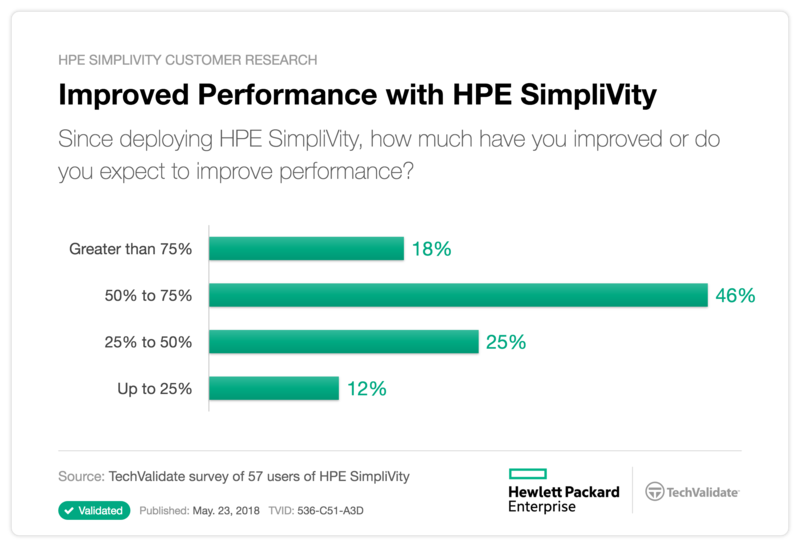
A recent survey of HPE SimpliVity customers revealed that these organizations have experienced tangible, measurable results in terms of higher data availability, better operations, and reduced labor related to data backup and DR.
Fig 1: Performance improvement using HPE SimpliVity
Source: https://www.techvalidate.com/product-research/HPEHybridITSolutions/charts/536-C51-A3D
Because the HPE SimpliVity 380 deduplicates, compresses, and optimizes data the first time it is written to disk and maintains it in that state for its life cycle, backup copies are already deduplicated and compressed, thereby eliminating the need for third-party software or purpose-built backup appliances.
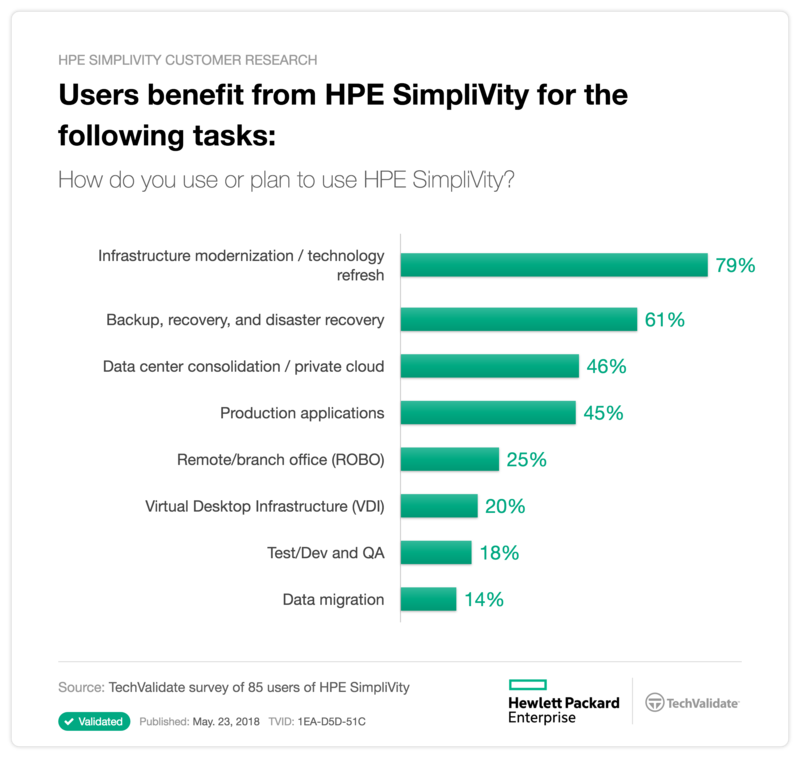
Fig 2: Tasks achieved using HPE SimpliVity
Source: https://www.techvalidate.com/product-research/HPEHybridITSolutions/charts/1EA-D5D-51C
The HPE SimpliVity approach to data protection is to provide all the benefits of a full backup and data replication at the speed of a snapshot. The methodology is also an excellent defense against ransomware because all prior images are saved as full images, permitting recovery at a point prior to the ransomware (or any other) infection.
Conclusion
IT organizations must fundamentally rethink their data protection strategies to meet increasingly stringent data and application availability requirements. The predominant backup/recovery methodologies, where the backup environment is separate from the compute environment, were designed for the client/server era. While it is possible to use these same techniques on newer architectures, they are unlikely to bend the cost and labor curves enough to make a big impact on overall IT operations.
HPE SimpliVity with built-in data protection schemes automates operations such that they become a by-product of the compute process, offering a real opportunity to simultaneously simplify and improve data protection results. It helps eliminate the need for third-party data protection. HPE SimpliVity delivers the resilience, built-in backup, and bandwidth-efficient replication you need to ensure the highest levels of data integrity and availability.
Source: HPE