
Welcome
The recent hype around "modern" business intelligence (BI) and analytics platforms has left some confused and even questioning their BI strategy. This newsletter sheds light on how the demand for business users to do analytics on their own has given rise to "modern BI." The market is flooded with novel analytic tools for every purpose and every user, and many top-performing traditional platforms have evolved to meet the "modern BI" definition and are providing new opportunities to drive better business outcomes and improve productivity. Cognos Analytics is one such example. IBM has invested significantly in the last few years to bring to market new offerings that package the best attributes of traditional BI and data discovery in engaging new user experiences, opening the door to new users and analytic success.
We hope that you find these perspectives helpful as you consider how to implement a modern BI and analytics platform.

How to Implement a Modern Business Intelligence and Analytics Platform
- Joao Tapadinhas
- 12 April 2016
A modern BI and analytics platforms that is easy to implement and operate is not enough to guarantee success. Data and analytics leaders must offer the right platform capabilities, roles, processes and integration with existing BI environments to meet user expectations.
Key Challenges
- Most of the modern BI and analytics platforms available in the market today are easy to set up, administer and work with, but that alone does not guarantee successful data exploration.
- The modern BI and analytics platforms can be deployed with disparate capabilities and follow different architecture models, leading to different business outcomes.
- Some organizations deploy modern BI and analytics platforms that offer the wrong set of capabilities to business users, or are used as analytics silos, with no governance or proper integration with the overall BI landscape, which leads to poor results.
- While most vendors are growing their capabilities and expanding their footprints from the information portal to the data science laboratory, there are still gaps that can't be solved by a single tool, leading to problems with solution design and integration pains.
Modern Business Intelligence and Analytics from IBM
In the featured research "How to Implement a Modern Business Intelligence and Analytics Platform" Gartner stresses that analytics leaders must offer the right platform capabilities, roles, processes and integration with existing BI environments to meet user expectations. They explain that poor results stem from deploying modern BI and analytics platforms that are used as analytics silos, with no governance or proper integration with the overall BI strategy, or that offer the wrong set of capabilities to their business community. In fact, Gartner even predicts that "By 2018, a third of modern BI and analytics platform implementations will fail to meet user expectations due to poor design, lack of governance or improper integration within the overall BI landscape."
A key objective of a modern BI and analytics platform is to empower business users to create their own analytic content and insights. The Analytics Trust implementation scenario achieves that objective with a high focus on the reliability of the user built content. The Analytics Trust implementation scenario provides a level of self-service analytics to business users, without significantly disrupting the BI content creation processes in the organization.
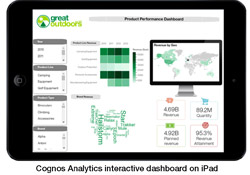
The Analytics Trust scenario aligns perfectly with the direction we have taken with IBM Cognos Analytics. Cognos Analytics is an integrated solution for managed reporting and business user discovery based on a proven enterprise platform built for Analytics Trust. Cognos Analytics provides a highly scalable and secure environment for communities of users to consume, create and share insight from all types of data. It is an upgrade from previous releases of Cognos Business Intelligence that guides business users in the creation and sharing of new datasets, dashboards and reports – without requiring help from IT but with the ability to stay synchronized with IT managed data to avoid creating information silos or basing decisions on the wrong information. Full scheduling and alerting capabilities mean reports and dashboards can be centrally authored (and subsequently customized with the interactive interface) so users can monitor their areas of the business with minimal effort. This pre-built content provides a strong base from which the individual can further explore.
