Building Your Hybrid Cloud Infrastructure Strategy
Gartner Hype Cycle for Hybrid Infrastructure Services
Research from Gartner
Hype Cycle for Hybrid Infrastructure Services, 2018
Hybrid infrastructure services continue to mature, though organizations look for services to manage digital infrastructure components such as data centers, private and public cloud, IoT, and edge computing. Providers continue to expand offerings to meet demand.
Analysis
What You Need to Know
Hybrid IT infrastructure services continue to evolve, with digital business, the Internet of Things (IoT) and intelligent automation services driving innovation in the market. Trends in software-defined infrastructure and cloud continue to create opportunities and challenges for IT, sourcing and procurement teams to keep up with evaluating new IT services. Analytics and automation are combining to enable service providers to offer intelligent services with service-specific business outcomes. Additional value-added offerings focus on optimizing an organization's infrastructure, as well as managing transitions to hybrid and cloud-based architectures.
This Hype Cycle will help end-user organizations evaluate the various infrastructure service options available to them to implement and manage new hybrid models. Organizations must understand the new wave of infrastructure service offerings included in this Hype Cycle to inform and guide their service sourcing strategy and investment decisions.
The Hype Cycle
The 2018 Hype Cycle for hybrid infrastructure services provides organizations with a forward-looking time horizon of how hybrid infrastructure services are positioned in market hype, service maturity and market penetration. This Hype Cycle is designed to showcase the focus on hybrid IT and cloud in particular, as organizations struggle to optimize internal and external resources.
Traditional multiyear, annuity-based infrastructure outsourcing services such as desktop outsourcing, storage outsourcing and data center outsourcing are considered to have reached full maturity and, consequently, have moved off the Hype Cycle. Some of these services are included in Gartner's "IT Market Clock for Hybrid Infrastructure Services." There are a growing number of more-flexible services with usage-based procurement models that have replaced traditional outsourcing services. These second-wave infrastructure services such as public cloud storage and private PaaS are primarily clustered on the Slope of Enlightenment of this Hype Cycle, as market acceptance continues to grow and the technology moves toward the Plateau of Productivity.
In 2018, the following services all are in the Trough of Disillusionment as adoption of cloud became more mainstream:
- Cloud networking
- Cloud service brokerage
- Hybrid cloud computing
- Private cloud computing
- Cloudbursting
The following are appearing on the Slope of Enlightenment:
- Cloud UC (UCaaS)
- Cloud computing
- Disaster recovery as a service (DRaaS)
- Public cloud storage
The hybrid IT infrastructure service market is widely regarded and often defined as "mature." One service, persona-based workplace services, will be obsolete before the plateau. The reason for this is that, today, persona-based workplace services is beginning to be seen as not a service by itself, but part of managed workplace services and multidiscipline service desk outsourcing.
Other areas of hybrid infrastructure services continue to evolve and demonstrate advancement through the adoption and integration of technology Innovation Triggers. Hybrid cloud storage is an Innovation Trigger in 2018. Hybrid cloud storage is now being used for modern workloads that transform data using the elasticity provided by public cloud compute. Digital business, IoT, intelligent automation services, SDx-related services, analytics, machine learning and cognitive computing will all introduce digital transformation opportunities to this market. Technologies that show potential in a hybrid infrastructure environment are included in this Hype Cycle such as IoT-enabled product as a service and managed IoT services. Advances in analytics and a business-outcome focus mean that providers are changing the way services are defined, priced and delivered to make them more dynamic and closely aligned with buyer profiles and value drivers.
First-generation outsourcing services were primarily aimed at replicating in-house models and concentrated on doing IT less expensively. These service line silos were based on leveraging economies of scale and labor arbitrage in lower-cost offshore locations. While these capabilities and strategies still have roles to play, their potency and relative importance are diminishing as the use of automation tools increases. In general, labor arbitrage will decrease, and automation arbitrage will be the new focus; however, adoption of automation will require a different labor force with a different skill set – albeit the labor force will be smaller in size. Next-generation services will go beyond doing IT for less and will be targeted at delivering business-outcome-based services instead of business-cost-focused services, taking advantage of intelligent automation services and analytics.
Industrialized, one-to-many, cloud-based infrastructure solutions continue to mature, and hybrid architectures adopt them as key components. The rise of as-a-service offerings is undeniable; however, many of these so-called services are little more than the elastic provision of technical capability, with a consumption-based cost model. The "service" element of as-a-service requirements is often missing, and providers need to focus on wrapping their capabilities with a variety of services that truly drive technology penetration and usage. This will enable customers to derive more value from their subscriptions. Cloud service brokerages (CSBs) combine technology, people and methodologies to help (internal or external) organizations consume cloud services. While external cloud service brokerage and internal cloud service brokerage were both included on other Hype Cycles in 2017, this is the first year of inclusion on the Hype Cycle for hybrid infrastructure services. Both are just beginning to enter the Trough of Disillusionment. With this comes an increase in complexity, and the move to such infrastructure service ecosystems may create the need for a multisourcing service integrator (MSI)-type role to reduce the complexity of vendor management in this scenario.
This Hype Cycle highlights the following critical themes for end-user organizations:
- Hybrid infrastructure services are rapidly maturing – There is a strong concentration of services on the Hype Cycle clustered at the Peak of Inflated Expectations and on the Slope of Enlightenment approaching the Plateau of Productivity. Hybrid architectures will be the primary mode of service delivery. Consequently, for the foreseeable future, services such as hybrid cloud computing and cloud service brokerage will become increasingly important to enable buyers to migrate workloads and transform their infrastructure at their pace and on their terms.
- The majority of cloud infrastructure services are less than five years from mainstream adoption – Services such as cloud service brokerage, hybrid cloud computing, private cloud computing and public cloud storage are viewed as disruptive to traditional outsourcing services and have gained traction at a fast pace, yet they are at different stages of maturity. Most are in the Trough of Disillusionment or Slope of Enlightenment. All of the cloud services on this Hype Cycle are less than five years from mainstream adoption, except hybrid cloud storage, which is a newer service and five to 10 years away from mainstream adoption.
- Digital business is everywhere – Increased business demand to deliver on the promise of digital capabilities has seen a rise in digital-based service offerings. To ease the move into digital, new consulting services and platforms have just passed the Peak of Inflated Expectations, with businesses having significant expectations from these services.
- Internet of Things has high or transformational benefits for enterprises – IoT business solutions and IoT-enabled product as a service will both transform the way service providers deliver. IoT services, IoT platform, IoT security, IoT networking, and IoT integration will all have significant benefits and tangible use cases.
- Intelligent automation services have high or transformational benefits for enterprises – Advances in machine learning have led to a new class of automation tools that can extract pattern and meaning from previous data and can use algorithms to modify their behavior over time. Incorporation of these automation tools into existing services has allowed the creation of new service models, which have the potential to greatly increase quality and customer satisfaction, while reducing labor and other costs. Services such as intelligent automation for infrastructure managed services are now starting to move up the Hype Cycle.
Figure 1. Hype Cycle for Hybrid Infrastructure Services, 2018
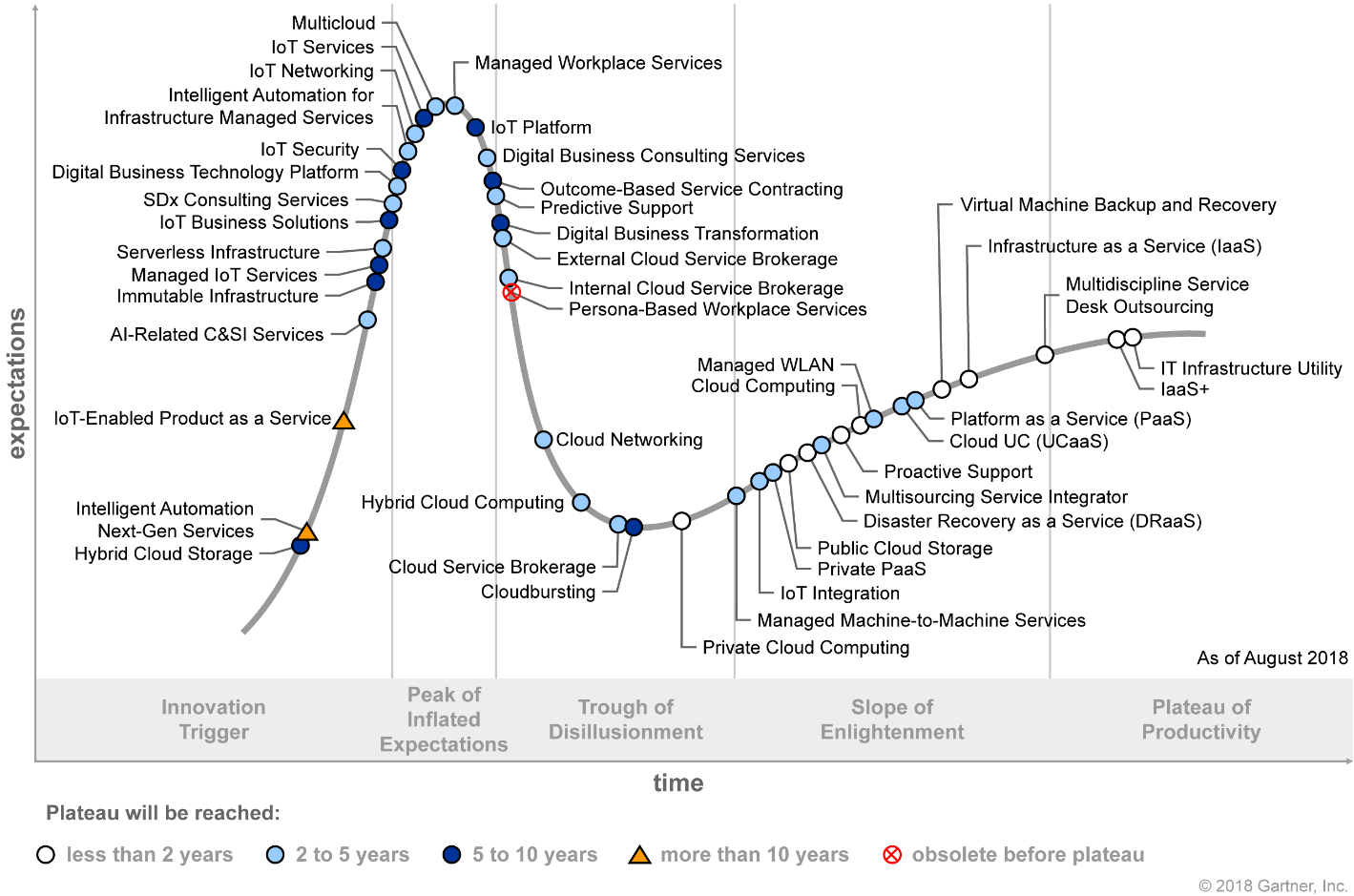
Source: Gartner (August 2018)
The Priority Matrix
The Priority Matrix is a companion to the 2018 Hype Cycle for hybrid infrastructure services. The Priority Matrix maps the benefits of each service by time to maturity (years to mainstream adoption) in an easy-to-read grid format. It is a useful method of visualizing the potential benefits associated with different service offerings.
The industrialization of the infrastructure service and IT outsourcing market continues. An increasing amount of revenue is shifting from traditional outsourcing delivery toward cloud-based services of all kinds – from unified communications as a service (UCaaS) to disaster recovery as a service (DRaaS). The infrastructure layer is a pivotal element of change for IT: First, although it is considered a mature area, there is room for efficiency gains, such as through centralization, standardization, virtualization and automation. Second, in addition to being an area targeted for efficiency gains, it is also targeted as an area for straight-out savings, such as with maintenance and support of IT infrastructure.
Users of this Hype Cycle should understand the maturity and availability of particular service offerings. Especially with some services in the Innovation Trigger phase, there can be variability from country to country, as well as among providers. Organizations should always invest time to understand fully the details and attributes of any service offering, because different service providers use different terminology to describe seemingly similar services. A detailed examination of global availability, SLAs, pricing and payment terms is a necessity. It is also important to consider that the sourcing management maturity of organizations and the capacity to manage end-user demand and related emerging solutions vary.
Here is an overview of the Priority Matrix:
- Less than two years to mainstream adoption – Twenty-three percent of the innovation profiles included in this Hype Cycle are less than two years to mainstream adoption. Cloud computing, infrastructure as a service (IaaS), IT infrastructure utility, private cloud computing, public cloud storage, DRaaS, virtual machine backup and recovery, IaaS+, multidiscipline service desk outsourcing, and proactive support all have less than two years to mainstream adoption. The only service that is transformational with less than two years to mainstream adoption is cloud computing. IaaS, IT infrastructure utility, public cloud storage, private cloud computing, and virtual machine backup and recovery all have a high benefit rating.
- Two to five years to mainstream adoption – Fifty percent of the innovation profiles included in this Hype Cycle are two to five years from mainstream adoption. Six are expected to deliver transformational benefits: digital business consulting services, digital business technology platform, hybrid cloud computing, AI-related C&SI services, platform as a service (PaaS), and serverless infrastructure.
- Five to 10 years to mainstream adoption – Twenty-two percent of the innovation profiles included in this Hype Cycle are five to 10 years from adoption. Three are transformational: IoT business solutions, digital business transformation and outcome-based service contracting. Six are of high benefit: IoT security, IoT services, IoT platform, managed IoT services, hybrid cloud storage and cloudbursting. The only service with a moderate benefit that is five to 10 years away from adoption is immutable infrastructure.
- More than 10 years to mainstream adoption – Two of the services outlined in this Hype Cycle are more than 10 years to mainstream adoption – IoT-enabled product as a service and intelligent automation next-gen services.
- Obsolete before plateau – One service, persona-based workplace services, will be obsolete before the plateau. The reason is that, today, persona-based workplace services is beginning to be seen as not a service by itself, but part of managed workplace services and multidiscipline service desk.
Regardless of where a service resides on the Hype Cycle, organizations must carefully match their IT and operational requirements against the characteristics, benefits and availability of the various service offerings to ensure that, ultimately, their individual business needs are met. Organizations must consider the benefits/risks of traditional outsourcing services that are now off the Hype Cycle, such as data center outsourcing, desktop outsourcing and storage outsourcing, compared to newer-generation offerings, such as hybrid cloud storage and hybrid cloud computing.
Note: Cloud networking was not placed correctly on the 2017 Hype Cycle, which has been corrected on this year's Hype Cycle and reflects the current state for this innovation profile. Networking is a mature market; however, the applicability and need for networking as it pertains to cloud is a relatively new market.
Figure 2. Priority Matrix for Hybrid Infrastructure Services, 2018
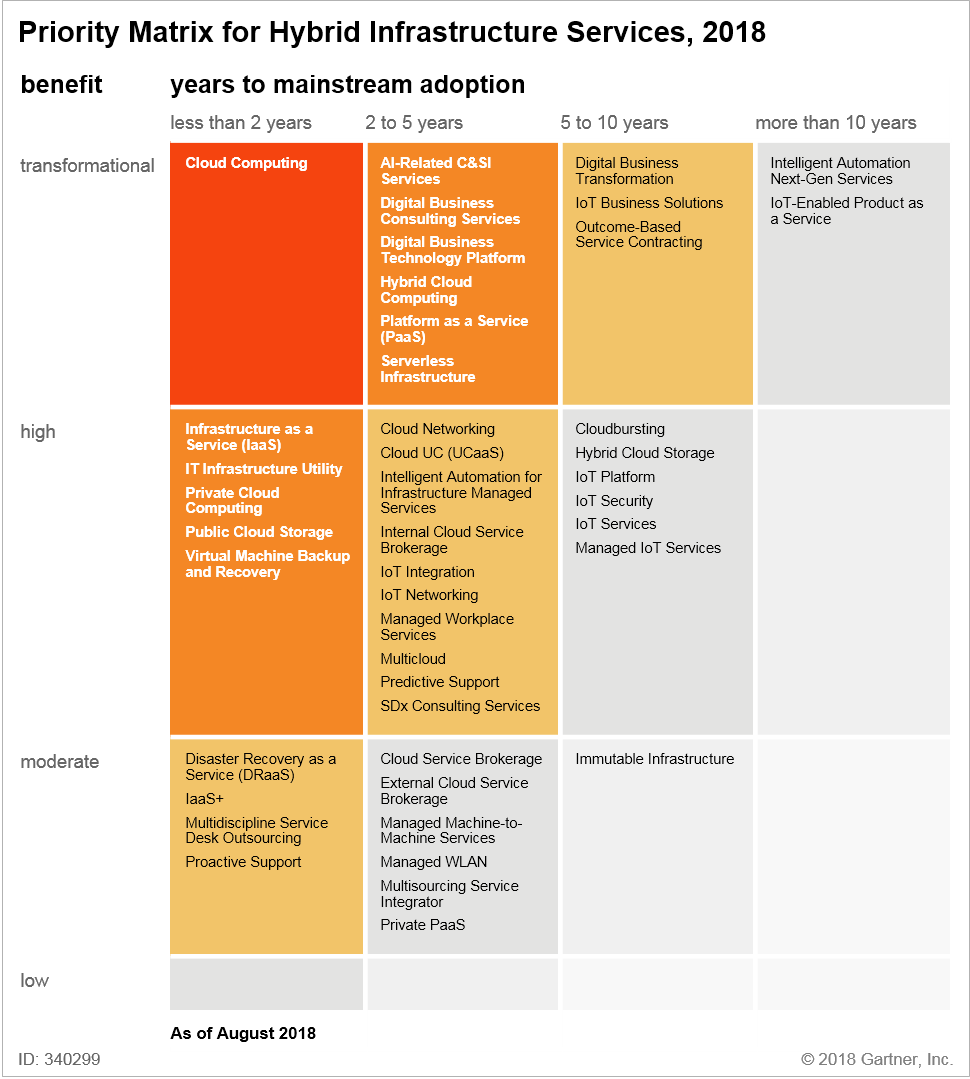
Source: Gartner (August 2018)
Off the Hype Cycle
- Hybrid unified communications and collaboration has been retired. It is no longer being used as a broad innovation profile because of nuances within specific unified communications technology (such as telephony, web/videoconferencing, group video systems and workstream collaboration tools).
- Proactive service desk has been absorbed into standard service desk offerings, and is no longer a distinct service offering on its own.
- Digital business has been removed from this Hype Cycle because of the focus on supply chain. Instead, the 2018 Hype Cycle includes digital business transformation.
- Cloud service brokerage via outsourcers and system integrators has been replaced by external cloud service brokerage.
On the Rise
Hybrid Cloud Storage
Analysis By: Raj Bala; Julia Palmer
Definition: Hybrid cloud storage encompasses a number of deployment patterns with varying underlying technologies. It can take the form of purpose-built hybrid cloud storage appliances, broader storage systems with hybrid cloud features or the use of storage technologies from within colocation facilities that are connected by private network link to cloud service providers. The common thread among the varying patterns is the notion of a seamless bridge between disparate data centers and public cloud storage services.
Position and Adoption Speed Justification: The term "hybrid cloud storage" was first used in 2009 by vendors in the cloud storage gateway segment to describe their nascent offerings. Those early hybrid cloud products treated public cloud storage as an archive tier for infrequently used, low-value data. But the current market for hybrid cloud storage has moved well past the early products in the cloud storage gateway market. Hybrid cloud storage is now being used for modern workloads that transform data using the elasticity that public cloud compute provides. These workloads typically start off as large, bulky datasets that require transformation to a smaller result. Examples include videos and a broad range of analytics-oriented data. In the case of videos, artifacts of a video are collected over time and then rendered into a final result using the compute capabilities of public cloud IaaS providers.
User Advice: Evaluate vendors of hybrid cloud storage across two imperatives: tactical and strategic uses. The tactical approach include uses such as tiering data to the cloud. The strategic approach includes using public cloud compute services to transform data into usable results. Most vendors focused on tactical use cases are unable to provide the strategic, transformational capabilities that are emerging in the market.
Business Impact: Tactical uses of hybrid cloud storage have been available for nearly a decade. These solutions are often designed such that data is not easily readable in the public cloud due to opaque storage formats used by vendors. As a result, these methods limit the full breadth of functionality that can be unlocked in the cloud.
The strategic uses of hybrid cloud storage are often developed with modern approaches in mind. As such, vendors have taken care to ensure that data can not only be read in the public cloud, but that data can be modified and synchronized back to its source. This end-to-end capability requires that providers of hybrid cloud storage solutions integrate deeply with the cloud service provider in a manner that far exceeds the functionality required to simply tier to the cloud.
Benefit Rating: High
Market Penetration: 1% to 5% of target audience
Maturity: Embryonic
Sample Vendors: Amazon Web Services; Microsoft Azure; Nasuni; NetApp; Panzura; Peer Software; Qumulo; SwiftStack
Intelligent Automation Next-Gen Services
Analysis By: Frances Karamouzis
Definition: Intelligent automation next-generation services are offerings that bundle (package) together products, services and intellectual property within specific-outcome-based commercial terms. These offerings may involve multiple parties (that is, vendors, product companies, commercial enterprises or investors) in some type of ecosystem structure. A critical element is that higher-order (more sophisticated) intelligent automation technology is the core enabler of the value proposition (that is, the underlying business and/or technology platform).
Position and Adoption Speed Justification: Intelligent automation technologies spending (and venture capital) has continued to grow at a feverish pace. Additionally, a large number of clients have dabbled with proofs of concepts or production systems, and therefore, this topic holds a top-five spot in Gartner inquiries. It has been estimated that more than $20 billion of intelligent automation technologies have already been purchased through more than 7,500 vendors. With a disparate marketplace and an array of solutions covering different industries, business and process focuses and general market forces around demand and supply have given rise to the formation of ecosystems. All types of vendors (services, software and newcomers) are teaming up with ecosystem partners to develop platforms for IA next-gen services (embedding intelligence into them). Today, these next-gen offerings are still nascent, hence the 5% post-trigger position.
Furthermore, the associated services' revenue is often several multiples (three times to 10 times) of the software spend. The cumulative effect of these market forces (commercial availability, adoption, head count decline and vendor investments) has given rise to intelligent automation next-gen services. These services may include one or more of the following:
- Help clients ideate use cases
- Design business or IT processes
- Select technologies
- Curate data
- Build and train models
- Deploy solutions
- Assess and mitigate risks
- Manage and operate the ongoing solutions
- Adapt talent mix and processes to successfully incorporate new AI solutions
The impact of this kind of a shift in the marketplace is one of several contributing factors that have led to the obsolescence of labor arbitrage as a primary strategy for competitive advantage. Some indicators of this include year-over-year decline in the overall head count of leading service providers combined with the investment in talent reskilling.
User Advice: Define and engage multidisciplinary teams within the enterprise (including but not limited to business unit leaders, EA teams, IT and sourcing teams) for the following:
- Proactively execute proof of concepts, and engage in fast-failure initiatives that yield learning and stakeholder impact.
- Emphasize internal transparency, knowledge sharing and early governance and structure to build the foundation and connective tissue for embracing the human workforce enabled by intelligent automation.
- Develop the tenets for adoption and variables required to scale.
The levels of complexity and diversity (breadth and depth of business processes) – and, most importantly, the difficultly of buyers to imagine or reimagine how to utilize and adopt these offerings to transform business processes – have proved difficult and expensive. (There is over $1 million for proofs of concept on the lower end of the range). Therefore, the adoption levels are relatively low, and commercial terms represent uncharted territory and are, as such, lengthy to negotiate. Buyers should be actively investigating intelligent automation next-gen services by forming multidisciplinary teams that include business unit personnel, enterprise architects, and IT and sourcing personnel. The teams need to review business processes, establish key performance indicators and launch potential executive-sponsored initiatives that have highly aligned business mandates. All endeavors should involve ideation workshops and proof of concept (POC) phases in order to determine the offering's ability to impact key performance indicators for specific business outcomes. This will often involve direct impact on either incremental or complete re-creation of knowledge-worker functions.
Business Impact: Intelligent automation next-gen services leverage higher-order (more sophisticated) AI technologies. They do not simply tabulate and calculate based on preconfigured business rules or a defined set of circumstances. Instead, they can be invoked, or can take action, based on dynamic sets of business- or IT-triggering events. These offerings address complex situations, characterized by ambiguity and uncertainty. In dynamic, information-rich and shifting situations, data tends to change frequently and is often conflicting. The goal is to continue to evolve, learn dynamically and solve problems with the level of fluidity inherent in business and IT processes.
To respond to the fluid nature of business and IT processes, intelligent automation next-gen services offer a synthesis of not just information sources, but also influences, contexts and insights from human and nonhuman sources. The business benefits are projected to be very high because the focus is on transforming business models for new revenue of increased profitability – assuming the right fit and approach. It's also important to understand the human and social impact of the offerings. The growth of these offerings will have significant impacts over a multiyear period as they give rise to new business models, operating structures and an addressable market for enterprise buyers.
Benefit Rating: Transformational
Market Penetration: 1% to 5% of target audience
Maturity: Embryonic
Sample Vendors: Accenture; Deloitte; GE Intelligent Platforms; IBM; Infosys; IPsoft; Tata Consultancy Services; Wipro
IoT-Enabled Product as a Service
Analysis By: Eric Goodness; Benoit J. Lheureux
Definition: IoT-enabled product as a service is a sourcing model where businesses acquire operational assets as recurring operating charges. Acquisition is based on structured agreements defining asset fitness for purpose, performance, availability and ultimately specific outcomes. Embedded IoT technologies, common IoT design patterns and industry frameworks provide users, manufacturers and financial intermediaries the data required to ensure asset effectiveness and availability, and to mediate concerns and remedies for nonperformance.
Position and Adoption Speed Justification: Examples of traditional leasing (such as for autos and industrial equipment) are well-established in select industries, However, the adoption of IoT-enabled product as a service, based on the true spirit of "as-a-service" where fee structures are utilization-based, across many industries and use cases is nascent.
To implement IoT-enabled product as a service, manufacturers, certified distributors-resellers and service providers, must apply IoT innovation to create connected products. Embedded technologies enable remote product state monitoring, control and optimization, release and change management for features updates and security patches. Connected products are integrated with back-end business applications to optimize support. For example, connected products are integrated to automate the procurement of consumables and spare parts or with field service management so they can schedule repair without intermediaries at the customer site or within the manufacturer.
A technical driver for IoT-enabled product as a service is that all the technologies needed to implement such a business model – including IoT platforms, data storage, analytics and cloud service delivery – are readily available. A commercial driver for IoT-enabled product as a service is the strong overall business trend to shift business costs from asset ownership and capital expenditure (capex) to asset subscription and operational expenditure (opex). Technical inhibitors to adoption of IoT-enabled product as a service include the complexity of end-to-end IoT business solutions and specific technical challenges, such as device management, security, integration and information management. Key commercial inhibitors include the relatively immature IoT-enabled product-as-a-service business model, challenging SLAs, outage penalties and access to managed assets.
User Advice: IoT-enabled product as a service has great potential for transforming how manufacturers offer their products and services, and how companies consume them. A good implementation of IoT-enabled product as a service means having a proven end-to-end IoT device to back-end application distributed architecture that supports a proven IoT-enabled product-as-a-service business model based on reliable outcomes with predictable SLAs for a reasonable cost. Such an implementation requires a provider's careful design, business acumen, good execution and sustained attention to detail.
Companies that are considering IoT-enabled product as a service should consider the following recommendations:
- Perform your own multiyear total-cost-of-ownership analysis to validate the benefits of IoT-enabled product as a service.
- Update business processes to take advantage of IoT-enabled insights or benefits, such as personnel scheduling or supply chain for predictive maintenance.
- Reconcile whether aggressive time-to-deployment requirements are achievable with internal resources, and if not, whether help (such as via a system integrator) is required.
- Negotiate agreements that clearly establish mutually agreed SLAs and OLAs for IoT-enabled product-as-a-service performance and reliability.
- Factor in all nonrecurring and recurring charges, terms of agreement and penalties into your IoT-enabled product-as-a-service business model.
- Secure the rights to IoT-enabled product-as-a-service data, including mutual agreements on exactly which data and the methods for accessing it.
- Consider IoT-enabled product as a service for more standard, expected product outcomes and realize that offerings are still relatively immature.
- Ask for end-user IoT-enabled product-as-a-service references – then speak to them before engaging with external providers.
Business Impact: Potential benefits of IoT-enabled product as a service for customers (i.e., end users) include:
- Shift asset acquisition from capex- to opex-based subscriptions.
- Leverage of economies-of-scale innovation investments by the manufacturers/providers.
- Mitigate risks for asset selection and procurement by transferring responsibility for IoT-enabled product-as-a-service outcomes, innovation and upgrades to the manufacturer.
- Potential faster time to deployment and asset benefits (assuming your IoT-enabled product-as-a-service provider can deploy faster than you).
Potential challenges include:
- Reliance on a manufacturer's investments to modernize IoT-enabled product-as-a-service offerings.
- Potential commercial and technical challenges for accessing IoT-enabled product data.
- Integrating IoT-enabled product-as-a-service solutions with your back-end applications and data
- Integrating heterogeneous IoT-enabled product-as-a-service offerings from multiple providers.
- Potential disruptions of IoT-enabled product-as-a-service offerings that become commercial failures.
Benefit Rating: Transformational
Market Penetration: 1% to 5% of target audience
Maturity: Emerging
Sample Vendors: Bosch Software Innovations; Caterpillar; Danfoss; GE Digital; Michelin; Philips Healthcare; Xylem
AI-Related C&SI Services
Analysis By: Susan Tan
Definition: Artificial intelligence (AI)-related consulting and system integration (C&SI) services are a subset of intelligent automation services. They help clients ideate use cases, design business or IT processes, select technologies, curate data, build and train models, deploy solutions, assess and mitigate risks, and adapt talent mix to successfully incorporate intelligent solutions. Intelligent solutions must involve one or more advanced technologies, such as machine learning, deep learning and natural-language processing.
Position and Adoption Speed Justification: Organizational buyers are engaging service providers to explore the inclusion of AI in solutions. A large majority of these engagements (68% according to a survey of 24 service providers) are in ideation, exploration and proof-of-concept. To accelerate time-to-value, service providers are using rapid, phased approaches, platforms and prebuilt assets and/or pretrained models to deliver intelligent solutions.
While the market is emerging, many leading SIs are already working with their clients on intelligent solutions, often including AI with other more proven technologies. Their track record has proven success using AI to achieve targeted business outcomes such as increased productivity, increased consistency, reduction in error rates and improvement in customer retention and revenue. This should improve the confidence of other clients using such services and lead to higher adoption in the next two to three years.
However, obstacles to organizations adopting AI-related C&SI services at this stage include:
- The technology is new and some aspects – for example, security, privacy, risks, liabilities – are still unknown.
- Limited understanding of the capability, limitations and implications of AI.
- Lack of internal skills and competencies to initiate an AI program and roadmap.
- Availability of ready-to-use data for training AI, long lead time for training AI and lack of process standardization and documentation.
- Limited understanding of how to scale and integrate AI into existing systems and workflows.
- Fear of the impact of intelligent solutions on jobs and tasks.
Due to limited internal capabilities, when organizations are ready to apply AI, a high-proportion turn to service providers for consulting and implementation.
User Advice: Clients looking to engage AI-related C&SI service providers should:
- Use a "start small, achieve benefits, then scale up" approach by focusing on a narrow domain use case and the associated business outcomes where AI approaches can add value beyond traditional techniques.
- Contract a time-boxed engagement for service providers to help build a minimum viable product or automate defined tasks in a single knowledge domain to make training the AI faster and reaping the benefits quicker.
- Avoid "moonshot" projects that take years of training and validation, unless it results in the potential to disrupt an entire industry or bring disproportionate competitive advantage as a consequence. In this case, ensure you have contract terms that prevent service providers from divulging such intellectual property (IP) to competitors and ensure you have executive commitment at the highest level.
- Engage service providers to help you understand the impact of AI on your organization's processes and workforce. Additionally, take steps to mitigate risks, institute change management and apply responsible AI ethics such as avoiding bias and unintended consequences, and developing AI systems that are secure, transparent and explainable.
- Favor service providers that have invested in building AI-leveraged or pretrained solutions, such as AI-infused predictive maintenance for your industry.
- Decide what data and IP you need to protect explicitly in contracts to avoid service providers using them in their solutions for other clients.
- Ensure service providers bring the right mix of interdisciplinary consultants with relevant experience, including technical, domain and industry/process knowledge, while understanding that the newness of the technologies means few have direct AI solutioning experience.
- Get references and discuss with them how their implementation went and the areas they did not anticipate to avoid repeating the same mistakes.
Business Impact: AI-related C&SI services can be applied to any business process or model. A recent Gartner study found organizations are deploying the following use cases:
- Predictive analytics: Providing insights, detecting anomalies, providing personalization, predicting likely events by using learning systems that use data mining and pattern recognition across large amounts of data.
- Automating tasks and replacing human judgment using a combination of AI and RPA. An example of a business process optimization use case is the use of intelligent search which can summarize contract data. In this way, intelligent technology ingests structured and unstructured data, extracts relevant key clauses in contracts and policies that requires attention, shrinking the amount of text to be read and enables employees to concentrate their time on relevant clauses.
- Chatbots or virtual agents that use text or voice to communicate with users in natural language to scale call centers quickly and have more compelling personalized conversations, often in multiple languages.
- Products with embedded sensors and AI technologies to make them smarter so they learn about their environments.
- Mechanical equipment such as drones and robots with AI that can perform tasks in dangerous or remote environments, and/or learn from its environment and its experience to perform better.
Benefit Rating: Transformational
Market Penetration: 5% to 20% of target audience
Maturity: Emerging
Sample Vendors: Accenture; Atos; Deloitte; EPAM; Fujitsu; IBM; Infosys; Luxoft Holding; Mindtree; PwC
Immutable Infrastructure
Analysis By: Lydia Leong
Definition: Immutable infrastructure is an architectural pattern in which the system and application infrastructure, once instantiated, is never updated in-place. Instead, when changes are required, the infrastructure is simply replaced. Immutable infrastructure could encompass the entire application stack, in-versioned templates provisioned using API-enabled infrastructure capabilities, which are most commonly available in cloud infrastructure as a service (IaaS) or platform as a service (PaaS).
Position and Adoption Speed Justification: Immutable infrastructure is typically used by organizations that take a DevOps approach to managing cloud IaaS or PaaS; however, it can be used in any environment that supports "infrastructure as code." It represents a significant change in process for traditional infrastructure and operations (I&O) organizations. It may be instantiated using native cloud capabilities, such as Amazon Web Services' CloudFormation or Microsoft Azure's Resource Manager templates; cloud management platforms (CMPs), such as RightScale; software tools, such as HashiCorp's Terraform; or the customer's own automation scripts.
Some or all of an application stack will be instantiated, often in the form of VM images combined with continuous configuration automation (CCA) tools – such as Ansible, Chef or Puppet – that run after the initial boot of the VM. However, in environments that use OS containers, containers may be quickly replaced, whereas VMs remain constant. Containers improve the practicality of implementing immutable infrastructure and will drive greater adoption in cloud, as well as noncloud, environments.
User Advice: Immutable infrastructure is used to ensure that system and application infrastructure is accurately deployed and remains in a known-good-configuration state. It can simplify change management, support faster and safer upgrades, reduce operational errors, improve security, and simplify troubleshooting. It can also enable rapid replication of environments for disaster recovery, geographic redundancy or testing.
The application stack for immutable infrastructure is typically composed of layered components, each of which should be independently versioned and replaceable. The base OS for the stack may be updated using traditional patching tools, or automatically or manually updated. Automation is then used to bundle components into artifacts suitable for atomic deployment – for example, a tool such as HashiCorp's Packer may be used to create VM images, or Docker may be used to manage container images. However, immutable infrastructure typically consists of more than just compute infrastructure. Storage, network and other resources are also provisioned as part of the atomic deployment. The scripts, recipes, and other code used for this purpose should be treated similarly to the application source code itself; this requires appropriate software engineering discipline.
Some organizations that use immutable infrastructure will reprovision only when a change is made, whereas others automatically refresh the infrastructure at frequent intervals to eliminate configuration drift or the possibility of advanced persistent threats. Frequent refresh is only practical in environments with fast and reliable provisioning; thus, it benefits strongly from containers.
The use of immutable infrastructure requires strict operational discipline. IT administrators should eliminate the habit of making one-off or ad hoc modifications in order to avoid configuration drift. Updates must be made to the individual components, versioned in a source-code-control repository, then redeployed so that everything is entirely consistent. No software, including the OS, is ever patched "live." Organizations that use immutable infrastructure may turn off all normal administrative access to instantiated compute resources – for example, not permitting Secure Shell (SSH) or Remote Desktop Protocol (RDP) access. IT leaders should set a hard date for when all new workloads will use immutable infrastructure if technically feasible; deadlines can be effective motivators of behavior change.
Business Impact: DevOps-oriented organizations that can instantiate infrastructure via automation – typically, in cloud IaaS, PaaS or container services – should strongly consider using immutable infrastructure for continuous delivery environments. It is even more vital for continuous deployment environments. Organizations with high-security or regulatory compliance needs should also strongly consider adopting immutable infrastructure in order to continuously maintain consistent, compliant configurations without traditional patch management. Broadly, most organizations with environments that support "infrastructure as code" may be able to benefit from immutable infrastructure. IT organizations that adopt immutable infrastructure must adapt their application life cycle and operational processes around this architectural pattern. The success of immutable infrastructure depends on having the operational discipline to ensure that the infrastructure is truly immutable and disposable.
Benefit Rating: Moderate
Market Penetration: 1% to 5% of target audience
Maturity: Adolescent
Sample Vendors: Amazon Web Services; Fugue; HashiCorp; Microsoft; RightScale
Managed IoT Services
Analysis By: Denise Rueb
Definition: Managed IoT services are third-party services that support part or all of an end user's production IoT solution on an ongoing basis. Delivery of managed IoT services is enabled by cloud-based tools and skilled personnel observing structured processes in an operations center. These services may reside on the customer's premises, in a colocation facility, or within public and private clouds.
Position and Adoption Speed Justification: Managed IoT services integrates and aggregates a composite of technologies, including edge devices, platforms, integration points and analytics, to formulate business outcomes. The goal for managed IoT services is the optimization of service delivery through automated operational and administration activities that may require integration with other digital platforms like ERP or CRM.
Enterprises recognize the need to offload the management of their IoT solutions for a number of reasons, including the following:
- Cost reductions
- Access to skills they don't have
- Improved user experience
- Effective monitoring and management to guarantee a certain level of uptime, security and so on
Managed IoT services moved further toward the Peak of Inflated Expectations on the Hype Cycle. The move is based on the increase in IT-centric and IoT service providers now offering managed IoT services and the use case examples being shared with Gartner. For example, IT system integrators and communications service providers are offering managed IoT services, beyond the traditional machine-to-machine (M2M) providers.
User Advice: The use of managed IoT services can be complex in terms of service activities supported, pricing, the ecosystem involved and required expertise. IT leaders should apply the following before contracting managed IoT services:
1. Gain an understanding of what both basic and complex managed IoT service deals might entail:
- A basic managed IoT service deal may be a per-incident, at-will relationship to include passive threshold monitoring of IoT devices with event notification to a user's service desk. The event notifications may be accompanied by best-effort remediation, depending on service entitlements.
- A complex managed IoT service deal can be a multisourcing service integration agreement for the management of security, infrastructure, and instances across customer premises and cloud environments. Such deals may encompass the full ITIL "stack" of service operations management, including continual service improvement targets and agreements.
2. Align managed IoT service provider attributes and capabilities within your sourcing selection criteria, including foundational elements, such as:
- Expertise in creating and managing large, complex multisourcing agreements that span the management of technologies, service delivery, technology and business SLAs, and financial imperatives relating to IoT solutions
- Consulting for integrating IoT edge devices, IoT platforms and IoT data into enterprise applications
- Alignment of your key performance indicators (KPIs) with the SLAs of the managed services proposed.
Business Impact: The primary value for adopting IoT is often on internal cost reductions and operational efficiency. However, there is increasing demand for IoT-enabled "soft dollar" benefits, such as improved customer experience, new "connected" products and services, and value creation (for example, revenue and insights from data).
An enterprise deploys managed IoT services for the following key reasons:
- Substantially reduced time to value
- A cost-optimized solution with little or no capital expense
- Support for the IoT adoption strategies, as well as fulfillment of planned benefits and outcomes
- Access to providers that have expertise in IoT technology and development
- The ability to structure meaningful joint ventures across the continuum of value in the IoT stack
Benefit Rating: High
Market Penetration: 5% to 20% of target audience
Maturity: Early mainstream
Sample Vendors: Accenture; Atos; ClearObject; Fujitsu; HCL Technologies; Insight; Integron; Orange Business Services; Tata Consultancy Services; Wipro
Serverless Infrastructure
Analysis By: Arun Chandrasekaran
Definition: Serverless infrastructure is a model of IT service delivery – The underlying enabling resources are used as an opaque, virtually unlimited, shared pool that is continuously available without advance provisioning and priced in the units of the consumed IT service. The runtime environment consisting of all the necessary underlying resources (specifically the compute, storage, networking and language execution environment) required to execute a function are automatically provisioned and operated.
Position and Adoption Speed Justification: While the term serverless is actually a misnomer, it does transform how compute and associated resources are provisioned, operated and consumed. The provisioning and management of that server infrastructure is fundamentally abstracted from the consumer of the services. The key benefits of serverless infrastructure are:
- It supports running code without having to operate the underlying infrastructure (e.g., servers, storage and network resources) for it.
- It can enable easier horizontal scaling, due to the autoscaling properties of the back-end resources.
- When consumed in the public cloud IaaS, serverless frameworks are truly on-demand consumption because there are no idle resources or orphaned VMs or containers. If chosen for the right application, they can be a cost-effective means for using computing resources.
Serverless delivery of IT services has gained broad notice after Amazon popularized its Amazon Web Services (AWS) Lambda function platform as a service (fPaaS). Although some associate the notion of serverless exclusively with fPaaS, the significance of serverless, as seen by the leading vendors (including Amazon, Google and Microsoft), extends beyond functions. All PaaS capabilities can be delivered with serverless characteristics; some are already and most will in the future.
User Advice: Serverless infrastructure does not spell the end of traditional I&O roles. However, it will significantly change the way I&O roles operate. Although perhaps counterintuitive, serverless does require operations, but, instead of managing physical infrastructures, I&O leaders will increasingly have to adapt to new serverless realities by:
- Taking an application-centric view and understanding the interdependencies between application components, whether they are optimally designed to enhance scalability, reliability and performance.
- Including the cost implications of event-driven application architectures and the pricing models of different vendors to ensure cost governance and budget control when planning for serverless deployments.
- Revising data classification policies and controls to account for the fact that objects in a content store can now also represent code, as well as data.
- Rethinking IT operations from infrastructure management to application governance, with an emphasis on ensuring that security, monitoring, debugging and ensuring application SLAs are being met.
Business Impact: New application architectures, such as microservice patterns, are enabling unique competitive differentiation for companies that are able to rapidly scale their applications with the continuous deployment of software features, a high level of resiliency and more automation. The rise of these new application architectures has resulted in innovations at the computing layer, with new abstractions, such as serverless frameworks, which have emerged during the past few years. Serverless infrastructure, implemented on-premises or off-premises, enables applications to be quickly built and deployed at a large scale. As such, it is suitable for any customer or web-facing activity where speed of response and dynamic scalability is a concern. For variable workloads, serverless can be economical, compared with alternatives, due to its ability to provision and consume infrastructure resources only when they're needed. Exceptions such as workloads with heavy invocations can make API gateway costs high.
Serverless infrastructure is transformational in terms of flexibility and reduced operating costs, but demands substantial transformation management.
Benefit Rating: Transformational
Market Penetration: 1% to 5% of target audience
Maturity: Emerging
Sample Vendors: Amazon; Google; IBM; Joyent; Microsoft Azure; Oracle; Red Hat; Stackery
At the Peak
IoT Business Solutions
Analysis By: Benoit J. Lheureux
Definition: An IoT business solution is a mix of IT/OT assets, including IoT endpoints (i.e., IoT connected assets, products and equipment), at least one IoT platform, and various non-IoT back-end systems and data. Collectively, these technologies are seamlessly integrated to meet a digital business objective (e.g., asset optimization, product as a service). You don't buy an IoT business solution – you assemble it by investing in new IoT technologies, and integrating those with existing IT technologies and skills.
Position and Adoption Speed Justification: To date, most IoT projects are fairly limited in scope both technically and commercially, and their IoT value proposition is not fully understood or realized. One way companies will initially implement IoT is via a point solution that combines IoT endpoints with some form of IoT platform configured or customized to address one or more specific business needs, e.g., smart lighting or predictive maintenance. At times such point solutions may also include a specific related application, e.g., EAM. Regardless, to deliver more value and improve overall business operational intelligence, either of these IoT solutions must typically be integrated with multiple back-end systems and data (e.g., CRM, ERP, MES, FMS and BMS). For example, by using stand-alone IoT technologies to implement condition-based asset management, you can detect failures on valuable equipment before it occurs – which, alone, can be very helpful. However, you can deliver much more value to the business if you create an end-to-end IoT business solution. An example is a solution that integrates a point IoT solution directly with, for example, your procurement, field service and CRM applications to IoT events to automate spare part ordering, the scheduling of repairs and customer engagement. Key challenges to achieving these objectives include entrenched investments in legacy applications, insufficient clarity on what the complete IoT business solution should be, sophisticated integration skills and limited cross-organizational collaboration (e.g., IT versus OT).
User Advice:
- Keep your desired business outcomes in mind. While more limited IoT point solutions can often deliver some business value, more complete IoT business solutions will likely be necessary in the long run to fully achieve desired outcomes, such as optimizing operations (e.g., via condition-based maintenance) and implementing new business models (e.g., product as a service).
- Begin planning what your end-to-end IoT business solution should look like, clearly identifying which IoT-enabled business outcomes you desire, then use these needs as input into defining what IoT endpoints, IoT platforms, and back-end applications and systems will be involved, and prioritizing which IT disciplines and technologies (e.g., integration, data management, analytics and security) are essential for successful IoT projects.
- Commission an IoT center of excellence (COE) role to explore the potential business value of IoT solutions and their potential impact on existing business units and IT infrastructure and applications.
- Plan a phased approach that leverages bimodal IT to quickly capitalize and fully realize IoT project potential. Focus initially on a proof-of-concept approach and leverage bundled IoT solutions and outsourcing where available for some quick wins. However, also recognize that limited-scope IoT projects will likely require substantial investments to achieve their full potential as IoT business solutions, and IT must undergo a cultural transformation that focuses on leveraging IoT to help digitize core business processes.
- If you already have investments in one or more IoT platforms, plan to integrate these over time with various back-end systems, data and analytics to leverage IT competencies such as straight-through processing, end-to-end process visibility and improved operational intelligence.
Business Impact: The business benefits of IoT – such as condition-based product, equipment or asset management – are proliferating. But, the isolated deployment of IoT point solutions alone will not yield the full potential of IoT. Improved ROI will occur when analytics and improved device control at the IoT device and platform levels are seamlessly integrated in an end-to-end fashion with business processes, data and analytics in various back-end applications and systems. For example, predictive maintenance can be improved by analyzing large volumes of historical maintenance data (such as average component life span), sensor-based real-time data (such as vibration) and external sources of information (such as weather). To reach the full potential of IoT, companies will need to implement end-to-end IoT solutions that combine the operational intelligence provided by IoT products with existing business applications and data.
Benefit Rating: Transformational
Market Penetration: 1% to 5% of target audience
Maturity: Emerging
Sample Vendors: Accenture; Ayla Networks; CGI; GE; Hewlett Packard Enterprise; NTT DATA; PTC (ThingWorx); SAP; Tata Consultancy Services; Tech Mahindra
SDx Consulting Services
Analysis By: Mark D. Ray; David Groombridge
Definition: Software-defined anything (SDx) consultancies provide expertise that enables the improved standards for infrastructure programmability and data center interoperability. Both of these are driven by automation inherent to cloud computing, DevOps and fast infrastructure provisioning. SDx consulting provides an architectural approach, roadmap and implementation capabilities for IT organizations that seek to achieve infrastructure agility.
Position and Adoption Speed Justification: The fundamental principle of an SDx architecture is the migration of IT services from hardware into software. By extracting services that were previously bound to hardware from a specific vendor, IT organizations can begin to leverage commodity hardware and software-only solutions, and take advantage of automated provisioning and policy-based orchestration.
SDx consulting is in the early stages of maturity and will change significantly over the next two to five years. Vendor-offered software-defined data center (SDDC) solutions as integrated, all-encompassing product offerings are emerging. They are gaining acceptance for specific workloads and environments, such as mobile and web applications interacting with systems of record. Most traditional data center outsourcing vendors have SDx consulting services; they can offer SDx as part of their data center modernization and cloud strategies, and have initiatives of their own underway.
Interoperability will be the biggest challenge to SDx's success, thus requiring expertise of a consultancy. APIs will become the "digital glue" for data center and hybrid interoperability: This API glue will allow SDx implementations to work with each other, and with other layers of infrastructure. Open APIs for SDDC functions will be required to enable full interoperability. However, we believe vendors will push proprietary APIs as a functionality differentiator. This will have a negative effect of vendor lock-in. It will also result in slower SDDC adoption, which will in turn inhibit development of interoperable standards. Another limitation of rapid adoption of SDx is that today, the SDDC APIs and underlying logic don't readily support public clouds and DevOps.
Vendor lock-in associated with APIs will remain a major stumbling block. This, combined with software lock-in due to API integration with applications and other infrastructure stacks, could lead to potential challenges in cost-effective licensing of software-defined solutions.
OpenStack adoption is on the rise, but has a way to go. In 2017, OpenStack adoption will be limited mainly to low-cost, low-risk use cases. The adoption of OpenStack platforms will increase significantly over the next two to three years as more mainstream vendors add support.
SDx consulting services will continue to see growth as organizations seek to achieve the potential cost savings and efficiencies promised from SDx. The SDx consultancies that achieve substantial growth will be those that have demonstrated the ability to deliver faster provisioning and integration with DevOps while circumventing the stumbling blocks.
User Advice:
- Engage with consultants or other types of solution providers to understand the state of the market and the potential benefits of employing SDx.
- Deploy SDx solutions for tactical gain and business advantage associated with speed and agility. Be cautious of implementing SDx initiatives driven solely by consultancies, system vendors and their go-to-market providers.
- Look for reuse of SDx skills between projects – initially for monitoring and high-level alerts – building up into more detailed recovery SLAs.
- Develop a documented cloud deployment and transition strategy to more effectively gauge the value of SDx for both Mode 1 and Mode 2 applications.
Business Impact: The migration of services from hardware-based implementations to software can deliver greater business value, agility, reduced complexity and automation. However, many of the software-defined product offerings still lack enterprise-class maturity, and more importantly, they lack interoperability between technology layers. By reducing operational complexity and enabling greater automation of processes, SDDC has the potential to significantly reduce both capital expenditure (capex) and operating expenditure (opex). This journey is not without its own complexity though. The use of a specialist consultancy to guide the design and implementation can reduce risk, and ensure that any operational and technical changes allow future developments to be integrated with ease. The growth of private and public cloud service providers is accelerating the growth of SDx, as most of these providers are investing in SD networks and SDDC, as well as providing ITaaS for hyperscale cloud service providers.
Benefit Rating: High
Market Penetration: 5% to 20% of target audience
Maturity: Adolescent
Sample Vendors: Accenture; Dell EMC; Dimension Data; DXC Technology; HCL Technologies; Hewlett Packard Enterprise; IBM; PwC; Tata Consultancy Services (TCS); Wipro
Digital Business Technology Platform
Analysis By: Bill Swanton
Definition: A digital business technology platform is the combination of technologies that enables an organization to participate in digital business ecosystems. It integrates existing platforms for IT, customer engagement, data and analytics, ecosystem partners and the Internet of Things to create new capabilities to detect business events, decide what to do, and implement a business response. Platforms share assets such as data, algorithms and transactions (both monetary and nonmonetary) with business ecosystems to match, create and exchange services.
Position and Adoption Speed Justification: Companies use a variety of new integration and cloud technologies to implement digital businesses technology platforms today. While digital native organizations are adept at these technologies, traditional companies often struggle with new architectural approaches, such as microservices architecture, event-driven architecture, and programmable infrastructure that are required for large-scale implementations and the rapid change in these technology markets.
Despite these challenges, we believe digital business technology platforms are moving rapidly to the Plateau of Productivity in two to five years because:
- Organizations are being driven to digital business to avoid disruption of their core businesses.
- Digital business technology platforms enable platform business models, which can create rapid market growth and potentially dominate industries.
- Regulatory requirements in some regions are requiring organizations to share business services through digital platforms. For example, PSD2 requires banks in the European Union to provide mandatory access to customer accounts for regulated third parties.
User Advice: ·Work with business leaders to identify likely use cases (sense, decide, act) needed to implement your digital business based on the strategy.
- Build out the digital business technology platform as needed to implement the initial digital use cases. The build out will take years and may require refactoring as the business scales and the technologies used mature. Given the limits most companies face on investment, the initial investment must be relatively small, with costs scaling with revenue, which precludes major upfront infrastructure and license costs.
- Work with technology and service providers to determine what digital technologies are needed to implement the use cases in a way that will scale to the level the strategy envisions. Most organizations do not yet have the skills to implement this technology so skills transfer needs to be part of any services contracts.
- Understand what APIs you might need to consume or provide to interact with customers and/or ecosystem partners inside or outside of the enterprise.
- Keep existing platforms loosely coupled by using techniques such as API mediation so you can modernize those platforms without disrupting your digital business build-out. Managing an inherently hybrid IT infrastructure for all these parts will be a major challenge.
Business Impact: DBTPs enables an enterprise to become a digital business. Without it, it will be much harder for an enterprise to gain the business benefits of digital business. They empower people, businesses and things to give, take or multiply value creation for the enterprise. Digital platforms will make it easier for new market entrants, startups, competitors and, eventually, smart machines to create and pursue new business opportunities. Traditional businesses will have to build a digital business technology platform to compete and/or participate in these new markets.
Benefit Rating: Transformational
Market Penetration: 5% to 20% of target audience
Maturity: Adolescent
IoT Security
Analysis By: Saniye Burcu Alaybeyi; Ruggero Contu; Barika L Pace
Definition: Internet of Things (IoT) security is part of digital security, and it addresses software, hardware, network and data protection for digital initiatives involving IoT. IoT security shares many of the same technologies and processes as IT, operational technology (OT) and physical security. IoT security controls create trust, as well as provide safe, reliable, private and resilient digital systems for digital business.
Position and Adoption Speed Justification: IoT security technologies and services are progressing rapidly and reflect the changes seen on the Hype Cycle from 2017. Specific progress in areas such as digital trust, tamper-resistant device hardening techniques in hardware and firmware, secure cloud integration, device discovery, event detection and response systems, and improved consulting and system integration are contributing to this progress. New IoT security technologies continue to emerge primarily as part of existing IT, OT and physical security technology refreshes.
User Advice: Security and risk management leaders, including business executives, chief digital officers, chief risk officers, chief information security officers (CISOs) and CIOs, should:
- Assess integration points in their networks for IoT implementations
- Determine design gaps in capability, skills and infrastructure
- Assess risk exposure from IoT-related initiatives and the organization's security posture
- Record all IoT assets, from sensors to large industrial equipment, and create visibility into their IoT networks and topologies
- Analyze regulatory exposure to IoT security requirements
- Work on developing in-house IoT security expertise
- Become familiar with successful implementations in the verticals
- Assign enterprise ownership for IoT technologies that are not already claimed by a business unit
- Invest in digital risk management to properly plan for IoT security in digital transformation projects
- Change governance and oversight of IT and OT projects to accommodate specific digital risk concerns that lead to IoT security decisions
- Restructure skill sets and support resources (that is, organizational accountability and responsibility) to accommodate differences in deployment and operation of digital initiatives requiring secure IoT systems
- Incorporate regulatory compliance requirements for IoT technologies within existing IT, OT and physical security regulation tracking and management
Business Impact: High-profile cyberattacks can create compromises in verticals such as telecommunications, government, transportation, energy and utilities, and healthcare. Initiatives such as connected homes, smart cities, connected automobiles and medical devices are vulnerable as well. Cyberattacks have driven early IoT security spend in these verticals and initiatives. Growing attention and pressure from different layers of government may lead to potential regulation. The effects of cyberattacks also highlight the overlapping safety regulation and general safety management impacts of IoT security. In the short term, IoT security will continue to be the No. 1 barrier to entry to the IoT. In the longer term, these emerging security technologies will enable the IoT.
Benefit Rating: High
Market Penetration: 1% to 5% of target audience
Maturity: Emerging
Sample Vendors: Armis; CENTRI; CloudPost; ForeScout Technologies; Giesecke+Devrient; Infineon Technologies; Mocana; Prove & Run; Sentryo Intelligent Automation for Infrastructure Managed Services
Analysis By: David Groombridge; David Edward Ackerman
Definition: Intelligent automation (IA) for infrastructure managed services is the application of technologies, such as machine learning, virtual cognitive agents and natural-language processing, for the delivery of IT infrastructure operations.
Position and Adoption Speed Justification: Infrastructure service providers are investing millions of dollars in enhancing their automation capabilities with artificial intelligence (AI), to embed intelligent automation in their existing infrastructure services. Where service delivery relies on knowledge workers, these services will take over all or part of that work from humans. Examples of such services include service desk provision, where chatbots based on natural-language processing will handle standard user calls, and provisioning and management of infrastructure, where such services can learn and automate the required operational activities.
Adoption by enterprises is already underway. In its research into infrastructure services outsourcing, Gartner has found many major providers reporting the development of such capabilities to the point of including IA in RFP responses. However, penetration to client accounts still remains patchy, and the impact on pricing is minimal at this time. Nonetheless, many of the large providers have rolled out IA in the underlining infrastructure addressing optimization and monitoring. With the majority of large service providers making substantial investments in these services, they will evolve rapidly and become core parts of all infrastructure service offerings within a few years.
User Advice: Organizations buying infrastructure managed services expect their service providers to offer year-over-year savings during multiyear contracts. In the past, providers delivered this through industrialization of services and use of low-cost labor in a global delivery model. In the future, buyers should expect that savings will be achieved by "automation arbitrage," in which intelligent automation replaces a substantial part of the human labor. In comparing providers' offers, sourcing and vendor managers should evaluate the use of intelligent automation in infrastructure managed services by seeking concrete cost and quality commitments from service providers. With a length of time required to bed in the solutions, these benefits will often come after year one of the contract, with continued benefit improvement over three years.
The critical component needed to make intelligent automation work is a substantial and detailed data record. For infrastructure managed services, artificial intelligence systems will learn by reading and identifying patterns in logs of incident, change or other data from the recent past, and how each was addressed. Sourcing and vendor managers must prepare for the use of AI now by ensuring that such log data is contractually available to their organizations in the future, even if an external service provider currently maintains it. Furthermore, the contract must require such data to be comprehensive, clear and complete, not brief, terse or ambiguous.
Business Impact: Intelligent automation in infrastructure managed services offers multiple potential benefits. Gartner expects contracts containing intelligent automation to show annual cost savings of 15% to 25% for commodity services, depending on how many incidents it can resolve. Furthermore, it will be quicker to scale to new business demand by rapidly deploying new instances of intelligent automation instead of hiring new people, and the intelligent automation will not require annual pay rises or leave to work for competitors. The intelligent nature of the automation will generate capabilities for preventative maintenance and architecture actions, which help reduce system downtime and impact to users. This combination of rapid scaling, reduced business impact and repeatable quality that intelligent automation delivers, along with the ability to refocus remaining staff on more value-added business needs, will all help improve user satisfaction and SLA delivery.
Benefit Rating: High
Market Penetration: 5% to 20% of target audience
Maturity: Adolescent
Sample Vendors: Accenture; Atos; CGI; Cognizant; DXC Technology; HCL Technologies; IBM; Tata Consultancy Services; Tech Mahindra; Wipro
IoT Networking
Analysis By: Bill Menezes
Definition: Internet of Things (IoT) networking is the communications infrastructure to support IoT initiatives, specifically how "things" and the rest of their related platforms connect through the enterprise network. Wireless is a strategic technology component of most IoT projects, although the IoT network may connect fixed or mobile endpoints over a wide-area, local or short-range network.
Position and Adoption Speed Justification: As enterprise IoT initiatives move from strategic planning to implementation, identifying the network technology that will be most appropriate in terms of performance, cost and availability will be a critical factor in successful execution. Given Gartner forecasts that the global installed base of business IoT endpoints will surpass 9 billion by 2021, IoT networking is on the Hype Cycle as an Adolescent technology, which we expect will move quickly toward maturity. Enterprises typically design IoT architectures based on combinations of endpoints, gateways and cloud infrastructure, needing diverse network connectivity to help achieve the IoT deployment's targeted business outcome. Increasingly prevalent are IoT edge architectures serving as a decentralized extension of an IoT platform, and defining how data generated by sensors or other "things" gets aggregated and integrated at the edge of a cloud, data center or campus network. Connectivity among components of such an architecture – endpoint "things," gateways, controllers – is an essential element of such architectures.
IoT networking platforms range from the commercially available and mature to the relatively emerging, indicating rapid movement from Adolescence to Mainstream productivity.
User Advice: Whether the architecture focused on edge computing, cloud-based intelligence or distribution of intelligence to the deployed "things," there will be numerous options for connecting IoT devices, applications, storage and other components. Calculate the varying performance, total investment and operating costs of options. Examples include Ethernet LAN; wireless LAN based on such technologies as 802.11n/ac or ZigBee; 2G/3G/4G cellular, including low-power wide-area and LTE machine-type communications; and short-range PAN platforms such as Bluetooth, NFC and 802.1ad (each is suitable for cable replacement).
Wireless will be the primary connectivity medium because of its capability for rapid deployment of endpoints that are outside the reach of the wired LAN or WAN, its increasing network throughput and capacity, and the declining cost of network hardware. An IoT deployment might use existing enterprise networking infrastructure or separate, parallel infrastructure from a service provider.
Identify and assess IoT endpoint and application performance requirements. Score networking products and services based on:
- Throughput
- Network capacity
- Range and coverage
- Power consumption
- Security
- Quality of service (including latency)
- Reliability
- Cost, both capital expenditure and operating expenditure
Filter the network technologies based on availability and applicability to the project. Choose technology that is commercially available by the end of 2018. For example, LWPA cellular access technology, such as LTE Cat-M or Narrowband IoT, may be more appropriate and cost-effective than standard cellular network services for IoT endpoints running on low power and transmitting or receiving very small amounts of data. However, few cellular network providers offered the capability in multiple geographic regions as of 1H18.
Business Impact: Well-planned network connectivity is critical to the successful execution of an IoT initiative. IoT networking choices will impact the project's implementation and operating costs as well as its ability to achieve the initiative's targeted outcomes. Effective network choices also impact the level of flexibility in which architecture or, more likely, which combination of architectural components, the project can utilize. Accounting for the impact of the architecture – comprising the "thing" and the IoT platforms serving as the intermediaries with IT – on the enterprise network is critical for realizing opportunities IoT presents for cost optimization, product refinement and new revenue models. IoT projects, including headless devices (such as smart readers and sensors), will add a large number of new endpoints to the enterprise network, requiring efficient methods for registering, onboarding and management.
Benefit Rating: High
Market Penetration: 5% to 20% of target audience
Maturity: Adolescent
Sample Vendors: AT&T; Cisco; Hewlett Packard Enterprise (HPE); Sigfox; Verizon; Vodafone
IoT Services
Analysis By: Denise Rueb
Definition: IoT services represent professional services activities that provide both business and technical expertise in support of IoT planning and solution implementation. Various methods and assets, such as design thinking and use of intellectual property like vertical-specific solutions, are used to accelerate these IoT services. Note: IoT services might not be specifically labeled as such by the provider or not perceived primarily as IoT services by some buyers – for example, IoT services could be related to digital product design.
Position and Adoption Speed Justification: Technology proliferation continues across the IoT value chain – from the edge to business insights. As such, enterprises are challenged and lack sufficient internal resources skilled in IoT technology and solution implementation. In the 2017 Gartner IoT Strategies Survey, approximately 59% of respondents indicated they use external IoT services to some extent in support of IoT project implementation efforts.
There also continues to be a broad mix of providers offering a range of IoT services – from advisory consulting to product support services. This mix of providers and offerings will be challenging for buyers seeking to prioritize and identify the right IoT service provider. IoT services moved slightly on the Hype Cycle toward the Peak of Inflated Expectations. Providers are gaining further IoT service expertise through increased IoT engagements that have moved from POCs into production solutions, formalizing their IoT service practices to include industry-specific solution offers, and filling IoT skill and expertise gaps through formal partnerships.
User Advice: Take steps now for your IoT service prioritization and provider selection process:
- Develop a business-focused IoT framework, including vision, readiness assessment, a prioritized IoT solution rollout plan and a set of measurement metrics. Based on this framework, define the necessary IoT service requirements across the IoT projects identifying when to contract with an IoT service provider.
- Think beyond traditional IT services when selecting an IoT service provider. IoT is a hybrid of technology, combining multiple capabilities across IT and business operations. Knowledge of the business use and the user in question are just as important as the technology with IoT projects. The need for building an adaptable organization that can apply IoT requires new thinking around IT/OT convergence, end-to-end application and data integration, as well as collaboration across people, processes and technologies.
- Enterprises are challenged to move IoT POCs to production solutions. We now see more IoT services focused on proof of value versus technology. Such offerings will better align business outcome or payback associated with the POC. Buyers should seek this value within their IoT service evaluation and selection process. Define and deploy a roadmap for moving service provider projects from POC to production.
- Educate the sourcing organization to understand the value of IoT service providers. Legacy vendor management approaches threaten to impede value recognition through nontraditional service models, such as revenue sharing and contingent-fee contracts. Include metrics to measure the success of the service provider.
Business Impact: IoT enables business transformation across all industries. It supports both internal and external business outcomes, including operational efficiency, cost savings, improved customer experience and new revenue opportunities. Buyers seek IoT services to support this transformational focus with demonstrable business outcome. However, the challenge is twofold: understanding what IoT services are required and identifying the provider that offers the best fit set of IoT services.
- Enterprises must assess their internal IoT service expertise to fully understand the gap. However, we see many today continue to think of it as business as usual when, in fact, IoT requires myriad skills – from the edge to the cloud – and data analytics.
- The IoT service market continues with a mix of providers, many of which claim they can provide end-to-end services. This is often not the case. Providers must bring industry-focused IoT assets/solutions that deploy IoT solutions with justifiable ROI.
Benefit Rating: High
Market Penetration: 5% to 20% of target audience
Maturity: Adolescent
Sample Vendors: Accenture; AT&T; Cognizant; EPAM Systems; EY; Hitachi; Infosys; NEC; SAP; Virtusa
Multicloud
Analysis By: David Mitchell Smith
Definition: Multicloud computing refers to the use of cloud services from multiple public cloud providers for the same purpose. It is a special case of hybrid cloud computing, which is a broader term.
Hybrid cloud refers to multiple cloud services from multiple providers. It does not specify the origin of those services, but in most cases a public source and a private source are involved. Hybrid cloud, as a broad term, is subject to more hype and confusion and is more common.
Position and Adoption Speed Justification: Multicloud computing can be planned or can evolve due to multiple groups in an organization making decisions to procure multiple services from different providers. An example of this is when multiple cloud providers are used as part of a high availability or redundancy or exit strategy in a planned manner. Multicloud is much more common in IaaS (and converged IaaS/PaaS) scenarios than SaaS. While it is possible for multi-SaaS environments in an organization, these would typically be stovepiped types of situations. Multicloud does not include very common situations such as using Amazon Web Services (AWS) for IaaS and Microsoft Office 365 for cloud office SaaS.
Multicloud computing can provide advantages of lowering the risk of cloud provider lock-in and can specify functional requirements that a business unit may have. It can also provide service resiliency and migration opportunities, in addition to the core cloud benefits of agility, scalability and elasticity.
As with many cloud-related concepts, there are many variations in real-world use and scope. In this case, there are "multicloud strategies" that entail the various goals (e.g., exit strategy, portability, use of multiple providers – but don't specify details) and "multicloud solutions" (which rely on architectural principles and specific implementation details).
User Advice: When using multiple cloud computing services, establish security, management, governance guidelines and standards to manage cloud service sprawl and increasing cost, and develop decision criteria to decide placement of services. Multicloud implementations will need coordination and strategy across the enterprise to identify the type of services needed and deliver the benefits of a cloud environment. IT organizations will also need training, skilled engineers, and be prepared for the additional expense. Use of a cloud management platform (CMP) and/or a cloud service brokerage (CSB) in a multicloud environment can enable organizations to implement governance and optimizations. However, care must be taken to not just shift vendor lock-in to a CMP or CSB vendor.
Business Impact: Multicloud provides an organization with agility and the potential of some target cost optimization opportunities. It also provides a basis to lower cloud provider lock-in and increase workload migration opportunity.
Benefit Rating: High
Market Penetration: 1% to 5% of target audience
Maturity: Adolescent
Sample Vendors: Amazon; Google; IBM; Microsoft; Oracle
Managed Workplace Services
Analysis By: Daniel Barros
Definition: Gartner defines managed workplace services (MWS) as a subset of the IT outsourcing (ITO) market. MWS includes traditional end-user outsourcing (EUO) services, such as service desk, desktop/laptop/mobile device support and new digital workplace services that provide cloud-first, automated and integrated experiences to end users. MWS implements digital workplace to leverage employees' digital dexterity in the development of digital business services by boosting employee engagement and agility through a more consumerized work environment.
Position and Adoption Speed Justification: Managed workplace services are in their adolescence as holistic and integrated services to support the client's digital workplace strategy. They often include transformation delivered as professional services to implement key components of a digital workplace, such as intelligent automation, universal access to a workplace environment and flexible device support (walk-up support, self-service kiosks, smart lockers and IT vending machines). The objective is to provide a flexible end-user environment that supports the organization's digital business initiatives.
Most providers in this market have embedded, to some extent, automation (robotic process automation [RPA] and/or AI-based automation [intelligent automation]), self-service, peer-to-peer support, persona-based support and workplace analytics to improve support effectiveness and resource efficiency. However, in many cases, such services are focused on the provider's internal efficiencies. In these cases, they do not focus on boosting the employee's engagement and agility through a more consumerized work environment to support the organization's business strategy, which is the core of a digital workplace strategy.
User Advice: Client organizations sourcing MWS must be diligent in understanding what is hype and what is real in this market. It is important to reach out to references that have previously implemented such services to inquire about which results were effectively achieved. Gartner clients can use Peer Connect and Peer Insights to get other clients' feedback from service providers' MWS. If no such references exist, and the client decides to pioneer a service, then conduct a proof-of-concept project to assess what is possible. Consider a shorter-term deal with balanced risk-and-reward price models based on outcomes achieved over time.
Even for more mature MWS (that is, self-service or persona-based support), it is important to include expected outcomes from implementing new service models to support the organizations digital workplace strategy. Traditional end-user SLAs, such as first-call resolution and number of contacts per user ratio, are not as effective for MWS, because automation, peer-to-peer support and self-service seek to eliminate the number of contacts with human agents. The pricing throughout the contract's life cycle must reflect the results of efficiencies gained with self-service, peer-to-peer support and automation, and the SLAs are a measurement of the efficiencies gained and customer satisfaction.
There are many obstacles to effective implementation of MWS. The biggest from a buyer perspective is the excessive hype about "artificial intelligence" or "cognitive computing" that makes it difficult for client organizations to differentiate what results can be realistically achieved in their environment during the contractual term. From the seller perspective, it is the continuous investment in research, the competitive environment to reduce costs and development to make analytics and machine learning services more effective. Also important is how to address the labor displacement that will come with increased levels of intelligent automation.
Business Impact: Most organizations are being challenged to expand their digital services and products, and are challenged to acquire and retain the skills necessary for digital business transformation. To succeed in digital business, organizations must transform their workplace experience to make it more digital, flexible and consumerized. MWS must take a user and business-centric approach to the end-user workplace experience to increase employee engagement and discretionary effort to support the development of digital business.
Benefit Rating: High
Market Penetration: 5% to 20% of target audience
Maturity: Adolescent
Sample Vendors: Atos; Cognizant; CompuCom; DXC Technology; Genpact; HCL Technologies; NTT Data; Tata Consultancy Services (TCS); Unisys; Wipro
IoT Platform
Analysis By: Alfonso Velosa; Eric Goodness; Benoit J. Lheureux
Definition: An Internet of Things (IoT) platform is software that enables development, deployment and management of solutions that connect to and capture data from IoT endpoints. It is a suite of functional capabilities:
- Device management
- Integration
- Data management
- Analytics
- Application enablement
- Security
It may be delivered as a hybrid combination of edge software platform and/or cloud IoT platform as a service.
Position and Adoption Speed Justification: Enterprises continue to add IoT capabilities to assets and products, seeking benefits such as asset optimization, better interactions with customers, and new business opportunities such as product as a service. The sophistication, scale and business value of these interactions call for specialized technology resources, resulting in the IoT platform. The IoT platform may be deployed in a hybrid cloud or edge fashion to meet technical or business objectives. The edge software is further distributed between the endpoints and gateways.
Continued vendor hype, along with culture, schedule, security and technical challenges for IoT projects, has pushed IoT platforms past the Peak of Inflated Expectations. 2018 sees many large vendors reorganizing their IoT businesses and evolving their offerings and market strategy. A further complication is the rise of embedded solutions by OEMs using them as part of existing business operations. These issues also lead us to push out the time to plateau to five to 10 years.
User Advice: CIOs should factor in the following for their IoT platform strategy:
- Project strategy: Identify the range of IoT projects for your enterprise, and segment them by their complexity and business objectives. This will help you establish a flexible, multivendor architecture. Start with smaller initiatives to build momentum, test business hypothesis and acquire implementation lessons, while limiting enterprise and career risk.
- Skills: IoT projects will require new capabilities for your organization. Build an IoT capabilities gap analysis, a skills migration plan, and training program for your developers and business analysts. In parallel, perform an assessment of IoT skill sets within your enterprise. Plan to leverage a service partner to ramp up as you train internal resources.
- Platform customization: Understand that an IoT platform is a starting point. No IoT platform will work straight off the shelf. Customize the platform to build a solution for your unique circumstances (for example, adding third-party security or device support or analytics to meet special needs).
- Vendor selection: Evaluate candidate IoT platforms in terms of their fit-to-your-business objectives and technology, but expect roadmaps to evolve quickly in the fast-changing IoT market. Key criteria will be vendor capabilities to scale from proofs of concept to operational-scale deployments, vertical market expertise, their partner ecosystem and customer references.
Business Impact: There is a significant opportunity from IoT-enabled business moments to achieve greater business value. This includes making better decisions from the insights, information and data that are generated by instrumented assets, and providing better control of things distributed across the enterprise and its external stakeholders. Unfortunately, this data has been largely locked in the assets – mostly due to lack of connectivity, but also because of lack of systems and governance processes to obtain and share this data systematically.
IoT platforms act as the intermediary between the "thing" and the IT and OT systems and the business processes. Therefore, they facilitate the introduction of a new potentially transformative wave of digital business innovation and digital transformation to enterprises. IoT platforms provide the middleware foundation to implement asset-centered business solutions – and are part of a broader technology solution to manage multiple IoT applications in an agile/flexible fashion.
Benefit Rating: High
Market Penetration: 5% to 20% of target audience
Maturity: Adolescent
Sample Vendors: ABB; Atos Origin; Bosch Software Innovations; GE Digital; LTI; OpenText; Prodea Systems; relayr; Software AG; WSO2
Digital Business Consulting Services
Analysis By: Chrissy Healey; Brendan Williams
Definition: Digital business consulting services (DBCS) are consulting services with the objective of generating increased business value by using digital technologies to optimize clients' operating models and/or transform business models.
It includes:
- Digital strategy and design
- Digital operations improvement
- Digital employee experience
- Digital customer experience
- Digital product and service enablement
- Digital business model transformation
Position and Adoption Speed Justification: Many businesses are experimenting with digital business, but relatively few have embarked upon full, top-to-bottom digital transformation initiatives. Adoption of DBCS is widespread, but also relatively shallow. While many businesses have launched digital business initiatives, especially in more mature areas of the market such as digital customer experience, these are still relatively small in scale. Fewer businesses have proceeded to the next step of scaling their pilot programs or POCs. Fewer still are exploiting the potential of digital technologies to transform the core of the business by radically rethinking their operating models. Up to this stage, growth in DBCS has been driven primarily by clients adopting digital for the first time. As the market for DBCS matures further, it will be driven more by existing clients scaling their DBCS initiatives and extending their DBCS activities across more of the six key DBCS service lines.
User Advice: Organizations in all industries and countries across the globe are seeking to take advantage of the opportunities and mitigate the risks presented by the shift to digital business. Over the past decade, consulting providers have responded to this rising demand with increasingly sophisticated offerings aimed at helping these organizations achieve their digital business ambitions, resulting in a large and growing market for DBCS.
After years of providers and other evangelists proclaiming that "digital is everything," the term "digital" has become so ubiquitous that it's at risk of losing its meaning completely. "Digital disruption" and "digital transformation" are two terms in particular where the hype has far outpaced the reality.
Only around 20% of CEOs think their digital business initiatives so far have been a success. Many have become disillusioned upon learning that digital transformation is a hard, long slog in practice. Digital technologies such as predictive analytics, intelligent automation, and the IoT have incredible potential, but are not magic solutions. Many clients are finding that implementing these technologies is harder in practice than they were led to believe. The hype surrounding the transformative technologies underpinning DBCS has served to obscure the reality. Success in DBCS still requires providers to be competent in fundamental business consulting capabilities, such as business process improvement, organizational design, and above all, cultural change.
Business Impact: DBCS engagements aim to innovate and optimize current business models and/or to create new business models for organizations and industries by focusing on the peer exchange of information between business, people and physical things as equal entities. DBCS buyers can be CEOs and boards of directors, but can also be CDOs, CMOs, CIOs, and lines of business leaders.
Current market penetration is from:
- New business with new clients (first time buyers of DBCS).
- New business in the same area with existing clients (e.g., scaling up a digital CX pilot).
- New business in a new area with existing clients (e.g., a client started only in digital CX, but now has initiatives in multiple service areas – potentially all six. These may or may not be part of a larger companywide transformation initiative).
The primary driver of growth in DBCS is starting to move from (1) to a combination of (2) and (3).
Benefit Rating: Transformational
Market Penetration: 5% to 20% of target audience
Maturity: Adolescent
Sample Vendors: Accenture; BCG; Capgemini; Cognizant; Deloitte; EY; KPMG; McKinsey & Co.; PwC; Wipro
Outcome-Based Service Contracting
Analysis By: Eric Goodness
Definition: Outcome-based service contracting is the award of IT-OT services and business processes to an external provider where commercial terms are tethered to user-prescribed business measurable goals and objectives versus traditional measures such as IT-OT-IoT availability and performance. Additionally, vendor compensation is primarily based on delivery of the service and the recognition of the contracted outcomes.
Position and Adoption Speed Justification: The greatest challenges to creating outcome-based service contracts include:
- Finding providers with the requisite business and sector acumen, processes and systems to provide guaranteed outcomes that span IT and OT requirements.
- Defining and negotiating impactful and actionable nonperformance criteria for a provider.
- Lack of alignment between users and external service providers on expected business outcomes due to inadequate statements of work, indefinite terms relating to disputes on contingent fees, and lack of equitable criteria to measure success.
- Vendor managers and procurement teams that create RFPs are risk-averse to new contracting styles and pricing methodologies. Additionally, outcome-based service contracts are more complex and there needs to be multiple stakeholders involved, such as finance and operations.
Most nonperformance agreements are based on benign enforcement mechanisms focused on vendor absolution rather than meaningful assessment of penalties. New outcome-based contracts require ESPs to augment their systems and processes to translate the impact of IT-OT-IoT services management based on business opportunity and real dollars to business units, personnel, the general ledger, and the top and bottom lines.
When the organizations represented by the CIO, CFO and COO are collectively represented in the development of services outcomes, the potential for business value, beyond cost reduction and containment, is transformational. In the near term, the pool of vendors investing in the processes and technologies to recognize such transformational value is modest. Investment of IoT (as a bridge between IT and OT) is most often executed in a fragmented or "stove-piped" manner among independent centers of excellence and business units within many companies. Therefore, Gartner believes that the time to plateau for "real" outcome-based services will take more time to reach the market. It is also increasingly clear that the success of outcome-based services, which includes IoT-enabled product-as-a-service, is increasingly dependent on the emergence of a new class of financial intermediary to underwrite user investment and manufacturer risk.
User Advice: Outcome-based service contracting, often referred to as "outcome-based procurement," has existed in many forms as outsourcing preferences and delivery models have changed during the past 15 years. The re-emergence of contracts based on definable and measurable outcomes has found the greatest traction in the managed service market. Providers blend IT- and IoT-technology-based services and personnel – such as real-time monitoring, service management, service and process automation and full-time-equivalent-based root cause analysis – to achieve results. Typically, outcomes have taken the form of service-level guarantees by individual IT elements (such as per active port, per instance and per virtual machine). As users demanded more business value beyond IT performance and availability, continual service improvement within managed service agreements augmented standard SLAs to achieve targeted outcomes. Such challenges will only increase as enterprises build out digital business platforms that create dependencies for the business, and the platform is extended to third parties that comprise its digital ecosystem.
Sourcing leaders must connect with the leaders of, or change agents responsible for, business-focused innovation and digital initiatives within their organization to ensure that outcome-based service contracting is understood and considered by business unit teams, enterprise architects and IT leaders. Outcome-based services contracting is achievable among providers that have invested in platform-centric capabilities to monitor and manage technology elements of IoT solutions; capabilities to measure, rate and meter platform and system utilization and health; and technology and business transactions.
Business Impact: The new form of outcome-based service contracting will require ESPs to augment their systems, processes and personnel to incorporate and recognize IT and IoT data, events and incidents. They will also need to translate their impact – in terms of opportunity and real costs – on the business. KPIs for performance vs. nonperformance must be set.
The benefits of outcome-based service contracting will be transformational in terms of costs and impact to the enterprise. Early examples have confirmed improvements in customer satisfaction, alignment of pan-enterprise requirements and reduction in costs (capital and operational expenditures and ultimately profits), risk mitigation, and improvements in processes (elimination of time waste and improved process outcome). Gartner expects the market pressure to invest and innovate in the next generation of outcome-based service contracting will take 5 to 10 years. Many service contracts are currently based on SLAs, where true Outcome-Based Service Contract outcomes are directly tied to real business metrics, enabled by digital business/IoT.
Benefit Rating: Transformational
Market Penetration: 1% to 5% of target audience
Maturity: Emerging
Sample Vendors: Accenture; BOGE; Cognizant; Fujitsu; General Electric; Genpact; Philips Healthcare; TenFour; Xylem
Predictive Support
Analysis By: Christine Tenneson; Rob Addy
Definition: Predictive support provides real-time incident prevention based on a combination of continuous monitoring and anomaly detection. Predictive support prevents service-impacting events and incidents, as well as guarantees performance and availability. Using automation, predictive services reach out to individual customers before specific unknown or unpredictable issues manifest. Service providers proactively attempt to eliminate causes and mitigate contributory factors, where feasible, within the scope of the defined support contract.
Position and Adoption Speed Justification: Predictive support offers more than the enhanced incident management that proactive support provides on a per-element basis. Predictive support provides automated incident prevention. It leverages monitoring, event correlation and root cause analysis on a systemwide basis to predict future performance and eliminate future issues.
When unavoidable issues are identified, predictive services ensure customers are automatically notified ahead of time. Predictive support is a product-based support service aimed at increasing the level of return from the customer's specific technology investment under support, while minimizing planned and unplanned operational costs. Real-time monitoring remains a cornerstone of predictive support offerings. Monitoring on its own is still not enough.
Organizations that want to derive the benefits of predictive services must participate in the process with the OEM or channel partner. Acceptance of this new operations model is beginning to be seen, as a growing percentage of organizations give their providers the visibility and access required.
We position this technology on the Hype Cycle based on the adolescent deployment of the technology and the minimal but growing penetration across the vendor landscape.
User Advice: Support customers:
- Conduct detailed reviews to determine if the vendor solution is actually operating in real time to detect yet-unknown problems and intervening to remove the defects.
- Challenge your support providers to quantify how predictive services improve system performance and availability.
- Balance the potential operational impacts of system failures against the higher costs of predictive services when deciding where to deploy predictive services.
- Request comparative customer performance and experience data from providers so you can see how the predictive support experience differs from other support options.
- Establish the foundation for a trust-based relationship with key support providers, which will be necessary to fully leverage predictive support services.
- Be prepared to open your corporate firewall to enable real-time monitoring of, and direct provider intervention to, mission-critical production systems.
Business Impact: Businesses looking to take advantage of prevention-based services must accept that they will have to spend more and work closely with their provider to realize the benefits. This requirement for greater involvement will deter many. However, the upside is significant. Those that are ready, willing and able to play their part in predictive support processes will benefit in many ways. Predictive support services help organizations avoid the pain, frustration and costs associated with system failures. They also help organizations realize a greater return from their technology investments. Total cost of operations reduction will be the primary driver for most adopters, but that is only the beginning.
Traditional total-cost-of-ownership models often neglect to include the full life cycle costs associated with technology failures. The true costs of an IT system go far beyond those associated with purchasing, implementing and running it.
Predictive support services have the potential to dramatically reduce or eliminate these "hidden" costs, while increasing stability and driving higher returns from legacy technology investments.
Benefit Rating: High
Market Penetration: 5% to 20% of target audience
Maturity: Adolescent
Sample Vendors: Cisco; Citrix; Cloudera; Dell EMC; Hewlett Packard Enterprise; IBM; Juniper Networks; Pure Storage; Red Hat; SAP
Sliding Into the Trough
Digital Business Transformation
Analysis By: Don Scheibenreif; Kristin R. Moyer; Jorge Lopez
Definition: Digital business transformation is the process of exploiting digital technologies and supporting capabilities to create a new, competitively robust, digital business model.
Position and Adoption Speed Justification: Digital business transformation is focused on how the organization creates value and includes new business and operating models. At times, digital optimization can lead to digital business transformation. However, the way the organization makes money must change for an organization to become a digital business, and optimization on its own cannot accomplish this.
For example, DNV GL launched a digital platform called Veracity to provide new services like port arrival prediction, fleet performance management and predictive maintenance. This is digital business transformation because the organization is using new products and services to create value in new ways.
While 66% of leaders think they are transforming, only 11% are achieving this at scale (source: Digital Business Survey 2018). A number of barriers to transformation exist. The top three barriers are culture, talent and resources. Business model change may also be slow. While 63% of CEOs say they are likely to make changes to their business model in 2018 to 2020, only 30% expect to make substantial changes to the profit model. For these reasons, we expect it to take at least five to 10 years for digital business transformation to reach the Plateau of Productivity.
User Advice:
- Assume the mantle of "educator in chief" for digital business in your enterprise. Adopt these four definitions in your own lexicon, and make a point of using these terms accurately. Use them over and over again until you see them become part of your peers' lexicon as well.
- Pay attention when colleagues use these terms. If you sense ambiguity as to their meaning, ask questions to clarify – for example, "What do you mean by digital transformation? Digital marketing, IT modernization or something else?"
- Ensure that a misunderstanding of these terms does not cause corporate executives to commit to a less ambitious strategy than the enterprise needs. Executives often believe they are pursuing digital business when they are really engaged in digital optimization.
- Evaluate technology and service providers in part on the accurate use of the four terms. Misuse indicates a lack of understanding of digital business or an attempt to make conventional offerings sound more exciting. A common understanding of terms with vendors will help put initiatives and expectations in to their proper context.
Business Impact: Digital business transformation is creating industries and destroying old ones. It is changing the basis of competition in industry after industry. Not every organization needs to be the organization that is disrupting their industry. But every organization does need to have a strategy for how to deal with the realities of digital business transformation and creating value in new ways.
Benefit Rating: Transformational
Market Penetration: 1% to 5% of target audience
Maturity: Emerging
External Cloud Service Brokerage
Analysis By: Jim Longwood; Sid Nag
Definition: The term "external cloud service brokerage" replaces "outsourcers and system integrations (SIs)." It refers to well-established IT and cloud services providers that have combined their traditional or cloud-managed services, consulting or SI capabilities with a focus on the cloud service brokerage (CSB) role. It For these providers, the intermediation capabilities required of a CSB are an extension of their existing IT services offerings that are becoming integrated with these offerings as more of their clients adopt cloud services.
Position and Adoption Speed Justification: With hybrid IT services ecosystems evolving, clients need both the CSB and multisourcing service integrator (MSI) roles to effectively manage the service delivery of multiple cloud and traditional IT service providers with an average of seven key or strategic providers. While pure-play CSB providers are growing rapidly, a range of traditional and cloud-managed service providers, as well as consulting and SI providers, are undertaking the CSB role as an add-on to these existing offerings. They often build or buy the CSB enablement platforms necessary to manage cloud operations. When preparing our most recent MSI-service integration and management (SIAM) Market Guide, we also found most MSI offerings integrate CSB aggregation functions into their offerings. A range of U.S., U.K. and New Zealand government agencies also include CSB aggregation requirements in their preferred MSI-SIAM approach.
Thus, the external CSB role is positioned just past the Peak of Inflated Expectations, but still behind the internal CSB and CSB technologies. Traditional outsourcing and SI providers are leveraging their MSI capabilities and their infrastructure/software-as-a-service capabilities to offer a range of external CSB services to their hybrid IT services enterprise clients. Brokerage of platform-as-a-service offerings continues to be integrated in this ecosystem. Adoption is accelerating, with Gartner predicting that "Through 2020, 50% of organizations will engage a cloud service brokerage provider for their cloud needs, given the increased adoption of multicloud and hybrid cloud consumption models."
User Advice: The CSB role has four primary roles: aggregation, integration and customization brokerage, as well as governance. CSBs' "intermediate" use of cloud services is such that they do not control, and cannot change, the nature of their service offering or delivery model unless the cloud provider allows the change. In contrast, the MSI role historically focused on less-complex/more-static environments with well-defined interprovider handoffs.
Recommendations for using service providers in the external CSB role include:
- Ensure the provider can cope with the operational and contractual challenges involved in this dynamic environment, which often includes providers with whom CSBs have a working relationship based on a simple virtual contract, with a transactional fee-for-service-by-usage payment basis.
- In cloud-service-focused ecosystems, use the CSB selection and evaluation criteria to determine whether the external provider has the necessary CSB intermediation capabilities and necessary toolsets. These include orchestration, a cloud management platform (CMP) and intelligent automation capabilities, along with strategic partnerships with major cloud service providers.
- If the incumbent external provider lacks CSB intermediation capabilities, consider having an external CSB specialist/pure-play provider assume the lead contractor role.
- When in a hybrid IT services ecosystem with a traditional enterprise system focus, define the critical intersection points, ensuring that, whichever route you take, process handoffs across all providers are clearly defined. Leverage the incumbent external provider's MSI capabilities to manage this scenario more effectively. If not, use a specialist MSI provider.
- Consider using an external CSB to establish the role via a "build, operate and transfer" approach, initially delivering the role as a managed service until you are ready to take over responsibility for it.
Business Impact: Using a service provider in the external CSB role has potentially medium-to-high business impact, because these firms:
- Understand the enterprise risk profile and can meet the need for highly reliable, available, secure and scalable services, which will be inherent in the hybrid IT ecosystem, especially for private and public cloud services
- Are well-positioned with the right toolsets and processes to play the roles of CSB aggregation, integration and customization within their trusted client accounts, as well as providing more mature governance frameworks
- Can assist internal IT in taking on the role of IT-as-a-service broker in a hybrid IT environment
- Can reduce the complexity of an enterprise's journey from providing traditional IT services to integrating cloud services and, subsequently, digital business solutions
Benefit Rating: Moderate
Market Penetration: 5% to 20% of target audience
Maturity: Adolescent
Sample Vendors: BT Global Services; Capgemini; DXC Technology; Fujitsu; IBM; Infosys; NTT DATA; Rackspace; Tata Consultancy Services (TCS); Tech Mahindra
Internal Cloud Service Brokerage
Analysis By: Jim Longwood; Sid Nag
Definition: A cloud service brokerage (CSB) is an IT role and business model. In this role, a company or other entity adds value to one or more (public or private) cloud services on behalf of one or more consumers of that service via four primary IT service roles:
- Aggregation
- Integration
- Customization brokerage
- Governance
Internal CSB is the application of the CSB role by internal IT organizations (as an alternative to external service providers) for brokering a combination of public and private cloud services.
Position and Adoption Speed Justification: The internal CSB role is evolving as IT organizations respond to the growing need to improve the provisioning, consumption, management and governance of often-complex cloud services in their fast-expanding hybrid IT service ecosystems. It is growing in companies desiring to get ahead of cloud service demand and to govern, manage and offer an appropriate set of internal and external cloud services to meet business demand. As an alternative to the external cloud service brokerage, many companies are relying on their own internal IT organizations to establish an internal CSB as part of their IT broker role.
The role is responsible for dozens of nontrivial cloud service competencies that cloud providers often don't offer in their portfolios. This includes, but is not limited to, licensing, provisioning, security, management, risk, application integration, disaster recovery, support and compliance. The CSB role also requires CSB-enabling services (e.g., consulting and implementation) technologies and toolsets (like cloud management platforms [CMPs] and integration platform as a service to facilitate SaaS integration) to implement the role effectively and manage this complex environment. We have outlined vendors or related products in the section on "sample vendors."
Internal CSB lags behind the CSB technology innovation profile, which is accelerating in its adoption and also includes key capabilities and functions that this role lacks. In the related multisourcing integrator (MSI) role, clients use an internal MSI role around 60% of the time, and we expect the internal CSB role to follow suit.
User Advice: The internal CSB role is evolving quickly to address the more dynamic cloud environment, involving many diverse and fast-evolving cloud service provider offerings. Gartner predicts that "through 2020, 50% of organizations will engage a cloud service brokerage provider for their cloud needs, given the increased adoption of multicloud and hybrid cloud consumption models."
Consider using an internal CSB role when:
- You need to apply governance and policy regarding how cloud services are provisioned and used.
- It is mandated as a required internal core competency – for example, for security or compliance.
- It is perceived to better meet IT requirements (such as by reducing risk, time to deployment or project life cycle total cost of ownership).
- You already play a traditional IT shared service or IT broker role, and want to expand this role with internal CSB skills and technology.
- No viable external CSB is available for your requirements.
Use Gartner's CSB evaluation criteria the starting point for developing your own set of CSB requirements. Then establish your own shortlist of CSB skills – such as provisioning, security and integration – which you need to scale up cloud adoption.
Review your IT organization structure, investing in CSB-enabling service providers and toolsets (such as CMPs) and cloud access security brokers to assist in optimizing the operations of the internal CSB. Seek executive-level support to ensure the success of your internal CSB initiatives.
Evaluating service offerings that comprise managing multivendor ecosystems is addressed in MSI research. This related role, which often includes the CSB aggregation role, evolved out of the need for complex service integration requirements across a smaller number of multiple vendors in large and stable outsourcing deals and, more recently, cloud and digital services.
Business Impact: The internal CSB role's business impact is broad, significant and enduring because:
- Cloud adoption is quite pervasive across industries and geographies as part of a hybrid IT service ecosystem. (Currently clients have, on average, five or more cloud service providers.)
- The CSB role involves many new nontrivial technical and commercial cloud service competencies.
- Most cloud initiatives start relatively simply, but they usually evolve into more-complex projects requiring aggregation, integration, customization brokerage and governance.
- Many organizations prefer to assume the role because they are closer to the lines of business (LOBs) and more able to work with them on their diverse requirements.
- Utilize the sample vendor list to provide tools and/or services to assist you in building the internal role.
As LOBs continue to bypass IT in adopting cloud, the influence of IT will decline if no action is taken. By assuming the internal CSB and IT broker role, IT can help LOB cloud initiatives be more successful and, therefore, reassert a positive and influential role for IT in the company.
In hybrid IT service ecosystems, we see the MSI and internal CSB aggregation roles interlinked and evolving together to provide broader business impact on managing the growing number of service providers involved. For example, organizations typically have, on average, seven "key" or "strategic" service providers, including both traditional and cloud service providers.
Benefit Rating: High
Market Penetration: 5% to 20% of target audience
Maturity: Adolescent
Sample Vendors: AppDirect; Dell Boomi; Fujitsu; FullArmor; Google; Hewlett Packard Enterprise; IBM; Jamcracker; Parallels; Service-Flow
Persona-Based Workplace Services
Analysis By: Daniel Barros
Definition: Persona-based workplace services integrate standardized service components from an industrialized service catalog to address the specific roles of end-user communities. The mass customization and economies of scale derived by such a model allow service providers to address the needs of user constituencies without compromising efficiency and quality.
Position and Adoption Speed Justification: Persona-based workplace services have become obsolete before plateau. They have become a part of managed workplace services or multidiscipline service desk outsourcing and are no longer offered as a stand-alone service.
User Advice: Organizations engaged in managed workplace service initiatives should:
- Evaluate the provider's ability to deliver a specific set of profile-based services focused on the specific needs of your key end-user constituencies. In doing so, assess the provider's ability to deliver beyond the "low-hanging fruit," such as "knowledge, task, temporary, office or mobile worker" or "VIP" personas.
- Seek a direct link between the persona characteristics and pricing, assessing the relation between the effort to provide support and the related cost. Identify any risks around additional out-of-scope services, as these could easily skew your expected cost-optimization objectives.
- Note that persona-based workplace services will be influenced by key forces – from cloud to automation, mobility, bring your own device (BYOD), social and alternative support models. Thus, it will be crucial to assess the provider's portfolio roadmap and its focus on leveraging technology innovation while addressing workplace transformation.
- Focus on demand management. Drive your end users to clearly separate the "what they like" from the "what they need." Exceptions will be costly and should not be accepted unless they deliver a tangible operational or business benefit.
- Carefully assess your level of tolerance toward standardization, automation and virtualization. Make sure the provider is willing and able to adjust the speed of adoption to your maturity and that it can assist in the organizational change management.
Business Impact: Even if, in certain regions like North America, these services have achieved a higher level of adoption, the current business benefit envisioned for this service is moderate. This service often focuses on establishing a transparent model to correlate the level of service that each user/user group receives and the relative costs, a need felt increasingly by organizations that want to charge back or decentralize end-user IT budget. In the future, however, we expect providers will have the potential to use such an industrialized platform as the foundational layer by which to integrate vertically oriented components that will enable key users' communities to drive overall business performance.
This approach will allow end-to-end MWS to leverage technology such as the Internet of Things (IoT), consumerization, mobility, cloud and analytics to enable users to support the organization's development of digital business. The communities could include specific sales force roles, R&D, product engineering, marketing and CRM teams that are instrumental in driving the operational efficiency of the organization and enhancing its competitive position in the market. This will inevitably elevate the business benefit delivered and represented here.
Benefit Rating: Moderate
Market Penetration: 5% to 20% of target audience
Maturity: Adolescent
Sample Vendors: Atos; Capgemini; CompuCom; DXC Technology; Fujitsu; HCL Technologies; IBM; Unisys; Wipro
Cloud Networking
Analysis By: Sid Nag
Definition: Cloud networking is a service offered by service providers to connect disaggregated hybrid IT and hybrid cloud environments. Cloud networking services provide robust interconnectivity between external cloud data centers and a customer's on-premises data centers. Cloud networking services typically include capabilities that address quality of service and latency, and network availability for applications that require reliable connectivity between the customer's premises and an external cloud service.
Position and Adoption Speed Justification: In the next two to five years, cloud networking will be a major criteria for selection of cloud providers by 50% of enterprises. Organizations should select providers that must include cloud networking as a cornerstone of their cloud-managed services offerings as issues with network connectivity across the hybrid IT environment and multiple cloud providers data centers increase in complexity. Cloud networking also has a part in building and managing secure private networks over the public internet by utilizing global cloud computing infrastructure. In cloud networking, the traditional network functions and services, including connectivity, security, management and control, are delivered as a service in the cloud.
User Advice: Users should look for cloud networking offerings that include capabilities to select the right connectivity provider whether it is a cloud provider, an exchange provider or a traditional ISP. User must also make sure that the adequate quality of service and latency and availability issues are addressed, especially for mission-critical applications that are running in the cloud. This offering should also get into issues related to dual homing, peering point selection, route advertising and other networking issues. Other capabilities to look for include rapid provisioning of MPLS, VPN and SD-WAN support for complex overlays for connecting an organization's on-premises locations into the cloud provider's data center. Furthermore, it should provide cost comparisons of selecting one connectivity provider over the other.
As users move applications into the cloud, cloud networking requirements may emerge:
- There will often be a requirement for the application running in a cloud provider's data center to interact and interoperate with other applications that still reside in the customer's data centers.
- Cloud applications may need to interact with other applications running in a different cloud provider's cloud data center.
- Due to governance and compliance reasons, the data associated with an application running in the cloud may still have to reside in the customer's data centers.
All of these scenarios create a need for a robust connectivity model in order to achieve optimal application performance.
Business Impact: Cloud networking challenges rank among the top inhibitors to the use of public cloud services. Cloud networking challenges, which ranked among the top four challenges to the adoption of cloud, have received less attention in the industry despite being a critical element that many organizations are concerned about. It is clear that cloud interconnect architectures are important for all applications across the disaggregated hybrid cloud and hybrid IT environments. Moving forward, however, as organizations move vertical-specific mission-critical applications to the cloud, cloud interconnect architectures will become even more critical.
Benefit Rating: High
Market Penetration: 5% to 20% of target audience
Maturity: Early mainstream
Sample Vendors: Amazon Web Services (AWS); AT&T; CenturyLink; Digital Realty; Equinix; Google Cloud Platform; Microsoft Azure; QTS Realty Trust; Verizon; VMware
Hybrid Cloud Computing
Analysis By: Milind Govekar; Dennis Smith; David W. Cearley
Definition: Hybrid cloud computing is the coordination of cloud services across public, private and community cloud service providers to create another cloud service, which is how it differs from multicloud computing. A hybrid cloud computing service is automated, scalable, elastic, has self-service interfaces and is delivered as a shared service using internet technologies. Hybrid cloud computing needs integration between the internal and two or more external environments at the data, process, management or security layers.
Position and Adoption Speed Justification: Hybrid cloud offers enterprises the best of both worlds – the cost optimization, agility, flexibility, scalability and elasticity benefits of public cloud, in conjunction with the control, compliance, security and reliability of private cloud. As a result, virtually all enterprises have a desire to augment internal IT systems with external cloud services. The solutions that hybrid cloud provides include service integration, availability/disaster recovery, cross-service security, policy-based workload placement and runtime optimization, and cloud service composition and dynamic execution (for example, cloudbursting).
A hybrid cloud computing architecture enables multicloud implementations. While most organizations are integrating applications and services across service boundaries, we estimate approximately 10% to 15% of large enterprises have implemented hybrid cloud computing beyond this basic approach – and for relatively few services. This decreases to less than 10% for midsize enterprises, which mostly are implementing the availability/disaster recovery use case. While most companies will use some form of hybrid cloud computing during the next two years, more advanced approaches lack maturity and suffer from significant setup and operational complexity. Positioning on the Hype Cycle advances toward the Trough of Disillusionment as organizations continue to gain experience in designing cloud-native and optimized services, and seek to optimize their spending across on-premises and off-premises cloud services. However, this is different from hybrid IT, which is where IT organizations act as service brokers as part of a broader IT strategy and may use hybrid cloud computing. Hybrid IT services are professional services that provide cloud service brokerage (CSB), multisourcing, service integration and management capabilities to customers building and managing an integrated hybrid IT operating model. These services are provided by vendors (such as Accenture, Wipro, Tata Consultancy Services [TCS]) and other service providers and system integrators.
Microsoft has launched Azure Stack and VMware has launched Hybrid Cloud Extension to support hybrid cloud implementations – mainly hybrid cloud orchestration.
User Advice: When using hybrid cloud computing services, establish security, management, and governance guidelines and standards to coordinate the use of these services with internal (or external) applications and services to form a hybrid environment. Approach sophisticated cloudbursting and dynamic execution cautiously because these are the least mature and most problematic hybrid approaches. To encourage experimentation and cost savings, and to prevent inappropriately risky implementations, create guidelines/policies on the appropriate use of the different hybrid cloud models. Coordinate hybrid cloud services with noncloud applications and infrastructure to support a hybrid IT model. Consider cloud management platforms, which implement and enforce policies related to cloud services. If your organization is implementing hybrid IT, consider using hybrid cloud computing as the foundation for implementing a multicloud broker role and leveraging hybrid IT services and service providers to complement your own capabilities.
Business Impact: Hybrid cloud computing enables an enterprise to scale beyond its data centers to take advantage of the elasticity of the public cloud. Therefore, it is transformational when implemented because changing business requirements drive the optimum use of private and/or public cloud resources. This ideal approach offers the best possible economic model and maximum agility. It also sets the stage for new ways for enterprises to work with suppliers and partners (B2B), and customers (B2C), as these constituencies also move toward a hybrid cloud computing model.
Benefit Rating: Transformational
Market Penetration: 5% to 20% of target audience
Maturity: Adolescent
Sample Vendors: Hewlett Packard Enterprise (HPE); IBM; Microsoft; OpenStack; Rackspace; RightScale; VMware
Cloud Service Brokerage
Analysis By: Gregor Petri; Sid Nag
Definition: Cloud service brokers combine technology, people and methodologies to help (internal or external) organizations consume cloud services. Cloud service brokerage (CSB) is defined as an IT role and business model in which a company or internal entity adds value to one or more (public or private) cloud services. This is done on behalf of one or more consumers of that service by providing an aggregation, integration, customization and/or governance role. CSB enablers provide technology to support cloud service brokering activities.
Position and Adoption Speed Justification: As cloud computing continues to become more mainstream while skills and knowledge remain scarce, the awareness of cloud brokering (either taken on internally or outsourced to a service provider) continues to increase. This has cloud services brokering moving steadily toward the Plateau of Productivity, although maybe more slowly than initially expected by some. As companies continue to formulate their cloud strategies, the role of internal IT as a cloud service broker has become a role model for many IT organizations.
The area related to cloud services brokering that has, however, grown the fastest over the last few years is the segment of third-party managed service providers (MSPs). These MSPs offer added-value services for cloud migration and managed services on top of cloud infrastructure. Providers come from a wide variety of backgrounds, including system integration, managed hosting and full-service outsourcing, which compete with pure-play startups.
Providers of CSB-enabling technologies include dedicated cloud brokerage platforms, cloud management platforms with embedded brokering capabilities, and a wide variety of cloud management point solutions. We have seen a significant wave of acquisitions of these enablement companies by a variety of (managed) service providers.
User Advice: In the area of SaaS, providers of cloud services tend to focus on a narrow set of functionality (for example, expense management, HR support, CRM, big data analysis, office productivity, or file storing and sharing) at an enormous scale. The result is that enterprises will use multiple cloud services from numerous SaaS providers. Meanwhile, we see in the infrastructure area that the preference for multicloud cloud strategies continues to increase.
In this multivendor environment, your organization needs to find the right balance. In some cases, your organization can take on the role of an internal service broker to provide multiple cloud services to both internal and external customers via a brokerage enablement platform/app store. And for some other cases, your organization can turn to the app store or marketplace of an external cloud services broker.
Consider outsourcing the CSB role to an external service provider if you lack the requisite CSB skills and capabilities, or when an external provider can best meet your time-to-deployment or risk management requirements. Make sure to assess potential CSB provider maturity at the commercial and technical level/
Consider an internal CSB role when brokering is perceived as a required internal core competency. Examples are when you want full unilateral control over cloud consumption, or you are responsible for delivering IT services across a hybrid combination of public and private clouds.
Give preference to CSB providers or CSB technology enablers that have a roadmap indicating the broad understanding of the emerging role of the CSB as the enterprise strategic intermediary for cloud consumption.
Business Impact: Although internal IT has embraced the cloud services broker term, external providers by and large still shy away from using the "broker" label. Instead, they prefer terms such as "cloud integrator" or "cloud managed service provider." They continue to struggle to find the right business model for monetizing their value-added brokering activities, and the impact of cloud service brokering on the industry will be significant.
New pure-play brokering service providers are emerging, while large traditional system integrators and hosting providers are repositioning themselves as brokers instead of trying to compete against rapidly growing hyperscale cloud providers. Distributors, value-added resellers, independent service providers and OEMs are redefining their business models in context of the new cloud service reality. Communications service providers and emerging new players (such as banks and financial institutions) are entering the cloud service brokering market with small- or midsize-business-focused offerings.
Benefit Rating: Moderate
Market Penetration: 5% to 20% of target audience
Maturity: Adolescent
Sample Vendors: Accenture; AppDirect; Cloudnexa; Cognizant; ComputeNext; DXC Technology; Hewlett Packard Enterprise (HPE); Ingram Micro; Rackspace; RightScale
Cloudbursting
Analysis By: Ed Anderson
Definition: Cloudbursting is the use of an alternative set of public or private cloud services as a way to augment and handle peaks in IT system requirements at startup or during runtime. Cloudbursting can span on-premises private cloud with public cloud, and may cross cloud providers or resource pools within a single provider. Typical use cases for cloudbursting include the expansion of IT resources across internal data centers, external data centers, or between internal and external data centers.
Position and Adoption Speed Justification: The notion of cloudbursting is based on the idea of "bursting" out of an internal data center to an external cloud service (usually infrastructure as a service (IaaS) or platform as a service (PaaS)) when additional computing capacity is needed. Cloudbursting can be implemented as a type of autoscaling, implemented across service environments. Cloudbursting includes any scenario where cloud services are utilized in an on-demand fashion when additional capacity is required. However, cloudbursting could also include scenarios where less critical resources are moved to a cloud service in order to free up internal capacity for critical on-premises workloads.
Today, cloudbursting is often a manually initiated process, but over the next two to three years, cloudbursting may become automated through the use of triggers and service governor technology for the following roles:
- A provisioning time placement role
- A runtime movement role
- A runtime expansion role
The provisioning time placement role is the easiest to implement and requires the least governance insight because services are placed based on available capacity and policy. The runtime movement role is harder, may require some downtime and will be less common because moving services between cloud environments and across different providers is often quite complex. The runtime expansion role requires applications to be specifically written or adapted to cloudbursting, such as scale-out web architectures or batch-computing jobs that can disperse the work in parallel across distributed data centers. Most applications have storage and database architectures that cannot be easily adapted to geographically dispersed data centers. Likewise, networking challenges, including latency, can make cloudbursting unfeasible.
Barriers to cloudbursting usage include the lack of cross-cloud provider API standards, inadequacy of application instrumentation, root cause analysis and management tools, latency between data centers, security and networking configuration and automation, and incompatible application architectures. Penetration in large organizations is 5% to 20%. However, the number of services that make use of actual cloudbursting is small and is focused on the more stateless web or application tiers, and less so on the more complex and often stateful data tier.
The rising interest in multicloud architectures has elevated interest in cloudbursting as a means to leverage cloud capacity and capabilities across cloud environments. Although interest in multicloud environments is growing, the challenges of implementing cloudbursting remain difficult for most types of applications, particularly complex applications.
User Advice: Cloudbursting is often cited as one of the primary use cases for hybrid cloud or multicloud environments. In practice, cloudbursting remains an aspirational notion for most organizations because of the practical difficulties in implementing cloudbursting. When considering the use of cloudbursting, it is prudent to take a pragmatic approach, recognizing the challenges associated with an operating environment that assumes cloudbursting capabilities. Select workloads and applications that are conducive to scale-out execution using parallel and distributed processing models.
- Do not assume that cloudbursting will become a broadly viable approach for workload portability and expansion across cloud services, even when hyped technologies such as "containers" are used.
- Assess which applications will get value from cloudbursting and whether they meet the technical criteria and constraints for implementation such as whether they are designed to be distributed, will not be impacted by network latency, and have appropriate application instrumentation.
- Account for cloudbursting in the IT service architecture of workloads with highly variable demand to take advantage of extending cloud services across cloud environments to meet fluctuating resource demands. Recognize that implementation will require development and integration skills to enable bursting (for example, security, Internet Protocol addressing and provisioning) as well as to trigger the increase or decrease in capacity, and to write the automation to perform the implementation.
- Implement robust network connectivity and reliable transport between cloud service environments where cloudbursting will occur.
- Carefully evaluate the financial implications of the dynamic movement of workloads; there may be significant costs associated with storage and networking.
Business Impact: Cloudbursting has the potential to reduce the overall cost of running cloud services by dynamically provisioning additional capacity on-demand, and potentially from different providers to meet the needs of workloads with variable resource demands. It enables the use of cloud services to address capacity overflow for on-premises or cloud-based systems.
Benefit Rating: High
Market Penetration: Less than 1% of target audience
Maturity: Adolescent
Sample Vendors: Amazon Web Services; Dell; Google Cloud Platform; Hewlett Packard Enterprise; Joyent; Microsoft; OpenStack; RightScale; Scalr; VMware
Private Cloud Computing
Analysis By: Thomas J. Bittman
Definition: Private cloud computing is a form of cloud computing used by only one organization, or one that ensures an organization is completely isolated from others. As a form of cloud computing, it has full self-service, full automation behind self-service and usage metering. It does not have to be on-premises, or owned or managed by the enterprise.
Position and Adoption Speed Justification: Private and public cloud computing are at opposite ends of the "isolation" spectrum. As public cloud providers have offered virtual private cloud, dedicated instances, and dedicated hosts, the gap between private and public has become a spectrum of isolation choices. Organizations that build a private cloud service are emulating public cloud computing providers to acquire similar benefits – mainly agility, mainly for new cloud-native applications, mainly for business value and growth. This can be for infrastructure as a service (virtual machines or containers), platform as a service, or in some situations, software as a service.
The use of third parties for cloud computing (private and public) has been growing rapidly. The ongoing cost and complexity of building a true private cloud can be extreme, and the rationale for building your own has been declining.
This term is also used to describe a very different trend. In this case, traditional infrastructures are being modernized with virtualization, some automation and some self-service – leveraging only some valuable attributes of cloud computing, but applying them to existing applications with traditional infrastructure requirements. However, because these are different trends, Gartner does not include this form of modernization in our definition of private cloud. But when the goal is IT efficiency or modernization for existing applications, these "just enough cloud" architectures can be beneficial (but that's not covered in this profile).
User Advice:
- Evaluate third-party options first. These include hosted private cloud, managed services, virtual private cloud alternatives, or public cloud.
- Choose your private cloud strategy based on the necessary return on investment or business goals. If it's business growth or business value for new applications, consider a true cloud architecture. If it's IT efficiency or IT modernization for existing applications, choose cloud-inspired technologies and methods to implement surgically. Just-enough cloud is often enough.
- Focus on business and application needs first, don't start with the technology. One technology architecture and operational model cannot support all of the application needs of a typical enterprise. Either build multiple architectures and operational models, or leverage third-parties.
- Focus on services that fit the cloud model – standard, high-volume and self-service; those that require agility, horizontal scalability; and usages that might be short-lived.
- Consider the long-term roadmap for your private cloud services. Build with the potential to integrate, interoperate or migrate to public cloud alternatives at the appropriate time.
- Manage the scope of work – start small, and broaden based on the business case.
- Build expertise in managing multiple architectural and operational models, and multicloud – this is more valuable to an enterprise than expertise in building a single cloud architecture.
Business Impact: Cloud computing enables agility that an enterprise can use to react quickly to business requirements in functionality or scale. Due to economies of scale, cloud computing can also improve efficiency and lower costs. However, because leveraging a true cloud computing architecture requires applications and operational models designed for cloud computing, the cost of transformation for existing applications does not always justify the investment.
True private cloud computing is used when enterprises aren't able to find cloud services that meet their needs in terms of regulatory requirements, functionality or intellectual property protection. True private cloud computing is almost always purpose-built for a specific set of new applications, and their success can be measured in revenue or market share.
When the primary goal of a private cloud is IT efficiency, businesses can reduce costs and improve overall operational efficiency for their existing application portfolios by leveraging cloud technologies where appropriate. That is in addition to adding manual or custom intervention, or customized changes as needed to support those applications.
However, enterprises need to recognize that these are two different goals, with different architectures, and trying to do them in a single architecture usually achieves none of the goals well. Being bimodal, based on business and application needs makes the most business sense.
Benefit Rating: High
Market Penetration: More than 50% of target audience
Maturity: Mature mainstream
Sample Vendors: Apprenda; BMC; Hewlett Packard Enterprise; IBM; Microsoft; Pivotal; Red Hat; VMware
Managed Machine-to-Machine Services
Analysis By: Eric Goodness
Definition: Managed machine-to-machine (M2M) services encompass hardware, software, and network and IT services that are generally bundled and managed by a third-party provider. The intent of the offering is to enable enterprises to connect, monitor and control business assets and processes over a fixed or wireless connection. Managed M2M services are key to informing and integrating purpose-built and stand-alone telematics systems, IoT platforms or legacy back-end IT (e.g., ERP, CRM, SCM) and OT systems (e.g., SIS, SCADA, DCS).
Position and Adoption Speed Justification: Managed M2M services transfer the risks of sourcing technologies and value-added services, the process implementation and integration, and the day-to-day operations to an external service provider. The advantages of faster time to solution and a lower costs basis also figure in solution selection. In the market, the term "M2M" largely connotes 3rd Generation Partnership Project (3GPP)-based public network services (including narrow band alternatives standardized in Release 13). However, there is a large installed base of assets and processes built upon other network service technologies such as such as field-area networks (FANs), which include Wi-SUN Alliance mesh networks and low-power WANs (LPWA) such as LoRa-based WANs. Additionally, the demand for private networks is growing beyond specialized security and segmentation of public network services to include the use of vendor-owned, or customer-owned and vendor managed, network infrastructure and services (e.g., LoRa macrocells, Wi-SUN access points-bridges-relays) to serve specific campus-focused and regional or municipal requirements (e.g., airports, warehouses and depots, monitored utility meters).
The market for cellular-based-managed M2M services is mature for traditional 2G, 3G and 4G LTE networks. However, the business potential of alternative public network modalities such as LPWA, both 3GPP and proprietary, is driven more by promise than massive market adoption at this point.
As an example, the deployment of LTE-M network services in the U.S. appears to be a solution waiting for a customer base with no announcements by providers pointing to marquee customers. Public LoRa WANs and NarrowBand IoT networks suffer from a lack of timeliness and availability across multiple markets. Although, there is some evidence of appeal and adoption of public LPWA in China.
Also, retarding market growth is the lack of broader IoT solutions being offered by CSPs and MVNOs. Most CSPs and MVNOs offer customers and prospects SIM cards, network service contracts and SIM management portals. End-to-end IoT platforms is rare within these providers leaving customers to source device engineering and resale, device management software and other IoT platform elements.
User Advice: Managed M2M services are a very small component of an IoT solution. However, it is important that the managed M2M services solution components are appropriate and rightsized for broader IoT initiatives. There are providers that offer enterprise users monitoring services, device management, hardware development, wireless access services, hardware interface designs, basic analytics and visualization and some other functions required for broader IoT solutions.
Only a few aggressively work to integrate device-driven data into enterprise applications or offer business process transformation services. As a result, users must invest time and resources to integrate multiple vendors' offerings that span the value continuum of IoT solutions. Users are advised to look to third-party advisory and integration providers as part of the planning and building of any managed M2M service initiative to reduce this burden.
Business Impact: Managed M2M services have many benefits for enterprise users and governments. Managed M2M services are part of broader telematics and IoT solutions to improve the efficiency of assets, provide data-driven decisions for asset utilization and offer incident management for enterprise assets.
Managed M2M services should be seen as an important set of facilitating technologies and services for use in operational technology (OT) and consumer environments. At an architectural level, particular care should be taken when choosing managed M2M services to ensure they support the secure integration of IT and OT.
When the portfolios of CSPs and MVNOs broaden to consistently offer more value than connectivity, the number of solutions aimed at specific industry verticals will grow at a fast rate. Many CSPs and MVNOs with managed M2M services offerings provide vertically integrated, end-to-end solutions in the areas of automotive, utilities, transport and logistics, and healthcare. Gartner also sees some traditional system integrators and outsourcers acting as multisourcing service integrators (MSIs) to manage connectivity services and IoT platforms for end-to-end managed M2M services.
Benefit Rating: Moderate
Market Penetration: 5% to 20% of target audience
Maturity: Early mainstream
Sample Vendors: Comcast; Globetouch; Itron; Kore; Senet; Sierra Wireless; Telefónica; Verizon; Vodafone; Wireless Logic Group
Climbing the Slope
IoT Integration
Analysis By: Benoit J. Lheureux
Definition: IoT integration refers to integration requirements and technologies needed to assemble end-to-end IoT business solutions that minimally include IoT-specific integration challenges, such as integrating IoT devices, IoT data and IoT digital twins. Other traditional integration challenges include enterprise application and data integration, business process integration, SaaS integration, and B2B/ecosystem integration, as well as mobile app and legacy system integration.
Position and Adoption Speed Justification: IT projects incorporating IoT typically involve back-end application, data and process integration – competencies that are relatively mature in many companies. But, IoT projects also introduce new integration requirements, such as device and mobile app (back-end) integration, digital twin integration, scalable API interoperability, highly distributed infrastructure, large data volumes, and IoT time-series event streaming and analytics. Many companies can address some of these needs, but few can address them all. Some companies are acknowledging this deficit and expanding their skills; however, many still are not. Most IoT platforms offer some basic integration capabilities, including device communications (for example, MQTT) and simple API management (for example, for security). But, compared with stand-alone integration products, many IoT platforms do not yet support the most commonly used protocols, best-of-breed translation engines, general-purpose workflows, and a complete portfolio of adapters for existing applications, mobile apps and cloud services. However, providers with such gaps are beginning to close them, as evidenced by Software AG's acquisition of Cumulocity and Salesforce's acquisition of MuleSoft.
User Advice: Investing in essential integration skills and technologies will help IT leaders more successfully implement IoT projects. Nearly every IoT platform provider has adopted an "API-first" approach to addressing integration. For example, most IoT platform providers offer APIs for IoT device connectivity, data synchronization and process integration, between their solutions and their customers' existing applications and systems. Typically, they provide event stream processing, RESTful APIs and, sometimes, message-oriented middleware (MOM), such as MQTT. IoT project implementers often find that this API-first approach, combined with the built-in integration capabilities of their IoT platforms, is sufficient for initial IoT project interoperability requirements. However, interoperability alone does not address crucial integration needs. Semantic integration (to translate data from one format to another) or workflow (to choreograph the linking of data, events and processes across many systems) are also required to better meet these implementers' more distributed, complex integration requirements. Thus, these implementers often discover that they must leverage stand-alone integration technology, such as iPaaS, API management, ESB suites and ETL tools. We believe that through 2020, 50% of IoT projects will be supplemented with third-party integration tools. IoT project implementers often supplement IoT integration capabilities by adding API management and best-of-breed forms of integration and intermediation via commercial integration tools, such as iPaaS. For IoT project implementers, the goal is to more broadly adopt a pervasive integration approach using a holistic set of integration skills and technologies to address all forms of integration required in their projects.
Business Impact: All end-to-end IoT business solutions require device, data and process integration. The challenges are nontrivial, often involving extraordinary:
- Heterogeneity (that is, multiple types of IoT devices, products and equipment, data, vendors, and systems to integrate)
- Distribution (that is, IoT devices, products and equipment are often remotely located across long distances and multiple geographies)
- Performance (that is, large numbers of IoT devices, products and equipment with high API throughputs and large volumes of data)
The cost of such integration includes:
- Integration skills development and integration development time
- Integration middleware (ESB software, iPaaS, data integration tools and API management)
- Hardware resources to support development, testing, operations and maintenance
Integration middleware licenses are typically between $100,000 and $200,000, or more. To govern IoT APIs and data, tooling for API management and information management must typically be licensed separately. Integration products focused on operational technology (OT) integration (such as from OSIsoft and Skkynet) also must be licensed separately. There can also be significant IT services fees when outsourcing integration to a system integrator.
Benefit Rating: High
Market Penetration: 20% to 50% of target audience
Maturity: Early mainstream
Sample Vendors: Dell Boomi; Google (Apigee); Informatica; Microsoft; Reekoh; Salesforce (MuleSoft); SAP; SnapLogic; Software AG; TIBCO Software
Private PaaS
Analysis By: Yefim V. Natis; Paul Vincent
Definition: A private platform as a service (PaaS) is a type of PaaS that offers exclusive access to a customer organization. Private PaaS may be established on-premises or hosted on a public IaaS by the customer organization (self-managed). It can be managed by a service provider (provider-managed), typically as an isolated-tenancy (dedicated) rendition of a public PaaS available from the same provider.
PaaS framework software products are designed as supporting technology to set up a private self-managed PaaS.
Position and Adoption Speed Justification: "Private PaaS" is a name that has been often attributed – incorrectly – to simply a deployment of a PaaS framework software. Examples are Pivotal Application Service or Red Hat OpenShift Container Platform. Private PaaS has also been attributed incorrectly to a less-opinionated container management software, such as Mesosphere DC/OS or Pivotal Container Service. Container management on-premises is a progressive development for most organizations, it delivers greater agility and efficiency to the organization's IT. But it does not automatically deliver the cloud benefits associated with PaaS – standardization, separation of concerns, elastic scalability and self-service. Private PaaS is associated foremost with the separation of providers of services and the subscribers. There must exist a platform operations team that is independent of the development team that subscribe to the platform services. In a self-managed environment, both the operations and the development teams belong to the same organization. In the provider-managed scenario the operations and the development teams are different companies (the provider and the customer). In both scenarios, a portal must isolate the two sides (the operations and development teams) and the provider does not offer any customer-specific services, only a standard list, available equally to all qualified subscribers. Such organizational discipline is hard to enforce in most self-managed deployments; the provider-managed option is more likely to deliver true cloud PaaS experience in a private context.
Growing popularity and production experience of organizations with PaaS framework and container management software have led most organizations to a more realistic understanding of what outcomes and experiences are available with that technology and the associated necessary investments. Some organizations have succeeded in establishing the firm separation of the providers and subscribers of the PaaS capabilities. Others have simply settled on the better operation IT environment. The greater sense of reality for self-managed private PaaS and the increasing use of the provider-managed (dedicated) private PaaS – both lead to overall increasing maturity of private PaaS deployments, advancing it toward the Plateau of Productivity.
User Advice: Application Leaders, CIOs, CTOs, IT leaders and planners should:
- Plan private PaaS initiatives in the knowledge that true cloud outcomes are not achieved through technology alone, but require changes to the IT organization, its culture, processes, policies and operations.
- Where feasible, choose public cloud services; recognize that establishing a private PaaS is not a trivial exercise – it will require a lot more effort, skill and experience than subscribing to a public PaaS service.
- When determined to establish a private PaaS environment, understand that taking the provider-managed (dedicated) private PaaS approach is more likely to deliver the desired cloud outcomes.
- Recognize that software that is suitable for enabling a private PaaS environment is also suitable for building a modern, continuous DevOps environment. Distinguish between these two objectives and understand their priorities to make the most of the technology available and avoid unnecessary costs and disappointments.
Business Impact: Private PaaS offers access to some of the benefits of cloud computing for organizations that are concerned about public cloud maturity, security and quality of service, or the vendor lock-in. It positions these organizations for gradual transition to hybrid and public application platform options. Thus, private PaaS accelerates cloud adoption by the more-conservative mainstream enterprises. It also opens the customer organizations to potential multicloud presence to reduce vendor lock-in.
Benefit Rating: Moderate
Market Penetration: 5% to 20% of target audience
Maturity: Early mainstream
Sample Vendors: Docker; IBM Cloud Dedicated; Mesosphere; Oracle Dedicated Compute Classic; Pivotal; Red Hat
Public Cloud Storage
Analysis By: Raj Bala
Definition: Public cloud storage is IaaS that provides block, file and/or object storage services delivered through various protocols. The services are stand-alone, but often are used in conjunction with compute and other IaaS products. The services are priced based on capacity, data transfer and/or number of requests. The services provide on-demand storage and are self-provisioned. Stored data exists in a multitenant environment, and users access that data through the block, network and REST protocols provided by the services.
Position and Adoption Speed Justification: Public cloud storage is a critical part of most workloads that utilize public cloud IaaS, even if it's often invisible to end users. In fact, the default volume type used for virtual machines on some providers is SSD-based block storage. Unstructured data is frequently stored in object storage services for high-scale, low-cost requirements, but end-users are often unaware of the underlying storage type being used. However, the market for public cloud storage is becoming less invisible to end users as cloud providers begin offering more traditional enterprise brands with data management capabilities of storage systems found on-premises.
User Advice: Do not choose a public cloud storage provider based simply on cost or on your enterprise's existing relationship with the provider. The lowest-cost providers may not have the scale and operational capabilities required to become viable businesses that are sustainable over the long term. Moreover, these providers are also unlikely to have the engineering capabilities to innovate at the rapid pace set by the leaders in this market. Upheaval in this market warrants significant consideration of the risks if organizations choose a provider that is not one of the hyperscale vendors, such as Alibaba, Amazon Web Services, Google and Microsoft. Many of the Tier 2 public cloud storage offerings that exist today may not exist in the same form tomorrow, if they exist at all.
Utilize public cloud storage services when deploying applications in public cloud IaaS environments, particularly those workloads focused on analytics. Match workload characteristics and cost requirements to a provider with equivalently suited services.
Business Impact: Public cloud storage services are among the bedrock that underpins public cloud IaaS. Recent advances in performance as it relates to these storage services have enabled enterprises to use cloud IaaS for mission-critical workloads in addition to new, Mode-2-style applications. The security advances allow enterprises to utilize public cloud storage services and experience the agility aspects of a utility model, yet retain complete control from an encryption perspective.
Benefit Rating: High
Market Penetration: More than 50% of target audience
Maturity: Mature mainstream
Sample Vendors: Alibaba Cloud; Amazon Web Services; Google; IBM; Microsoft; Oracle; Rackspace; Virtustream
Disaster Recovery as a Service (DRaaS)
Analysis By: John P Morency; Mark Thomas Jaggers; Ron Blair
Definition: Disaster recovery as a service (DRaaS) is a cloud-based recovery service in which the service provider is responsible for managing virtual machine (VM) replication, VM activation and recovery exercise orchestration. Increasingly, in addition to service offerings that just recover VMs, a growing number of service providers are now offering managed hosting services for hybrid recovery configurations that are composed of both physical and virtual servers.
Position and Adoption Speed Justification: Estimated DRaaS worldwide revenue is $2.4 billion in 2018 and will grow to $3.7 billion by 2022. In addition, the number of providers offering DRaaS now exceeds 500. DRaaS growth is strongest in smaller organizations (that is, SMBs), or where business processes are supported by IT systems beyond virtualized x86 environments (such as bare-metal servers, as well as legacy UNIX platforms for providers that support it).
Initially, small organizations with less than 100 employees were DRaaS early adopters. The reason for the service uptake in smaller organizations was because they often lacked the recovery data center, experienced IT staff and specialized skill sets needed to manage a disaster recovery (DR) program on their own. This made managed recovery in the cloud an extremely attractive option. However, since the beginning of 2014, many large enterprises (with 1,000 to 5,000 employees) and very large enterprises (with more than 5,000 employees) have also begun initial piloting or have moved beyond the piloting stage to full production.
Because of the growing number of service providers, rapidly falling service pricing and continuing increases in service pilot evaluations, Gartner has increased the Hype Cycle position of DRaaS to post-trough 30%.
User Advice: There are some DR use cases for which the use of DRaaS may not be the most optimal solution. These include user requirements that include computing-platform-specific recovery, the need for stringent data privacy, geographical data sovereignty regulations and active-active operations, among others. In addition, a new class of software (IT resilience assurance or ITRA) supports the means by which product customers can orchestrate their own recovery using a hyperscale cloud service. Therefore, it is important to look at DRaaS as just one possible alternative for addressing in-house recovery and continuity requirements.
Consider cloud infrastructure when:
- You need DR capabilities for either existing Windows- or Linux-based production applications
- Formally managed recovery service levels are required
- The alternative to a cloud-based recovery approach is the acquisition of additional servers and storage equipment for building out a dedicated recovery site
Additionally, because public cloud services continue to rapidly evolve, carefully weigh the cost benefits against the service management risks as an integral part of your DR sourcing decision making.
Business Impact: The business impact is moderate today. The actual benefits will vary, depending on the diversity of computing platforms that require recovery support and the extent to which service customers can orchestrate recurring recovery exercises that need to be performed. An additional consideration is the extent to which the customer can transparently and efficiently use same-provider cloud storage for ongoing data backup, replication and archival. The key challenge is ensuring that these services can be securely, reliably and economically used to complement or supplant the use of more traditional equipment subscription-based services or the use of dedicated facilities.
In addition, given that no service, including DRaaS, is immune to scope creep, it is incumbent on service users to ensure that providers consistently deliver on committed recovery time and availability service levels. This is especially important as the size of the in-scope configuration increases and the in-scope data center configuration becomes more heterogeneous.
Benefit Rating: Moderate
Market Penetration: 20% to 50% of target audience
Maturity: Early mainstream
Sample Vendors: BIOS; Bluelock; C&W Business; IBM Resiliency Services; Infrascale; Microsoft; NTT Communications; Recovery Point; Sungard Availability Services; Webair
Multisourcing Service Integrator
Analysis By: Jim Longwood; Gilbert van der Heiden
Definition: A multisourcing service integrator (MSI) is a role that coordinates and integrates service delivery of multiple internal and external IT and business process service providers. It can be undertaken by the client or a third-party service provider appointed by the client. The MSI role differs from the prime contractor role in that, if outsourced, the client organization has a direct contract with not only the MSI, but also each of the service providers managed by the MSI on the client's behalf.
Position and Adoption Speed Justification: As cloud and Internet of Things (IoT) adoption increases, and as hybrid IT services' ecosystems grow more complex and highly multisourced, the MSI role continues to move up the Slope of Enlightenment as client adoption increases and as offerings mature. The MSI role is also referred to as service integration and management (SIAM) in some geographies. In this case, we also see the terminology "SIAM V2" emerging to reflect the market move from first-generation, more transactional-/operational-based SIAM offerings into second-generation ecosystem-based SIAM service offerings. Ongoing trends are:
- Adoption of the MSI role is increasing along with integration of cloud service brokerage (CSB) and use in emerging areas like IoT and digital services.
- Anecdotally, we see that MSEs tend to insource the role or use a lead service integrator and larger enterprises outsource the role or use a build-operate-transfer (BOT) approach.
- A range of maturing MSI offerings in the market focus on consulting, BOT or managed MSI services using standardized solution architectures and toolsets.
- Solutions based on "clustering" the management of a range of related services such as managed network services are growing.
- Specialist MSI offerings continue to grow for the "lead service integrator/SI" variant of the role and for verticals such as higher education and transportation.
- Clients are also starting to ask for specialist consulting and implementation services for MSI functional components, and interest is increasing for justifying the business benefits of the role.
Emergence of a complementary function to do solution brokering, which is akin to IT acting as a service broker and typically being done by business information managers.
User Advice: The MSI role helps IT sourcing managers achieve integrated, end-to-end service delivery outcomes across an increasing number of traditional, cloud and IoT service providers. The role's maturity for infrastructure services is higher than in application services with limited uptake in BPO and growing uptake in emerging service offerings such as for digital.
Before starting this journey, ensure that you and your IT service providers are ready for the role and that you are managing individual providers well. Then decide whether to insource (e.g., using a BOT approach) or outsource the MSI role when you and your service ecosystem are ready. If you take a DIY approach for more control, ensure that you have the budget to buy and integrate the required IT service and performance management toolsets and dashboards.
As you increase adoption of disruptive digital, IoT and cloud-based services, use the role to improve management of all service providers, reducing gray areas in handoff points. Integrate the MSI and CSB roles into your adoption of an IT solution broker role for your hybrid IT service ecosystem. As part of this:
- Review any MSI arrangement you have in place to ensure integration with an evolving hybrid IT service ecosystem.
- Ensure that there are senior staff delivering and managing the MSI role and service providers in your ecosystem.
- Prepare a comprehensive business case to ensure that you can allocate an appropriate budget for implementing or undertaking the MSI role.
- Ensure that operational-level agreements (OLAs) and service provider interfaces are set up between all providers, your organization and the MSI.
- Foster a collaborative working environment built on trust among providers.
- Ensure that mature experience management tool suites based on ITSM best practices and processes are used and are integrated with dynamic performance monitoring dashboards.
Consider using emerging offerings, e.g., for SLA/OLA auditing and solution brokering.
Business Impact: The MSI role is key to achieving required end-to-end business and service outcomes in multisourced hybrid IT service ecosystems. When scoped, budgeted and executed properly, the MSI role, along with well-structured OLAs, proves critical in breaking down intraprovider/interprovider service silos for seamless and integrated end-to-end service experience. The solution broker function is emerging to enable rapid delivery and management of new as-a-service solutions to the business. Executed properly, the role reduces interprovider incident, problem and change management issues; streamlines process handoffs; and fosters interprovider collaboration. It also improves process excellence via standardization and reduces the management complexity of hybrid IT service ecosystems. This further optimizes operating costs and business agility and improves operational efficiency and business effectiveness over time, providing the business case for implementing the role.
As cloud adoption further grows, the MSI and CSB aggregation roles will coalesce to ensure improved end-to-end hybrid IT service performance. Expanding IT/OT convergence will also drive evolution of the MSI role to also manage service integration across business and IT processes. We note that management of some large cloud service providers is providing similar challenges for the MSI role to the historic challenges of managing megavendors.
Benefit Rating: Moderate
Market Penetration: 20% to 50% of target audience
Maturity: Early mainstream
Sample Vendors: Atos; Capgemini; CGI; DXC Technology; Fujitsu; HCL Technologies; Infosys; Orange Business Services; Tata Consultancy Services (TCS); Wipro
Proactive Support
Analysis By: Christine Tenneson; Rob Addy
Definition: Proactive support is a product support activity aimed at addressing support issues before they occur. In addition, proactive support improves system resilience and performance. This product support service provides enhanced incident management based on analytics. Proactive services use customer environmental data and known problem profiles to notify customers of contingent and preventive action that should be taken to minimize the chances of problems developing and/or to mitigate the impact when they do occur.
Position and Adoption Speed Justification: Many hardware and software vendors have launched proactive support service offerings. Packaging of the offerings varies, with some vendors including proactive support in standard support offerings, and others including it only in premium offerings. Proactive support is designed to have enhanced incident management, but the specific entitlements of the offering vary from vendor to vendor and may not be fully automated. In addition, specific services offered may include an assigned account support manager, issuance of specific technical guidance on a regular basis, and monitoring of devices. The collection of customer data can be used to proactively alert customers of potential issues that may affect them before those potential problems arise in their environments.
Independent software vendors and OEMs are promoting proactive support services for sound business reasons. Proactive support services are less expensive to deliver than reactive services. Reducing the unpredictable inbound call flow and pushing out fixes and workarounds before known technical issues become real-life incidents can reduce needed support resources. Providers can reduce their need to staff first-line and second-line support functions as densely as they would have for a purely reactive support service. Proactive services reduce the level of unplanned site attendance, enable engineer utilization rates to improve, and deliver increased customer value. Support providers that deploy proactive support see the benefits as improved margins and minimized fluctuation in their cost bases. Proactive support is truly a scenario that benefits both the support industry and its customers.
To date, adoption of proactive support has been slower than some OEMs had hoped for, but it is growing. Gartner expects that more vendors will move to position proactive services as the default support option. Some of the barriers to adoption include:
- Some continued concerns about security/privacy
- Reluctance to share all contract management information with providers for fear they will force upgrades
- Lack of communication between roles (procurement "buys" proactive, but IT doesn't activate it)
Adoption will remain slow until support providers publish the results and create additional awareness of the benefits.
Some OEM channel partners are doing an inadequate job of educating their enterprise clients about the proactive support options available and the benefits of the offerings.
We position this technology on the Hype Cycle based on the maturity of the technology and the mix of penetration of the service among OEMs.
User Advice:
- Ask service providers to describe their proactive service offerings. Find out whether the proactive services are included with a standard support contract or with a premium support contract. If the vendor has an additional fee or premium for proactive as an uplift, oftentimes a trial of the proactive service can be negotiated to demonstrate the value.
- To achieve the best value, understand how the service is activated. Some customers receive proactive services as part of maintenance purchases, but are not utilizing the services.
- Ask your provider to present an analysis and breakdown of how a proactive support offering can help you from a total cost of ownership perspective.
- Learn how to optimize the proactive service. Some vendors will offer an assessment to make sure that any proactive service that includes a hardware or software appliance is properly set up to achieve maximum results.
Business Impact: IT managers can either let incidents happen and simply react, or they can allow their support providers to proactively intervene on their behalf and direct change to happen on their own terms. End users do not want their support providers to be really good at putting the fires out after they have started. They would much rather have providers that can help them avoid the fires in the first place. The costs associated with system failures (which include disruption to operations and sales generation opportunities) are likely to far exceed the costs of putting in place processes and controls to decrease the likelihood of such failures. Beyond the obvious elimination of system outages and downtime to your IT infrastructure, other possible benefits from proactive support include savings from:
- Elimination of disruption to your staff, operations, clients, customer goodwill and branding
- Elimination of potential lawsuit liabilities caused by disruption to customer operations (especially mission-critical and high-availability)
- Quantification of the basic economics (reduction of expenses and improved performance) and a desire to mitigate risk and uncertainty will be key drivers for the widespread adoption of proactive support services.
Benefit Rating: Moderate
Market Penetration: 20% to 50% of target audience
Maturity: Early mainstream
Sample Vendors: Avaya; Cisco; Commvault; Dell EMC; Hewlett Packard Enterprise; Juniper Networks; Microsoft; NetApp; Oracle; SAP
Computing
Analysis By: David Mitchell Smith
Definition: Cloud computing is a style of computing in which scalable and elastic IT-enabled capabilities are delivered as a service using internet technologies.
Position and Adoption Speed Justification: Cloud computing is a very visible and hyped term, and has passed the Trough of Disillusionment. Cloud computing remains a major force in IT. Every IT vendor has a cloud strategy – although many aren't cloud-centric, and some are better described as "cloud inspired." Although users are unlikely to completely abandon on-premises models, there is continued movement toward consuming more services from the cloud and enabling capabilities not easily done elsewhere. Much of the focus is on agility, speed and other non-cost-related benefits.
"Cloud computing" continues to be one of the most hyped terms in the history of IT. Its hype transcends the IT industry and has entered popular culture, which has had the effect of increasing hype and confusion around the term. In fact, cloud computing hype is literally "off the charts," as Gartner's Hype Cycle does not measure amplitude of hype (that is, a heavily hyped term such as "cloud computing" rises no higher on the Hype Cycle than anything else).
Although the peak of hype has long since passed, cloud still has more hype than many other technologies that are actually at or near the Peak of Inflated Expectations. Variations, such as private cloud computing and hybrid approaches, compound the hype, and reinforce that one dot on a Hype Cycle cannot adequately represent all that is cloud computing. Some cloud variations (such as hybrid IT and now multicloud environments) are now at the center of where the cloud hype currently is.
User Advice: User organizations must demand clarity from their vendors around cloud. Gartner's definitions and descriptions of the attributes of cloud services can help with this. Users should look at specific usage scenarios and workloads, map their view of the cloud to that of potential providers, and focus more on specifics than on general cloud ideas. Understanding the service models involved is key.
Vendor organizations should focus their cloud strategies on more specific scenarios and unify them into high-level messages that encompass the breadth of their offerings. Differentiation in hybrid cloud strategies must be articulated. This will be challenging, as all are "talking the talk," but many are taking advantage of the even broader leeway afforded by the term. "Cloudwashing" should be minimized. Gartner's Cloud Spectrum can be helpful.
Adopting cloud for the wrong reasons can lead to disastrous results. There are many myths surrounding cloud computing as a result of the hype (see "The Top 10 Cloud Myths") for details and advice.
Business Impact: The cloud computing model is changing the way the IT industry looks at user and vendor relationships. Vendors must become providers, or partner with service providers, to deliver technologies indirectly to users. User organizations will watch portfolios of owned technologies decline as service portfolios grow.
Potential benefits of cloud include cost savings and capabilities (including concepts that go by names such as "agility," "time to market" and "innovation"). Organizations should formulate cloud strategies that align business needs with those potential benefits. Agility is the driving factor, most of the time.
Benefit Rating: Transformational
Market Penetration: 20% to 50% of target audience
Maturity: Early mainstream
Sample Vendors: Amazon; Google; IBM; Microsoft; Oracle; Red Hat; Salesforce; SAP
Managed WLAN
Analysis By: Bill Menezes; Ted Corbett
Definition: Managed wireless LAN (WLAN) is a local access network an enterprise outsources to a system integrator, value-added reseller or service provider for the planning, design and installation of the WLAN. An enterprise may also outsource the WLAN's ongoing operation and management if it lacks resources to do those tasks effectively. Some organizations also may outsource management of WLAN infrastructure they deployed themselves.
Position and Adoption Speed Justification: WLAN infrastructure providers continue updating their cloud-based management architectures to support multitenant services, enabling partners (such as their VARs, system integrators and network service providers) to offer outsourced managed WLAN for enterprises requiring campus and distributed branch office networks. This will continue moving the technology quickly through the Hype Cycle to Early Mainstream status. The strategy of moving costs from capex to opex has been an impetus for enterprise adoption of managed WLAN, along with increasing complexity of wireless connectivity requirements in "wireless first" work environments, from BYOD programs to the influx of IoT endpoints. Carriers and large system integrators are bundling WLAN outsourcing with LAN, WAN, voice, conferencing and hosting capabilities in packages tailored for large enterprises and SMBs.
User Advice: Align your enterprise user device and application performance requirements with organizational capacity, access, security and management requirements to ensure that the design and implementation of WLANs meet all usage scenarios. Calculate the total cost of ownership (TCO) for five to seven years for a self-implemented and operated WLAN versus an outsourced solution. In the process, identify the total hard and soft costs of a DIY WLAN if the organization has not done so. Specify SLAs or key performance indicator (KPI) requirements to outsourcing providers to ensure an appropriate user experience. WLAN outsourcing will become a standard option for the access layer, but pricing will become confusing because providers will offer numerous monitoring service options. Providers will also offer pricing choices by access point, by user, by actual usage of each switch port or wireless access point, and by the level of management and support features and functionality required. Solicit competitive proposals to identify the most competitive price points for the organization's requirements. Avoid paying a premium price for a small WLAN deployment by only considering a quote from a single local provider.
Business Impact: Organizations with limited IT resources for deploying and operating a WLAN, either for a single campus or throughout distributed branch locations (such as retail stores or remote offices), can benefit from outsourcing the network to a managed WLAN service. The offering can also be scaled to address larger organizations that are moving business applications to the cloud or have a mix of remote and campus-based offices. Businesses have a range of procurement and opex cost options. Providers may offer services with the hardware included or deployed separately and may be priced per location, per access point, per user, or based on the amount of actual usage.
Benefit Rating: Moderate
Market Penetration: 5% to 20% of target audience
Maturity: Early mainstream
Sample Vendors: Aerohive Networks; AT&T; Cisco; Comcast; Extreme Networks; Hewlett Packard Enterprise (HPE); Mojo Networks; Verizon
Cloud UC (UCaaS)
Analysis By: Rafael A Benitez
Definition: Unified communications as a service (UCaaS) includes instant messaging and presence (IM&P); enterprise telephony; unified messaging (fax, voicemail, and SMS delivered to and stored in email systems); meeting solutions (audio/web/video conferencing, whiteboarding and file sharing); team collaboration; and mobility. Businesses buy a per-user monthly subscription for UCaaS service delivered from multitenant platforms. An alternative to UCaaS is dedicated hosted, which provides the benefits of SaaS.
Position and Adoption Speed Justification: The functionality offered by UCaaS applications specialists (for example, RingCentral, 8x8 and Fuze) increasingly rivals the functionality of premises-based UC solutions. Today's UCaaS providers focus R&D investment on enhancing their architectures to exploit the scaling benefits of infrastructure as a service (IaaS) and microservices delivery. UCaaS offerings are typically strong in mobility, APIs, user experience and analytics. In previous years, the UCaaS market focused on small and midsize businesses (SMBs). During the past two years, larger enterprises (multithousand seats) are increasingly adopting UCaaS because:
- Providers expand their capabilities to address the requirements of large enterprises (e.g., management and global footprint.)
- The required set of enterprise telephony features has diminished.
Larger enterprises would prefer UCaaS (SaaS in general) from megavendors, such as Cisco, Microsoft and Google. However, the UC capabilities of megavendors are generally less than those of the UCaaS applications specialists, although they're steadily catching up. As the megavendors develop their offerings and expand functionality during the next one to two years, they will be equipped to scale to large, complex deployments.
User Advice: SMBs (fewer than 1,000 employees) should look at UCaaS as their first option. The business case for SMBs can be compelling, given their limited IT resources and skill sets, the complexity of supporting remote sites, and the benefits of the high pace of innovation that UCaaS vendors provide. Many such businesses value the integrated contact center offered by selected cloud UC providers. SMBs are largely located in a single geographical region, making the deployments far simpler, and giving them a wider choice of providers from which to select.
UCaaS is now a viable option for enterprises with 1,000 to 5,000 employees, especially when their locations are concentrated in a single region. Many public-sector organizations fall into this category and are starting to adopt UCaaS with regularity. Enterprises in the 1,000- to 5,000-employee range may, at times, select UCaaS application specialists; however, in general, they prefer solutions from megavendors.
Enterprises with more than 5,000 employees represent the final frontier for cloud UC. Outside the public sector, large enterprises have personnel distributed across multiple global regions. They often have security, compliance, cultural biases, or country and language requirements that often act as barriers to a migration to UCaaS. Nonetheless, a select base of large enterprises finds that UCaaS fulfills their requirements. Many organizations of this size and scope select hybrid UCaaS deployments, with a mix of cloud and on-premises delivery. When UCaaS is a bad fit for large enterprises, some will use dedicated hosted solutions.
Business Impact: UCaaS enables organizations to outsource the delivery of telephony, mobility, IM, presence, team collaboration and meeting solutions (which include audio, web and video conferencing).
CFOs are attracted to UCaaS because it:
- Transforms capital expenditures (capex) to operational expenses (opex)
- Helps organizations become more agile as they grow, retrench or acquire
- Supports disaster recovery with replicated data centers
Businesses opting for UCaaS believe that UC functions are becoming commoditized and, therefore, suitable for cloud delivery. This enables them to reduce costs, focus on core competencies, and reallocate IT staff to focus on strategic and competitive differentiation. The long-term view of UCaaS is positive, evidenced by how aggressively premise-based UC vendors are pivoting their R&D investment to the cloud.
The infrastructure licensing policies of major vendors such as Cisco, Microsoft and Google favor single-vendor, or at least dominant-vendor, solutions. Hence, UCaaS is well-suited to organizations that are open to dominant-vendor solutions and have highly distributed workforces. Businesses using UCaaS will need to undertake a process of vendor rationalization to streamline suppliers.
Benefit Rating: High
Market Penetration: 5% to 20% of target audience
Maturity: Early mainstream
Sample Vendors: 8x8; AT&T; BroadSoft; Cisco; Fuze; Google; Microsoft; Orange; RingCentral; Verizon
Platform as a Service (PaaS)
Analysis By: Yefim V. Natis; Paul Vincent
Definition: Platform as a service (PaaS) is a type of a cloud offering that delivers application infrastructure (middleware) capabilities as a service. Gartner tracks multiple types of PaaS (xPaaS), including, among many more, application platform as a service (aPaaS), integration PaaS (iPaaS), API management PaaS (apimPaaS), function PaaS (fPaaS), business analytics PaaS (baPaaS), IoT PaaS and database PaaS (dbPaaS). PaaS capability can be delivered as a provider-managed or self-managed, multitenant or dedicated.
Position and Adoption Speed Justification: The time of rampant hype and confusion about the promise and nature of PaaS is behind us, although some confusion remains, brought about by the blurring boundaries between PaaS on one hand and IaaS and SaaS on the other. Mainstream users have been gaining real value from PaaS deployments and a growing number of organizations are making long-term plans for PaaS projects, replacing their reliance on on-premises and IaaS+ initiatives and seeking new relationships with megaPaaS vendors. The following trends are increasing customers' confidence and advancing adoption of PaaS overall toward the Plateau of Productivity:
- The increasing maturity of PaaS offerings overall
- The fast-improving execution by IT megavendors (including Microsoft, Amazon Web Services [AWS], Google, SAP, Salesforce, IBM and Oracle)
- The growing market acceptance of the smaller xPaaS innovators (including Dell Boomi, Mendix, Kony, Informatica, Pegasystems, OutSystems, StereoLOGIC, C3C IoT and many others)
- The momentum of SaaS and IaaS introducing PaaS to more organizations
- The emerging born-on-the-cloud xPaaS capabilities (such as fPaaS) that are inherently cloud-only
Some specific xPaaS categories have already reached the maturity of mainstream adoption, including aPaaS, iPaaS, dbPaaS and others.
User Advice: Application Leaders, CIOs, CTOs and IT leaders and planners:
- Build new business software utilizing PaaS offerings. This will help you to gain expertise in cloud-native experience, take advantage of the continuous innovation common to the cloud environment, and gain high quality of service, including high availability, DR and security. Additionally, this will help you to be prepared for the next wave of business and technology innovation that will mostly be cloud-native and often cloud-only.
- Look beyond just the application development using aPaaS. A mature PaaS can provide application platform, integration, event processing and stream analytics, IoT, business process management, portal, database management, in-memory data grids, business analytics, contextual data discovery, and other middleware services. The PaaS market can be as diverse in functionality as the traditional platform and middleware market, and it can support a broad variety of project types.
- When public cloud is not an acceptable option, consider the provider-managed (dedicated or local) virtual private PaaS ahead of the self-managed private. Self-managed private PaaS is often too hard to carry out, for organizational and cultural reasons. The provider-managed virtual private PaaS can be a suitable alternative.
- Choose comprehensive PaaS (megaPaaS) providers when looking to consolidate some cloud business relationships, but avoid exclusive commitments to retain the technical and business ability to incorporate PaaS capabilities of multiple providers.
- To build a dependable platform strategy and reduce vendor lock-in, consider PaaS for initiatives that build on your commitments to SaaS or IaaS providers – in preference to embedded platform features.
Business Impact: The relationship between the vendors and their customers changes dramatically with transition to the cloud, where the vendors shift from just the role of the manufacturers of software to that of active facilitators of their customer's platform operations. Responsibilities, costs, skills, organization and culture of enterprise IT (and business operations) undergo a transformation. IT vendors and users that delay strategic adoption of cloud platform technology, architecture and organization, are at risk of losing loyalty of their customers. Customers that delay adoption of cloud platform services (PaaS), will find themselves with expensive vendor lock-in and chaotic handling of their hybrid technology environment.
Benefit Rating: Transformational
Market Penetration: 20% to 50% of target audience
Maturity: Early mainstream
Sample Vendors: Amazon Web Services; Dell Boomi; Google Cloud Platform; IBM Cloud; Mendix; Microsoft Azure; Oracle Cloud Platform; OutSystems; Salesforce Platform; SAP Cloud Platform
Virtual Machine Backup and Recovery
Analysis By: Garth Landers; Philip Dawson
Definition: Virtual machine (VM) backup and recovery focuses on protecting and recovering data from VMs, as opposed to the physical server they run on. Backup methods optimized for VM backup typically leverage hypervisor-native APIs for changed block tracking (CBT), which enables block-level incremental-forever backup, eliminating the general need for the in-guest agent backup method. Some backup vendors create their own CBT driver before a hypervisor vendor introduces its own, and adopt hypervisor-native CBT when it becomes available.
Position and Adoption Speed Justification: Enterprise VM backup typically focuses on VMware and Hyper-V, as they are the most deployed hypervisors in enterprise data centers. Increasingly, data center backup vendors also support KVM hypervisors from Red Hat, Nutanix and AWS. For VMware backup, most backup software solutions have abandoned the traditional guest OS agent approach and have adopted image-based backup, leveraging VMware's VMFS snapshots and CBT. However, VMFS snapshots with vSphere versions earlier than v.6.0 can cause the "VM stun" issue in a large environment with high change rates, and some backup vendors have developed methods to overcome that issue. Others can convert VM formats between VMware and Hyper-V, which is useful for migration. On the downside, many traditional backup applications require installation of guest OS agents to do granular item restore for applications, such as Exchange and SharePoint running on VMware. Other differentiators center around ease of use, scalability and self-service capabilities. For Microsoft Hyper-V, Microsoft introduced its native CBT function in Windows Server 2016, and many backup vendors have integrated with it. While both VMware and Microsoft have native backup tools for small homogeneous VM environments, data center customers continue using third-party backup tools that are more scalable and have more options. More vendors are offering a socket-based pricing model in addition to a capacity-based model, and a few have also added VM-based pricing.
User Advice: Recoverability of the virtual infrastructure is a significant component of an organization's overall data availability, backup/recovery and disaster recovery plan. Protection of VMs needs to be taken into account during the planning stage of a server virtualization deployment, as virtualization presents new challenges and new options for data protection.
Evaluate application data protection and restoration requirements before choosing VM-level backup. Additionally, snapshot, replication and data reduction techniques, and deeper integration with the hypervisor provider, should also be viewed as important capabilities. Hundreds to thousands of VMs may be deployed in the enterprise, typically with 10 or more mission-critical VMs on a physical server. Therefore, improved data capture, bandwidth utilization, and monitoring and reporting capabilities will be required to provide improved protection without complex scripting and administrative overhead.
Business Impact: As production environments have become highly or completely virtualized, the need to protect data in these environments has become critical. VM backup and recovery solutions help recover from the impact of disruptive events, including user or administrator errors, application errors, external or malicious attacks, equipment malfunction, and the aftermath of disaster events. The ability to protect and recover VMs in an automated, repeatable and timely manner is important for many organizations.
Benefit Rating: High
Market Penetration: More than 50% of target audience
Maturity: Mature mainstream
Sample Vendors: Actifio; Arcserve; Cohesity; Commvault; Dell EMC; IBM; Rubrik; Unitrends; Veeam; Veritas
Infrastructure as a Service (IaaS)
Analysis By: Lydia Leong
Definition: Infrastructure as a service (IaaS) is a standardized, highly automated offering in which computing resources owned by a service provider, complemented by storage and networking capabilities, are offered to customers on demand. Resources are scalable and elastic in near real time and metered by use. Self-service interfaces, including an API and a graphical user interface (GUI), are exposed directly to customers. Resources may be single-tenant or multitenant, and are hosted by the service provider or on-premises in a customer's data center.
Position and Adoption Speed Justification: Cloud IaaS is a mainstream technology that can be used to host most workloads, including mission-critical enterprise applications. Customers must still pay careful attention to selecting an appropriate provider, architecture and security controls, and are responsible for proper governance.
The best use of IaaS is transformational, where it can offer significant benefits in business agility, operations quality and cost. IaaS is frequently used to improve developer productivity and agility, and can facilitate continuous integration/continuous deployment (CI/CD), and the use of "infrastructure as code," including immutable infrastructure.
IaaS is increasingly used as a general substitute for data center infrastructure, and may drive improved operations, efficiency and cost savings. In this context, it is typically used to host traditional business applications, and may even host complex enterprise applications, such as ERP.
Although growth of the market outside of the U.S. has been slower – non-U.S. competitors have been much weaker, with immature and limited offerings, and regulatory and data-sovereignty requirements may require keeping data and processing in-country – global demand is robust. Non-U.S. adoption continues to accelerate as the market leaders open data centers in more countries.
User Advice: The cloud IaaS provider market has bifurcated. Hyperscale integrated IaaS and PaaS providers dominate the market, and a single vendor (Amazon Web Services) holds a commanding market share lead. The nonhyperscale providers have largely been relegated to specialized scenarios – primarily scenarios that require deep support for legacy technologies, or that have specific location requirements that cannot be met by a hyperscale cloud provider. In general, the hyperscale providers offer a broad range of capabilities, and can meet enterprise requirements for availability, performance, security, regulatory compliance, service and support. The other providers also generally offer high-quality services, though these services are more limited in scope. Businesses can safely adopt these services. The risks are not significantly greater than with other outsourced hosting approaches, assuming the cloud services used match the service levels and security needs of the applications.
Most enterprises have begun to adopt IaaS strategically – and have a broad range of workloads on IaaS, including production applications. Public cloud IaaS now represents more than 15% of overall workloads. Midmarket businesses are the most likely to believe that IaaS will replace nearly all of their data center infrastructures during the next five years. Most businesses have at least piloted IaaS, but those that have not done so should begin with new applications.
Both public multitenant and private single-tenant offerings are available; however, the distinction between public and private cloud IaaS is blurring. The most cost-effective clouds are highly standardized and use a shared capacity pool. There are hybrid public/private cloud offerings – enabling "cloud bursting" for on-demand capacity and business continuity – however, this technology is likely to remain confined to narrow niches.
In most cases, there are no technical barriers, and few contractual or business barriers, to using cloud IaaS for a virtualizable x86-based application. Instead, IT leaders should ask themselves whether cloud IaaS is the best possible solution for an application. In many cases, organizations should consider using both IaaS and PaaS, preferably from a cloud provider that offers integrated IaaS and PaaS, rather than IaaS alone.
Business Impact: Cloud computing infrastructure services are broadly advantageous for IT organizations. The cost benefits, driven primarily by automation, are particularly significant for small and midsize businesses (SMBs). Larger enterprises benefit primarily from greater flexibility and agility, although they can potentially also achieve cost reductions.
The benefits of IaaS have been driven primarily by the developer empowerment that comes from self-service, the flexibility offered by on-demand infrastructure, and the quality and efficiency of automation. Over time, system management tasks have become increasingly automated, leading to more-efficient infrastructure management. Organizations that simply "lift and shift" workloads to the cloud will reap limited cost and efficiency benefits, compared with those that use IaaS to drive IT transformation.
The metered-by-use attribute of these services will result in more-efficient use of capacity, and their self-service nature will empower employees outside IT operations. This will improve developer productivity and make it easier for business buyers to obtain infrastructure.
Benefit Rating: High
Market Penetration: 20% to 50% of target audience
Maturity: Early mainstream
Sample Vendors: Alibaba Cloud; Amazon Web Services; Google (Cloud Platform); IBM; Microsoft (Azure); Oracle; Skytap; Virtustream
Multidiscipline Service Desk Outsourcing
Analysis By: Daniel Barros; David Groombridge
Definition: Multidiscipline service desk (MDSD) outsourcing refers to a multiyear service relationship involving the transfer of the service desk activities to a service provider. It differs from the traditional help desk by also providing support to Level 2 – and for some applications even Level 3 – for a wide scope range in multiple areas. Examples are IT, business and collaboration applications (both cloud and traditional), as well as more traditional Level 1 help desk support.
Position and Adoption Speed Justification: While traditional IT help desk outsourcing is a mature discipline, MDSD outsourcing was introduced in 2011. It is currently going through the Slope of Enlightenment because of new-generation service desk services platforms that are based on intelligent automation and analytics, and services that have been increasingly adopted in replacement of traditional labor-based service desk services. Such service platforms offered by vendors in the MWS market focus on improving service desk agent effectiveness through technology to deliver a more consistent service to end users without having to rely entirely on the agent's personal knowledge and experience.
This service offering is progressively becoming a standard as end-user clients seek for greater value to service desk services. Several service providers have invested in full stack platforms that provide an integrated a self-service portal (for example, HCL Technologies' DRYiCE and OptiBot, Wipro's ServiceNXT, TCS' ignio, among others) to provide intelligent automation services that complement service desk services.
User Advice: Clients looking to outsource their service desk must understand the new trends driving the market today. They must especially consider expanding the initial scope of their initiative to leverage the existing technology that is being offered by service providers today to improve the end-user experience. The main characteristics of an MDSD are:
- Support to cloud-based business and collaboration applications.
- Intelligent automation (automated password resetting, automated software distribution and device reimaging, user-invoked scripts, machine learning).
- Multiple-channel contact and support method (chat, email, social media).
- AI-based virtual assistance (avatar and chatbot)
- Predictive and prescriptive analytics that help to identify potential failures before they affect the end user.
- Enhanced self-service features to improve end-user productivity and satisfaction (self-service portals and peer-to-peer support).
- Persona-based services (personalized service desk services based on specific personas' needs)
The MDSD model has shifted away from a highly commoditized and low-value service to a more industry-specific and high-value service. Thus, the scope of what is delivered by an MDSD service can have great variance from provider to provider. Clients must evaluate if and how their potential provider can deliver MDSD outsourcing with the characteristics above and especially how it relates back to their business needs to provide more agility and flexibility to its end users.
Business Impact: Digital business transformation is driving traditional organizations to expand its digital services, reaching new consumers. However, the corporate end-user IT environment remains unchanged in most cases, making it unattractive to attract tech-savvy workers, which are often millennials. To succeed in the digital business, organizations must transform their employee workplace experience to be more digital, flexible and consumerized. MDSD services, along with other managed workplace services, take a workforce-centric approach to end-user experience and support in order to leverage their digital dexterity for the development of digital business.
Benefit Rating: Moderate
Market Penetration: 20% to 50% of target audience
Maturity: Early mainstream
Sample Vendors: Atos; Cognizant; DXC Technology; Fujitsu; HCL Technologies; IBM; NTT Data; Tata Consultancy Services; Unisys; Wipro
Entering the Plateau
IaaS+
Analysis By: Yefim V. Natis; David Mitchell Smith
Definition: IaaS+ is a platform deployment model where application infrastructure (platform) software is deployed on an infrastructure as a service (IaaS), including instance IaaS and container IaaS. In contrast to PaaS, here the cloud provider does not take ownership of the layers above IaaS and does not manage the quality of service, versioning and administration of the application platform software. IaaS may be offered with preinstalled, but not managed, application infrastructure, forming the instances of IaaS+ or container IaaS+.
Position and Adoption Speed Justification: IaaS+ is often presented as PaaS because it deceptively offers some of the same application infrastructure capabilities (such as application platforms, DBMS or integration). But IaaS+ does not deliver the PaaS experience, cost patterns or productivity. It is not PaaS, though "not PaaS" may be exactly what customers need when full control of the technology stack is the objective, such as for hosting legacy applications in the cloud or seeking assured multicloud portability. IaaS+ can be the preferred choice for the high-control projects that look for access to the underlying technology infrastructure and are equipped for the challenge. It may also be the first-choice option for projects that seek to migrate existing on-premises software to the cloud with minimal disruption, or for those planning for multicloud deployments, especially in the case of independent software vendors (ISVs).
As more users have gained experience with both PaaS and IaaS+ models, it has become evident that, for mainstream customers, the increased productivity and consistency of outcomes of PaaS outweighs the added control and familiarity of IaaS+. At the same time, the improving understanding of the reality of IaaS+ allows those that truly need the extra control to begin to choose IaaS+ for its true merits. Thus, use of IaaS+ is solidifying in its specialized use cases (assured multicloud, "lift and shift," unique technical requirements). The confusion between the two approaches is mostly in the past. This trend is gradually bringing IaaS+ toward the Plateau of Productivity.
User Advice: For application leaders, CIOs, CTOs, IT leaders and planners:
- Choose IaaS+ when you want to maximize control over your application infrastructure, such as for DBMS, application and integration platforms, and when you are prepared to maintain the required in-house expertise.
- Choose IaaS+ when retaining on-premises software and skills, or when hybrid and multicloud deployment are high priorities.
- Choose IaaS+ for development and test of applications intended for production deployment on-premises to reduce the costs and to expedite production delivery of the applications.
- Choose a container IaaS+ when looking to utilize the agility and efficiency of OS containers and delegate container orchestration and management, while retaining control of the application infrastructure.
- Choose a PaaS if you are looking for reduced complexity or increased productivity of provisioning, management and administration for IT projects.
- Plan for applications developed and deployed with the use of IaaS+ to achieve their ROI targets within the next two to three years, enabling you to re-evaluate the choice between IaaS+ and PaaS in the future.
Business Impact: For many organizations, use of IaaS+ serves as the initial step toward PaaS. It is the least disruptive means of initial cloud adoption by established IT organizations. Its limited platform efficiency and productivity are balanced by a greater degree of control over the operating environment and greater portability with the on-premises skills and software (compared with PaaS). Some advanced users take advantage of the extra levels of control in IaaS+ and build advanced solutions, including some new PaaS capabilities. Others use IaaS+ for development and test of applications targeted at on-premises deployments and for migration of existing software off-premises. ISVs and some others use IaaS+ to assure multicloud portability of their applications.
Benefit Rating: Moderate
Market Penetration: 20% to 50% of target audience
Maturity: Early mainstream
Sample Vendors: Amazon Web Services; CenturyLink; Google (Cloud Platform); IBM (Cloud); Microsoft (Azure); Oracle (Cloud Platform); Rackspace
IT Infrastructure Utility
Analysis By: Claudio Da Rold; David Groombridge
Definition: Infrastructure utility services (IUS) provide managed IT infrastructure in the form of predesigned and preconfigured standardized solutions that are highly automated and repeatable, scalable and reliable, and are intended to meet the needs of multiple organizations. Private (externally delivered, including hosted private) cloud services is the main type of IUS, where highly standardized cloud infrastructure services are delivered as external offerings to support specific infrastructure and application outcomes.
Position and Adoption Speed Justification: These services represent the industrialized version of data center managed services, and as such, an increasing number of businesses are migrating to IUS and hybrid cloud services to increase their international competitiveness and lower their IT costs. Driven by continued price reductions in data center services, clients continue to move to more effective IUS and hybrid cloud models, thus eroding the more traditional data center services (in house and outsourced/hosted). Gartner forecast a growth of 13.9% compound annual growth rate (CAGR) between 2017-2022 for IUS, wherein the traditional data center outsourcing (DCO) services will come down by-3.8%. The most basic IUS style is utility hosting. The most developed offerings are built on standard infrastructure blocks and cloud components (public, virtual private and, to a lower extent, private) with an overall end-to-end management approach to the hybrid IT infrastructure. With IUS, the client remains in full control of its customized applications, while the service provider develops and manages the operating platform up to a level below the application. Providers focus on improving level of standardization, improved performance and intelligent automation. The service architecture/performance and price are tailored to the application requirements (billing per server, per instance, per gigabyte, per user or based on environment specific metrics, like SAP Application Performance Standard).
User Advice: Heads of infrastructure operations delivering IT infrastructure services in-house must monitor IUS offerings in the market as these offerings are becoming the benchmarks for price, service delivery efficiency and usage flexibility.
Heads of infrastructure operations considering IUS offerings should:
- Exercise due diligence in requesting and checking references. Discuss transition issues as a key area in terms of complexity and impact on potential year one ROI.
- Start piloting or conducting proof of concept IUS projects while evaluating the impact of hidden costs (scoping, transition, potential deployment of new technology products) on the total cost of ownership.
- Ask the provider for detailed documentation of the processes and the SLAs underpinning service delivery quality, reliability, security, compliance and efficiency.
- Request that providers communicate their service/architecture, investments and automation roadmaps to gain an understanding of how their offerings will evolve over time and to judge the potential for lock-in into their specific architecture.
- Understand the full impact of deal pricing as focusing on unit definition and entry-level pricing is insufficient and could actually be misleading. Be sure to consider aspects like disaster recovery, high availability, impact of additional environments, resources or users, sandboxes etc.
- Concentrate on pricing units and pricing schema related to those units as consumption moves up or down. The degree of flexibility must align with client requirements and provides insight into the offerings' maturity.
- Verify the impact of software licensing models when moving from dedicated to shared infrastructure-utility-based hosting solutions.
- Pay particular attention to providers' portfolio roadmaps in assessing how providers propose to manage hybrid IT infrastructures and cloud-first migrations as these represent the most current evolution of IUS approaches.
Business Impact: IT IUS can be deployed for a variety of application environments. Currently, by far their most widely adopted use remains that of acting as an industrialized infrastructure platform for SAP, while the fastest-growing aspect is the management of hybrid IT infrastructures (traditional, utility and cloud) and the intelligent automation of operations. Generally speaking, these services succeed in:
- Optimizing the cost efficiency and service effectiveness of IT infrastructure by aligning cost to consumption.
- Offering vast usage flexibility in response to varying business requirements.
- Delivering an open, predefined and automated platform for innovation.
Future growth in adoption will require clients to overcome significant cultural, financial and technical issues. However, we believe persistent economic uncertainty, the strong pressure on the "run the business" IT budget, and a fast-growing focus on adopting industrialized solutions in the data center (shift toward cloud-first strategies) will continue to drive adoption of IUS services.
Benefit Rating: High
Market Penetration: More than 50% of target audience
Maturity: Mature mainstream
Sample Vendors: Accenture; Atos; Capgemini; DXC Technology; Fujitsu; HCL Technologies; IBM; T-Systems; Tata Consultancy Services; Wiprov
Appendixes
Figure 3. Hype Cycle for Infrastructure Services, 2017
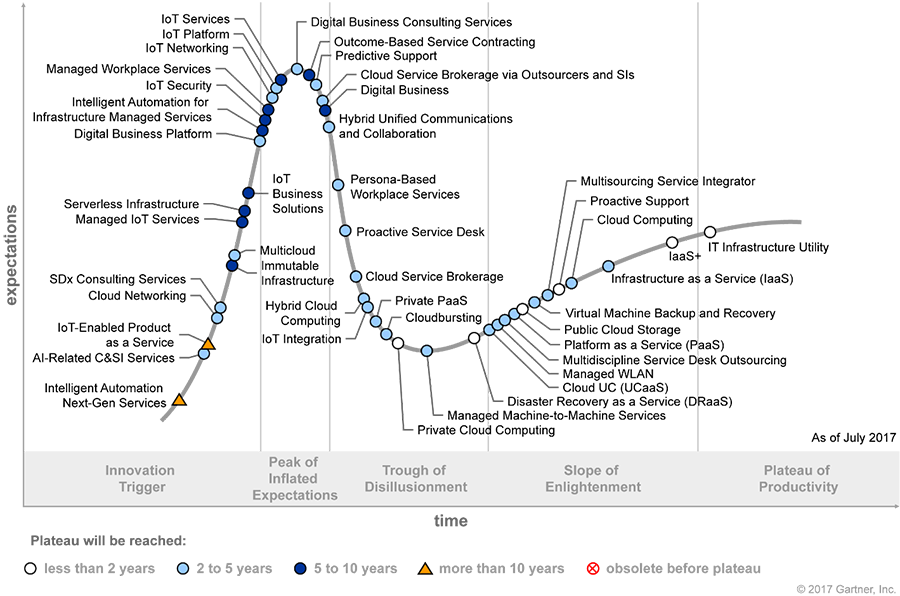
Source: Gartner (July 2017)
Hype Cycle Phases, Benefit Ratings and Maturity Levels
Table 1. Hype Cycle Phases
| Phase | Definition |
|---|---|
| Innovation Trigger | A breakthrough, public demonstration, product launch or other event generates significant press and industry interest. |
| Peak of Inflated Expectations | During this phase of overenthusiasm and unrealistic projections, a flurry of well-publicized activity by technology leaders results in some successes, but more failures, as the technology is pushed to its limits. The only enterprises making money are conference organizers and magazine publishers. |
| Trough of Disillusionment | Because the technology does not live up to its overinflated expectations, it rapidly becomes unfashionable. Media interest wanes, except for a few cautionary tales. |
| Slope of Enlightenment | Focused experimentation and solid hard work by an increasingly diverse range of organizations lead to a true understanding of the technology's applicability, risks and benefits. Commercial off-the-shelf methodologies and tools ease the development process. |
| Plateau of Productivity | The real-world benefits of the technology are demonstrated and accepted. Tools and methodologies are increasingly stable as they enter their second and third generations. Growing numbers of organizations feel comfortable with the reduced level of risk; the rapid growth phase of adoption begins. Approximately 20% of the technology's target audience has adopted or is adopting the technology as it enters this phase. |
| Years to Mainstream Adoption | The time required for the technology to reach the Plateau of Productivity. |
Source: Gartner (March 2008)
Table 2. Benefit Ratings
| Benefit Rating | Definition |
|---|---|
| Transformational | Enables new ways of doing business across industries that will result in major shifts in industry dynamics |
| High | Enables new ways of performing horizontal or vertical processes that will result in significantly increased revenue or cost savings for an enterprise |
| Moderate | Provides incremental improvements to established processes that will result in increased revenue or cost savings for an enterprise |
| Low | Slightly improves processes (for example, improved user experience) that will be difficult to translate into increased revenue or cost savings |
Source: Gartner (August 2018)
Table 3. Maturity Levels
| Maturity Level | Status | Products/Vendors |
|---|---|---|
| Embryonic |
|
|
| Emerging |
|
|
| Adolescent |
|
|
| Early mainstream |
|
|
| Mature mainstream |
|
|
| Legacy |
|
|
| Obsolete |
|
|
Source: Gartner (August 2018)
Source: Gartner Research Note G00340299, C. Tenneson, D. Groombridge, E. Goodness, 8 August 2018
"The strategic uses of hybrid cloud storage are often developed with modern approaches in mind. As such, vendors have taken care to ensure that data can not only be read in the public cloud, but that data can be modified and synchronized back to its source. This end-to-end capability requires that providers of hybrid cloud storage solutions integrate deeply with the cloud service provider in a manner that far exceeds the functionality required to simply tier to the cloud."