Accelerating Digital Transformation in Insurance
Research from Gartner
How to Achieve Digital Business Excellence by Mastering Pervasive Integration
To make customer experience, IoT, ecosystems, intelligence and IT systems work together, a digital business technology platform must effectively interconnect all these subplatforms at scale. Application leaders should implement a pervasive integration strategy to succeed in digital business.
Key Challenges
- Any digital business technology platform (DBTP) initiative has to tackle a daunting array of integration challenges, but for many digital business leaders, integration is only an afterthought.
- The growing importance of digital business ecosystems is forcing organizations to face unprecedented scale and diversity of integration tasks, for which conventional B2B integration technologies and paradigms are proving inadequate.
- Application teams focused on individual DBTP subplatforms tend to address integration challenges on a small, local scale by optimizing short-term goals in a stovepipe fashion. This attitude may lead to a lack of agility and duplication of efforts, technologies and skills.
- To monitor, detect and react to business moments in an event-driven, business real-time fashion, while engaging their ecosystems, organizations are forced to integrate a variety of application services and data sources within and across the DBTP subplatforms.
Recommendations
Application leaders in charge of modernizing integration strategies and infrastructure to enable DBTP:
- Secure adequate investments and managerial attention to integration by educating your digital business leadership about the importance of a proactive, pervasive integration strategy to shorten time to value and improve the agility of your DBTP.
- Enable "event thinking" by adopting appropriate integration capabilities to empower your organization to join digital business ecosystems and their transformative opportunities.
- Develop a pervasive integration strategy by incorporating in your DBTP a comprehensive set of proper technical capabilities to enable an integrated digital business.
- Make these technologies pervasively available by implementing a centrally delivered hybrid integration platform (HIP) supported by a bimodal approach to integration to empower persona-based, self-service integration across the DBTP.
Introduction
The DBTP provides organizations with the technical foundation to support their digital transformation strategies. The DBTP is a "platform of platforms" that combines IT systems, customer experience, Internet of Things (IoT), ecosystems and intelligence platforms to enable new products, new services and even new business models. Application systems within these "subplatforms" must be integrated with each other and with systems in other subplatforms.
An "unintegrated DBTP" is simply an oxymoron.
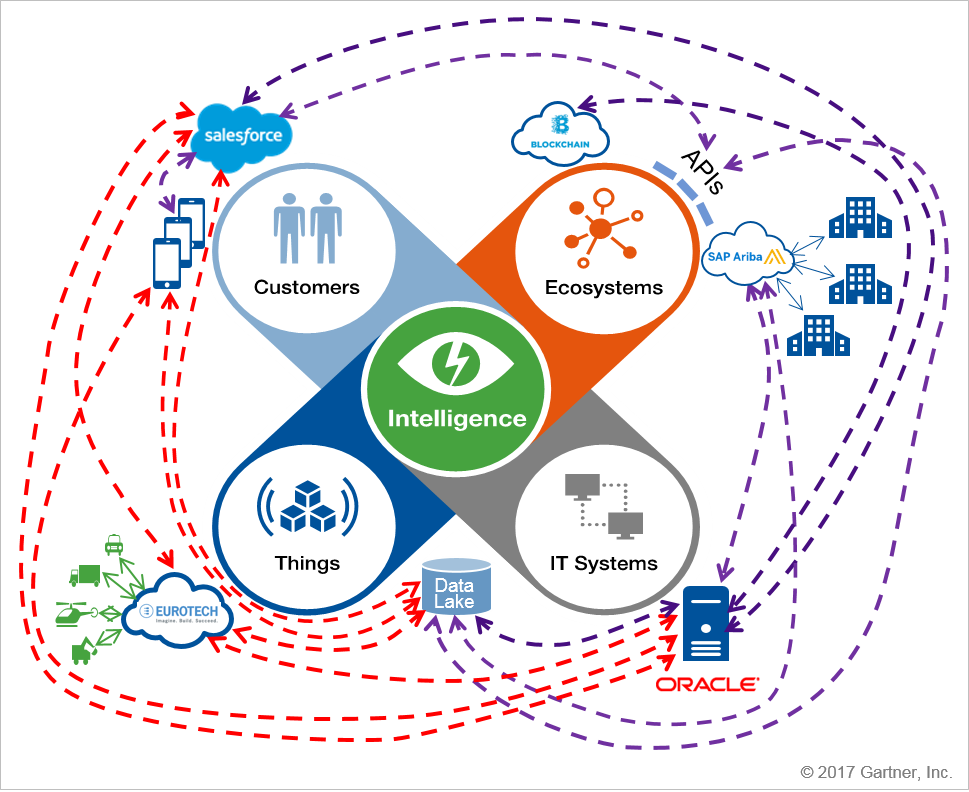
To make their DBTPs work, organizations need to tackle myriad integration challenges that pervasively manifest across all the platform components (see Figure 1).
Figure 1. Examples of Digital Business Integration Challenges
Source: Gartner (August 2017)
These integration challenges pervasively manifest at multiple levels of a given DBTP:
- Across different organizations within the same ecosystem and across ecosystems
- Across platforms (for example, to convey data from things into the intelligence platform, to back-end IT systems and ecosystem partners)
- Between systems and applications within the same platform (for example, between a business-to-customer [B2C] e-commerce portal and a lead management system within the customer experience platform)
Due to the quickly changing and highly competitive nature of digital business, organizations must be able to address these challenges quickly and cost-effectively (see the Octo case study in this research).
A sound pervasive integration strategy (see Note 1) is no longer simply "nice to have." It cannot be an afterthought for organizations with digital ambitions.
Digital business is in its essence collaborative, heterogeneous and continuously changing and expanding. Without a solid underlying integration infrastructure and pervasive "integration thinking," there is no digital business.
Integration, however, is a tricky problem for application leaders to tackle. Moreover, it is often hard for them to secure resources and managerial attention to the issue. For many digital business leaders, in fact, integration is regrettably just "an implementation detail." This attitude often stems from the incorrect belief that, after all, integration is a "solved problem." This attitude occurs because of all the hype and rhetoric digital business leaders hear about APIs.
The tough reality is radically different:
Without a well-thought-out and wisely governed pervasive integration strategy, a DBTP will inevitably end up being based on an unmanageable, fragile, rigid, hard-to-change and horribly expensive "digital business spaghetti" nonarchitecture.
A digital spaghetti could potentially undermine the effectiveness and agility of any digital transformation initiative and keep the organization isolated from digital business ecosystems and their transformative opportunities.
This research is meant to help application leaders responsible for supporting DBTP initiatives to address these challenges by providing them with:
- The rationales needed to explain to business leaders why a sound, pervasive integration strategy is a key success factor for any organization's DBTP
- Recommendations about how to articulate a pervasive integration strategy that empowers any-to-any, API and event-based cooperation across their DBTP and with their ecosystem partners
Analysis
Secure Adequate Managerial Attention and Investments for Pervasive Integration by Educating Your Digital Leaders About Its Key Role
Even a superficial look at the integration issues associated with your DBTP will reveal that you must:
- Integrate the established, pre-DBTP information systems with new, innovation-enabling technologies, such as IoT platforms, platform business brokers, mobile apps or blockchain.
- Enable integration of processes while maintaining the quality of business operations throughout the highly heterogeneous and rapidly changing technology environment and ecosystem setting.
Even more daunting than the intrinsic complexity of supporting these requirements within and across the DBTP subplatforms is the sheer amount of integration work driven by digital business. For example, you may need to:
- Rapidly, securely and cost-effectively onboard hundreds, if not thousands, of ecosystem partners via event notifications, service APIs, web hooks, electronic data interchange (EDI) protocols, managed file transfer (MFT) and other means.
- Connect your intelligence platform with hundreds of thousands of IoT devices via a variety of protocols and data formats that are generating data at various speeds and volumes.
- Support millions of consumers that want to do business with your organization using multiple channels, thus becoming, in some cases, parts of your digital business ecosystem.
Without proper leadership, planning and substantial investment in terms of technologies, organizational settings and skills, you will never be able to sort out integration issues of that scale and complexity.
It is imperative that you properly sensitize your digital transformation leadership about the key role of pervasive integration to make sure top management allocates adequate managerial attention and investment as part of your organization's DBTP plans.
Action Items:
- Engage with your business and IT digital leadership to identify early on the key integration challenges your organization will have to face while implementing its DBTP strategy.
- Demonstrate to your business leadership how pervasive integration technologies (such as, integration platform as a service [iPaaS] and API management platforms) and methods address these challenges in a more agile and cost-effective fashion than traditional integration methods. You can do this through, for example, reference visits, peer networking, proofs of concept (POCs), pilot projects and early, limited-scale successes.
- Justify investments in pervasive integration based on the following factors:
- Ability to participate in event-driven ecosystems and to enjoy their transformative innovations
- Ability to enable superior business agility by supporting rapid replacement of now-inadequate DBTP elements (whether applications or ecosystem partners) with more valuable alternatives
- Ability to monitor the business value and the end-to-end technical efficiency, quality and reliability of integrated digital business processes
- Ability to achieve shorter (up to 50% or even 75%) time to integration for new digital applications
Adopt Event Integration Capabilities to Empower Your Organization to Join the Digital Business Ecosystems
A key component of your DBTP is the ecosystem subplatform, which enables your organization to collaborate with your business partners in ways that go beyond traditional, decades-old models. Supporting these new approaches to ecosystems poses specific integration challenges that only in part overlap with the integration issues that manifest across the other DBTP subplatforms.
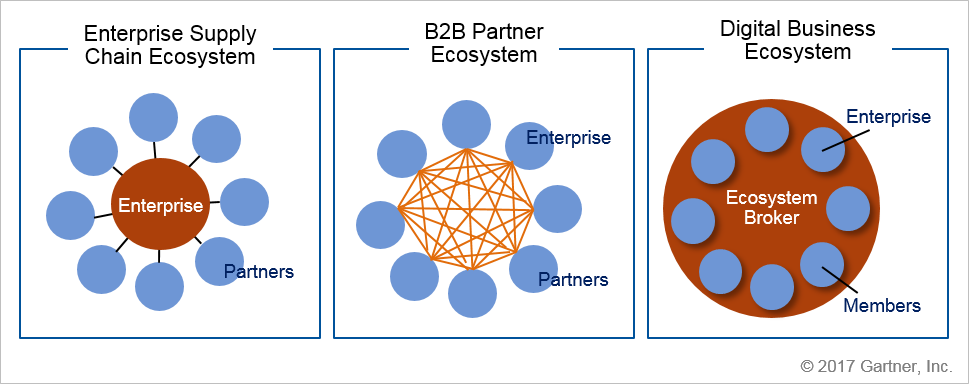
The hierarchical supply chain relationships (for example, a carmaker and its parts suppliers) and the B2B partner ecosystems where organizations enter into specific point-to-point agreements are widespread. However, these forms of ecosystems are too rigid, constrained and slow to support the digital context where real-time continuous monitoring for IoT events and ecosystem-supported business moments is a common behavior.
The more elastic and agile digital business ecosystems are peer networks of members that are facilitated by a third-party ecosystem platform broker. Their model is a direct descendant of the architecture of sharing economy platform businesses, such as Uber or Airbnb (see Figure 2).
Figure 2. Evolution of Ecosystem Models
Source: Gartner (August 2017)
The members/partners of any ecosystem are always independent entities with their own IT architecture and business models. Therefore, integration capabilities are essential in all ecosystem models. However, the digital business ecosystem peer network poses different integration challenges:
- In supply-chain-style ecosystems, the controlling enterprise (the carmaker in the earlier example) dictates the integration policies, protocols and technologies.
- In the B2B partner ecosystem, each partnership is negotiated separately, and your organization must be able to support all the protocols, formats and policies that are necessary.
- In the digital business ecosystem, a third-party platform broker technology is provided to all members. This technology is designed to support digital-business-style operations: real-time event-driven collaboration, matching, orchestration, creation, market-style brokering and other services to facilitate responsive business models and business ecosystem-supported business moments.
The demands to the IT infrastructure embedded in the broker platform and in the infrastructure of the ecosystem members include:
- Event-based integration, including communication and event object semantic transformation
- Stream and event analytics
- Ecosystem context sensing and analysis
- Decision automation and support derived from integrative event and data analysis
- High-productivity administration tools to allow business actors to join and influence the ecosystems
- High-control development tools to design algorithms and integrations for event, event stream and command processing in context
Member organizations of a digital business ecosystem retain fully autonomous operations and process their ecosystem-derived business internally, using their internal integration infrastructures and approaches. In that respect, the ecosystem business is an "edge" activity that requires substantial integration investment due to its inherent diversity. It "plugs in" with the core integration infrastructure of the organization that manages the coordinated work of its own application, cloud services and other ecosystems or partnerships of various types where the organization is a member.
It will likely become imperative in the next two to three years that your organization be ready to join digital business peer-network-style platform businesses and ecosystems. Your integration strategy must support this imperative.
Action Item:
- Incorporate in your integration strategy technical capabilities, competencies and skills to enable integration of event-driven, real time operations, including stream-based processes.
Develop a Pervasive Integration Strategy by Including in Your DBTP an Appropriate Set of Technical, Organizational and Skills Capabilities
Many of the digital business integration challenges that we discussed above have a common trait: They must be addressed in a matter of weeks, days or even hours – not months or quarters – no matter what.
Most likely your organization already has in place one or more teams of integration specialists – typically referred to as integration competency centers (ICCs) – that take care of integration across IT systems. In general, ICCs do not have the amount of resources that are needed to perform the myriad integration projects and tasks that will emerge as you implement your DBTP. Should the ICC have to deal with "all" these requirements, it would rapidly become a bottleneck, no matter how efficient the team is.
In the absence of a pervasive, organizationwide integration strategy, your individual DBTP platform leaders and specific project teams will naturally tend to address their integration challenges locally by optimizing their short-term goals (for example, developing ecosystem-enabling APIs) in a stovepipe fashion. They do not, and cannot, have a holistic perspective of the overall DBTP integration challenges, which may lead to duplication of efforts, technologies and skills within your DBTP and across your organization.
Moreover, developers, not necessarily with deep integration platform skills ("ad hoc" integrators), and even business users (citizen integrators) under time-to-value pressure inevitably want to address their integration issues by themselves (see Note 2). This may lead to further duplication of efforts.
The market offers several categories of platforms that can address a wide range of functional requirements and support these different personas (see Note 3). However, in most cases and especially in large and global enterprises, no single one of these platforms can support all the integration issues stemming from a DBTP initiative. You may need a combination of these platforms, but you will also want to optimize such a combination to keep your costs under control.
All the dimensions of your pervasive integration strategy – organizational, architectural and technical – must aim to minimize the costs of supporting these requirements while maximizing the agility and flexibility of your DBTP.
Action Item:
- Appoint a "digital integration czar" in charge of understanding the current and emerging requirements, defining a strategy and driving the pervasive integration plans. Should your organization already have an ICC, the head of this team could be a good candidate for the role.
- Set up a "digital business ICC," typically (although not necessarily) led by the integration czar, and task it with initially implementing what Gartner calls the "systematic approach to integration," which encompasses:
- Collecting, from digital transformation projects, short-, medium- and, if possible, long-term integration requirements in terms of functionality and target integration personas
- Defining your pervasive integration technology platform capabilities (typically based on the HIP framework) that meet these requirements
- Selecting the proper combination of integration technologies that best implements these capabilities
- Implementing, managing, maintaining and evolving these technologies as an integrated whole
- Providing integration delivery services to the teams engaged in DBTP initiatives
- Meeting agreed key performance indicators (KPIs) such as time-to-value, integration platform availability and efficiency, number of supported and enabled application teams, and integration cost reductions
If your organization already has a traditional ICC, it most likely already has these practices in place. It is only a matter of extending them to cover the DBTP requirements. - Task the digital business ICC to incrementally evolve toward a role of facilitator for integration specialists and ad hoc and citizen integrators according to a "bimodal" approach.
Implement a Centrally Delivered HIP Supported by a Bimodal Approach to Integration
To react to business moments (but also to support more conventional process automation requirements), your organization must be able to integrate applications and data across the DBTP platforms in a business real-time, event-based fashion. For example, you may need to order a missing spare part via your procurement application (in your IT system platform) when a preventive maintenance algorithm (in your intelligence platform) notifies you of a potential failure in one of your IoT-enabled asset (via your "things" platform).
To support these types of scenarios, therefore, intra-/inter-subplatform and ecosystem integration capabilities must be available and consumable to the appropriate integration personas, anywhere throughout your DBTP. Ideally, you would like to have a single, shared set of DBTP-wide integration capabilities that are available, in a self-service fashion, to any integration persona in any DBTP subplatform. Such a setting enables:
- Agility and flexibility, from an integration delivery perspective, so that integration personas can address their needs in business real-time without being constrained by ICC personnel availability
- Central management and control, from an integration governance perspective, so that the ICC can monitor integration personas' activity in real time; troubleshoot issues as they happen; ensure technology consistency; and enforce security, compliance and governance policies
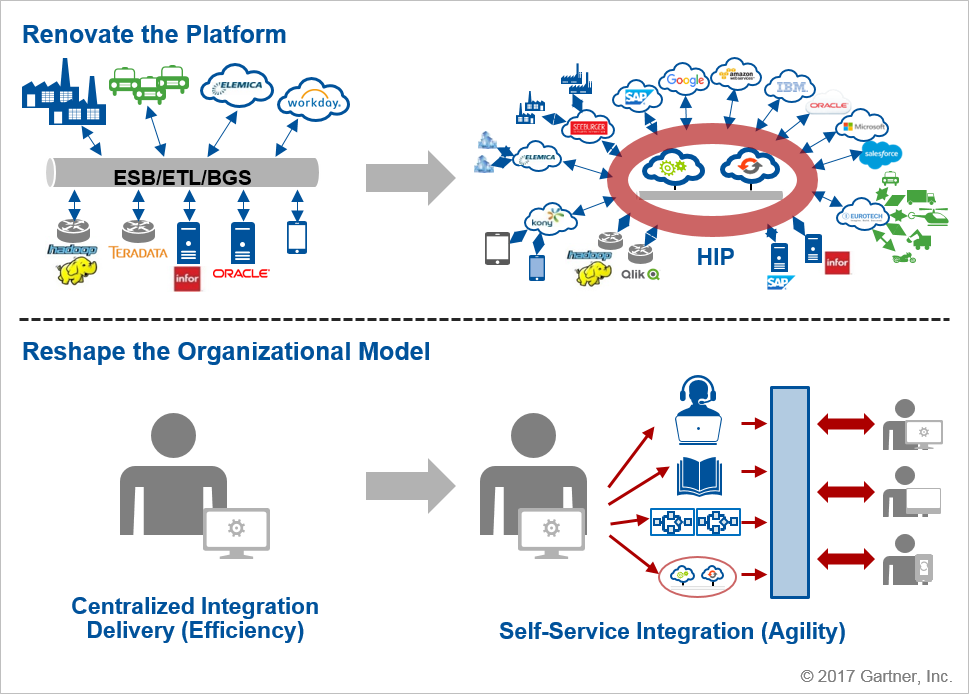
Enabling this model implies an extension of your current integration platform (if you have one) to cover the new requirements, such as IoT and digital business ecosystem integration. It also requires, however, a change in your organizational setting to extend your "systematic" ICC with resources, methods and skills aimed at empowering and facilitating such a self-service and persona-based approach to integration across your DBTP (see Figure 3).
Figure 3. The Two Aspects of a Pervasive Integration Strategy Plan
Source: Gartner (August 2017)
Renovate the Platform by Implementing a HIP
As discussed previously, you can pick-and-choose from a wide range of integration platform offerings to get the products and services that best suit your needs. However, the risk of duplication of technologies is high and, to a certain extent, inevitable. Moreover, from a central IT perspective, the issue is how to make these integration platforms available to multiple stakeholders across your DBTP without encouraging an unregulated, chaotic integration spaghetti. From the technology perspective, you can mitigate the problem by providing the integration platform capabilities as a shared infrastructure (that is, your own private iPaaS). Everybody could use (upon authorization) it, but your digital ICC would deliver, manage, monitor and maintain it centrally.
Gartner calls such an approach the HIP. This is not a product that you can buy, but rather a framework of on-premises and cloud-based integration and governance capabilities that enables different integration personas to support a wide range of use cases, ideally in a self-service fashion.
Your HIP-inspired integration infrastructure ("your HIP," for short) will likely implement only a subset of the overall HIP framework. Your HIP will be constructed by assembling a variety of technology building blocks, from one or more providers that, nonetheless, should be managed as a cohesive, federated and integrated whole.
To tackle your digital business integration issues with the necessary agility, short time to value and adaptability, your HIP must be able to support some combination of the following requirements:
- Empowerment of different personas: Integration specialists and ad hoc and citizen integrators
- Connectivity to a range of endpoints: Cloud, on-premises, mobile, external ecosystems and IoT
- Ability to enable a variety of integration patterns and use cases: Application, data, event streams, B2B and process integration patterns, IoT, mobile, cloud, and on-premises integration use cases
- Ability to allow cloud, on-premises, and hybrid (cloud and on-premises) deployments: Including capabilities embedded in other products and services
Your ICC, ideally, should make these functionalities available in a role-based, self-service fashion. For example:
- Integration specialists have access to all your HIP functionality at any level of granularity.
- Ad hoc integrators are allowed to use an extended subset of these functionalities, often through some high-productivity, "low code" development environment.
- Citizen integrators are enabled only to customize and deploy integration templates (typically built for them by the ICC) via simple configuration wizard or artificial intelligence (AI)-assisted automation tools (digital integrators).
Reshape the Organizational Model to Support a Bimodal Approach to Integration
The "systematic approach to integration" has its merits in terms of efficiencies and quality of service, but, as discussed above, may not be agile and responsive enough. Thus, it may encourage ad hoc and citizen integrators to work around the ICC bottleneck by relying on self-procured, "high-productivity" integration tools to quickly address their local integration issues by themselves.
Gartner calls this the "adaptive approach to integration." It can rapidly deliver value and instant gratification, but it can also introduce long-term challenges in terms of economies of scale, expanding technical debt, manageability, auditability, security and compliance. These challenges extensively magnify across the DBTP. They particularly affect subplatforms that must face high-scale integration challenges (IoT, ecosystems and customer experience).
Both the systematic and the adaptive approach deliver benefits and have drawbacks. Neither is inherently the best, but each can prove better than the other for specific use cases. You should plan, therefore, to reshape your organizational model to be able to support what Gartner calls the bimodal approach to integration. In this approach, the systematic and adaptive approaches complement each other.
The bimodal approach implies an evolution of your digital ICC toward a model that supports implementation, delivery and management of your HIP infrastructure. The ICC continues to deliver integration projects according to the systematic approach. But it also plays the role of facilitator for ad hoc and citizen integrators (but also for specialists elsewhere in the organization) by providing them:
- Integration aids in the form of templates, best practices, standards and guidelines
- Integration services such as training, consulting, support and help desk capabilities
- A self-service user experience they can leverage to access the integration aids and services as well as to consume the HIP functionality available to their roles
- A decision framework that helps them make informed decisions on whether to assume the systematic or adaptive approach on a project-by-project basis.
Action Items:
- Plan to aggregate the technologies required to support your digital business integration needs into a HIP-inspired infrastructure to be delivered as a shared, self-service infrastructure.
- Adopt bimodal integration by leveraging the best of the systematic and adaptive approaches.
- Gradually evolve the mission of your ICC from a centralized "integration factory" toward a role of "integration facilitator."
- Implement both the technology and organizational aspects of your pervasive integration strategy in a stepwise fashion by incrementally introducing new capabilities in sync with the requirement emerging from your DBTP implementation plans.
- Consider federated settings, such as at the DBTP subplatform level, should a single HIP/single digital ICC arrangement prove impractical for technical, business or political reasons.
Case Study
Octo, founded in 2002, is a company providing a range of telematics services. It operates in 26 countries, with a particularly strong presence in the U.S., the U.K. and Italy. Octo business strategy is to help insurance and automotive companies successfully exploit the opportunities stemming from the dramatic transformation these industries will tackle over the next three to five years:
- Full digitalization of value chain
- Autonomous car
- Next generation CRM and billing
Octo based its business and service delivery strategy on a DBTP, implemented as a multitenant cloud platform, whose capabilities are delivered to partners via APIs and an IoT hub according to several models, including PaaS and business process outsourcing (BPO). Through this platform, Octo captures behavioral, contextual and driving data from consumer vehicles (cars, motorbikes and scooters). This data is then aggregated and analyzed in real time to provide services to a variety of different industries (insurance, automotive, car rental and fleet companies, and, through the Omoove subsidiary, mobility sharing organizations).
To implement and deliver these services, the company had to address myriad integration challenges involving IoT integration, event ingestion, API publishing and inter-DBTP integration issues.
These integration challenges are complex and at scale. The company has approximately 90 B2B partners (including Axa, General Motors, Unipol, Liberty Mutual, Admiral, Hastings Group, Mapfre Insurance and LeasePlan), and its telematics network connects more than 5.3 million vehicles, which gives the company a dominant market share in its segment.
Octo's DBTP provides a set of horizontal capabilities on top of which the company has implemented the services that consolidate the company's industry-specific, historical know-how. In this way, the company aims to:
- Generate more value for its partners via synergies across the different ecosystems
- Improve time to market for new services
- Reduce costs for its customers
A key enabler of the Octo DBTP is its HIP – based on Software AG's integration technology – which provides connectivity across IoT devices, Octo's internal systems, third-party service providers and ecosystem partners.
Octo's offerings include both real-time notification services (for example, car crash detection, parental control, theft prevention and "find my car") and "after the fact" services (for example, first notice of loss, crash reconstruction, damage estimation and various actuarial analytics). In turn, partners leverage Octo's capabilities to use data for improving their performance on pricing, claims and fraud detection. Moreover, partners can use those capabilities to provide innovative services for their consumer clients. For example:
- Insurance partners are selling driver behavior-based car policies and emergency services
- Automotive partners are proposing to clients customized support and maintenance services
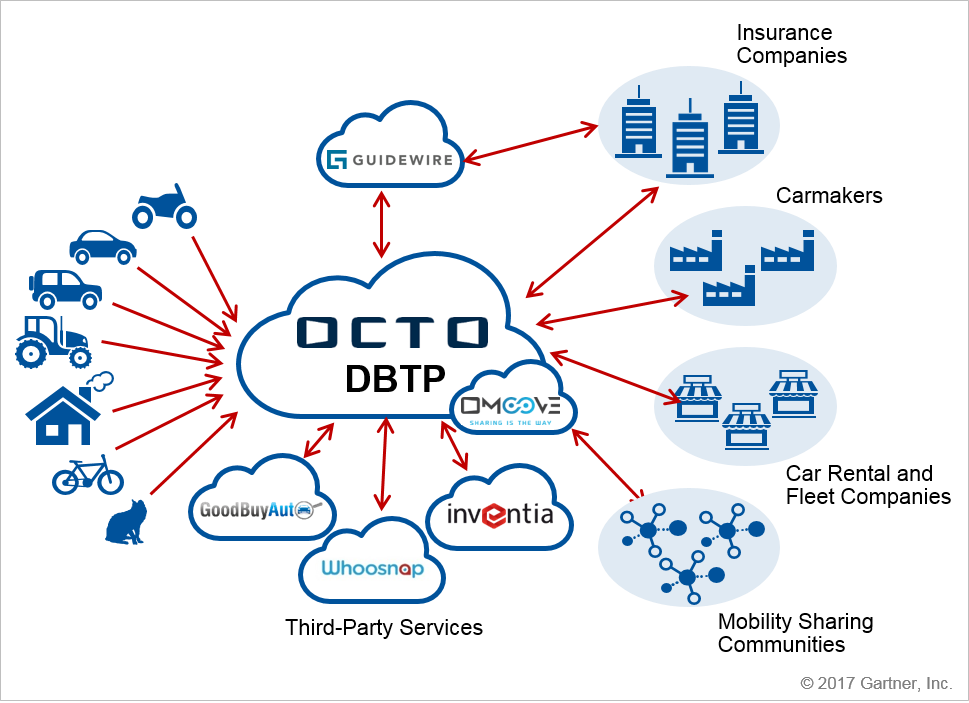
Figure 4. Octo Digital Business Technology Platform
Source: Gartner (August 2017)
Octo's DBTP consists of:
- Sensor devices deployed in the motor vehicles and other devices (for example, home devices) either by self-installing by consumer or by a dealer
- A horizontal application platform based on Software AG's IoT platform (Cumulocity), stream analytics (Apama) and in-memory data grid (Terracotta BigMemory)
- Actuarial analytics based on SAS Institute technologies
- Logistic services implemented via SAP ERP
- CRM and user experience services implemented via Salesforce
- Integration with third-party services (integration with Guidewire, Whoosnap, GoodBuyAuto and Inventia is under development)
Atop these horizontal services, integrated through the company's HIP, Octo's DBTP provides configurable application frameworks for the vertical industries it currently supports.
Such an architecture enables Octo to generate value from the IoT data for multiple ecosystems and across ecosystems alike. By reducing by 40% the time to market for new services, Octo expects that the new platform will enable the company to act as the "innovation enabler" for its partners. This way, the company aims to at least double its addressable market (for example, by entering the smart home, healthcare, agriculture and heavy machinery segments) and reinforce its global market leadership.
Source: Gartner Research Note G00337200, Massimo Pezzini Yefim V. Natis, 31 August 2017
Note 1
Pervasive Integration Defined
Pervasive integration is an organizational practice to build enterprisewide competency for integration across:
- An explosion of endpoints, such as homegrown applications and data sources, SaaS, mobile apps, and IoT devices
- Domains, such as data, process, application and B2B integration
- Deployment models, including on-premises, cloud and/or hybrid
- Integrator personas to enable integration specialists, along with ad hoc, citizen and digital integrators
Note 2
Integration Personas Defined
- Integration specialists are developers totally dedicated to integration. They have deep skills in one or more integration platforms, and their job is to implement integration projects either on behalf of their entire organization or of some specific organizational entity, such as a line of business (LOB) or subsidiary. They are typically located in a central or decentralized IT department and grouped in some form of ICC.
- Ad hoc integrators are developers, SaaS administrators, API product managers, data scientists or other personnel with IT skills who occasionally need to perform integration tasks in the context of the projects and initiatives they are engaged with. As such, they can at times use integration platforms that provide easy-to-learn and easy-to-use tooling.
- Citizen Integrators are business users (such as marketers, salespeople and customer support personnel) with limited or minimal IT skills. However, as part of their daily jobs or in the context of specific initiatives (for example, a product launch), they need to perform simple integration tasks via specific, extremely easy to use tools, such as iSaaS.
- Digital integrators are not humans, but tools that apply machine learning and AI techniques to facilitate the resolution of complex integration problems. These technologies may include chatbot-based integration flow development for conversational user experience, assisted data mapping and integration process optimization.
Note 3
The Integration Platform Market
The integration platform market is a large (approximately $12 billion in provider revenue in 2016) and growing market. Some of the most relevant segments of this market are:
- Integration platform software (such as ESBs and data integration tools) provides a rich set of core integration capabilities, enables a range of integration patterns and targets integration specialists.
- Integration platform as a service (iPaaS) offerings provide similar capabilities as their on-premises counterparts, but they are delivered as cloud services and, in most cases, are designed for ad hoc integrators.
- Integration software as a service (iSaaS) offerings are wholly focused on citizen integrators. In many cases, they provide only very basic core integration capabilities.
- API management platforms implement key integration governance features (such as security policies, monitoring and tracking), manage access to any API-enabled endpoint and are a good fit for ad hoc integrators and integration specialists.
In addition to these general-purpose tools, you can also find specialty platforms in the market. These typically address use-case-specific integration needs. For example:
- B2B gateway software supports information exchange between an organization and its ecosystem partners' business processes using a variety of mechanisms (such as MFT, EDI protocols and APIs). These exchanges are typically based on industry-specific data formats.
- IoT platforms facilitate operations involving IoT endpoints and enterprise resources, such as analytics, cloud services and on-premises systems. They support event stream analysis, decision making, and triggering of actions into business processes such as ERP, manufacturing execution systems (MES), supply chain management (SCM) and others.
- Mobile back-end services deliver capabilities to mobile apps via APIs and/or software development kits (SDKs) that can be incorporated into mobile apps, web apps and other digital channels. These services are delivered as an intermediary layer between the client-resident mobile apps and the enterprise applications along with any public or third-party data sources.
However, many other software products and cloud services – such as business process management (BPM) tools, analytics platforms and even packaged and SaaS applications – "embed" integration capabilities.