h1 Quis autem vel eum iure reprehenderit qui in ea laudantium aperiam
h4 Neque porro quisquam est, qui dolorem ipsum quia dolor sit amet, consectetur, adipisci velit, sed quia non
Research from Gartner
Hype Cycle for Digital Commerce, 2015
Enterprises use digital commerce as a key way to develop relationships with customers and drive revenue. This Hype Cycle helps enterprises evaluate the suitability of various digital commerce technology capabilities hyped in the market, and understand their maturity and business value.
Strategic Planning Assumption
By 2017, due to Internet-enabled price visibility, the digital customer experience will be the key differentiator of your organization.
Analysis
What You Need to Know
Technology-related issues are a top strategic business priority for the next two years for 25% of CEOs, behind only growth, according to the "2015 CEO Survey: Committing to Digital" (see also Figure 1 below). This is the highest position ever recorded in the survey for the category, highlighting the importance of technology and the manner in which it is being used to solve business problems and define business strategies. Expectations are high for revenue attributed to digital business, of which digital commerce is a key component. The 2015 CEO survey notes that digital revenue is expected to double to 41% by 2019. The expected growth rate was similar across industries, including B2B sectors. Digital commerce is a core component of revenue for businesses, and investments specifically in digital commerce should continue to grow.
Enterprises use digital commerce as a key way to develop relationships with customers and drive revenue. This Hype Cycle helps enterprises evaluate the suitability of various digital commerce technology capabilities hyped in the market, and understand their maturity and business value.
Figure 1. Priority Matrix for Digital Commerce, 2015
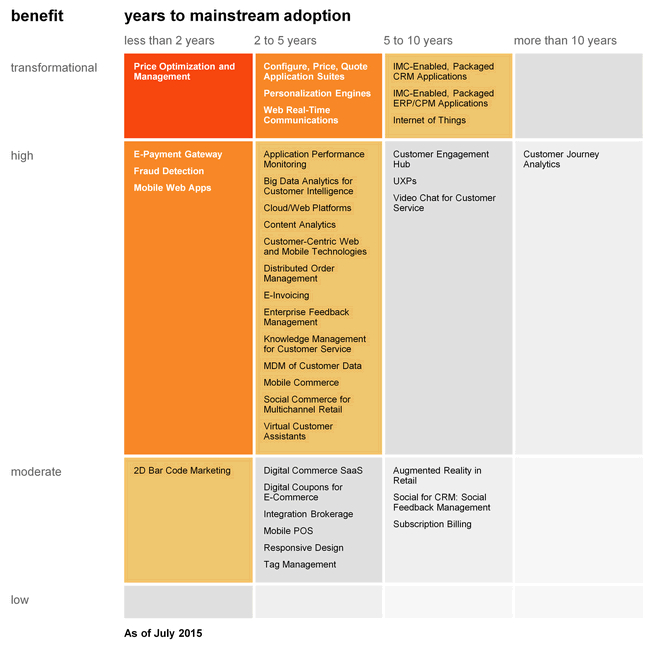
Source: Gartner (July 2014)
Mobile POS
Analysis By: Miriam Burt
Definition: Mobile POS refers to a point of sale (POS) application that is usually delivered on a retailer-owned, untethered wireless device to enable scanning, queue busting or payment processing on the store floor.
Position and Adoption Speed Justification: A fast and hassle-free check-out experience features consistently in the top basics customers expect when shopping in store. Mobile POS continues to interest retailers in this regard, and they are increasingly looking to implement mobile POS capability on store associates' handheld devices. There is also a continuing trend toward large multichannel retailers "beefing up" their mobile POS capability through third-party mobile POS vendors.
User Advice: Make sure to understand the customer process when customers are making transactions in the categories you sell. Mobile POS is more suitable for some categories than for others (for example, more suitable for grocery categories, rather than categories that include high-margin, high-ticket items, such as consumer electronics or apparel, that might require the store associate to also conduct activities such as detagging and bagging).
Market Penetration: 20% to 50% of target audience
Appendixes
Figure 2. Hype Cycle for Digital Commerce, 2014

Source: Gartner (July 2014)
Table 1. Hype Cycle Phases
| Product | Website | Basic Test Management Capability | ||
|---|---|---|---|---|
| Manage Test Cases | Test Planning and Execution | Defect Tracking | ||
| RTH | requirementsandtestinghub.com | x | x | |
| Tarantula | testiatarantula.com | x | x | |
| TestCube | jatakasource.org/testcube | x | x | |
| TestLink | testlink.org | x | x | x |
| Testmaster | testmaster.sourceforge.net | x | x | |
| WebTst | webtst.sourceforge.net | x | x | |
Source: Gartner (July 2014)
Table 2. Maturity Levels
| Evaluation Criteria | Weighting |
|---|---|
| Product or Service | High |
| Overall Viability | Medium |
| Sales Execution/Pricing | High |
| Market Responsiveness/Record | Medium |
| Marketing Execution | High |
| Customer Experience | High |
| Operations | Medium |
Source: Gartner (July 2015)
- Disk Space 50GB
- Free Setup No
- Bandwidth 500GB
- Domains Unlimited
- cPanel Yes
- Dedicated IP No
- Free Antivirus Yes
- Website Builder No
Note 1
"Advanced Attacks"
Most enterprises consider an attack to be "advanced" when it bypasses their traditional blocking and prevention controls. The reality is that many of these attacks are not advanced in techniques; they are simply designed to bypass traditional signature-based mechanisms. What enterprises need and what this research describes is an architecture for an adaptive protection process that is capable of addressing all types of attacks, advanced or not. It must be assumed that some of these attacks will bypass the traditional blocking and signature-based protection capabilities of the upper-right quadrant in Figure 1. [...]
- Monitoring outbound network traffic to detect the network signature of malware command-and-control traffic, or traffic with a destination IP address of known botnets, is an effective way to detect resident malware. Representative vendors include Damballa and leading secure Web gateway vendors. Next-generation firewalls and IPSs also support integration with reputation services for this type of monitoring.
- Monitoring outbound network traffic to detect the network signature of malware command-and-control traffic, or traffic with a destination IP address of known botnets, is an effective way to detect resident malware. Representative vendors include Damballa and leading secure Web gateway vendors. Next-generation firewalls and IPSs also support integration with reputation services for this type of monitoring.
- Monitoring outbound network traffic to detect the network signature of malware command-and-control traffic, or traffic with a destination IP address of known botnets
- Comprehensive monitoring of endpoints — such as monitoring applications executed, processes launched, network connections, registry changes and system configuration changes — is a good way to detect indicators of compromise.
Source: Gartner Research Note G00271692, Jeremy D'Hoinne, Adam Hils, Greg Young, 15 July 2015
Evidence
Most enterprises consider an attack to be "advanced" when it bypasses their traditional blocking and prevention controls. The reality is that many of these attacks are not advanced in techniques; they are simply designed to bypass traditional signature-based mechanisms. What enterprises need and what this research describes is an architecture for an adaptive protection process that is capable of addressing all types of attacks, advanced or not. It must be assumed that some of these attacks will bypass the traditional blocking and signature-based protection capabilities of the upper-right quadrant in Figure 1. [...]
- Monitoring outbound network traffic to detect the network signature of malware command-and-control traffic, or traffic with a destination IP address of known botnets, is an effective way to detect resident malware. Representative vendors include Damballa and leading secure Web gateway vendors. Next-generation firewalls and IPSs also support integration with reputation services for this type of monitoring.
- An emerging approach is to monitor network activity and compare it with normal traffic patterns, looking for suspect bursts of traffic volume or destinations, or new ports and protocols. Vendors that can help with network analysis include Blue Coat (via its acquisition of Solera Networks), RSA (via its acquisition of NetWitness), Fidelis Cybersecurity Solutions (acquired by General Dynamics), Lancope, TraceVector and Sourcefire's Advanced Malware Protection (AMP; acquired by Cisco).
- Continuous monitoring of user activities, logins, system access and behaviors, and analyzing this information for indications of account compromise or insider threats — examples include Click Security, Fortscale, GuruCul and Securonix.
- Monitoring outbound network traffic to detect the network signature of malware command-and-control traffic, or traffic with a destination IP address of known botnets, is an effective way to detect resident malware. Representative vendors include Damballa and leading secure Web gateway vendors. Next-generation firewalls and IPSs also support integration with reputation services for this type of monitoring.
- Vendors that can help with network analysis include Blue Coat (via its acquisition of Solera Networks), RSA (via its acquisition of NetWitness), Fidelis Cybersecurity Solutions (acquired by General Dynamics), Lancope, TraceVector and Sourcefire's Advanced Malware Protection (AMP; acquired by Cisco).
- Monitoring outbound network traffic to detect the network signature of malware command-and-control traffic, or traffic with a destination IP address of known botnets
- Lancope, TraceVector and Sourcefire's Advanced Malware Protection (AMP; acquired by Cisco).
- Comprehensive monitoring of endpoints — such as monitoring applications executed, processes launched, network connections, registry changes and system configuration changes — is a good way to detect indicators of compromise. For example:
- Vendors that can help with network analysis include Blue Coat (via its acquisition of Solera Networks)
- Comprehensive monitoring of endpoints
- Vendors that can help with network analysis include Blue Coat (via its acquisition of Solera Networks)
- Comprehensive monitoring of endpoints
- adshjfasdfl 3
- adshjfasdfl 1
- adshjfasdfl 2
- adshjfasdfl 1
- adshjfasdfl 2
- adshjfasdfl 1
- Vendors that can help with network analysis include Blue Coat (via its acquisition of Solera Networks)
- Comprehensive monitoring of endpoints
- adshjfasdfl 2
- adshjfasdfl 1
- adshjfasdfl 2
- adshjfasdfl 3