and Prepare for the Future in Life Sciences
Research from Gartner
Life Sciences CIOs: Identify Essential Data and Analytics Capabilities to Improve Commercial Effectiveness
Legacy data and analytics solutions do not meet emerging marketing demands for multichannel targeting, dynamic forecasting and real-time insights to drive growth. Life science CIOs should use this research to identify essential capabilities to modernize their commercial intelligence capabilities.
Key Findings
- Legacy data and analytics solutions cannot meet the needs of commercial operations teams. Commercial teams demand timely access to data in order to generate effective and timely insights that in turn will allow them to assess brand performance and identify opportunities for growth.
- IT’s lack of agility with respect to changing business needs frustrates commercial operations leaders. In response, they opt for vendor-led data lake solutions. Without thorough consideration of long-term implications, they thus inadvertently turn data lakes into data swamps.
- CIOs making data and analytics investments seek scalability, operational cost savings, advanced analytics capabilities and agility to meet changing business needs.
Recommendations
Life science CIOs seeking to enable digital strategies for R&D and commercial impact should:
- Identify the capability gaps in your current data and analytics solutions that are the root causes of commercial pain points by analyzing business needs against modern data and analytics capabilities. Use the gaps to define and prioritize objectives for modernization by collaborating with your business peers to align use cases with defined business outcomes.
- Support the delivery of business outcomes by creating a holistic and integrated analytics architecture that supports both routine and sophisticated use cases and allows for continuous expansion of functionality.
Analysis
Data and Analytics Are Now More Important Than Ever for Commercial Operations — Here’s Why
Life science (LS) commercial operations teams seek greater access to data and information than ever before to gain competitive advantage in increasingly complex marketing and selling approaches. For example, with treatment decisions shifting from individual physicians to institutional customers, LS brand teams look to key account managers (KAMs) to create long-term relationships with such institutions to drive brand growth. Yet KAMs report challenges in obtaining basic information about their institutional customers from internal systems — such as organization structure and operating model — thereby hampering their ability to plan and execute. For many LS companies, information is available in such purchased data assets as electronic medical records (EMRs) or it can be readily purchased, but it isn’t accessible to KAMs for informed decision making.
LS commercial organizations that continue to rely on legacy data and analytics solutions exacerbate these challenges. In fact, through Gartner research and inquiries, CIOs report that a lack of business-IT alignment, legacy architecture and operating models, and on-premises deployment models are the three principal barriers preventing them from modernizing their information intelligence capabilities. The good news? LS CIOs hope to change this, according to Gartner’s 2019 CIO Survey. Establishing a modern advanced analytics capability was a key investment priority, with over 46% of LS CIOs stating that business intelligence (BI) or data analytics capabilities will receive the largest amount of new or additional investments. Additionally, 14% of LS CIOs said that artificial intelligence/machine learning (AI/ML) initiatives will receive new or additional investments (see “2019 CIO Agenda: Life Science Industry Insights”).
Capabilities of the Modern Data and Analytics Intelligence Platform
Analytics is an irrefutable strategic LS priority and is today central to sales and marketing business user success. The traditional approach — where specialized IT skills and tools and significant upfront “data processing” are prerequisites to enable analytics capabilities — is no longer acceptable to marketing and sales users who seek expedited access to data. Commercial stakeholders, therefore, need IT to enable modern platforms that can support such organizations’ initiatives as customer 360, launch analytics and intelligent orchestration for personalized engagements (see Figure 1 and “Life Science CIOs: How to Accelerate Your Digital Business Platform Approach to Enhance Commercial Value”).
Figure 1. Five Must-Have Capabilities for Modern Intelligence Platforms
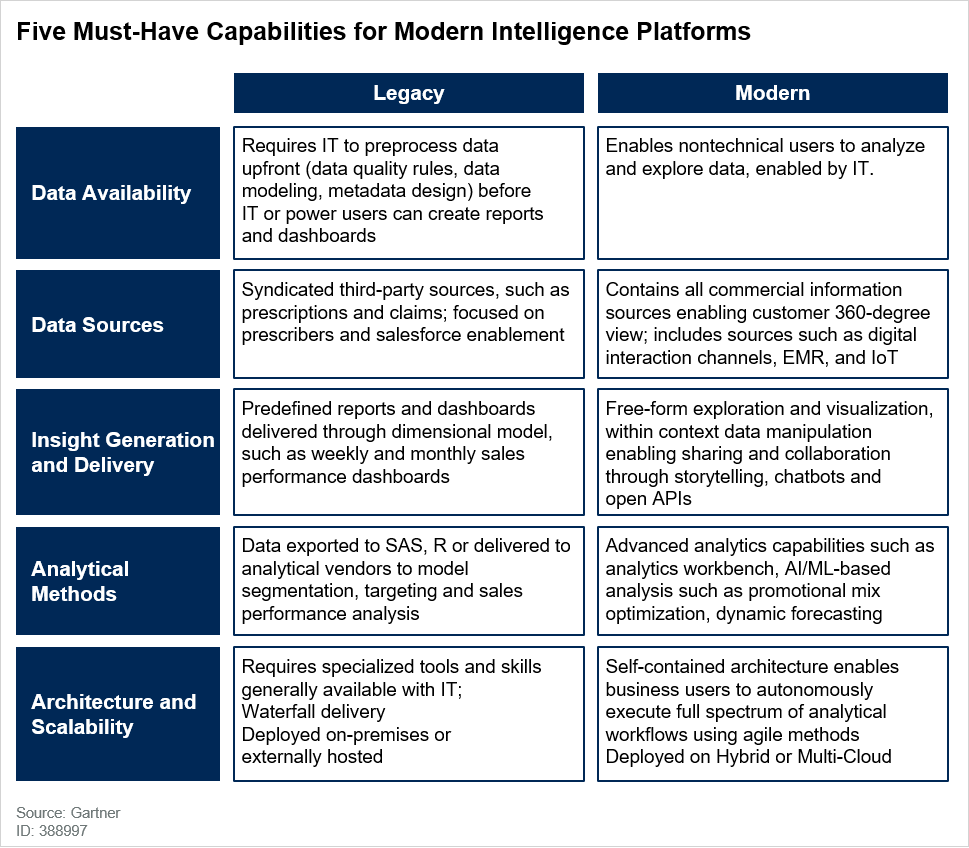
Modern intelligence platforms — combined with the skills needed from data science and analytics teams to analyze data from such platforms — will produce actionable insights that will enable companies to differentiate their drugs and devices from the competition’s. But many LS companies take a shortsighted view of data and analytics and choose analytics platforms that focus on a single business domain, such as sales performance. These tools typically offer only limited capabilities, such as business intelligence reports. The result? CIOs invest time and resources trying to fit square pegs into round holes. The results couldn’t be more predictable: While the platform may meet the needs of one department, it fails to deliver innovative capabilities such as customer 360, dynamic forecasting and other use cases that deliver significant business value.
The key to architecting the right intelligence platform lies in identifying the data and analytics capabilities that are most relevant to the company’s specific needs. There are three steps in this process:
- Identify capability and workflow gaps of current data and analytics platforms. This step answers the question, “How are our current data and analytics capabilities keeping us from achieving business growth objectives?”
- Develop modern next-generation intelligence platform requirements by starting from desired business outcomes and then moving to assess required technical capabilities for enablement. This step should answer the questions, “What next-generation capabilities are most important to our organization? And what technology is needed to enable them?”
- Create a holistic and integrated analytics target architecture that can support sophisticated use cases and allow a continuous expansion of functionality and use cases. This step should answer the question, “What next-generation technology capabilities are needed to enable the use cases important to my organization?”
Identify Capability Gaps and Measurable Business Outcomes to Make the Case for a Modern Intelligence Platform
No matter the state of your current data and analytics platform, it is very likely that your IT staff and business leaders have had their share of challenges with the current platform. For example, many Gartner clients cite issues stemming from decentralized information management, partial data quality checks, gaps in business rules implementations and overall lack of agility. These challenges affect such downstream business processes as targeting and incentive compensation and lead to loss of business user confidence in data platforms. In fact, these challenges and the loss of confidence drive business leaders to invest in such point solutions as vendor-managed data lakes. Gartner analysis shows that while such proprietary point solutions solve immediate challenges, they also lead to such larger problems as data silos, limited expansion capabilities beyond initial scope and vendor lock-in.
Maintaining a data and analytics status quo is not an option. You must collaborate with your business peers to identify business-focused data and strategic analytics capabilities needed for your new intelligence platform. The intelligence platform requirements should clearly articulate what analytics will do for the organization in business terms by answering these questions:
- Which problems will it solve?
- What business value will it deliver? For whom?
- How will it match, differentiate or innovate relative to competitors in the market?
Ultimately, How Will the Insight Improve Value for Healthcare Patients, Providers and Your Organization? Formulate Current State Assessments of Assets and Challenges
Start by identifying current challenges, the assets that exist, where they are and how they are presently accessed and managed. This information will prove valuable in compiling a blueprint for your modern intelligence platform and in identifying must-have requirements, key supporting business processes, existing contractual considerations and cost bases. You and your commercial leaders should actively seek partnerships with business stakeholders to alleviate such common challenges as obtaining key information from business-aligned agencies and vendors.
The inventory should include:
- Current concerns about data quality, processes, business rules and algorithms.
- Utilization data from service requests that allow you to gauge the frequency and severity of gaps as well as response times.
- An inventory of your information assets, including BI reports, tools and applications, data purchases and such internally generated operational data as marketing campaigns. Such an inventory should include an accounting of current information assets and supporting technologies, including assets directly managed by business peers.
Typical sources of information used for commercial operations are provided in Table 1. Use this table as a checklist to help accelerate capturing your organization’s current data sources and associated informatics.
Table 1. Typical Informatics Sources in Commercial Operations
| Source | Type of Information |
|---|---|
| Customer Relationship Management (CRM) | Calls, Details, Samples, Closed-Loop Marketing (CLM) Engagement |
| Speaker Programs | Engagement, Financials |
| Vouchers (including e-vouchers) and co-pay programs | Redemptions, Downloads |
| Campaigns | Engagement |
| Display Banner Ads | Engagement, Reach |
| Organic Search (SEO) | Search Traffic, Engagement |
| Paid Search (AdWords) | Engagement, Reach |
| Physician Social Networks | Engagement, Reach |
| Website | Click Activity, Channel preferences |
| Targeting and Segmentation | Alignments, Territories, Products, Call Plan, Employees (Field Representatives) |
| Master Data Management | Prescribers, Healthcare Organizations (HCO), Key Opinion Leaders (KOL), Patients |
| Enterprise Resource Planning (ERP) | Direct sales, shipping, billing, inventory |
| Expense Management | Expense transactions |
| Pricing and Contracting | Reference pricing, GPOs, Business-to-Business Hierarchies |
| Incentive Compensation | Plan design, Goals, Alignments, Call Plan |
| Reporting and Analytics | Reports, Dashboards, Excel Spreadsheets |
| Market Access | Influencers, Formulary |
| Syndicated (Third Party) | Electronic Medical Records (EMR), Prescriptions (Rx), Claims, Drug Distribution, Formulary, Co-Pay, Treatment Insights, Promotional Insights |
| Market Research | ATU (Awareness, Trail, Usage), Attitude, Preferences |
| Traditional Media (Print, Direct-To-Consumer, Direct Mail) | Engagement, Reach |
Source: Gartner
Identify Opportunities to Improve Business Performance Through Information Intelligence Capabilities
Developing an appropriate business case isn’t a simple process and it isn’t one you can do successfully on your own. You will need to engage early with line-of-business peers to develop a clear understanding of your organization’s current and future analytics needs, identify opportunities for consolidating duplicative solutions and secure funding and other needed resources.
Start by collaborating with your business peers to identity business use cases that will yield strategic ROI. The use cases provided in Table 2 will help you accelerate requirements development. Use these high-level examples of business challenges and opportunities as a checklist to identify and more specifically articulate your own.
Table 2. Data and Analytics Use Cases Supporting Commercial Effectiveness
| Functional Area | Use Case | Challenge | Opportunity |
|---|---|---|---|
| Marketing | Segmentation, Targeting, Orchestrated engagements through omnichannel | Combine available first-party and third-party data to formulate a comprehensive 360 view of the customer | Optimize sales and marketing resources; provide targeted, personalized customer engagement |
| Dynamic Targeting and Segmentation | Utilize ML with longitudinal patient claims data in order to understand the physicians’ involvement through the patient journey | Continued reliance on traditional segmentation and targeting models based on prescriptions | Deploy advanced methods to segment prescribers utilizing behavior patterns shown by individual prescribers through multitude of data sources |
| Patient Identification | Utilize advanced analytics to identify appropriate target patients for therapy, especially in rare disease therapeutics | Identifying the right patient and the right time that can benefit from therapy | Utilizing machine learning to combine and mine reimbursement claims, EMRs and lab testing datasets |
| Sale Force Effectiveness | Enabling dynamic customer engagement via analytics, insights and suggestions | Sales representatives forced to data-mine for actionable insights through traditional reporting methods | Improved pharmaceutical prescriber experience in engagement with sales representative; improved productivity for sales representatives |
| Market Access | Ensuring contract performance and compliance; leveraging analysis for new deals. | Performance of contracted deals with PBMs and Health Plans tend to go untracked | Gain a strategic advantage through comparison of actual performance vs. historical deal assumptions to inform future contract decisions |
Source: Gartner
Use cases are starting points for initiating conversations with business peers — they are not exhaustive. Thus, you will need to both prioritize and extend use cases, making them specific to your organization’s current market position and strategic vision. For example, manufacturers of a rare disease drug are likely to prioritize patient-identification analytics. In contrast, an established manufacturer with a diverse portfolio is likely to prioritize prescriber engagement and payer analytics.
Use documented capability gaps and prioritized business use cases to determine high-level solution requirements.
Use Analytics Reference Architecture to Select and Support Analytics Capabilities Needed to Deliver Business Value
The traditional IT data and analytics approach — where specialized “IT” skills, tools and significant upfront “data preprocessing” are required to access data and analytics — is no longer acceptable to business stakeholders. Commercial business teams are no longer willing to wait for days, even weeks in some cases, for such third-party datasets as prescription and claims information to be made available. Modern business users demand agility, speed and data quality to generate effective and timely insights to assess brand performance and identify opportunities for growth.
As such, your selection of the right analytics capabilities is tied directly to your ability to enable your internal partners’ desired business outcomes. You must broaden information access by modernizing the underlying architecture, expanding advanced analytical capabilities including AI and ML and enabling such self-service capabilities as visual discovery. Only then will your sales and marketing partners be able to achieve their critical business outcomes.
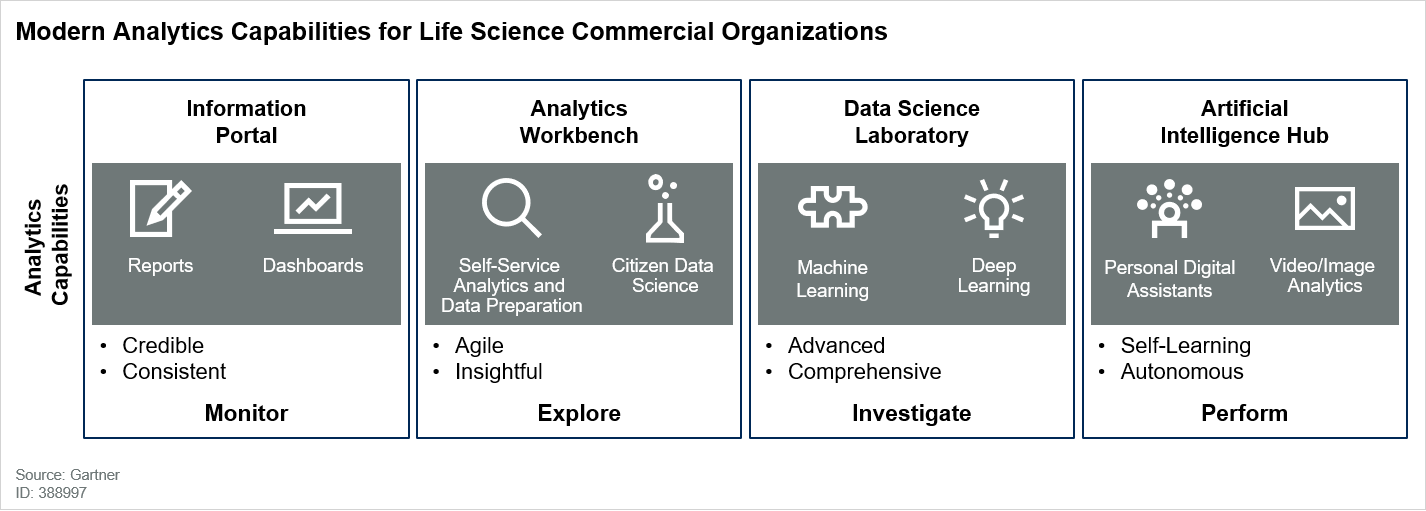
We have identified the four sets of analytics capabilities that are most important to LS commercial organizations (see Figure 2 and “Gartner Analytics Evolution Framework”). This framework will help you deliver on selected use cases and requirements defined for your modern intelligence platform. The tools identified in this framework, which include a broad range of technical and analytical capabilities, are likely to come from multiple vendors. That’s why we’ve included references to Magic Quadrants, Market Guides and other Gartner research featuring detailed information about technologies and vendors in each capability section below.
Figure 2. Modern Analytics Capabilities for Life Science Commercial Organizations
Information Portal
An information portal presents static reports and dashboards. This is the most basic set of analytics capabilities and the one that’s the most widely deployed within commercial organizations for such system of record reporting as CRM sales dashboards. Gartner client interactions show that many commercial organizations’ system of record reporting solutions that utilize core back-end system information, such as ERP, still utilize information portals. As you navigate toward your modern intelligence platform, traditional reporting and dashboards will still need to be supported. Utilize the research in Gartner’s “Market Guide for Traditional Enterprise Reporting Platforms” to compare traditional enterprise reporting capabilities to assess if they meet your future state requirements.
Analytics Workbench
An analytics workbench empowers business users with the ability to autonomously produce and publish insights, mainly through self-service data preparation and visual data discovery tools. Leading tools allow business users — even those who aren’t necessarily tech-savvy — to access, explore and share information, increasing the overall analytics maturity of the organization. Business users can self-author content and narrate stories through visual dashboards and other modalities to highlight specific business opportunities or challenges.
Gartner client interactions show that many commercial organizations utilize such leading platforms as Microsoft, Tableau, Qlik and MicroStrategy for such static reports as sales force performance dashboards and brand performance reports. There are limited examples of clients utilizing full potential of this capability to narrate special market events, such as competitive product launch. Utilize the research in Gartner’s “Magic Quadrant for Analytics and Business Intelligence Platforms” to compare analytics workbench capabilities most suited for your specific business requirements.
Data Science Laboratory
A data science laboratory supports commercial-focused data science teams and citizen data scientists in the delivery of advanced analytics outputs that utilize predictive modeling, prescriptive analytics, machine learning and other sophisticated analytic capabilities. Examples include dynamic forecasting modeling, pre/post-deal contract analytics and predicting patient adherence to therapy.
Gartner client interactions show that many data science teams enable such capabilities outside traditional data and analytics platforms because those platforms are incapable of supporting such needs. Utilize the research in Gartner’s “Magic Quadrant for Data Science and Machine Learning Platforms” to compare data science laboratory capabilities most suited for your specific business requirements.
Artificial Intelligence Hub
This set of capabilities bridges the gap between advanced analytics and business processes, such as providing sales representatives recommendations on next best courses of action. This involves technology that aims to augment human performance by learning from historical data, identifying new ways of doing things, predicting trends and prescribing next best actions. These capabilities help commercial organizations understand and analyze complex content, engaging in natural dialogues with customers, enhancing human cognitive performance and replacing repetitive tasks, freeing time for employees to engage in higher-value tasks. Examples of this include assisting with promotional content approvals through intelligent automation and utilizing hands-free voice technology for sales representatives while they are driving to their next detail.
Gartner client interactions show that most LS commercial organizations are still in the exploratory stage with AI technology (see “Life Science CIOs Can Accelerate Commercial Effectiveness With New Applications of Artificial Intelligence”). Utilize the research in Gartner’s “Innovation Insight for Continuous Intelligence” to identify key requirements to implement custom-built continuous intelligence solutions to apply real-time analytics to high-volume event data to make faster and better decisions.
Conclusion
Intelligence platforms that meet Gartner-defined next-generation characteristics have the ability to respond quickly to evolving business needs, consolidate duplicative solutions and lower operating costs. Staying with traditional data and analytics platforms will continue to result in IT business challenges with business stakeholders eventually moving out of frustration to vendor-hosted point solutions. This will lead to higher overall costs to the organization, data silos and limited insight generation, locking the business into increasingly dated ways of working.
Evidence
Gartner interacts regularly with life science companies. Their observations, challenges and successes form the primary source data for this research. Additional evidence was obtained from vendors in this space, industry inquiries, previous Gartner research, public sources and direct experience.
Source: Gartner Research Note G00388997, Animesh Gandhi, 9 October 2019
Note 1 Gartner CIO Survey Methodology
The 2019 Gartner CIO Survey was conducted online from 17 April through 22 June 2018 among Gartner Executive Programs members and other CIOs. Qualified respondents are the most senior IT leader (CIO) for their overall organization or a part of their organization (for example, a business unit or region). The total sample was 3,102, with representation from all geographies and industry sectors (public and private). The survey was developed collaboratively by a team of Gartner analysts and was reviewed, tested and administered by Gartner’s Research Data and Analytics team.