2021 Global AI+IoT Developers Ecosystem
Tuya Smart, the leading global AI+IoT platform #interconnectivity
Research from Gartner
Turning Smart Cities Into Intelligent Urban Ecosystems
Current smart city strategies are inadequate if governments, businesses and citizens want to benefit from the broader value of an intelligent urban ecosystem. CIOs and their stakeholders driving digital transformation need to develop a data-focused urban infrastructure and citizen service strategy.
Key Findings
- Each city or urban region sets its own unique priorities on social, environmental and economic drivers. This makes global technology blueprints difficult to apply, as there is no "one size fits all" approach.
- The Internet of Things (IoT) is being deployed not just for operations, monitoring and efficiency, but to create a systematic situational awareness of assets, citizens and the environment.
- Intelligent urban ecosystems will be driven through a multitiered application environment that is utilizing urban open government and business data to generate a data marketplace.
- CIOs are challenging their IT and OT providers to create open-source urban platforms to avoid vendor lock-in.
Recommendations
Local government CIOs transitioning to digital government through smart city initiatives should:
- Connect their smart city investments, projects and programs to a broader intelligent urban ecosystem strategy.
- Contribute to or align the IT governance toward the definition of a data governance strategy to enable the extraction and contextualization of data in service platforms and data exchanges, and for new approaches using artificial intelligence (AI) and blockchain.
- Interconnect smaller projects to establish best practices and delay big bang approaches while leveraging innovation sites and "living labs."
- Prioritize collaboration platforms that support the joint focus of ecosystems toward community goals, digital equity and knowledge exchange.
- Lead with a new service and government culture to accelerate digital transformation, which is flexible and measured by citizen and employee success criteria such as inclusion and innovation.
Analysis
The development of cities in the face of increasing global urbanization is closely linked to the economic, environmental and demographic opportunities of society. Starting around 2015, the first wave of smart city strategies focused predominantly on technology and operational efficiencies including IoT.1 Cities today need to align support functions to the individual needs of citizens to create dynamic service experience and entrepreneurship of citizens and community.2 This is especially true when cities increasingly will compete on issues regarding the quality of their industrial and citizen ecosystem, workforce and digital skills; their industrial and open data availability; as well as an ambient and sustainable environment.
For example, in January 2018, Amazon announced the finalist cities in its competition for its second U.S. headquarters.3 Amazon had required many smart city objectives from the competing cities. In this case, it is critical that CIOs and the supporting urban planners of smart cities must incorporate those objectives include key performance indicators for visibility of the engagement of the city and its ecosystem to battle resource constraints, advance skills and ecosystem development, and addressing environmental sustainability concerns based, for example, on fossil fuel cars and industrial manufacturing.
At the same time, cities represent an extensive melting pot of innovation potential (see Note 1). An example is Portland, Oregon, which drives knowledge exchange in schools, universities and laboratories.4 Innovation labs will marry technology innovation to contextualized services and business models based on smart city objectives and stakeholder engagement.
CIOs must engage with urban planners to create the future combined constructs to facilitate smart city development. They should host workshops and "imagineering" events to fully realize which technologies should be included in a local delivery plan.
Smart City and Intelligent Urban Ecosystem Definition and Scope
A smart city and community initiative delivers constituent value in adaptive ways. Smart city adopts an integrated approach to digital technologies. An intelligent urban ecosystem of actors is facilitated with algorithmic business, legal frameworks and policies and data marketplaces. This ecosystem is supported via information exchanges and enabled with a portfolio of digital services. Benefits of the ecosystem include citizen safety and quality of life, economic stimulation, and environmental protection. Virtual and physical business platforms are augmented via digital business using soft skills such as digital equity, data democracy and inclusion. This smart city and intelligent urban ecosystem strategy works even if every citizen isn't a digital citizen, either through choice, skills or investment.
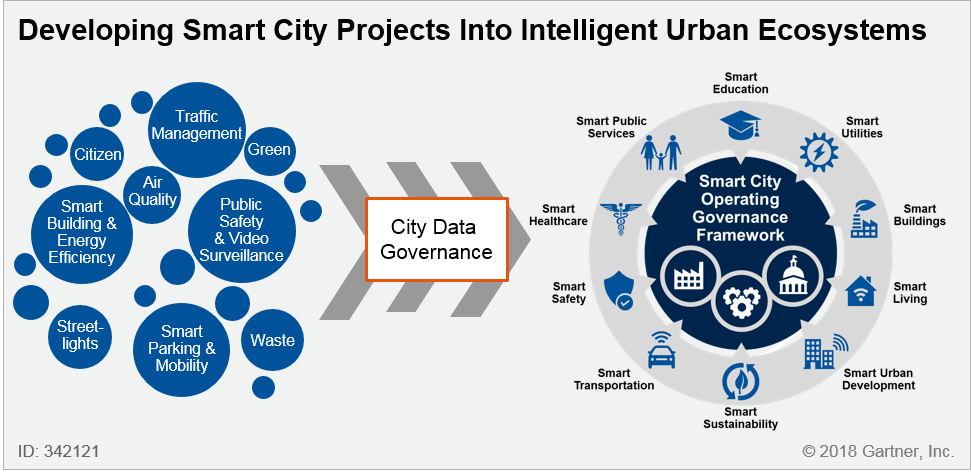
Figure 1 shows the development of smart city initiatives into an intelligent urban ecosystem.
Figure 1. Developing Smart City Projects Into Intelligent Urban Ecosystems
Source: Gartner (June 2018)
The roadmap of cities' approaches to smart city and intelligent urban ecosystems will determine the degree and depth of innovation in technology, services and information management. However, the talk track of the urban ecosystem and stakeholders, including businesses and councils, will frequently start with broader societal and environmental issues. Therefore, local government CIOs need to be prepared to enable, moderate or support the scope of the guiding principles that the urban ecosystem and its stakeholders are prioritizing by:
- Inclusion and digital equity: Expanding digital and social inclusion, often initiated or supported by national policies to abolish the digital/broadband divide of all citizens, regardless of status, nationality and age.
- Collaboration, community and citizenship: Development of community-driven value services, often supported by connected voluntarism in times of emergency across agencies. This includes collaborative design and participation, often in an online app store development environment. Resilience operations often are powered by community-driven value approaches, as demonstrated by the Rockefeller Resilient Cities.5
- Service and ecosystem diversity: Generation of service availability from multiple yet connected providers, where the city is operated as an innovation lab to obtain best-of-breed services, applications and technology environment. This also includes ecosystems for smart buildings, industrial parks and integrated service environments. The outcome will be better use-case-focused innovation initiatives with collaborative and societal benefits.
- Urban sustainability and infrastructure efficiency: Resource awareness and management of utilities, transportation and traffic networks help reduce carbon dioxide emissions, energy consumption and noise levels, while improving air quality, parking availability and traffic flows. Energy and utility investments in smart grid operations and microgrid, energy management, and efficiency are key enablers to develop new operational benefits. Water management is key, especially in increasing drought situations — even in mature countries. Converting waste to energy can be regarded as an additional source of heat and power. Especially concerning air quality issues, with pollution emissions reaching limits where car movements in cities will be limited, communities and cities need to work with industry players to increase the penetration and mobility of electric fleets.
- Urban policy, transparency and economic growth: While not only limited to cities, economic development, GDP, employment, corporate investments and entrepreneurship are key elements for successful city and community development. Therefore, urban policy needs to be translated in governance that determines the internal and operational benefit of smart city policies, such as emergency response, resilience, and command and control. Transparency of the decision-making process is critical to determining the roadmap of deployments and the ownership of smart city information and data governance.
- Open city data marketplaces and city data democracy: Data democracy means equal access and rights to data from a city level to a citizen level, while understanding that, in order to protect that access, there will be security levels for data so that some data cannot be offered. Democracy means that this access should be offered in the context of the requester, meaning that there should be different levels of data presentation based on the know-how of the requester to read and understand data. City, community, state and national data portals will have to become more like data marketplaces, where (like an application store or marketplace), the data and information are packaged and presented based on the demand of the users. Data marketplaces allow citizens to choose the data and the level of context they are interested in (for example, data and information sets delivered through applications, such as traffic apps, routing, or data with web browsing capabilities).
- Citizen services: The distinct citizen services that are generated through the exchange for contextualized information can be offered through many different channels: government agencies, public entities, service providers, public/private partnerships and businesses. The government and operations view will be looking at smart city predominantly in an operational efficiency and process alignment perspective, in the form of government governance domain. This includes open government initiatives and digital inclusion, as well as compliance to other national initiatives.
- Continuous ecosystem feedback loop: For smart city and intelligent ecosystems, it is essential to build a continuous feedback loop between government and citizen to understand community concerns and the context of the requests. Critical enablers are collaboration and communications platform strategies including ecosystem hackathons and the extensive build-out of 311-like public service call centers.6 Creating a smart city and community roadmap especially with an ecosystem is a journey where the route and destination will evolve continuously in response to democratic or other processes, depending where you are in the world. But however it works, feedback and evolution are important politically, and the smart city architecture needs to be flexible enough to support this.
Recommendation for CIOs of smart cities planning to leverage intelligent urban ecosystems:
- Define your role as IT leader and CIO in the scope and engagement of a smart city strategy that is built on social, economic and environmental principles. Recognize that a smart city is empowered through technology, not led by it.
- Assess the digital maturity of stakeholders to create effective collaboration and communications systems that provide transparency of guiding principles and key performance indicators (KPIs).
- Identify smart city and ecosystem governance and roadmap requirements, and advise on the prioritization of services and programs that execute on those.
Supporting Intelligent Ecosystems Through Context and Data
Urban areas consist of physical clusters, such as buildings, business parks, residential areas and corporate locations — or even entire cities or groups of different cities (urban regions) connected with each other. Examples are the Northeast Corridor from Boston to Washington, D.C., in the U.S.; the Midlands in the U.K.; and the Delhi-Mumbai Industrial Corridor in India.
Different industry sectors operate within each urban area — such as the public sector, utilities, education, real estate, transportation and healthcare. Local government CIOs collaborate across sectors to unlock different sector-specific systems to contribute to urban-area-wide sustainable outcomes, such as advanced metering or network sensors for utility networks or traffic sensors for congestion charging. Undoubtedly, better use of information can make each sector smart. However, smart city and intelligent urban ecosystems require that CIOs or CDOs share sector-specific information across many or all sectors. This strategy will be key to influence overall city performance.This data cannot just be private-sector data and information.
During the past two years, an increasing number of private-sector investment and business initiatives have been formed around the leverage of data. They are using the data available from sectors and private partners, as well as from urban infrastructure utilization patterns, to create smart city business models. One example is urban mobility. Automotive OEMs such as BMW are planning to build their own electric charging stations into the lampposts in Munich. This enables them to harvest the transaction data from the charging process through their own mobile application. The transaction data, the charging process itself, the vehicle data and the citizen data, in conjunction with location and the environment, combine to become a powerful information network. This iterative, data-rich feedback loop defines learning organizations that get "smarter" over time. Artificial intelligence and machine learning in this scenario will support the advancement of these systems. Local government CIOs and their teams urgently need to develop or influence and advise on data governance models to define data flows that are secure and trustworthy. Only those data flows will be valuable and accountable for citizens on privacy and digital inclusion concerns, as well as for industrial real-time business models.
Data Exchange Across the Ecosystem Will Spur Urban Innovation
Innovation in smart city and intelligent urban ecosystem development requires a holistic and sustainable approach to leveraging the sharing and exchange of information if it is to generate value for all city and community stakeholders. While information is a key ingredient to drive the efficiency of network systems, the advantage to stakeholders (such as citizens and users of the infrastructure) is not always obvious.
Public-sector and related utility investment in urban development often starts in infrastructure enhancements, such as transportation, roadways and parking, municipal water, electricity grids, and public buildings. Those enhancement strategies leverage new technology approaches, such as the Internet of Things (IoT) and analytics, to optimize their infrastructure and delivery model, which reduces administration, maintenance complexity and management expenses. For the public sector, network efficiency will not lead to service revenue but rather to cost containment and better uptime. In addition, cities and their third-party providers can use that information to build out services and applications that create energy and carbon reduction.
The ability to share and exchange information across an entire urban area ecosystem will both contribute to better citizen services and will create revenue and efficiency improvement opportunities for all enterprises involved. In the United Arab Emirates, the citizen benefits and services are the focus of the Smart Dubai city architecture. In Singapore's DEX, the well-being and economic opportunity of the nation is related to creating a sustainable and future-proof infrastructure and service environment with more data to build civic engagement and a data economy. The combination of improved citizen services, increased operational efficiencies and new revenue streams will determine the success of a smart city and community moving toward a digital economy and social entrepreneurship.
CIOs in local government who are enabling or driving intelligent urban ecosystems will be called on by the community to determine data exchange mechanism and secure data protection and cybersecurity aspects. Even CIOs who have not been involved in smart city discussions with their community or stakeholders need to be concerned about the increasing requirements around data access for open data. Citizens who are getting used to context-based services in the private sector will be expecting the same service convenience from government applications.
Recommendation for CIOs of smart cities planning to build data governance to create sustainable intelligent urban ecosystems:
- Support and align data clarity and management to the data understanding of different stakeholders in the intelligent ecosystem, as this will develop data trust and minimize data ethics concerns.
- Encourage the development of skills for data exchange by supporting data training and workshops, as well as digital equity within the society.
- Evaluate KPIs on benefits and savings of performance data analytics from assets and start injecting lessons learned into cross-ecosystem processes.
The Impact of Smart City and Intelligent Urban Ecosystems
Business Impact
Economic development is a core component for a local government, and it is contingent on local taxes — such as corporate taxes, sales taxes and real estate taxes — along with national and international investments within a city's urban areas. While emerging tax models, such as congestion or time-of-day charging, are helping cities raise revenue via transportation, these will provide only short-term revenue to the city or transportation authority.
For many local government CIOs, digital business transformation is one of the key areas of focus. The digital business impact of an intelligent urban ecosystem will require a direct government response of how services and the user engagement between citizen and government will be designed and executed. For example, Gartner research on smart city CIO leadership recommendations includes "The CIO's Role in Smart City Leadership Regardless of Who Is in Charge." The research shows that in Nashville, Tennessee, depending on the leadership of the CIO, as well as smart city and ecosystem design through stakeholder collaboration, communication is key to creating sustainable business impact.
Business ecosystem expectations also must be clearly defined in terms of business and infrastructure objectives for sector stakeholders and the ecosystem (for example, market share, revenue generation, reduction of complexity, on-time delivery, quality of care or cost optimization). That also includes the ability for innovation through designation of test and implementation test beds or "living labs" in for certain neighborhoods. One such example is the Dallas Innovation Alliance in the West End section of the city. Adding business values to smart city strategies through innovation centers and new industrial initiatives also provides the business environment for startup companies, research and development, as well as scientific education. Santiago, Chile's startup incubator program is an example, as is Herndon, Virginia's smart city accelerator.
One major cost of operating business is the ease and access to a talent pool with the required skills for those businesses. This links the economic result back to environmental and social factors. As long as the city is attractive enough to make the right talents stay, so will the business.
Technology Impact
Intelligent urban ecosystem development is facilitated through the use of data analytics and the ability to broker user context and services to the individual use case. Local government CIOs and their team should notice that those capabilities are widely available in e-commerce or automotive sectors, so citizens are becoming familiar with those offerings. Data analytics will lead to artificial intelligence and new machine learning techniques to make the assessment of data and alignment to the service environment much faster and intuitive. Chatbots at the front end of the engagement with the citizen and user will enable a more user-focused connection to the urban ecosystem.
Open source is one of the platform conditions to empower standardized interoperability between the different operations management platforms and the handoff to application environments. Standards following FIWARE will allow also third parties to publish applications and insights from open data. This also enables new microplatforms such as crowdsourcing platforms or brokerage, as well as transaction platforms.
IoT architectures will benefit from a range of embedded sensors in assets and items that are part of daily life. Especially with the increasing requirements for distributed computing, the discussion between 5G versus WLAN networks will be decided by the compute capacity on the edge of the network and the management of those capacities.
Data privacy and security remain critical components, as multiple assets and players in the urban ecosystem will connect to build value chains. The General Data Protection Regulation (GDPR) will require the handoff of data ownership back to the user, as well as stringent rules about data transparency.
Recommendations for CIOs of smart cities analyzing business and technology impact:
- Apply a comprehensive communications and collaboration strategy so that you can visualize and showcase the business benefits of services and platforms deployed.
- Design a digital security and privacy strategy for your networking and communications environment, as well as devices that register and connect with the ecosystem.
- Develop GDPR-compliant business services throughout applications, data exchange and data governance.
- Document the scope of urban innovation projects through business and technology KPIs such as ISO 37120 or the International Telecommunication Union (ITU).
Source: Gartner Research Note G00342121, Bettina Tratz-Ryan, Bill Finnerty, Refreshed 4 November 2019, Published 26 June 2018
Acronym Key and Glossary Terms
Smart city intelligent urban ecosystem A life cycle approach to urban governance to improve its citizens' lives, stimulate the economy and protect its environment.
Evidence
1 "Hype Cycle for Smart City Technologies and Solutions, 2017" shows the technology focus of smart cities over the Peak of Inflated Expectations, with many business and service models focusing on a holistic application or data sharing and still at the Innovation Trigger or climbing the hype curve.
2 In "New Business and Technology Priorities in Smart City Require CIOs to Change," Gartner describes potential evolutions of smart city strategies when new priorities impact CIOs' strategies for developing the communications and information infrastructure.
3 Amazon is looking for a good location for its second headquarters that leverages smart city parameters. The criteria for this competition include a metropolitan area with on-site mass transit access, an airport commute of approximately 54 minutes, detailed traffic congestion statistics, and a broad knowledge hub and university access. In return the potential for new employment could reach 50,000.
See Amazon HQ2 and E. Weise. "Amazon Second Headquarters: Some Expect Another Round of Finalists Before Winning Bid." USA Today. 30 April 2018.4 In 2016, the city of Portland, Oregon, together with Portland State University, built a smart city living lab environment using FIWARE architecture for innovation and citizen development.
5 The Rockefeller Resilient Cities focus on a standardized best practice for cities globally to leverage best practice and infrastructure solutions to foster resilient communities and urban ecosystems.
6 According to Harvard's Data-Smart City Solutions, 311 solutions that are not only recording citizens' complaints but are also using this for analysis to create good and trusted feedback circles are key for citizen communications and participation in urban development.
Note 1
Examples of Turning Cities Into Smart Cities and Intelligent Ecosystems
Consider these two examples as possible scenarios to turn cities into smart cities:
- The ability of a connected city to proactively save lives (rather than the reactive response used now). Connected devices and sensors in homes offer senior citizens the ability to live safely and comfortably in their own homes rather than in a nursing facility. Biometric face recognition can detect changes in facial composition of the elderly person and determines dehydration or a state of irritation or dementia. The alert triggers interaction with the person being monitored to identify colors or moving images, and failure to do so will create a notification call to social services, an emergency telephone number or the neighborhood watch.
- The benefits of a connected smart city to find the optimum medium for a journey and also reduce congestion. Commuter traffic can be influenced by understanding daily commute preferences, such as routing, business environment of the commuter, information on events close to or near the commute route, accidents, weather patterns, parking availability and the like. This helps people choose among different modes of transportation, not only saving time with more efficient ways of traveling, but also impacting each other's commuting patterns when sharing journeys. Cities such as Paris and Amsterdam have introduced electric-vehicle car-sharing pools to introduce an alternative means to reduce traffic patterns and parking in city centers. Autolib' is one such electric-vehicle car-sharing service.