2021 Global AI+IoT Developers Ecosystem
Tuya Smart, the leading global AI+IoT platform #interconnectivity
Intelligent Hardware
From CIC report
Intelligent hardware refers to the emerging terminal product of the Internet of Things that is based on the underlying hardware and software, and intelligent transformation by new generation of information technologies, such as intelligent sensor interconnection, human-computer interaction, and big data processing, and is capable of information collection, processing, and connection.
With the upgrading of technology, the improvement of infrastructure, and the continuous maturity of the application service market, the product form of smart hardware extends from smart phones to smart wearables, smart homes, smart vehicles, medical health, etc., becoming the intersection of the integration of information technology and traditional industries.
Thanks to the empowerment of the IoT PaaS platform, products between manufacturers can quickly open up agreements, and accelerate the construction of the smart home industry ecosystem. According to data provided by the consulting firm CIC, the total market size of smart home and smart business devices connected globally on the IoT PaaS platform reached 28.9 billion US dollars in 2019.
It is estimated that the total market size will reach 63 billion US dollars by 2024. The multiplication of the number of mainstream manufacturers is the main reason for the growth of the market, which directly increases the price of terminal equipment. With the introduction of value-added functions such as equipment management, data analysis, and market services, the average price of terminal equipment can reach up to 4.3 dollars per unit.
Intelligent hardware represented by large and small home appliances, lighting, electrician, security, sensing, IPC, etc., through the introduction of chip and operating system architecture, injects intelligence into various terminal products, and closely combined with the Internet and cloud computing, to meet the user needs of fitness, safety, energy saving, efficiency, health and entertainment, etc.
Among all hardware devices, home appliances and lighting electricians account for the largest proportion, while the platform penetration of central control devices such as routers is the highest.
2019 Global IoT PaaS Market Size (Smart Business and Smart Industry)
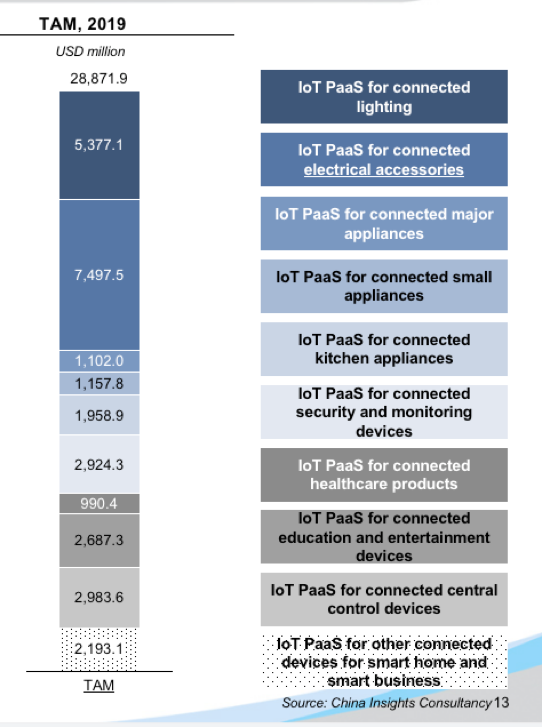
Source:CIC
2024 Global IoT PaaS Market Size (Smart Business and Smart Industry)
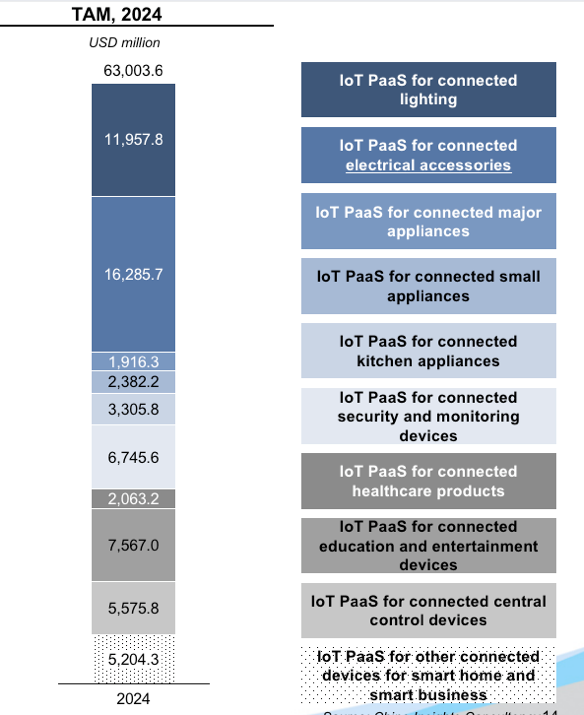
Source:CIC
At present, intelligent hardware has evolved from 1.0 of simple connection (connection between devices and the Internet), to 2.0 of interconnection of all things (connection between different devices), and to 3.0 of the intelligence of all things, that intelligence is not only the connection between hardware, but can also detect users' preferences and habits, to provide the best use scenarios to meet the consumer demands. In other words, the intelligence of all things is the upgrading from interconnection to intelligent services.
Smart Business Scenarios
From CIC report
Based on the foundation built by intelligent hardware, the AI+IoT industry has become an ecosystem with individual intelligent hardware integrated into different smart business scenarios. Traditional vertical industries have also put forward new demands during the digital transformation, which has accelerated the development of SaaS and PaaS-level solutions in the fields of home, hotel, apartment, security, community, industry, and agriculture.
According to data from CIC, smart hotels, long and short-term rental smart apartments, smart communities, and smart office buildings are the four key IoT SaaS smart scenarios. The total market size reached 22.8 billion US dollars in 2019, with smart communities accounting for 85% of the total market. The reason is that property and real estate companies have relatively more capital and are willing to pay for IoT SaaS.
The market penetration rate of smart hotels can be as high as 60%, as more and more hotels hope to satisfy and attract potential customers by improving their housing experience. And with more and more big brand hotels are deploying smart hotels, SaaS smart hotels will become the normal for every top hotel in the future.
According to CIC, as the Internet becomes more popular, the IoT SaaS market will see significant growth with an increasing number of connected devices.
2019 Global IoT SaaS Smart Scenario Market Size
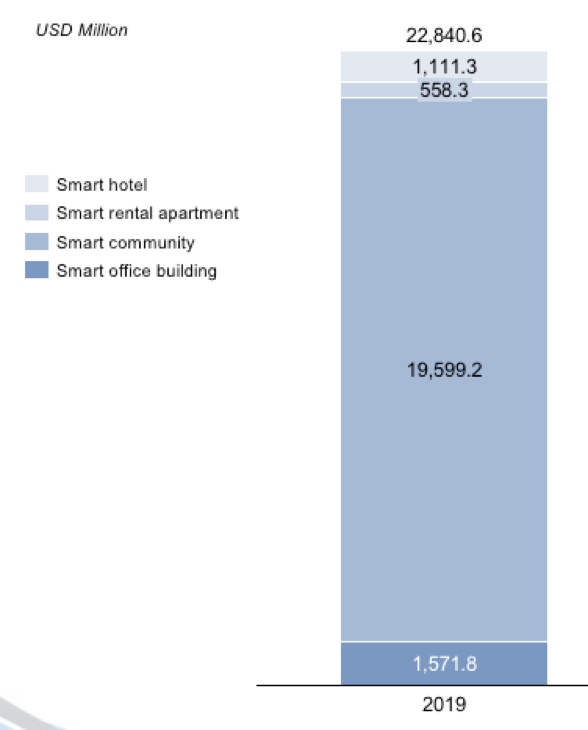
Source:CIC
In the future, the intelligent industry ecosystem will continue to explode, and the diversified vertical industries will flourish. Traditional industries will be gradually upgraded to intelligent business. In the process of these vertical industries turning smart, platform-level enterprises will become the cornerstone and lead the wave of intelligent business.
2.1.1 Major and Small Home Appliances
1. Overview of the Home Appliance Industry
As widespread adoption of AI and the IoT, the intelligentization development in the home appliance industry has made a preliminary progress. Meanwhile, the number of users for smartphones and smart speakers has increased very quickly, promoting the update and development of smart home products greatly.
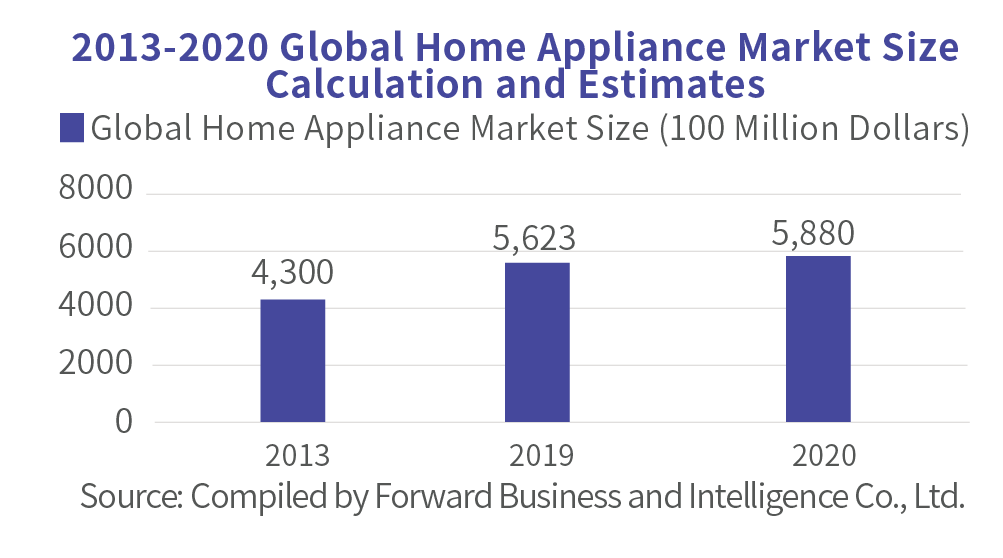
According to the data from Statista, a world-renowned data analysis company, the global market size for home appliances reached 430 billion dollars in 2013 and the number is expected to be up to around 588 billion dollars in 2020. As for the major home appliance market, in 2019, the global sales reached 203.1 billion dollars, up by 3.4 % year on year.
Figure 1. Statistics and Anticipation of Global Home Appliance Market Size (2013-2020)
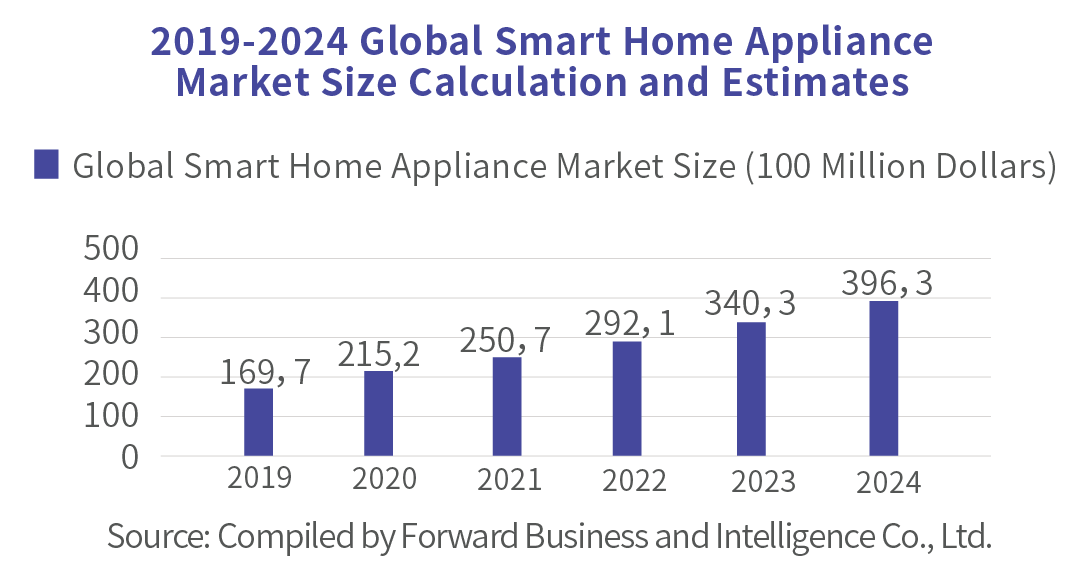
In the smart home appliance field, in 2019, the global market size for it reached 16.97 billion dollars and in 2020, the number is expected to reach 21.52 billion dollars, up by 26.8 %. In the next five years, the global market size for smart home appliances will achieve a compound annual growth rate that equals to 16.5%, reaching 39.63 billion dollars in 2024.
Figure 2. Statistics and Anticipation of Global Home Appliance Market Size (2019-2024)
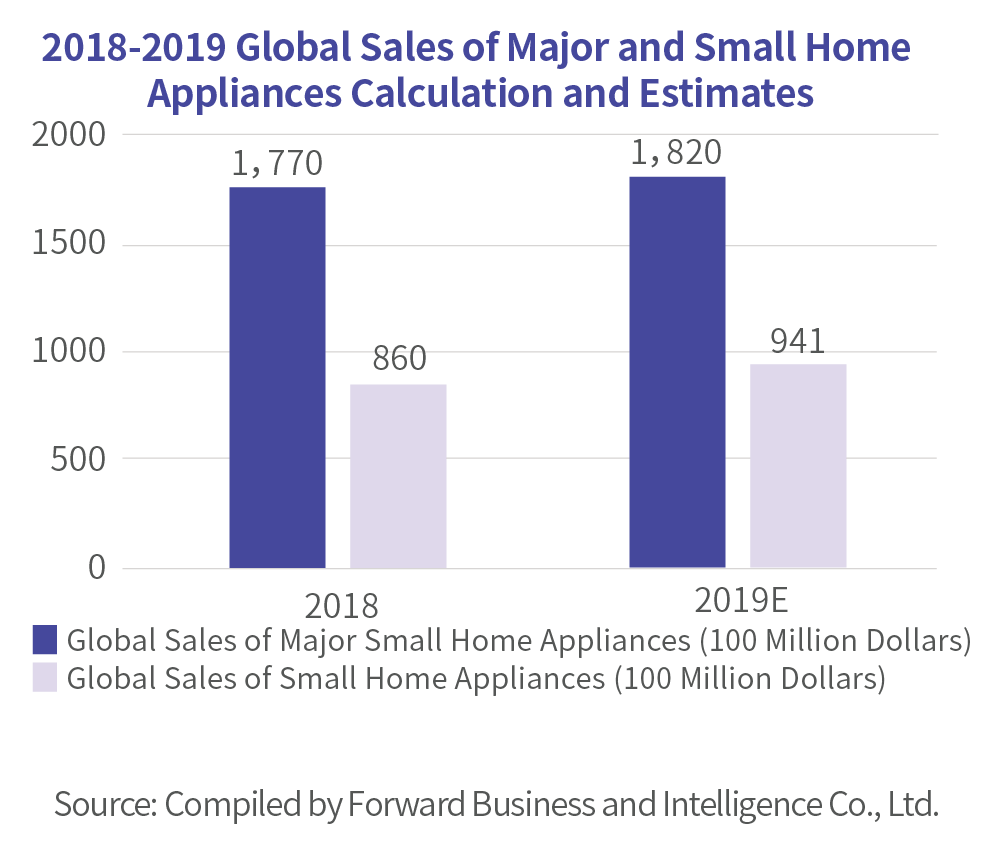
According to the data by GfK Temax, in 2018, the global sales for major home appliances reached 177 billion euros and the number for small home appliances was 86 billion euros, accounting for 32.7% of the global sales for home appliances.
Figure 3. Statistics of Global Sales of Home Appliances (2018-2019)
Compared with the traditional home appliance market, smart home appliances can meet diverse life demands of new consumer groups and largely improve the interactive experience of home appliances to create a cozy, intelligent and immersive life environment. According to the development trend, the smart home appliance industry will lead the consumption upgrade for a long time in future. The smart home appliance market has a great prospect.
1.1 Smart Major Appliance Industry
Smart major appliance refers to home appliances such as air conditioning, refrigerator, washing machine and television, featuring taking up a large space, high cost and low replacement rate and being the major application scenario in smart living. Currently, the market of smart TV, smart air conditioner, smart refrigerator and smart washing machine is pretty mature. The leading manufactures in the industry keeps updating the existing products, developing and introducing innovative and scenario-based ones.
Among traditional home appliances, the highest penetration rate is smart TV which can reach over 95%. Smart TV is also the most frequently used as well as the most interactive entry level smart product among the smart home appliances. The proportion of smart major appliances, for example, air conditioner, refrigerator, washing machine and etc. is increasing rapidly through innovation and iteration in the functions of remote control, connectivity and voice interaction.
1.2 Smart Small Appliance Industry
Different from the smart major appliance industry, the smart small appliance industry is more diversified, including smart sweeping machine, smart air purifier, smart heater and smart fan, being in various forms. It has market demands under different scenarios and provides great interactive experience based on its functions, such as device status alert, time-sharing and schedule setting and real-time remote interaction. The smart small appliances have gained a firm footing in the market place quickly for being easy to use and with clear functions and high replacement rate. At the same time, new brands in the industry have been growing rapidly. In particular, the emergence of creative products makes the industry enjoy broad market prospects.
1.3 Smart Kitchen Appliance Industry
eople’s passion for food has never diminished though the ages. In the past, people were only concerned with eating with fill, whereas at present, they want to eat well. people’s relentless pursuit of good food also changes the definition of modern kitchen.
In recent years, they have started to adopt a healthy diet supported by science and wanted to cook easily and smartly. Therefore, products such as smart range hoods and cooktop, smart oven, smart soft cooker, and smart air fryer have been developed. Different smart kitchen appliances provide targeted and professional cooking methods according to what the ingredient is. At the same time, these devices can help cook delicious food easily by being smart and connected with diversified recipes online to ensure the correct amount of ingredients and operate automatically. These functions allow the industry to develop and expand further.
1.4 Smart Pet Products
The pet ownership is on the rise and the pet economy is also growing. Having dogs or cats is not only for leisure. Instead, pets often offer emotional attachment. Pet owners have greater demand, with more and more young people hoping more than just keep their pets alive. A lot of people who were born in 1980s and 1990s are willing to spend their money on pets to please themselves and enjoy the life to the fullest.
With regard to pet food and accommodations, products such as smart pet feeder, smart drinking dispenser, smart self-cleaning litter and smart pet toys have been promoted for remote monitoring, regular feeding and real-time interaction. The smart pet products help pet owners to show their care and love in a real time way, let owners keep pets easier and make pets feel less lonely, and provide a concreate way for users to express their emotions.
With an increasing number of young people who would keep pets, the acceptance and demand for smart pet products will also continue to grow. Market potential will be huge.
In a word, the continuous technological change and consumer’s pursuit to make life easier make the smart home the best choice in the future. And the improving and upgrading Smart home related industries also give consumers more choices. With growing consumer demand, all sectors in smart home market will develop rapidly. We can see that planning ahead will be helpful for business transformation.
2. Solutions
Currently, there are some smart kitchen solutions with functions such as the clouding platform for menus, interconnection between multiple devices and intelligent speech interaction, concentrated on kitchen and home scenarios. It makes use of synergistic partnerships between kitchen appliances to offer the best cooking experience from purchasing ingredients to personalized recommendations on ingredients, satisfying users’ everlasting demands for various delicious food.
In the scenario of smart kitchen, the smart refrigerator is the central hub, recording and managing food ingredients in storage. It can also recommend healthy diets and recipes based on users’ personal preference. Meanwhile, it can be linked to the food ingredient market, with food ingredient shopping lists automatically generated for recommended recipes, to materialize the smart purchase by one click.
With preset recipes, refrigerators can control the whole kitchen by connecting with smoke exhausts, gas stoves, ovens and fryers to realize the whole process of cooking including purchase, storage, cook and cleaning. Users can enjoy the convenience of smart kitchen.
In addition, through the connection with public clouds, screens on refrigerators can show videos from video doorbells, ensuring a holistic approach for the safety at home. With the speech function of smart speakers, users can use voices to control devices such as stoves, which is convenient and interactive.
SKYWORTH Air Conditioning
Shenzhen SKYWORTH Air Conditioning Company was founded in June, 2014 as a wholly owned subsidiary of SKYWORTH Group. It is an environmentally-friendly and intelligent air conditioning manufacturing company with capabilities of R&D, production and sales. It has top R&D and manufacturing teams in the industry with advanced laboratory equipment from both home and abroad and its sales channels cover all over the world. Currently, it has two manufacturing bases, namely Shenzhen Longgan Base and Zhuhai Jinding Base, with a total designed yearly production capacity of 5 million.
Among all home appliances, an air conditioner is the product that can directly offer a cozy and healthy environment for users and it is an indispensable part of smart home. There are two reasons for the success of SKYWORTH Air Conditioning: first, SKYWORTH wants to increase its product categories; second, it is a part of the company’s smart home strategy in the era of smart home. In recent years, as the growth of air conditioning sales in the domestic market slows down, the market in China has become highly competitive. Many air conditioning companies are expanding their international market shares, so is SKYWORTH. Faced with various customer brands and customer demands, SKYWORTH also tries to find the best solution for its customers.
In 2019, SKYWORTH Air Conditioning released its voice-controlled smart Wi-Fi air conditioner. This air conditioner is not only intelligent, but also allows users to control other IoT devices by giving voice instructions to it. In this case, the air conditioner becomes the smart center of all smart home appliances and makes separated appliances connected with each other. The case also offers brand a new solution for home appliance intelligentization that one kind of home appliance can be more than just an ordinary product and it can be upgraded as the smart center to control other devices.
SKYWORTH air conditioners are sold globally. Unlike traditional home appliances, smart home appliances face challenges such as various internet speeds and varied response time in cloud computing in different regions. As a smart device, when sold to different regions and countries, it needs to deal with issues such as connection to local data centers and clouds, distribution of networks and match with local mainstream smart voice assistants.
Based on global third-party AIoT platforms, SKYWORTH air conditioners can be controlled and managed by popular smart speakers such as Amazon Alexa and Google Home in the international market. In the past, SKYWORTH managed various clients’ materials of different regions separately, which was inconvenient and time-consuming. However, with unified materials, now SKYWORTH only needs to maintain one material account for devices, which simplifies management and greatly boosts the efficiency of maintaining smart devices.
Qingdao Haier Smart Home
Haier Group was established in 1984. Qingdao Haier, one of the Global 500, is the main brand of home appliances in Haier Group and changed name to “Haier Smart Home” in June, 2019. Since its establishment, Haier Smart Home has founded dozens of manufacturing and R&D centers and offered eight kinds of products such as refrigerators, washing machines, air conditioners, water heaters and freezers. It is the only home appliance brand in China that has created a sound ecosystem for smart home from products, services to the brand.
As home appliance market has been saturated in recent years, it is a consensus in the industry to find new profit drivers. With the increase use of 5G technology for business and the development of IoT, UI and smart terminals have been upgraded. In the meantime, lots of customer demands have not been met yet. Home appliance companies are at the critical stage to intelligentize themselves.
Unlike other companies which have just started their smart home journey in recent years, Haier Smart Home began its own journey long time ago. In 2006, it founded and operated U-home Lab to test the reliability of smart home appliances. In 2010, it released the first IoT refrigerator in the world. In 2015, it further expanded smart home market by launching the U+ App.
Many companies start their smart home business by offering one category of smart devices, which causes difficulties for interconnection between various categories of devices. According to relevant statistics, there are averagely over 40 electrical devices of more than 10 brands in every family. Due to different systems, these devices are separated from each other and they are difficult to be connected together.
Additionally, limitation of application scenarios is also the existing difficulty in the field of smart home appliances. Segmented scenarios at smart home are important indicators to test whether smart home appliances are “humane”. Only by knowing about scenarios and customers’ demands and discovering more segmented application scenarios can a company serve users better. Undoubtedly, customers also prefer brands that can cover more segmented scenarios.
As for existing problems of smart home appliances, Haier Smart Home deals with them in the process of intelligentization by its ecosystem and application scenarios. Haier Smart Home shapes itself as a solution provider for all IoT application scenarios, offering all categories of products including refrigerators, freezers, washing machines, air conditioners, water heaters and kitchen appliances. With these smart products, Haier Smart Home offers customers “5+7+N”, a whole set of solutions for all scenarios, with features of“being a complete set, customization and iteration”.
However, in order to offer more diversified scenarios and services, Haier Smart home cannot achieve the goal of covering all scenarios just by itself. Therefore, in the course of intelligentization, it chooses to cooperate with Tuya Smart, a global AIoT platform, to enhance its scenario ecosystem for smart home by creating seven ecospheres including Internet of Clothes, Internet of Food, Internet of Air and Internet of Security.
GUANGDONG XINBAO ELECTRICAL APPLIANCES HOLDINGS CO., LTD
Guangdong Xinbao Electrical Appliances Holdings Co., Ltd was founded in 1995. It is a listed company focusing on developing, designing, manufacturing and selling kitchen appliances, homecare appliances, baby appliances, health and beauty appliances, intelligent appliances as well as electrical accessories and etc. Xinbao Co., Ltd is one of the export leaders of China’s small household appliances industry, with a leading export volume of ten categories of small household appliances for 10 consecutive years.
Now, Xinbao has grown into a leading enterprise in China’s small appliance industry, leading and participating in the formulation of a number of national standards. Owning multiple core technologies, more to the point, Xinbao has driven tremendous growth of the enterprise by industrial design, and has won many design awards including Red Star Design Award, Innovative Design Award, IF Award,Red Dot Design Award as a typical enterprise that evolves from “ made in Guangdong” to “ designed in Guangdong” and finally to “designed in china”. It has been recognized as a National Enterprise Technology Center, Provincial Engineering Technology Research and Development Center, National High-tech Enterprise, with more than 3300 patents including nearly 300 invention patents.
With a keen sense of the market, Xinbao deeply understands the increasing need for intelligent products in the market, and quickly starts to find the best way to upgrade its products to the level of intelligence. In the Canton Fair in 2018, Xinbao firstly met Tuya Smart and after primary communication and research, the two sides found themselves in great harmony and agreed to cooperation at the end of 2018.
As a well-known brand of small household appliances that are ready for export overseas, Xinbao has a wide product range and a huge capability matrix. Tuya Smart is also a rapidly-growing enterprise that has enabled thousands of companies with their products intelligence upgrading, accumulating rich experience and comprehensive development programs.
Relying on the technology of Tuya, developers of Xinbao only need to embed the cloud module of Tuya into the existing circuit to complete the hardware development. In terms of software development, Tuya offers multiple SDKs for Xinbao to complete the integrated construction of control end, cloud side and equipment side, as well as to tremendously shorten the period needed from conceptual design to sales and use of products.
Based on its own innovation and technology genes, Xinbao, joining hands with Tuya, has achieved rapid, efficient and low-cost intelligent upgrading for its current products, and quickly met the intelligent requirements of its global customers of its products. At present, Xinbao has accomplished intelligent upgrading of many of its products including its coffee maker, bread maker, humidifier, kettle and slow cooker, etc. The launch of those new products is greatly welcomed and recognized by the global market and its consumers.
Anker Innovations Technology Co., Ltd.
Ever since its establishment in 2011, Anker Innovations Technology Co., Ltd. ("Anker Innovations") is one of China's largest suppliers of export-bound consumer electronics, specializing in the design, research and development and sales of intelligent accessories and intelligent hardware. Anker has always been committed to shaping a Chinese consumer electronics brand for the world. Through continuous innovation, it has brought leading scientific and technological products to global consumers, a full demonstration of the strength of China's intelligent manufacturing.
Anker Innovations has successfully created the smart charging brand Anker, and has successively launched independent brands such as Soundcore (Speaker and Headset), eufy (Smart Home) and Nebula (Audio and Video Entertainment) as it stepped into the smart home field. It has made three smart hardware brands over a period of nine years that were sold 1.5 billion yuan each per year, winning nearly 80 million loyal users in more than 100 regions and countries around the world.
Since its establishment, Anker Innovations has grown at an annual growth rate of more than 50%, far exceeding the industry average growth rate: revenue in 2018 reached 5.232 billion yuan; In 2019, the annual sales reached 6.655 billion yuan. In August 2020, Anker Innovations was listed on the Growth Enterprise Market of Shenzhen Stock Exchange, with a revenue of 6.019 billion yuan from January to September 2020. Its market value is about 50 billion yuan.
Anker Innovations has done pretty well in AIoT, smart home, smart acoustics, and smart security. For example, in the field of smart home, there are sweeping robots, wireless vacuum cleaners, smart bulbs, smart switches, and smart scales. In the field of intelligent security, there are security cameras, intelligent doorbells, intelligent door locks and other products, which occupy a large share in the United States, Europe, Japan and other markets, representing high brand presence and user satisfaction.
To build up its competitiveness in the international market and remove the original main products-conventional charger products, Anker Innovations has continuously increased its R&D investment, actively worked on AIoT, based new growth points on smart home products. It had worked to launch wireless audio products and smart innovation products. The proportion of these two new product series in the main business income increased from 26.40% in 2017 to 41.97% in 2019. At present, Anker Innovations provides more than 1,000 product models, which better meet the diversified needs of the global consumer electronics market.
On the pathway to the integration with AIoT technology and quick realization of the intelligent upgrading of traditional household appliances, Anker Innovations chose to carry out in-depth cooperation with Tuya Smart, the world's leading AI + IoT developer platform. Since 2018, Tuya Smart has been providing stable and secure cloud storage and connection solutions for Anker Innovations’ intelligent hardware products, thereby effectively reducing its development costs and accelerating development progress. With the support of Tuya Smart's cloud module series services, eufy and other intelligent products under Anker Innovations brands are able to offer stable network connection and data transmission. A stable, efficient and safe interactive experience is ensured for products shipment quantity up to tens of millions.
IPC Market
1. Market size and estimations
According to a 2019-2022 survey, a total of 44 million units of IPC will be shipped in the global smart security products market, representing an average growth of 20% over four years.
Looking at different countries, the sales volume of consumer IPC is closely linked to their respective economic status and household consumption expenditure. The National Bureau of Statistics reported that China’s household expenditure accounts for less than 40% of its GDP, a number far smaller than other economies. Globally, the household expenditure accounts for approximately 69% in the USA, 63% in the UK, 56% in Japan and 54% in the European Union. Compared with only about 39% in China, the number is visibly smaller.
From the global consumer IPC shipment data 2019-2020, the annual shipment to the North America accounts for over 60% of global amount, meaning approximately 10 million units, which is followed closely by Europe. In China, the market is on the track of recognizing consumer IPC. Currently, shipments were made mainly from the three biggest telecommunication operators, in which China Mobile and China Unicom are the major player, who shipped approximately 3 million units from 2019-2020. Riding on this trend, with growing population and escalating economic level, China’s consumer IPC market could exceed that of the North America in 2022.
2. Consumer IPC industry analysis (Industry key players)
(1)Industry Key Players in China
Leading players in the market include 360 and Imou. Due to varying preference between Chinese and overseas consumers, mini cameras are not as popular as versatile cameras locally.
For those key industry players, China Mobile, China Unicom and China Telecom offered only versatile cameras in the recent one year. Apart from these operators, another major player locally also includes online retailers, namely JD.com, Taobao and Pinduoduo.
Currently, IPC prices are trending down, overseas sellers priced at RMB250 on average, while it was only about RMB100 if sold by domestic sellers. It is observed that before IPC sales volume ticks up significantly, the prices are already kept at very low levels. If the trend continues, it is expected that only a tiny fraction of the 1000+ manufacturers will survive here domestically.
(2)International key players
The North America, as a demonstrable market, key players are Ring and Arlo. Consumer IPC has seen exponential growth because the two players began to educate the market three years ago. Many other established brands, such as GE and Philips who focus on smart lightings, are beginning to sell IPC products, riding on the trend of IoT smart products.
In contrast to China’s market, leading brands in the North America rolled out their respective star products for consumer IPC. Ring offers video doorbells, Arlo offers low-power IPC pack. The two brands are the forerunners of consumer IPC in the North America, whose product MSRP (suggested retail price) continues to remain high as brand influence has been boosted by over three years of marketing. Wyze, an emerging brand in recent two years focuses on low-priced mini cameras and versatile cameras, who marked a legendary sales record on Amazon by distributing over 1 million units in a year. More fresh IPC brands are emerging offering basic types of mini and versatile cameras, making the cheap mini cameras a household device.
3. Major types of consumer IPC
Mini Camera
Basic function type of IPC comprises of the body and a stand. The body has the major parts of imaging unit and audio receptor. The stand allows multi-directional rotation to adjust the suitable angle for installation. Main features include its convenience and portability. Once finished installation, the area under monitor is fixed unless adjusted manually. Other features include video, audio, infrared, indicator light, SD card and power jack.
Versatile camera
Versatile camera supplements what a mini camera is unable to cover in a wider area, that by adding a cloud platform feature which allows users to control and change the position of the camera, hence adjusting the area under monitor. Thus, it is building on a mini camera that adds on cloud platform-related features.
Cloud platform control: Through mobile App, users can adjust the camera in 8 directions for monitoring the target area. The cloud platform can control the camera to rotate horizontally and vertically to adjust the area for monitoring.
Remark: Common types of cloud platform cameras can rotate approximately 300° horizontally, hence achieving an all-round monitoring through the lens width. Some of the upscales types supports 360° horizontal rotation, allowing fast rotation to any angle. These upscale cameras are more costly.
Default Setting: Areas to be monitored are usually fixed. Using cloud platform to adjust camera to certain positions repeatedly could be troublesome and may affect accuracy. The device has default setting function to pre-set certain camera angles as default, allowing simple click to rotate the camera automatically when deemed appropriate, thus enabling quick switch to monitor places such as door entrance and windows, where vigilant monitoring should be needed.
Patrolling: Adding on the default setting, the device supports automatic patrolling, monitoring all of the areas without manual manipulation. This feature is similar to automatic security patrol, monitoring the pre-set target areas one by one. The device also supports setting up of patrol clock, and how much time will be spent on monitoring a specific area. Remarks: Patrol function needs hardware support for frequent rotation, buyers may need to pay attention when making purchase.
Outdoor camera:
Designed for outdoor purposes, which is susceptible to changes of environment as different from indoor. One key feature is water and dust-proof, with improved versions supporting enhanced features of security and police-calling.
Water and dust-proof: Typically marked as IPXX, with the first number as dust-proof level and the second water-proof level. It defines how a device can still operate under specific conditions, ensuring it will be functional under undesirable weather conditions such as rain, snow, wind or dust. Device gradings can be seen as below:
IP gradings (IPxx)
IP First number Second number
0 No protection No protection
1 50mm solid substance, eg. Hand-touch water drip, eg. condensation
2 12mm solid substance, eg. Finger direct water-spray, tilting not over 15°
3 >2.5mm solid substance, e.g. gadgets, power cable water spray, tilting not over 15°
4 >1mm solid substance, e.g. gadgets, thin power cable water-spray from various angles, moderate water-proof level
5 Dust-proof –moderate dust-proof level (no harm to device) low-pressure water-spray from various angles, moderate water-proof level
6 Secure and dust-proof High-pressure water-spray from various angles, eg. Ship cabin, moderate water-proof level
7 submerge in water 15cm to 1m
8 Persistent submerge in water possible
Common outdoor cameras should require at least IP65, while IP66 is suggested.
Color and night vision camera: In contrast to infrared light used in indoor area, some outdoor cameras are equipped with white light, since it eliminates the concern of disturbing people in an outdoor area, while also allowing the light to be seen by lawbreakers as an alarm. More details can be seen through color camera. Light and sound can be of alarming effect.
Low-power(battery) camera
The above camera types have their own characteristics and appropriate scenario, one commonality is that they must be connected to power or internet, which means that the installation must be made near power socket or internet-covered areas, limiting the versatility of the devices to be installed. Longer power cables exposed presents certain risks and may be too visible to people. To solve the problems, a battery-powered camera is thus produced. Powering the device from batteries and Wi-Fi enables installation at any designated place without needing a connecting cable, maximizing versatility while not having to compromise your home aesthetics.
Device waking up: Devices on dormant mode do not capture pictures and conduct analysis. Usually a built-in sensor is installed to alert of capture and the time of it, and waking up the device. In a home setting, it is mainly used to monitor the people coming in and out, hence PIR technology to monitor if an invasion is being made.
PIR: PIR is the abbreviation of Passive Infrared Detector. This detector can target human movement while not affected by movement of pets and objects, enhancing its accuracy and lowering power use. PIR can be used on battery-type devices or other devices.
Battery Life: One key parameter of battery-type device is the battery life, which is a major factor for battery charge frequency and its use. Battery devices usually are installed in areas with less human movement due to its wake-up mechanism. Hence, if people movement is frequent leading to frequent wake up of the device, the batter life will be significantly shorter.
Lloyd’s
Enter just about any large retail store in Mexico, including The Home Depot, Walmart, Sam’s Club, or Best Buy, and you’re almost certain to find Lloyd’s products.
But the company’s beginnings—like that of so many successful companies before it—were humble, inspired nearly 30 years ago by the founder’s desire for an automatic lighting solution in his apartment building’s hallways.
He found one and he took it to market. And the rest is history.
Today, Lloyd’s motion sensors, smart lights, and high-definition IP security cameras can be found in more than 400 stores across Mexico and South America. Lloyd’s products are easily and remotely managed through any smartphone via the Lloyd’s Smart application, which is available on Android and iOS.
Of course, Lloyd’s hasn’t always been plugged into smart technology. In fact, wireless technology the way we understand it today wasn’t even around when the company started off many years by selling its motion sensors.
Lloyd’s saw an increasing interest in and need for the integration of smart phone technology to its products, such as the ability to control its lighting or security solutions from mobile phone apps.
In Tuya, Lloyd’s saw a chance to get an entire IoT ecosystem—app + connectivity + cloud—in one shot, plus the huge advantage of also being able to tap into Tuya’s vast global manufacturing network.
Thanks to Tuya, Lloyd’s was able to launch its first smart home line. In Mexico, smart security is a market with huge potential, and Mexican families invest heavily in security devices to protect their homes, both rented and owned.
Lloyd’s smart camera set a smart home security precedent in the Mexican market, greatly reducing the price threshold of Mexican smart security products and making affordable and convenient smart security products accessible to more local consumers. For example, unlike traditional cameras that only have monitoring functions, Lloyd’s smart cameras can actively respond to the recorded images and alert users to potential crime or intrusions.
Another example is Lloyd's family alarms. Unlike conventional products, which simply sound the horn, Lloyd's family alarms automatically send warning information to family members if the alarm is not cleared within one minute to ensure a timely response when danger comes.
These smart security products are more in line with the security needs of local consumers in Mexico and have become the best-selling products in the Mexican market.
In the future, Lloyd’s plans to launch more smart home products around smart security to fully meet the needs of consumers. Building on their increased smart home presence and ease of new product introduction that Tuya has enabled, Lloyd’s plans to broaden its reach not just geographically but also portfolio-wise as it builds smart home and smart security awareness in Latin America.
Hangzhou Meari Technology Co., Ltd.
Hangzhou Meari Technology Co., Ltd. is a smart technology company specialized in the R&D, production, marketing and operation of IoT, smart home, and civilian surveillance products. As a R&D- and technology-focused company, Meari has built a full-fledged R&D team, with over 80 R&D engineers working on architecture, hardware, embedded software, APP and server. It is particularly competitive in low power consumption products.
The Meari product line boasts a complete set of civilian surveillance products, including various types of cameras, doorbells, garden lights and baby monitors. Its products have penetrated from developed markets including Europe, America and Australia to developing markets including Southeast Asia and South America, and have gained popularity on e-commerce platforms such as Amazon and AliExpress.
With the rise of smart home, demand for civilian surveillance products has been increasing, especially in North America, where demand has surged driven by leading companies such as Arlo and Ring. However, civilian surveillance products are different from traditional security products, which impose high requirements on App, server and cloud architecture, as well as ongoing demand for value-added services such as cloud storage and AI.
To address these pain points, Meari encapsulates the interface between security devices and App quickly through its access to the global cloud and App SDK. With the ability to invoke relevant APIs, developers only have to develop embedded software to realize connectivity between devices and App/the cloud.
In addition to smart security products, Meari has been expanding its business and diversifying its product portfolio by accessing other smart platforms, developing other smart home products with surveillance module as the core, such as mopping robots, pet feeders, and lamps.
In terms of global business, Meari also has rapid access to smart voice platforms such as Amazon and Google through the global AIoT platform, which allows it to update third-party voice service in real-time and enhance the performance of its smart products.
Meari offers a diverse product portfolio with ten-plus models of civilian surveillance products. With an annual production capacity of over 5 million units, it manufactures products of its own brands and serves dozens of well-known players in the industry. Its products have presence in dozens of countries around the world, and are available in most of the major supermarket chains in Europe and the United States.
1. Overview of the Sensor Industry
At present, about 40 countries in the world are engaged in the development, production and application of sensors, among which the United States, Japan and Germany are quite strong. There are more than 6,000 research and development institutions and about 26,000 different types of products. Sensors evolved through three generations of technology: structural sensors, integrated sensors and intelligent sensors. China’s sensor industry has formed a spatial pattern featuring four major regions (the Yangtze River Delta, the Pearl River Delta, the Bohai Rim, and the central and western regions) based on its obvious geographical distribution characteristics. Here is a general introduction to the sensor industry with a few charts.
Figure 4. 2016-2020 Global Sensor Market Size Forecast
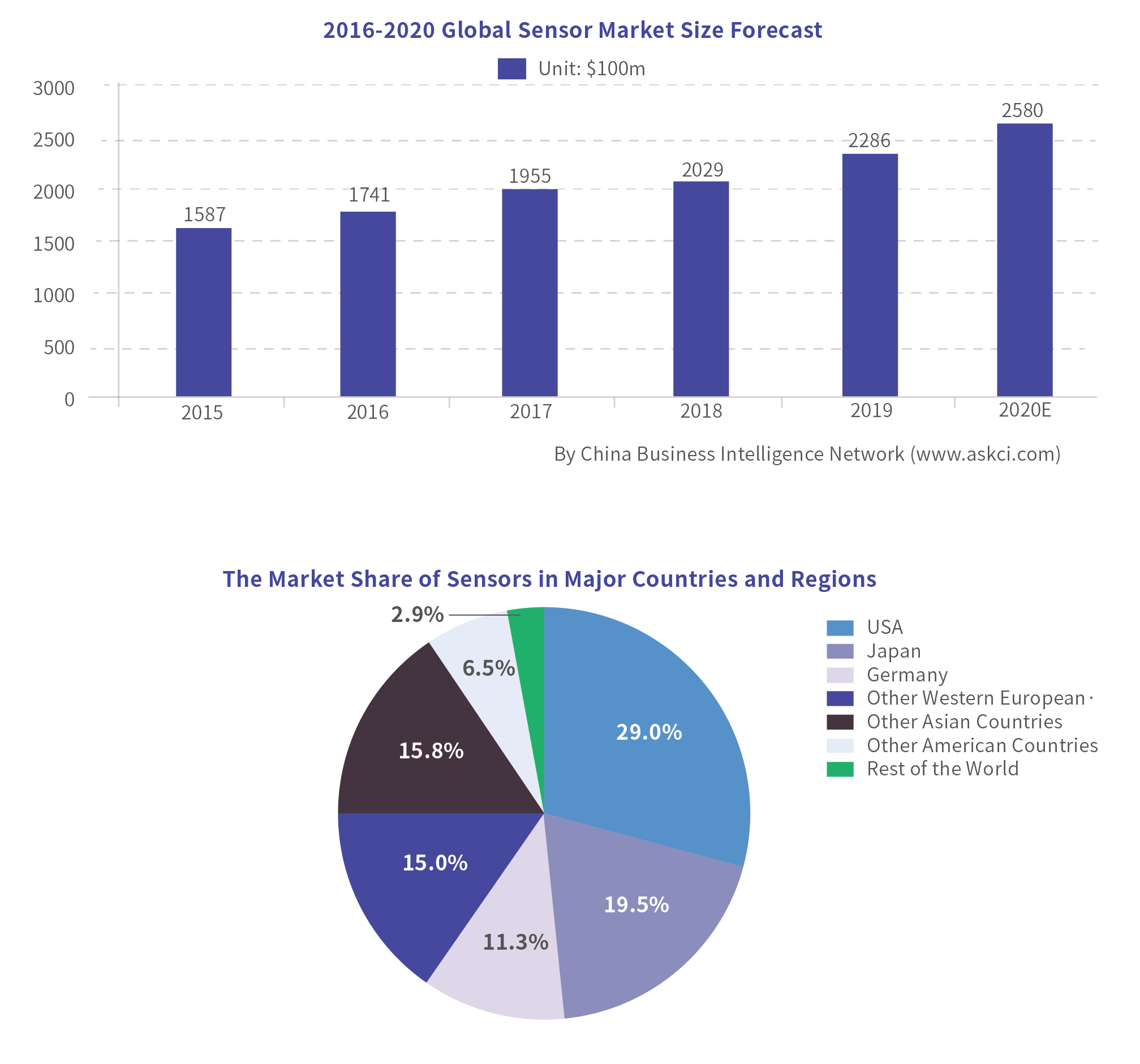
The global sensor industry has been growing steadily from 2015 to 2020, and now it is a huge market worth over $250bn. The United States is the largest sensor market in the world with a share of 29%, followed by Japan and Germany
Figure 5. 2018 Global Sensor Market Competitive Landscape (Unit: %)
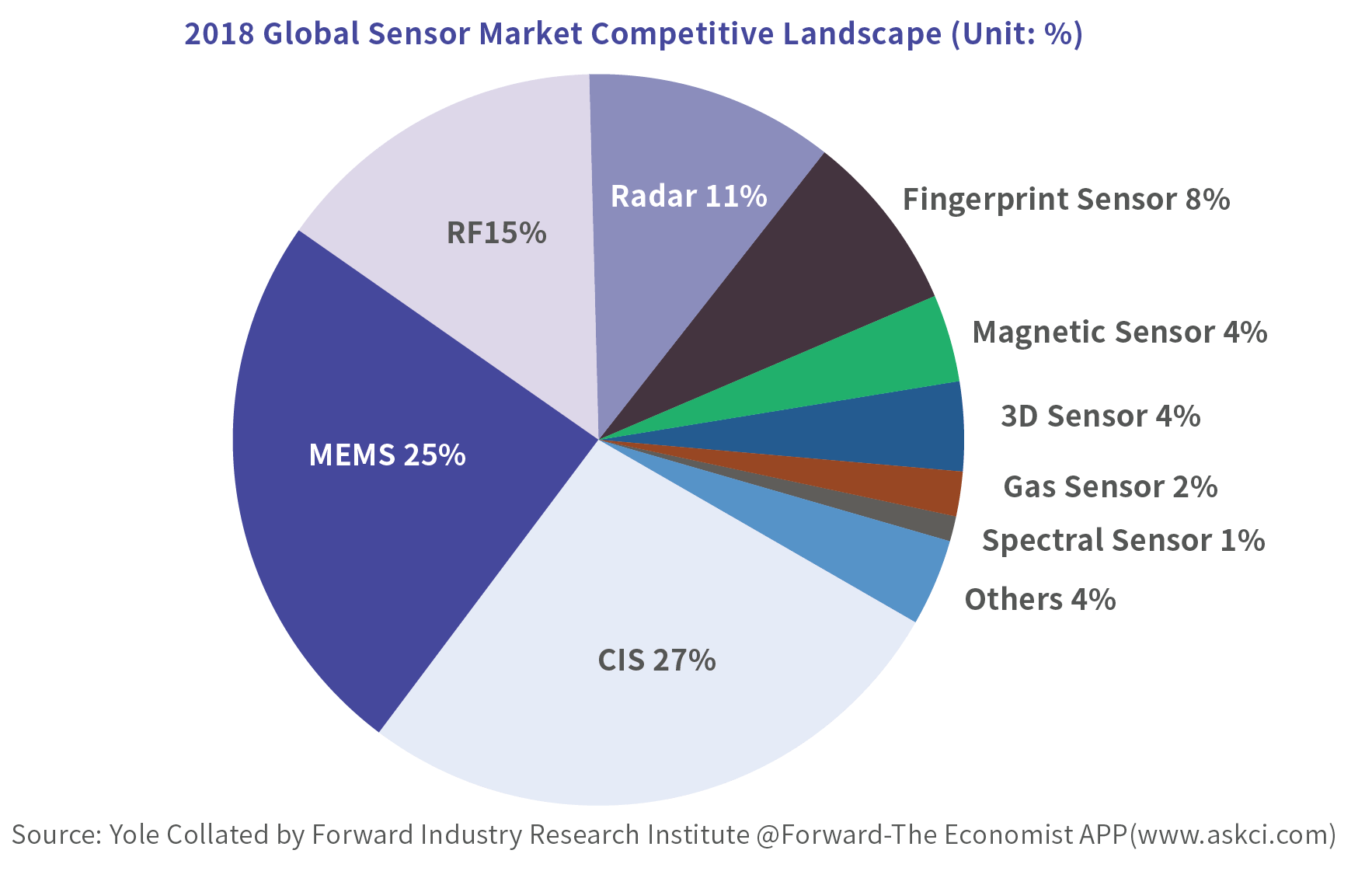
Figure 6. 2019 Global Sensor Market Size and Structure
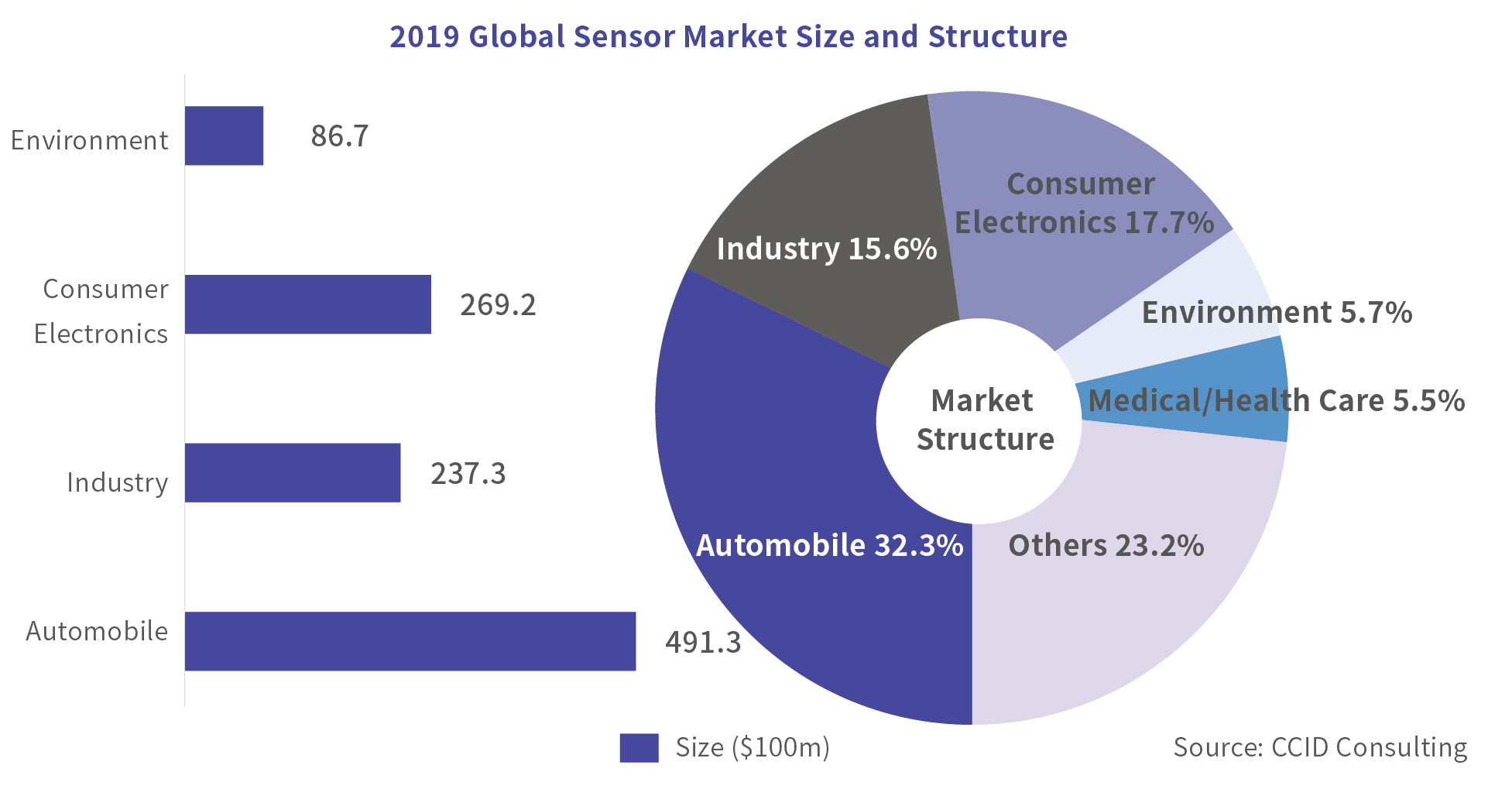
From the perspective of product structure, CMOS image sensors (CIS) accounted for 27% of the global market in 2018, followed by MEMS sensors (micro-electromechanical system) with a share of 25%. Fingerprint sensors as a type of single-material sensor enjoyed 8%.
From the perspective of market, sensors were mainly applied in automobile, consumer electronics and industry which accounted for more than half of the market share, about $100bn.
Figure 7. World IoT sensors market size
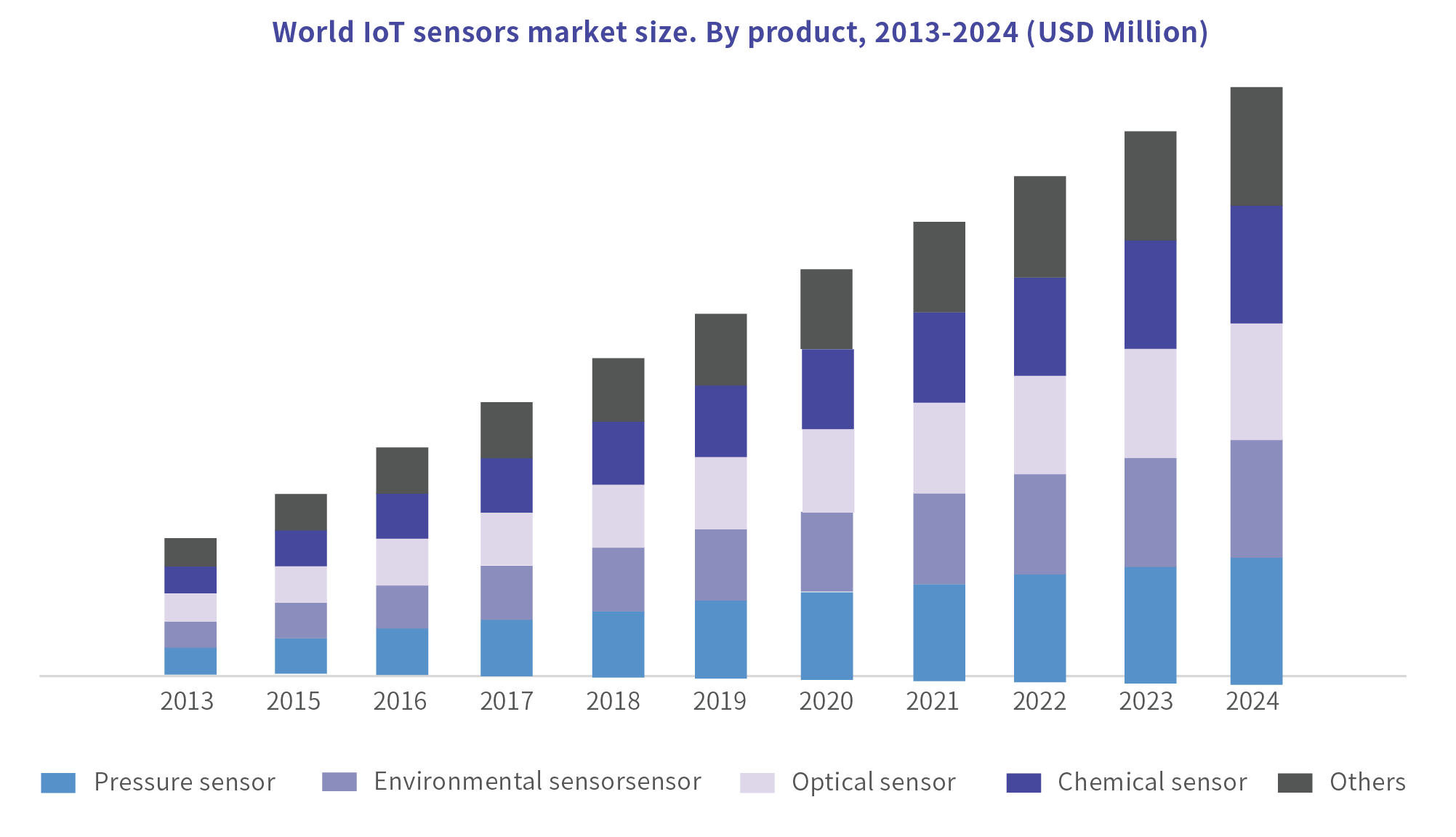
From 2013 to 2024, the global market size of smart sensors is expected to grow rapidly with a compound growth rate of 18.2%, reaching about $1.4bn in 2019. Each type of smart sensor (pressure/environmental/optical/chemical) shares a similar volume.
World IoT sensors market research report 2024 (covering USA, Europe, China, Japan and etc.) market share by application, 2019(%)
From the perspective of application, smart security enjoyed the largest market share (about 30%), followed by smart energy management (about 23%) and wearable devices (13%).
Smoke alarms, temperature sensors and infrared sensors accounted for more than 50% of the demand. As people pay more attention to the environment and health, PM2.5 detectors had the highest growth rate in demand. In addition, due to the needs such as elderly care and enhanced awareness of security and fire protection, the demand for human presence sensors, smoke alarms and infrared sensor increased significantly, all above 30%.
2. Sensor Solutions
A sensor is a detection device that senses the measured information and converts it into electrical signals or other required forms based on certain rules, so as to meet the needs of information transmission, processing, storage, display, recording and control.
Sensors are featured by miniaturization, digitization, intelligence, multi-functionality, systematization and networking. As the primary condition to realize automatic detection and control, sensors and their development enable objects to have senses such as touch, taste and smell, making objects come to life. According to their basic perception functions, sensors are generally divided into ten categories: thermal sensors, light sensors, gas sensors, force sensors, magnetic sensors, humidity sensors, sound sensors, radiation sensors, color sensors, and taste sensors.
Sensors are usually composed of four parts: sensing element, conversion element, conversion circuit and auxiliary power supply. The sensing element directly detects the measurand and outputs corresponding physical quantity signals. The conversion element converts the physical quantity signal into electrical signal. The conversion circuit is responsible for amplifying or modulating the electrical signal. The conversion element and conversion circuit usually need to be powered by the auxiliary power supply.
2.1 Cases in the Sensor Industry
Sensor products are essential in various fields including home appliances, security, commercial lighting, elderly care, hotels and apartments. Some major players in the industry have already produced intelligent sensors to match them with other intelligent products and improve the overall experience. For example, traditional security and fire protection brands Heiman and Siterwell have launched intelligent smoke alarms and made big sales. Traditional sensor manufacturer Multi IR has intelligentized its human presence sensors, door/window magnetic sensors and temperature and humidity products, gaining a good reputation in the industry.
Siterwell Electronics Co., Ltd.
Founded in 2010, Siterwell Electronics Co., Ltd. is a high-tech enterprise specialized in the R&D, production and sales of security products and solutions. Based on IoT and smart home, Siterwell is committed to building one-stop industrial solutions catering to multiple scenarios such as smart security, smart fire fighting, safe city and smart city.
Data collection and data processing are of great importance for smart security, which contributes to the huge market size of smart sensors. According to China Business Research Institute's 2019 Research Report on China Sensor Market, the market size of China's sensor industry was nearly 150 billion yuan in 2018, which further expanded to nearly 200 billion yuan in 2019.
With the AIoT platform Tuya Smart's strong technical know-how in IoT, Siterwell quickly built a real-time and reliable big data platform based on its own sensing devices, providing better services to the smart security ecosystem.
Using Wi-Fi modules, Siterwell developed smart smoke detector and smart water detector, upgrading traditional devices to wireless smart devices. Users can remotely control smart smoke detector through the mobile app, keeping track of home security even when away from home. When the alarm is triggered, in addition to sound and light effect on the spot, users can also receive notification on their mobile app.
Moreover, users can monitor all aspects of the device’s operation on their mobile phones, including product fault, battery and voltage status, etc., to ensure that the device is working well; through the cloud, Siterwell’s alarms can be connected to other smart products in the ecosystem, and integrated into a customized smart home solution.
Siterwell’s smart security devices support wireless operation and remote control, demonstrating overwhelming superiority over traditional stand-alone alarms. They have been widely recognized and accepted by end users. Smart smoke detector and smart water detector not only meet urgent needs in home security, but also offer better user experience with smart operation, ease of use and practical design. Currently, Siterwell’s smart sensors are among the best-selling products in Australia and many European countries, receiving positive reviews from the market.
1. Analysis of Smart Lock Market and Industry
1.1 Global Market Overview and Forecast
The global smart lock market size is expected to reach USD 24.20 billion by 2024, according to a new report by Grand View Research, exhibiting a CAGR of 60.1% during the forecast period. Rising awareness about smart home solutions, surging demand for portable connected smart devices, and growing preference for dynamic keyless locking/unlocking mechanisms are some of the primary factors fostering the growth of the smart lock market.
Regionally, developed countries are attaching greater importance to smart lock market. As a predominant market, North America has more than 1.5 million homes that are using smart locks. As recent statistics suggest, nearly 9.7 million units of smart locks were traded in 2019. The market size is set to upsurge at 38% annually, reaching 25.4 million units till 2022. BCG’s estimation is relatively conservative. The market capacity was about 2 million units in 2019, and will increase to 3.8 million units by 2022 at an annual rate of some 25%. In terms of market volume, it is reckoned that America (North and South) will account for over 50% in the global smart door lock market between 2020 and 2022.
European market is following close on the heel, given its growing momentum in the development of hospitality industry and construction of new hotels. In respect of market growth, smart lock market in Asia Pacific region is anticipated to grow at the faster rate, owing to fast progress in urbanization and continuous increase in disposable personal income in China, India and Indonesia in particular. In 2019, more than 17 million units of smart locks were shipped in China where vast market opportunities from retrofitting existing households and adoption of smart locks in urbanization are the strong driving force.
1.2 Smart Lock Industry Analysis
(1) Professional Players
In the global smart lock market, the prominent players are three security groups, namely Assa Abloy, Allegion, and Spectrum, each of whom has abundant and mature brand lines and product portfolios. Among them, Yale, August and Mul-T-Lock that are well-known to overseas consumers, come from Assa Abloy. Schlage is a core consumer brand belonging to Allegion. A mass-market brand in Spectrum, Kwikset together with Baldwin in the Group is focused on premium products.
(2) Ecosystem Partnership
Amazon, Google and Apple, the three Internet giants all have introduced businesses and ecosystem planning relating to smart lock products.
In Amazon’s smart lock business (Amazon Key), the product unit that incorporates smart camera and smart lock from the company’s ecosystem enables consumers to grant user-set one-time password to Amazon delivery people based on the APP, and to watch the real-time video recorded by the camera after the courier enters their home. This is to solve Amazon’s last-mile shipping problem, and to promote the implementation of its ecosystem of smart home. Alphabet, Google’s parent company has got its smart home division, Nest merged into Google’s hardware team. It is expected that Nest will integrate AI service and Google Assistant into more hardware products, so that the smart door lock products can be controlled via voice.
Apple Homekit is one of the ecosystems that are connected with all leading smart lock brands in the North America market.
(3) Start-ups
Latch is a North America-based start-up specialized in commercial smart lock for apartments. Nuki is a European company focused on smart locks for household retrofitting. And igloohome has been offering Asian markets with a full range of products, including smart locks and lock boxes. All of these companies are typical innovators fueling the development of smart lock market.
1.3 New Trend of Smart Lock Market and Product
- Communication Capacity: Wi-Fi keep-alive solution that allows real-time connectivity features plenty of advantages, such as convenience of real-time control, and cost benefits of no need to purchase gateway, thus becoming a weathervane in the market.
- Interaction with Devices: Given the increasing penetration of smart home, consumers are in stronger demand for the interaction with door locks, including video door phone and intelligent audio voice control.
2. Solution of Smart Locks
2.1 Overview of Smart Lock Solutions
Generally, smart lock solution is an integrated solution that consists of smart lock, smart home system and hardware “connected to cloud”. Relying on wireless communication module, smart lock App, IoT cloud platform service, industry SaaS, and application system etc., the smart lock solution is dedicated to empower door lock enterprises to provide smart solutions at fast pace and low cost. The solution is comprised of Wi-Fi, Zigbee, Bluetooth, NB-IoT, and other telecommunication modes.
Figure 8. Comparison Between Various Telecommunication Modes
| Connectivity | Power Consumption (4 Batteries) | Gateway | Function and Features | Use Case |
|---|---|---|---|---|
Wi-Fi (Not Keep Alive) |
6-12 Months |
Home Router |
Generally, weak networking schemes are adopted, most of which transmit data unidirectionally. The scheme consumes a lot of power when working, and is offline when not working. |
Used in household both at home and abroad (suitable for the single product of door lock in particular) |
Zigbee |
9-12 Months |
Zigbee Gateway |
Strong networking scheme is adopted, which can tell the status of door lock, provide two-way communication, and have comprehensive functions. |
Whole-house systems, and scenarios in apartment |
Bluetooth (directly connected with mobile phones) |
9-12 Months |
/ |
Convenient and safe, it is directly connected with mobile phones, and adopts a weak networking scheme. Due to physical distance-related limit, the door lock status is provided with a lag. |
Used in household both at home and abroad |
Bluetooth (Gateway) |
6-12 Months |
Bluetooth Gateway |
Similar to Zigbee, not only can it be connected with mobile phones for close control, but also can be managed remotely. |
Used in household both at home and abroad |
NB-IoT |
12 Months |
/ |
Similar to Wi-Fi, it features low power consumption, but has a relatively long network delay. |
Used in domestic household and apartments |
Wi-Fi (Keep Alive) |
3-6 Months |
Home Router |
It consumes more power than Zigbee, but has similar functions. |
Mostly used in overseas households |
2.2 Core Functions in Smart Lock Solutions
Smart door lock, born to be a must-to-have basic product, has an abundance of extensible functions. Different from conventional mechanical locks, smart locks have these advantages that can be divided into four categories:
(1) Forgetting keys is a headache facing all in daily life. Smart locks are compatible with plenty of unlocking methods using fingerprint, password, door card, face recognition, and finger vein etc., thus allowing you to go out of home without taking a key;
(2) Smart locks, like your butler, can tell you every occurrence out of your door, including the real-time door opening record, doorbell ringing, entering incorrect password, warnings like low battery, and information like the coming back of the old and young etc.
(3) Door lock permission is distributed in an intelligent way, thus catering the needs in various scenarios, such as life service, social networking, and business management. The smart lock supports remote door opening, member management, one-time password, and off-line password ( that can be created and used when the network is disconnected).
(4) Last but not the least, the lock is more a gadget that can interact with household living scenarios than a smart device. Put it into perspective. Door opened, light at the entryway turned on, electric curtains pulled slowly, timer of hot water heater set, aroma diffuser activated, all are working to generate a pleasing and comfortable experience after you are back home.
2.3 Products and Applications of Smart Lock Solutions
Smart lock solutions have upgraded the full range of mechanical locks used both at home and abroad, including household door locks used in China, commercial door locks used by hotels and apartments, popular locks sold abroad, smart lock conversion kit that allows to keep existing deadbolt, and such developments of smart locks as small Bluetooth padlock, smart cabinet lock, key box, smart safe, gun safe and other innovative locks. Therefore, apart from developments for household use, the smart lock is the core product in apartment and hotel SaaS. Integrated into SaaS systems in the industries, for instance, long and short-rent apartment, hospitality and real estate, smart lock solutions have expanded market opportunities widely for enterprises.
In terms of solutions, smart locks in various forms and for multiple application scenarios have their distinctive features. For instance, home lock solution that has a higher commonality is able to upgrade conventional mechanical and electronic locks into smart lock by connecting cloud and APP via mainstream module. Besides, the solutions can provide vast number of value-added services, including third-party voice and audio control, SMS and Phoning for security alarming, and video cloud storage etc. Generally, the solution costs RMB500,000 less per year than the independent research and development by door lock companies. The connection can be completed in 7 days in the best case, and the mass production of smart lock products can be realized within one month.
Commercial door lock solutions are focused more on connection efficiency and cost performance. Given the target of minimizing retrofitting cost, Bluetooth cloud key adopted by hotels and other SOC solutions are more suitable for the upgrading of a large number of rooms in hotels. Furthermore, commercial scenarios, such as apartment lock, hotel lock and office building control, should be accompanied by various SaaS systems, so as to realize smart space management and improvement of renting and living experience.
VOC
Founded in 2012 and headquartered in Wenzhou, Zhejiang, Zhejiang VOC Technology Co., Ltd. (hereinafter referred to as VOC) is a R&D-oriented company integrating high-end intelligent hardware manufacturing, SaaS platform R&Dd method supplier and independent brand operation. VOC develops and manufactures smart door locks, smart doors, and smart safes under its own brands. In 2019, it was among Forbes’ “Top 100 AIoT Chinese Companies”.
Used at the entrance of a smart home, smart door locks are the most critical devices in home security. In recent years, the market for smart door lock has grown rapidly, and a variety of new technologies have sprung up. In 2019, competition intensified and network connection became a standard feature for smart door lock products. As one of the leading brands in the smart security, VOC has been making vigorous moves to develop its smart door lock business as well.
Despite their variety, networking solutions on the market back then had inherent weaknesses, such as unstable connection, frequent data loss, high power consumption, and slow technology upgrade. In order to address theses bottlenecks, VOC not only put in more efforts in technology R&D, but also searched for innovative solution for smart lock network connection.
After integrating the Wi-Fi connection solution on a third-party IoT development platform, VOC was able to utilize the platform's relevant APIs, and further connect its devices to App and the cloud by developing embedded application software. It only took VOC half a month to complete the integration of its smart door lock and the Wi-Fi connection solution, which saved the company a great deal of time and costs and allowed it to launch the finished product quickly for higher market share.
After the launch of the finished product, VOC continued to optimize the product’s performance through refined data operations to better meet the market demand. It now offers various functionalities including device distribution review, device condition monitoring, active device calculation, App usage analysis, and real-time failure reporting. With big data and AI tools, the operation of smart products can also be smart.
Health
1. Industry Overview
Affected by the Covid-19, the global economy continues to take a slide, and countries around the world have attached even more importance to the development of the healthcare industry, which will enter the era of universal access to healthcare. The healthcare industry boasts tremendous market potential, with an array of segments closely-related to personal health, including health care, health(care) devices, health management, leisure & fitness, and health consultations.
The global healthcare industry was valued at USD 4.5 trillion as of 2018, maintaining a 6.5% yearly growth, and accounted for 5.3% of the world’s economy, with key areas including personal health, healthy diet, sport & health, health tourism, medical health, health & real estates, etc.
China’s healthcare market was valued at RMB 4.5 trillion in 2014, and it is expected to grow almost twice as much as of 2020, amounting to RMB 9 trillion. In 2023, it is expected to be at RMB 14 trillion and at RMB 16 trillion as of 2030. The coming decade holds a golden era for the development of the healthcare industry.
Figure 9. 2014-2020 China’s Healthcare Industry Market Size and estimation of 2020
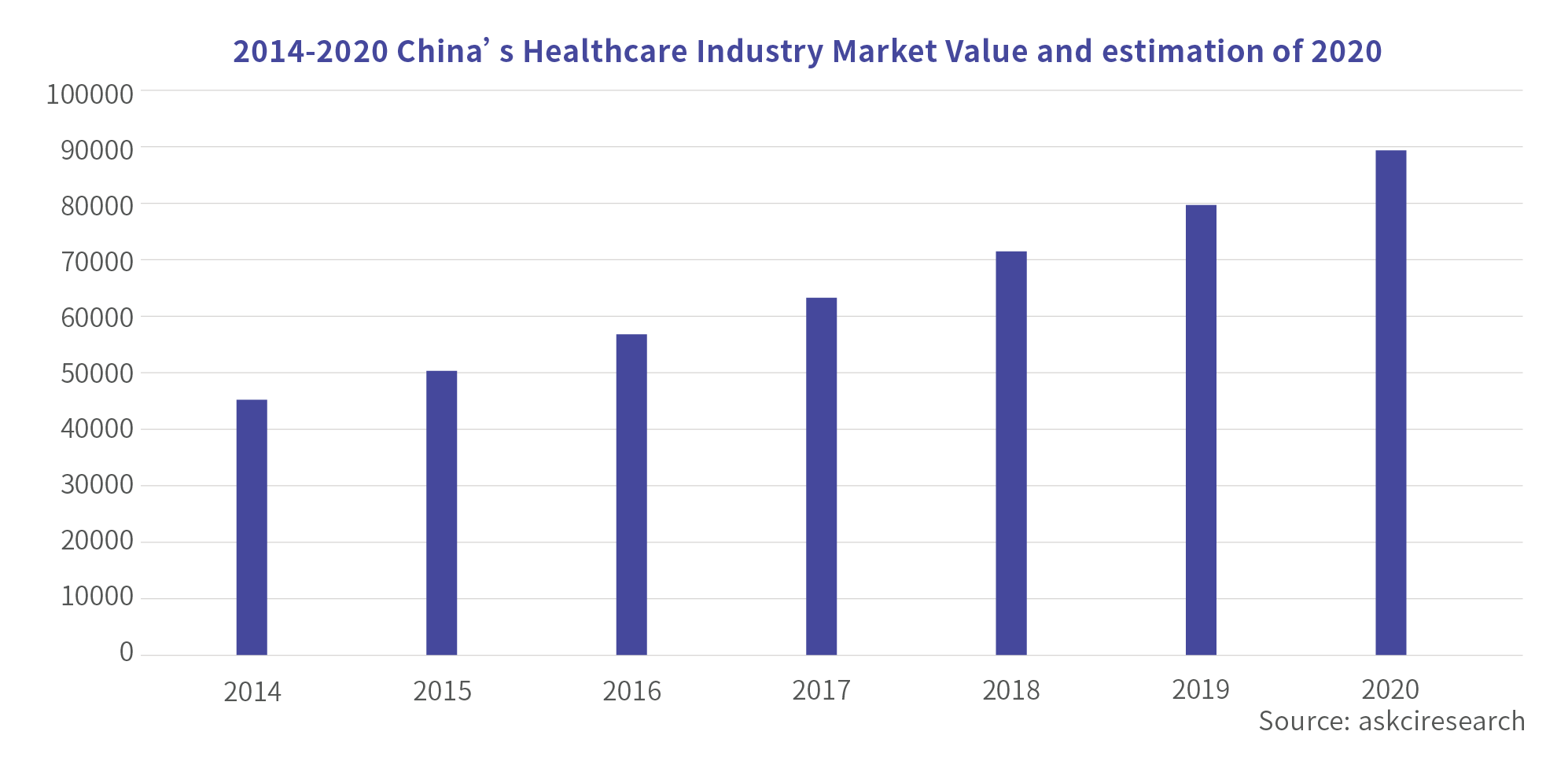
Source: askciresearch
The future trend of the healthcare industry will be going digital, constructing a user-centered healthcare model through smart devices that are driven by data in an intelligent way. Devices, data, intelligence, users, artificial intelligence (AI), these core concepts of the healthcare industry’s development coincide to profoundly align with what internet of things (IoT) entails.
In the fields of sport & health wearable products for sports and home fitness continue to gain intelligent market share on a yearly basis. According to research, the global shipment of wearable devices increased gradually over 2012-2018, with an average annual rate of growth reaching above 150% from 2012 to 2015. In 2017, 115.40 million units of wearable devices were shipped, meaning a 12.7% increase year-on-year. In 2018, 122.6 million units were shipped globally, meaning a 6.24% increase year-on-year. It is expected that in 2022, the global shipment of wearable devices will amount to 190.4 million units, representing a five-year CAGR of 11.6%.
Bluetooth protocol has been upgraded to BLE 5.0, which brings faster transmission rate, longer transmission range, lower power consumption, and the development of wearable devices. With fitness watches and bands already claiming substantial market presence, other innovative wearable products such as smart eyewear, earphone, rings and shoes, are getting more attention from consumers. Wearable devices can effectively record users’ activity data, transmitting data to cloud storage using IoT technology. Users’ historical data will be stored and shown directly to them on mobile Apps. Home fitness devices are now more than just fitness devices. Manufacturers leverage on the opportunities presented by the IoT development, and make their products smart – from bigger machines such as treadmill, elliptical machine and spinning bike to smaller ones like dumbbell, skipping rope and hula hoop – they produce data which will be connected to mobile records and stored. These products are gradually favored by consumers.
In the field of medical health, the market share of the current home devices is also growing rapidly. In 2017, the global medical device market value exceeded USD 400 billion, and the value went up to USD 427.8 billion in 2018, and was estimated to reach USD 600 billion by 2024, meaning a 5.6% CAGR between 2017 and 2024. For at-home medical device, the market was only valued at RMB 41.9 billion in 2014, it grew to RMB 94.8 billion in 2018, representing a CAGR of 22.6%. The market is estimated to worth RMB 150 billion by 2020.
Medical wearable devices can collect users’ health data and upload them to platforms for statistical and analytical purposes, giving advice to users with the connection to medical services. At-home blood pressure monitor, glucose meter, pulse oximeter, ear thermometer and thermometer are widely-used for families, and smarter versions of the products are becoming increasingly popular every year. Medical wearable devices play an important role in users’ self-monitoring and health data monitoring, allowing access to effective health data for doctors and services providers. Personal care products are transforming to become IoT-connectable as well. It is expected that China’s personal health appliances market will worth RMB 32.56 billion in 2020, the CAGR between 2015 and 2020 will be 15.5%. In 2018, electric shaver, hair care appliances and electric toothbrush recorded a retail sales volume growth of 24% year-on-year, and 40% year-on-year growth in terms of sales value. Manufacturers are also trying out ways to product smart personal care products, such as toothbrush, shaver, hair clipper, facial steamer and hair dryer. They do not account for a high proportion in market, while their market share is increasing significantly. Product users can also feel the service and experience beyond product functions.
Products are becoming smarter and data-driven in sport & health, medical health and personal care. Data generated by these products will help provide a better condition for data-driven services quality, enabling corporations to become more diverse, and giving birth to new market and development opportunities.
2. Solutions
For the health industry, devices as vehicles for data collection are of significant importance. All health products and services rely upon users’ data to pinpoint customer issues, allowing accurate user services to be provided, hence the ability to collect and upload data to cloud drive has become a prerequisite for health products. Health devices collecting users’ data have become increasingly relied upon various scenarios, where services providers can provide more customized services to users according to their respective health data.
As market demand changes, traditional offline devices are being gradually replaced by smart ones in the health industry. Market share of smart health products increases every year. Traditional manufacturers are seeking their ways of producing smart devices that align with their business development goals. Smart health products usually revolutionize the value chain in six areas, namely smart hardware, data communication, front-end software, cloud platform, smart data and health service. They are driven by data, providing health services through smart devices as a comprehensive health package for users.
The core of smart health product hinges on the abilities of networking and cloud platform, smart product solution with width and depth, and product services. The solution can be explained as follow:
Figure 10
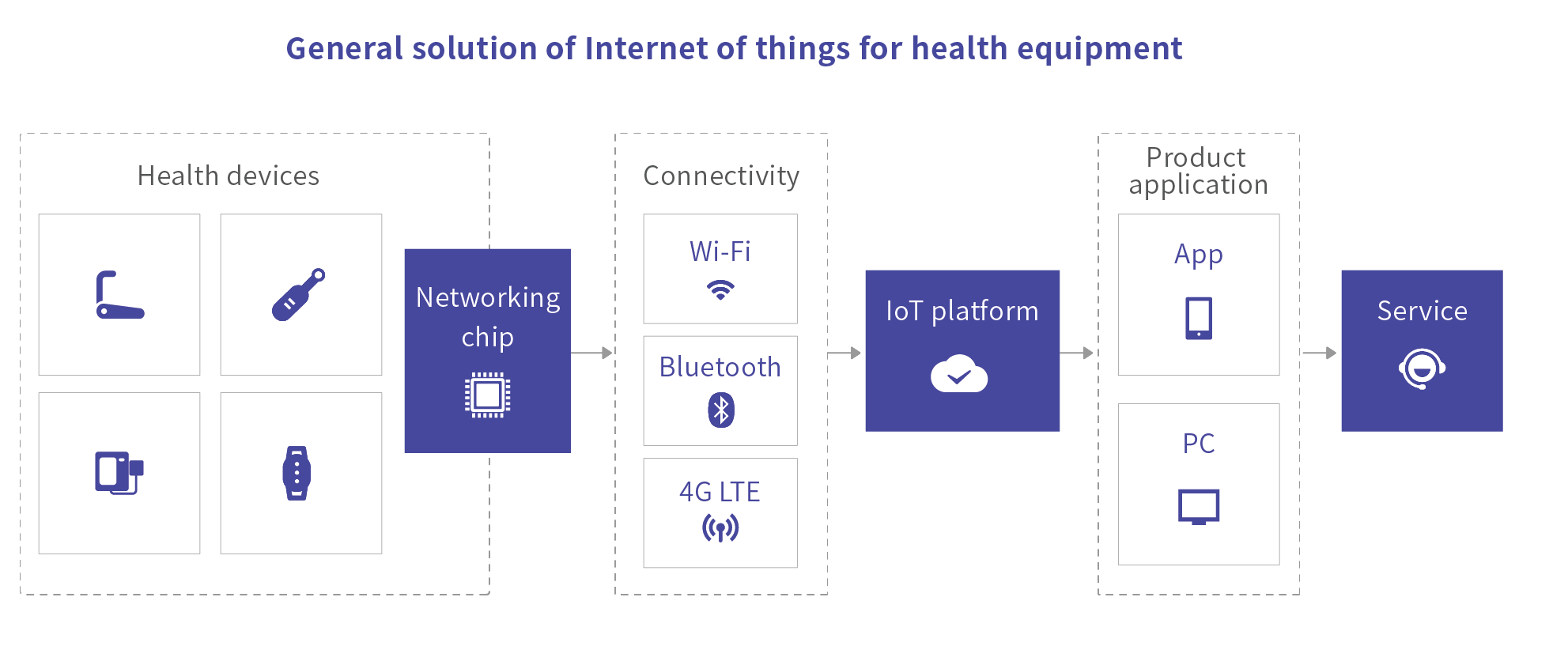
Connectivity is imperative for health devices to be smart. Deriving from such standpoint, Bluetooth technology is characterized by its convenience and low power use, hence most wearable health devices and personal care products are featured with Bluetooth connectivity. Bluetooth 5.0 version has better performances. In contrast with Bluetooth 4.2, the 5.0 version is twice as fast in transmission, and has 800% as much the transmission volume has increased by 800%. The transmission bandwidth is increased from 1M to 2M, with 4 times as much the transmission range increased by 4 times. Meanwhile, Bluetooth 5.0 technology entails lower power use and higher broadcast capacity, and versions of 5.1 and 5.2 have an enhanced precision of up to centimeter. Home fitness machines such as treadmill and elliptical machine will still apply Wi-Fi connection which allows continuous connectivity, thus any data could synchronize with the cloud drive at any time. Given accessibility to Wi-Fi in home setting, these machines and other home devices have become more convenient and interactive. On the other hand, some outdoor sports products transmit data without being connected to a mobile phone, usually using NB-IoT or 4G.
The cloud platform, its application and service solutions structure:
Figure 11
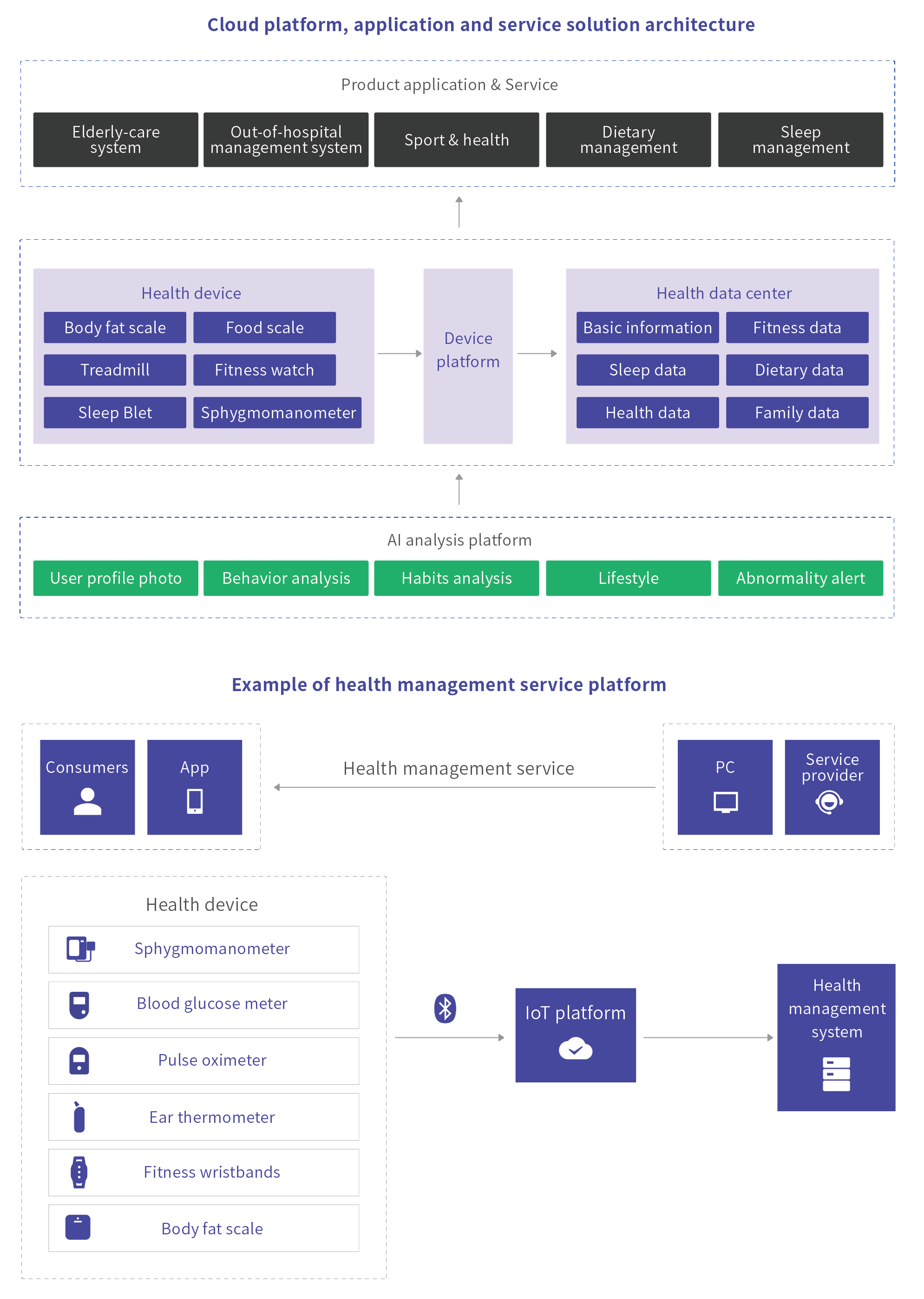
IoT cloud platform collects data transmitted from devices and manage the data systematically, forming a health center for users. Health center stores users’ basic data and analyzes them in depth through AI analysis platform, in order to understand the users and the data. Smart health products, user health center and AI data analysis platform will form a foundation for various health services to be provided, facilitating customized health applications and services being developed.
3. Industry case analysis
IoT is already common in the health industry. It is popular for sport & health, medical health and personal care. Below is a smart healthcare project incorporating smart devices, IoT cloud drive and health management system, and its main business is to offer health management services as solutions package to people who need at-home care.
The whole system encompasses three core elements, namely smart devices, IoT cloud drive and health management system.
Smart health devices are mainly used for collecting users’ daily health data in a home-setting, users could evaluate their health status based on the statistics shown on the devices. For users of healthcare needs, especially for people with chronic illnesses, daily blood pressure, blood glucose and blood oxygen monitoring have become a part of their daily routines. Most of the people have the devices at home to assess their health index in a timely manner.
IoT acts as a bridge connecting data from devices with application systems, making health data full of vitality. After data is collected, they will be synchronized to cloud drive and stored, then these data will be processed and analyzed for each user, generating more meaningful and comprehensible statistics.
Health management system uses data generated from devices and synchronized to IoT platform for developing higher-level applications, allowing service providers to collect corresponding users data and provide services pinpointing users’ needs. Smart healthcare project uses data collected from devices, consolidate the data and prepare weekly or monthly reports, and provide professional comments and advice to users.
Helian Health
Founded in 2014,Helian Health, knowledgeable in medical industry and The Internet of Medical Things (IoMT), aims to build a large online platform to serve patients, doctors and hospitals. It provides hospital Wi-Fi, medical apps for patients and clinical workers, as well as one-stop hospital IoMT solutions, etc. Helian Health now works with over 1,900 hospitals in 245 cities across China and served more than 900 million outpatient visits; with its Wireless access points (APs) reaching nearly 100,000, Helian Health is currently the largest hospital Wi-Fi service provider in China.
In April 2018, as the executive meeting of the State Council pushed to promote “Internet Plus Healthcare”, Internet-powered Healthcare has been developing in full swing. The medical industry has gradually moved closer to Internet market from physical clinics and hospitals, and medical applications are coming out to provide healthcare services catering to different needs in old and new scenarios. And this requires traditional medical institutions to improve its services and efficiency through the integration of informatization and intelligent technologies.
Helian Health initially entered the medical market as a hospital intelligent network provider (Wi-Fi business), and has become the industry leader with 60% market share within 4 years. Helian Wi-Fi now has covered 1,900 public hospitals nationwide, with more than 97 million end users (i.e. patients) and 1.3 million daily active users.
The operation and maintenance of equipment in more than 1,900 public hospitals is the biggest problem faced by Helian Health. For example, breakdown is fairly common to medical equipment, and it requires engineers to deal with it on-site. Although a simple reboot can fix the problem at most of the times, Helian needs to ensure engineers are always available to keep equipment going without causing delays in diagnoses.
Another characteristic of working in medical industry is high demand for accuracy and reliability. This low tolerance for errors means demanding technical requirements, tendency to collaborate with big, stable platform and preference for mature technologies.
Helian Health cooperates with the global AIoT platform, Tuya Smart, to deploy smart single plugs and power strips in hospitals, and maintain a large number of equipment through Tuya's operation and maintenance platform. When there is a problem with the equipment, it can be rebooted by restarting the socket in the SaaS back end, which reduces labour cost and improves the maintenance efficiency. Helian Health also has developed an operating platform for hospital equipment management based on Tuya Smart Cloud development platform, which provides real-time data on any equipment status for all hospital devices.
Monster
Monster®, the world leader in premium headphones, speakers, and power accessories, has been a catalyst for innovation and big ideas. After discovering that cables in hi-fi systems influenced the sound, Head Monster Noel Lee developed Monster Cable, which became an immediate hit with music lovers. Monster went on to engineer the sound of Beats® headphones and has now become the world’s leading manufacturer of high-performance headphones, all featuring Pure Monster Sound™ technology. Today, the company offers advanced connectivity solutions for professional musicians, home entertainment, computing, mobile, and gaming, as well as high performance AC Power and air conditioning products. Monster continues to lead in innovation, with over 500 patents granted and 100 patents pending worldwide, offering more than 5,000 products in over 160 countries. Monster also prides itself in helping those who are in less-than-fortunate circumstances through Monster Cares.
Monster announced at CES 2019 that it is teaming up with Tuya Smart, the world’s leading AI+IoT (AIoT) Platform, to co-create a new line of “Monster Smart Powered by Tuya” smart home products.
These products include innovative solutions for controlling everything from lighting and home entertainment to power, security, and more. The partnership between Monster and Tuya will facilitate the development of an entirely new category of highly efficient, easy-to-use, and secure smart products for the home and office. Monster Smart Powered by Tuya products will benefit from Monster’s world-renowned expertise in product design and development, supported by Tuya’s unsurpassed AIoT Platform, including big data capabilities that enable geolocation and environment-sensing features.
Initially, the product lineup will include the next generation of the Monster IlluminEssence products, with new power, home entertainment control, security system solutions, and more to be announced in the coming months.
Lee noted, “‘Always Deserve Better’ is why we’ve focused on better audio for 40 years. And now we think IoT and smart products will help consumers have a better life in so many ways and we’re looking forward to directing our innovation with Tuya in all things smart – starting with lighting, power, and security.”
Lighting
1. Overview of Lighting Industry
According to the investigation report published by Omdia in 2020, the annual sales of global smart lighting and connected controllers will reach $21 billion in 2030,a double increase from $10 billion in 2018.
Figure 12
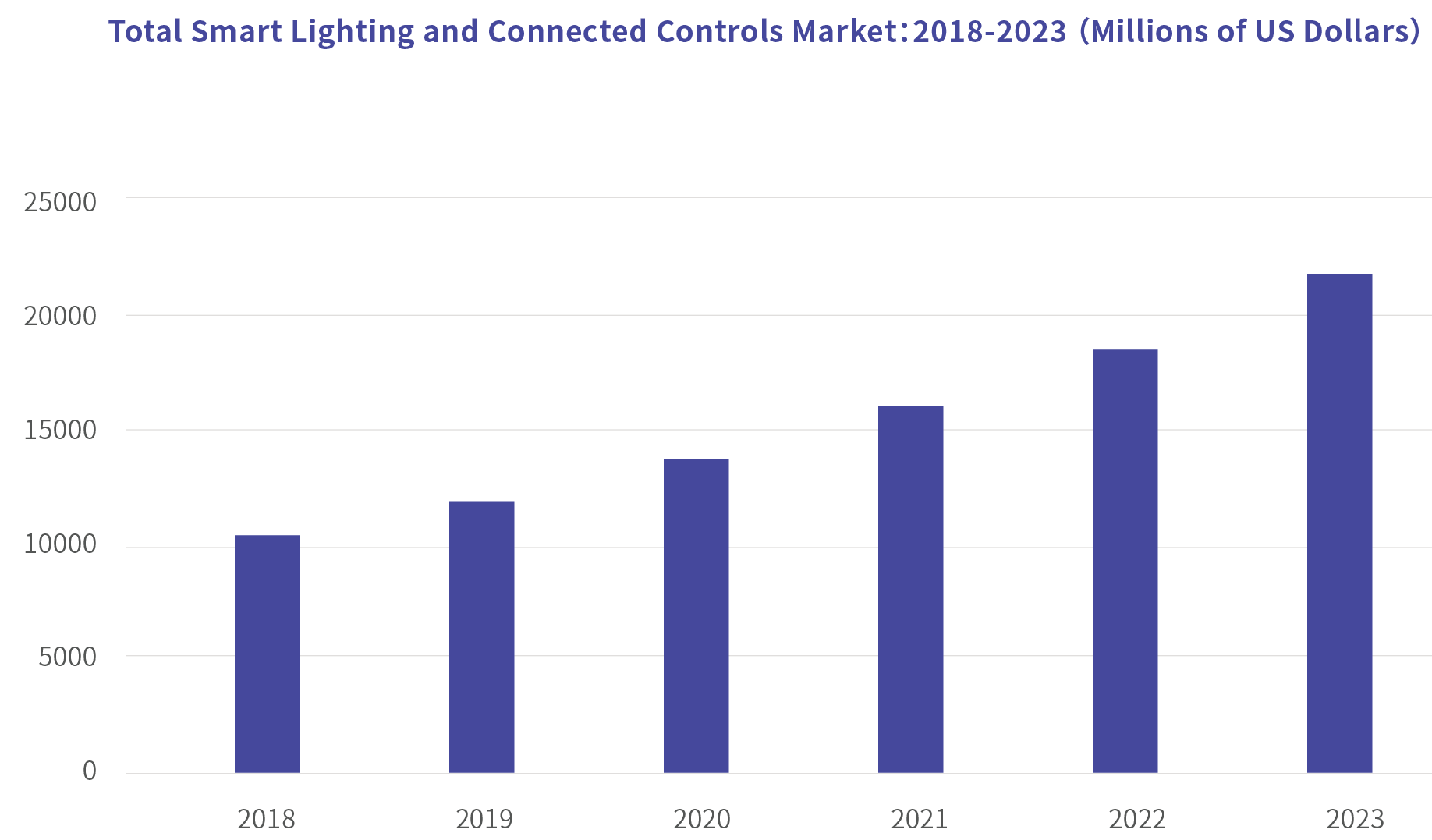
The investigation report points out that while the expected sales will double in the coming few years and enjoy a pretty growth curve, it is also worth noticing that consumer’s lack of understanding about the technological advantage of smart lighting will become a major factor to impede the greater market growth. Currently, light industry are paying more attention to emphasize the ways of controlling the lighting and which automatic mode to choose, which are not impressive enough to persuade consumers to change their traditional lightings into smart ones. With people’s living standards increasing, consumers are paying more attention on the health, thus the positive impact of smart lighting on people’s health will become an important driving factor for consumers to upgrade their lightings into smart ones, however the impact is hardly mentioned in the publicity materials.
There is a widely accepted concept concerning smart lighting’s impact on people’s health, namely, “Human Centric Lighting”. According to this concept design idea, human body can regulate hormone production from sunrise to sunset so as to guide the schedule for work and rest. The invention of of light, however, has disrupted regular variation brought by sunlight, thus causing people’s schedule in disorder, The lighting system should be in accord with the laws of nature to benefit people’s health. Scientific study indicated that relatively high color temperature in light help people concentrate and reduce the risk of making mistakes in work or study, medium color temperature can decrease fatigue feelings and is suitable for long time use, low color temperature can create cozy environment and is suitable for leisure. Inappropriate use of light may bring unpleasant results. For example, the use of cool white light before sleep will disrupt melatonin production thus interfering with the sleep and influencing children development. So it is suggested to use a lower color temperature like warm while light before sleep.
LED light source with its energy-saving, stable, triggered the fourth generation of lighting source reform. Now with the rapid development of various technologies, lighting system as the most important part of smart home, will be given more capabilities. So helping consumers realize and accept those capabilities will become a significant driving factor to boost smart lighting revolution.
2. Lighting Solutions
2.1 Miniaturization Solutions
Demodularization
With the rising market acceptance, sales of smart lighting are surging, so it is becoming increasingly important to control cost of single product. It remains the top priority for different ends of the supply chain to figure out how to control the cost without sacrificing the quality of product. In 2020, some lighting factories have already tried to reduce the PCB of wireless module, simplify the whole production procedures to control cost by combining communication module and driver board together. Meanwhile, this production plan has also brought some challenges to the lighting factories including refined SMT processing capabilities, wireless calibration test capabilities, RF design capabilities, board-level anti-interference design capabilities and process control capabilities.
Highly integrated chips
Previously, due to the small share of smart lighting in the industry, many driving solutions were pieced together from the driving solutions in traditional industry, such as power supply chips from home appliances and RGB driving chips from outdoor displays. In 2020, the major lighting driver factories has made great advances in the level of driving chip integration with fewer peripheral components, lower energy consumption, wider adjustment range, more precise adjustment control, and the original design focusing on the intelligent lighting solutions.
Three-dimensional structure
There are many types of lighting sources: such as A type, PA type, BR type, GU type, MR type, etc. The intelligent upgrade of small light sources may face many challenges and the structure, heat dissipation, light type, and wireless signal processing need to coordinatee with each other. At present, there is a minimum mass-production solution that can embed the power supply, driver, and wireless modules into the E14 lamp holder through a three-dimensional structure.
Antenna upgrade
Accordingly, the antenna designs of these different types of light sources are also constantly changing. The antenna can not block the lamp beads and should be characterized with the radiation performance, directional performance, as well as other features including the miniaturization, easy installation and easy fixation. Each link of smart lighting design is worth deeply exploring, including the inventions of PCB printed antennas, wire-type monopole antennas, as well as ceramic antennas and tries in making antennas by using aluminum substrates and aluminum lamp cups.
2.2 Sensor Fusion
As the eyes, ears, nose and mouth of AIoT, sensors need full-time and omnibearing coverage. People’s reliances on light make lighting products so ubiquitous that as long as there are human activities, there will be lighting products. This wide coverage of lighting products is very suitable for combining sensors and smart light sources, which can not only be used to control the light, but also increase the security attributes of the intelligent system, including intrusion detection, illumination detection, smoke detection, image collection, etc. For example, solar lawn light are featured with illumination detection, human body pyroelectric induction, MESH networking, and solar power supply. Through the App, it can be set to a normal lighting mode where the light is on when people come, or an alarming mode where automatic video will be recorded and reminders be sent when people come.
2.3 Multi-protocol Interconnection
Commonly used smart IoT communication methods such as Wi-Fi, Bluetooth, Zigbee, Cellular network, etc., all have their own best applicable scenarios, so how to interconnect these devices will play a vital role to constructing smart IoT.
Based on this idea, super gateway solutions, including aggregation gateways and voice gateways, will reconstruct the linking center. The aggregation gateway can support multiple communication protocols at the same time and can realize the interconnection and intercommunication of multi-protocol smart devices such as Wi-Fi, Zigbee, Bluetooth with one gateway, so as to create a more powerful smart home system.
2.4 Custom Scenario
When the smart IoT devices used by users reach a certain number of categories, the joint actions among products will make the smart system smarter. While autonomous learning capabilities, have not yet been achieved in smart devices, custom scenarios setting will provide better experience for people to enjoy the convenience from intelligence devices. For example, setting home mode: when you return home at night, the smart door lock will automatically be opened , followed by the soft lighting mode, then the fresh air system, and the air conditioning system will be turned on with the alarming mode of the sensors at home canceled. When you go out of house pressing the leaving button, or when the indoor sensor cannot detect the owner's activity for a long time, the leaving mode can adjust the above-mentioned equipment to the off state and the sensor into the alarming mode.
Users can add these smart scenarios one by one in the App, or just find a large number of default scenarios in the scenario database to quickly complete the setting.
Foshan Electrical and Lighting
Founded in 1958, Foshan Electrical and Lighting Co., Ltd. is a well-known enterprise focusing on the R&D and production of high-quality energy-saving lighting products. Since its establishment, it has been dedicated to promoting green lighting products, providing customers with comprehensive lighting solutions and professional services. With sound and efficient production operation system and quality management system, it is now one of the strongest brands in China’s lighting market.
In recent years, on the basis of its portfolio covering all elementary lighting products, Foshan Lighting has been expanding its business in smart lighting and health lighting. Product lines of its brands, including FSL, Fenjiang, QL, and Fozhao Electrical cover home lighting, commercial lighting, office lighting, outdoor lighting and many other categories. Around 40% of its products are for export, serving customers from over 110 countries and regions across the world.
One problem that has arised as Foshan Lighting goes global is the lack of interoperability between different products and platforms. Now, major communication protocols on the market include Bluetooth, Zigbee, Wi-Fi, 2.4G, DALI, DMX512, while products from different companies or cloud platforms cannot connect with each other. As a result, users have to install several Apps on the cell phone in order to use products from different companies, which is inconvenient and inefficient.
Nowadays, with various types of smart products emerging, customers have higher requirements for user experience. How to meet the customers’ “all-round needs” and enhance product reliability is a serious question that each smart manufacturer must answer.
Centered around smart lighting products, Foshan Lighting has been diversifying its product line by integrating smart hardware on third-party AIoT platform. With its well-developed one-stop solution for smart home, consumers can enjoy complete services and a carefree life.
In terms of product development, Foshan Lighting uses module SDK to develop smart lighting and smart security products, so that products can be deployed into the network quickly, and can ensure “ever-lasting” network connection under normal circumstances. The Foshan product lines covers light bulbs, light strips, light strings, downlights, ceiling lights, security alarms, etc. all of which are constantly updated and boast high malleability. Foshan Lighting’s products offer optimal user experience and good value for money, which help them quickly gained popularity in both online and offline channels at home and abroad. Its light source products have long been among the top three best-selling products on Amazon's e-commerce platform.
Calex
A Dutch decorative lighting company founded in 1970, Calex is the best-selling decorative lighting brand in Western Europe and the European decorative lighting market leader. Calex’s parent company, Electro Cirkel B.V., has been around for nearly 60 years.
Calex offers more than 400 SKUs in 15 categories. Its lighting products are characterized by a full range of dimmable, vibrant colors and high intensity whites from cool to warm.
About six years ago, Calex began to see the huge growth and opportunity of the European smart lighting market. The penetration rate of smart bulbs in Europe was 3.8% in 2019 but is expected to reach 10.7% by 2024, according to Statista.
In 2015, Calex launched a Bluetooth smart light bulb at a price of €25, but did not sell many of them because of the relatively high price and the need to improve the product experience. That’s when Calex realized it needed to partner with a smart home and smart lighting market expert to improve its pricing competitiveness and get a true foothold in the market.
In 2018, Calex partnered with Tuya to develop and launch a €10 Wi-Fi smart bulb. Using Calex's smart light bulb app, users can create various smart scenarios and automations, such as using voice control to turn a bulb on or off or connect it to an alarm clock. The lighting can also be used with various other home appliances, including refrigerators and washing machines.
Thanks to the combination of a powerful smart lighting app and affordable pricing, Calex's smart bulbs quickly took hold in the European market. Within a few months, Calex smart bulbs could be found in the main retail channels of six Western European countries, and in less than a year, Calex was able to distribute more than 5 million products bringing more than 1 million smart households to life.
Globe
Globe Electric, founded in 1932 and headquartered in Montreal, designs and manufactures LED lighting and electrical products for the consumer market. Working with the top North American retailers, Globe is a leading provider to the retail and consumer segment, and is widely known for bringing new and innovative technologies to market. Partnering with Tuya in 2017, Globe has brought their vast experience in lighting and the ways in which consumers interact with lighting controls to the relationship. Strong collaboration between the Tuya and Globe development teams has resulted in compelling product introductions, including a floor lamp that was featured by both Google and Amazon as part of their hot new product showcase at CES in 2020.
Feeding off their many years of experience in category management positions with the leading retailers, Globe has consumer insights and a data driven decision making approach to guide their product development. This has enabled a focused approach, leveraging the technical expertise of the Tuya team while driving innovation at the product and category level. Opportunities within connected products are limitless, but there remains the issue of a massively fragmented industry with the result being added confusion for consumers on interoperability, and ease of setup as the hurdles to more widespread adoption. Further, while there are certain product categories that are super saturated, there remain more niche products and features that are experiencing tremendous growth as they satisfy a market need.
The next phase of adoption, product and technology introduction has the potential to move the needle for manufacturers and retailers in the industry. The key will be accurately identifying the use cases, consumer needs, and enhancing, wherever possible, the simplicity in use and setup.
“The smart home industry, despite several years of sensational growth and popularity amongst consumers, remains in its infancy,” says Adam Chaimberg, Chief Merchandising Officer of Globe Electric. “The realm of IoT, AI, and smart home is like a great story; we are only finishing the introduction,” continues Chaimberg. Globe has built out a robust product roadmap across their key categories, with a keen eye towards meeting consumers where they are technologically but also with respect to more subtle aspects, such as how consumers live and how home automation can positively impact their lives. Despite nearly 90 years of lighting and electrical design and manufacturing, this is a company that behaves and acts with the speed and enthusiasm of a nimble startup.
Wipro Enterprises Limited
Wipro Consumer Care and Lighting (WCCLG) caters to the Fast-Moving Consumer Goods (FMCG) segment which deals in personal care, home care, lighting and furniture products. Established in 1945, WCCLG is now a company with revenues of over Rs.7700 Crores and a global workforce of over 10,000 from 22 nationalities and a marketing presence in over 60 countries including India, South East Asia, East Asia, Africa and the Middle East.
WCCLG has been working with Tuya, since 2018, which has helped Wipro to become the No.1 smart lighting brand in the Indian market with a comprehensive product portfolio that covers smart bulbs, smart battens, smart downlights, smart panel lights, smart LED strips, smart COB lights on both Wi-Fi and Bluetooth. The Wi-Fi based products target at the consumer lighting market for individual home use, that enables users for smart home lighting experience at extremely low-cost price of Rs.699, which is around $9, with overall functions of remote control, dimming, color changing, timer/scheduler, smart scenes, and automations with other smart home devices. All the smart devices are connected to Alexa and Google voice platform, that helps users control the connected devices via voice commands. Wipro Smart LED turns your home into a party lounge, a mini movie theatre, an office, a yoga class, even a campaign spot for your kids! It's 16 million color combinations create mood lighting suitable for every occasion. The “Wipro Next Smart Home” App is a cross-protocol and scalable app that not only controls smart lighting, but also other category products, which includes electricals, home appliances, security products, and healthcare products. This gives benefits to end users as it is platform-agonistic, and be it products that work on Wi-Fi, Bluetooth or Zigbee, they can use the same app to connect and configure. This helps in creating a smart home with an easier and seamless experience. With rich product lines and the vendor partner eco-system, that Tuya provides, Wipro can choose from over 200,000 products from more than 30,000 manufacturers. This helps cut the smart new product development time from one or two years to simply one or two months, thereby improving the product lifetime management efficiency by 10 times.
Besides consumer lighting and smart home businesses, Wipro has also entered into the smart commercial lighting segment, by adopting Tuya SaaS lighting system, so as to provide complete wireless lighting solutions for SMBs – which include offices, hotels, schools, retailers. Compared with traditional wired solutions like Lutron or Casambi, the Wipro wireless commercial lighting could help forge a same lighting solution at only 8%~10% of the total cost. It not only reduces the cost significantly, but also is a revolution in the reduction of wiring and helping improve project implementation efficiency. The system allows the installer a hassle-free implementation experience with wireless scanning and auto connection, and even plug-and-play. The management and settings of the lights thus become handy. For small deployments it even does not require electrician or technical expertise. Through SaaS web management portal, the administrator could monitor the real-time device status and power consumption statistics in a transparent way. The system also supports hierarchical settings and administration authorities to support headquarter and branch management in a same dashboard. The scalable system allows innumerable lighting device connections to cater to different scale of project installations. The solution is becoming an important part of Wipro home service segment.
Based on the rapid development of domestic smart business and good expectation of global IoT market, Wipro is now expanding their domain into multiple smart categories of smart electricals, retrofit solutions, security kits, and also has a plan to launch smart products overseas in the US, UK, Middle East and South East Asia, etc.
Brilliant Lighting
Smart Technology is already changing the way we live around our homes. By connecting your lighting, home appliances and security and partnering with Google Home or Alexa – this innovation has the power to transform our everyday lives.
With its comprehensive scope and intuitive design, Brilliant’s range of Smart Technology has the capacity to transform virtually every aspect of both households and businesses. Working its magic through your Wi-Fi connection, our Smart Technology range allows you to manage your home electronics, appliances or devices wherever you are, at any time, instantly.
Brilliant has a wide range of solutions ranging from lighting, electrical, air movement and smart technology.
Brilliant’s Smart Technology is fuelled by the simple yet powerful BrilliantSmart App, designed for ease of use and controlled directly by voice or smart device. Just say the word, and your house instantly obeys — even from hundreds of kilometres away.
Brilliant Lighting has partnered with Tuya since 2018 to launch a range of smart home products dubbed BrilliantSmart. The BrilliantSmart range includes about a dozen products, including lighting, security cameras, home appliances, and sensors, that can interact with Google Home and Amazon Alexa and can be controlled from an Android or iOS app without the need for a separate hub. These products all proudly wear the “Powered by Tuya” badge. By relying on the Tuya IoT Platform, end users benefit from smart scene control to power their devices and appliances on or off according to predetermined schedules.
BrilliantSmart technology is simple to operate via a large range of lighting, security, switches or electrical products, which can be controlled either individually or by each family member. To make these benefits accessible to everyone, BrilliantSmart is designed with the broadest compatibility in mind. All Smart Technology is fully connectable via your mobile, tablet, Alexa or Google Home device.
Brilliant is ever expanding its smart offering, always at the forefront of new technology to ensure customers’ needs and ease of use is prominent in what we do. Brilliant is now introducing BLE Mesh systems to assist large scale use of smart technology, which will assist customers in their smart experience if they require large amounts of smart products.
1. Global Development of Smart Electrical Engineering Industry
With the enforcement of “new infrastructure” policy and further development of AIoT technologies, smart home products have gained increased attention from customers, in which a new round of explosive growth will surely take place. According to Statista’s data, smart home market value will exceed $195.2 billion by 2025. Smart switch and socket, one of the first popular smart home products, have yielded great dividends to the development of IoT, intelligent manufacturing and other emerging industries. As basic devices in people’s life and work, smart switch and socket products will witness its penetration going up to above 8% in the global market by 2024. Thus, the smart electrical engineering market can provide sustainable and abundant business expansion opportunities.
Figure 13
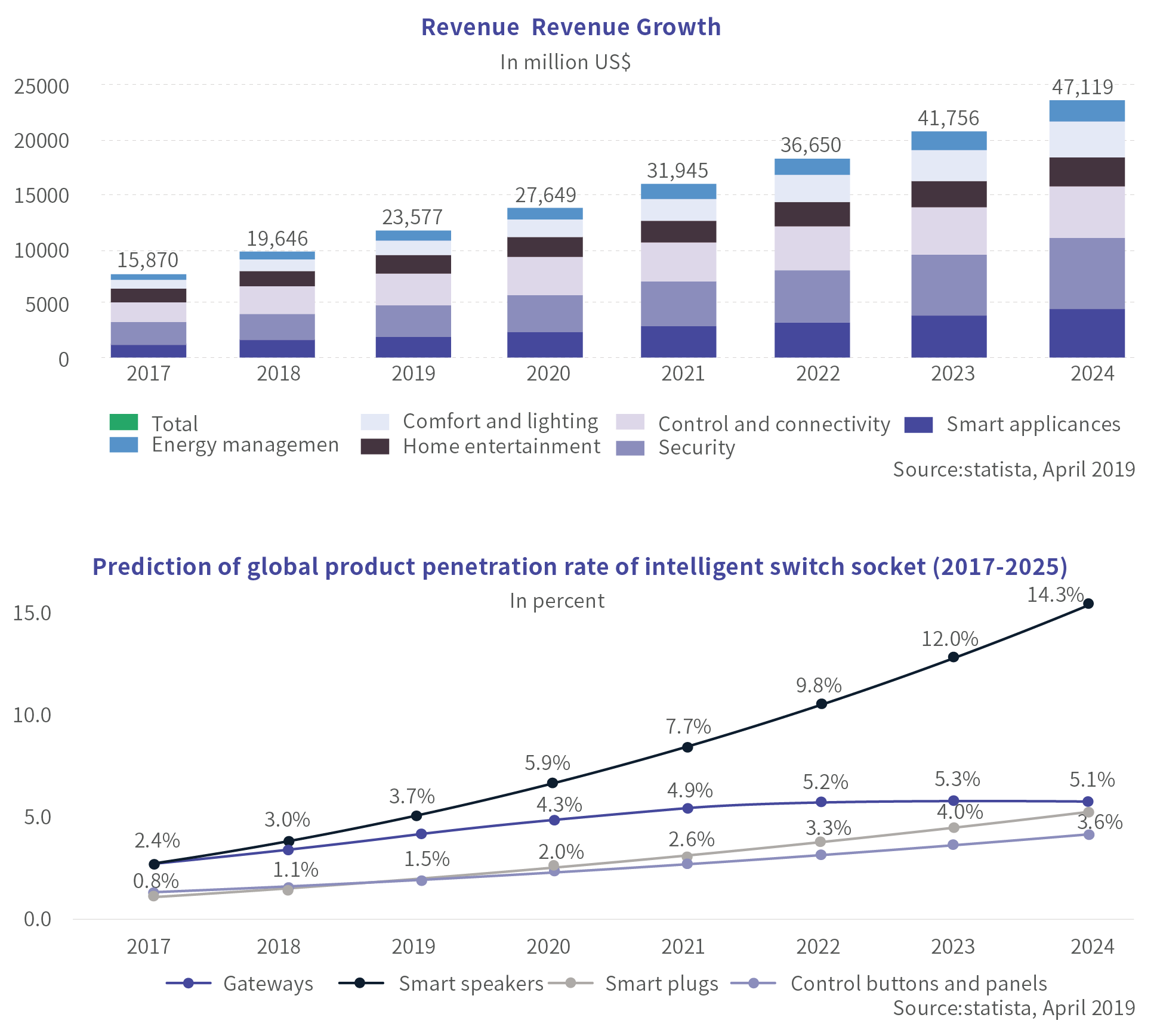
Source: Statista, April 2019
Owing to progress in IoT, big data, and cloud computing etc., and the establishment of ecosystems such as “smart city”, “smart community”, and “smart home”, the application of smart electrical engineering has been extended incessantly, and the industry has witnessed continuous transformations in aspects of upstream players, downstream channels, and product demands etc.
1.1 Increased Number of Players in the Industry
(1) Accelerated Smart Transformation in Conventional Power Companies
It is an inevitable development trend in the industry that more and more conventional electrical enterprises realize the importance of digital power and smart energy. From the bystander to the player, a number of companies have laid out their smart power product system. Starting from the whole-house smart home products including switch and socket, upstream exporters and OEMs, as well as traditional electrical engineering enterprises like Schneider Electric, Siemens Electric, and Simon Electric, have attempted to improve their product lines’ comprehensive competitiveness through the layout of smart electrical engineering product line .
(2) Active Participation of Players from Other Industries
Smart electrical engineering products, with its smart solutions, endow their traditional counterparts with playable and expandable attributes. Not only are there more opportunities for product innovation and function integration, but also many differentiations have been realized. The smart electrical engineering enterprises and giants such as Haier and Lenovo, have attached great importance to the smart electrical engineering market.
(3) Continuous Extension of Channel Boundary
Smart electrical engineering product is characterized with the features of the electrical product and the intelligent technology. It inherits from traditional electrical engineering products in terms of installation, function and usage, but its main highlights are the brand-new function and interaction process. It is necessary for the market to speed up training users and lowering the user threshold. Sales channels and strategies are more diversified.
Online channels, for example Amazon and China’s Tmall have paid more attention to explain product use scenarios, distribution network and other new experiences, in addition to displaying information on common product. Offline channels, conventional hardware stores, DIY channel and retail shelves have also launched their smart electrical engineering products.
To further lower the bar for installing and using the smart products, China has found the step-by-step development of real estate channel for delivering a house with refined decoration, home decoration channel for housing improvement, and channel for business upgrade in hotels and apartments etc. Each channel is actively trying to set up an offline experience store and smart home showroom, so that the customers can have direct experience in smart product.
1.2 Diversified Product Needs
(1) Diversified Product Interaction Mode
Conventionally, electrical engineering products interact with each other by touching on physical buttons. With the help of the smart technologies, the products can be controlled remotely on APP, and in near field through the instructions from smart speakers. This is the typical interaction mode in the 1.0 generation of smart home.
As AIoT technology further develops, customers have higher expectations of interacting with the smart products. In the future, AI computation may become the same infrastructure as water and electricity, so that the less people will rely on screens and actively-sent instruction. With the help of such core intelligent driving forces as big data and algorithm, smart electrical engineering products together with other smart products will make a difference in our daily life in a way that is people-oriented and more consistent with how human interacts, so that users are enjoying them subconsciously.
(2) From Smart Product to Smart Scenario, From Smart House to Smart Space
At the early stage of smart home development, its focuses are enriching product types and interaction approaches, and improving product experience to the extreme. So there are emerging popular products going viral in the global market, including smart single plug and smart panel. Smart product solutions are laying emphasis on the scenario experience, considering customers’ rising needs in safety, lighting, entertainment, energy and other comprehensive scenarios. In these scenarios, several devices are connected by means of interaction, automation and other strategies to build various scenario modes, including “going back home”, “leaving home”, and “audio & video”. These scenarios are the foundation of smart home. The whole-house smart applications based on smart scenarios are no longer exclusive to home settings. A lot of public areas, and business scenarios have been exploring into the user value and business value generated by smart products, in turn creating vertical solutions to the scenarios of community, school, hotel, apartment, and office building where smart electrical engineering products play a critical role.
2. Solutions of Smart Electrical Engineering Industry
2.1 Multi-product Solutions
Electrical engineering products are everywhere in our daily life. A number of the products , including power management, lighting control, intelligent metering, and low-voltage distribution etc., have been developed for convenience, energy saving, safety and comfort. Typical products are as follows:
Electrical Socket: including all kinds of portable conversion plug, power strip, outdoor socket, grass plug, and innovative composite products, such as lighting and plug (scene light socket) composite, and infrared and socket composite (air conditioning controller) etc. These easy-to-use smart products have gone viral in the global market and are thought highly of by customers.
Smart Panel: It is a basic product in a smart home. There are lighting control systems including light switch and dimmer that directly control lighting fixtures and light sources, in-wall curtain switch that directly controls traditional curtain motor, fan switch, hot water heater switch that controls water heater and other electrical appliances, and add-in card power switch used in hotel scenarios. Furthermore, new products have been provided, such as scene switch, central control panel, and wireless scene remote, which makes it possible that one button can be used for scene control, voice control, multi device management and other functions.
Conversion Kit: To refit conventional electrical engineering products into smart ones at lower cost, many conversion kits have been developed, including cassette on-off devices (switch box) for lighting control and curtain control, conversion kits for garage door motor and irrigation.
| Features | Wi-Fi | Zigbee | Bluetooth mesh |
|---|---|---|---|
The Major Applications in the Smart Electrical Engineering Industry |
Smart products: |
Whole-house |
Small-business Smart Lighting System: |
Transmission Rate |
Hundreds of Mbps |
20-250kbps |
1 Mbps |
The Number of Connected Devices |
Dozens |
Hundreds |
Hundreds |
Network Structure |
Star Structure |
Mesh Structure |
Mesh Structure |
Advantages |
Fast Rate |
Large number of Connected Devices + Stable Network |
Cost + Large number of Connected Devices |
Development Trend |
Wi-Fi&Bluetooth Integration, Distribution Network Optimization and NFC; |
Zigbee 3.0 Standard Protocol |
Bluetooth Mesh Standard Protocol |
Low-voltage Distribution: Products include circuit breakers and air switches etc. In addition to the basic protection function of breakers, the product is integrated with other functions such as smart metering, alarming management, and remote switching.
Smart Metering: There are electric meters, water meters, gas meters, heat meters and others. The device collects energy consumption data and uploads it to the cloud, and monitors historical energy consumption trends.
2.2 Multi-protocol Connectivity
As the basic networking capability, wireless communication protocols serve as an important access method in the smart home sector. The main connection protocols used in electrical engineering products, include: Wi-Fi, Zigbee, Bluetooth mesh, Sub-G and NB-IoT, etc. The application scenarios and development trends are as follows:
The communication protocols above all have their best application scenarios. Various communication protocols will coexist in the coming space intelligent solutions. To achieve better connectivity control for devices with different communication protocols, multi-protocol super gateway or router-gateway integration products will emerge to support the connection of sub-devices using multiple communication protocols, and to integrate voice control capabilities, thus empowering the connection hub of smart products.
2.3 Digital Electric Solutions
With the further development of big data computing and device perception, it is critical for the smart electrical engineering industry to figure out how to apply electrical products’ specifications and establish digital solutions. The industry focuses on electrical equipment’s data collection, monitoring, analysis, pre-warning, and early intervention by using big data computing, to discover problems in equipment and user end immediately, assist customers in decision making, improve user experience, and make full use of big data, thus taking a stride from smart home application scenario to smart business, smart industry and smart city.
2.4 Smart Energy Solutions
Focusing on “power”, the solution by connecting with multi-ecosystem devices in IoT, can realize power consumption monitoring, intelligent scheduling, and energy efficiency calculation, finally delivering targeted energy-saving management strategies to provide customers and end users with impressive energy efficiency and economic benefits. This is also an important direction for the development of smart power solutions, since there are urgent needs in areas of business lighting system, smart green buildings, household energy management, and long and short-term apartment leasing.
For instance, electricity and water meters, and air switch can collect energy consumption data for end users to visually monitor power consumption and manage prepayment. When the power of photovoltaic equipment is high, the system can automatically turn on some equipment, such as water heater socket and power supply, and car charging pile, etc. When the power is low, the equipment of low importance level can be automatically shut down to save energy. While increasing the efficiency of photovoltaic power generation, it can also extend the life cycle of the equipment, significantly improving the economic benefits of the system.
Apeman
Shenzhen Apeman Innovation Technology Co., Ltd., founded in 2016, is a consumer electronics company focusing on motion imaging and IoT. It includes intelligent imaging and AIoT products in its product ecosystem and has independently designed and developed a series of smart home products, such as intelligent electronic devices and intelligent lighting products.
In 2018, when developing IoT products, Apeman faced the problem of speed to market. They needed rapid design ideation, robust networking connectivity, and integration with Amazon Alexa for traditional electrical and lighting products.
They solved their time-to-market problem with Tuya's SDK technology module. Now, their hardware products can be operated in a more secure, convenient, and energy-efficient way by connecting the Powered by Tuya device to an Amazon Echo or other mainstream smart speaker to enhance the user experience for Apeman end users.
Tuya has established a deep cooperation and partnership with most voice service platforms, including Amazon and Google, so that the product can immediately leverage the third-party voice service capability. Systems and processes specially developed by Tuya for efficient production tests, data operations, and after-sales problem processing enables Apeman to obtain assistance with software and hardware support quickly.
Apeman's Teckin series of intelligent electrical and lighting products using Tuya's intelligent SDK module has been listed on the Amazon online platform, allowing them to break into the European and American markets. The safety, convenience, and stability of the products have also helped establish and enhance Apeman's reputation.
After more than four years of development, the Teckin series of intelligent electrical and lighting products that Apeman designed and launched have provided safe, convenient, and intelligent IoT life experience for tens of millions of users in Europe and the United States.
Apeman's product goal is to bring the safest and most convenient home experience for European and American users. The company plans to create an integrated smart home life experience and cooperate with foreign design teams through region-specific enhancements.
Okasha Smart
Okasha Smart is a smart product solution provider that has a portfolio of smart devices for everyday life. IoT smart devices from Okasha Smart are equipped with the latest cloud computing and AI technology, which makes them more secure, user-friendly, and affordable. Their wide range of devices cater to the everyday needs of security and energy efficiency for homes, hotels, and offices, as well as for corporate, industrial, and educational institutions.
Okasha Smart formed in 2007 by providing renewable energy and power solutions to households and firms. Their sister companies, Power Highway® and Solar Max®, have a nationwide sales and distribution network within Pakistan offering renewable energy systems including solar energy, wind power, and hydro power equipment and products. Every project of theirs is turnkey, with a mix of design, stability, and performance. Before coming up with their latest smart solutions and devices, they worked with both government and private sector companies and individuals over the years and have presented in international forums, helping to establish their brand trust globally.
By fully leveraging Tuya’s IoT Platform, Okasha Smart is able to introduce affordable smart home products to its customers with various options by means of multiple wireless protocols, a network of more than 30,000 competitive manufacturers offering more than 200,000 devices, and most importantly, a stable and cost-friendly cloud service. This has helped Okasha Smart to shorten its development cycle, lower development cost, and minimize operational cost. Some of the core competencies of Okasha Smart are:
- Easy installation and management
- Solutions for both households and corporate companies
- Innovative technology
- Professional and competent customer service
- Internationally certified products
Smart devices from Okasha Smart include lighting, electrical products, home security kits, and home appliances connected via Wi-Fi, Zigbee, and NB-IoT protocols to meet various business demands. For example, Wi-Fi devices are targeted at consumer retail business for individual home use, Zigbee devices for real estate projects, and NB-IoT devices for smart city projects.
Keeping up with the demands of time, the partnership between Okasha Smart and Tuya has generated products to keep up with the latest innovation and technology. Together, they aim to provide effective and efficient smart solutions and devices to end users, so that they can enjoy a better living experience. In the future, Okasha Smart and Tuya will also continue their in-depth cooperation in the IoT field for different smart solutions such as a smart commercial lighting system and smart hotel system to continue to provide value to companies in the region.
2.2.1 Smart Business
Smart Business aims to improve business performance and comprehensive competitiveness by coming up with effective business proposals with the help of collecting, managing and analyzing business information and data through technological means and gathering business knowledge and insights.
Based on the current technological development, AIoT and its core technologies (5G, AI, VR and IoT) are being used in different business scenarios to promote the digital transformation in various business fields, create brand-new smart business models, so as to provide smart and personalized services for consumers. Generally speaking, the market of smart business consists of smart retail, smart catering, smart hotel, smart apartment, smart community and etc.
The development of smart retail is based on the New Retail model. In order to improve the customer experience, digital transformation has become an important means for the global retail industry to meet the challenges. With the support of technologies including network communication, cloud computing and IoT, retail companies are able to collect user data to the maximum extent. The operation efficiency and customer stickiness can be better improved with the data integration and smart data analysis provided by data service platforms with AI technology.
Smart hotel and smart apartment aim to provide intelligent hardware and services, so as to improve user experience, enhance safety, reduce energy cost and human cost.
Xshuai Technology
Established in July, 2015, Xshuai Technology is a high-tech enterprise incubated by Haier.
As the pioneer and leading player in “internet movie projector”, products of Xshuai Technology has won many renowned awards in the industry, including 13 software patents, 5 patents for utility models and 9 appearance patents. Xshuai Technology has been reported by CCTV programs including Focus Interview and CCTV News. Besides, Xshuai Technology has made its appearance during “national innovation week” (mass entrepreneurship and innovation) consecutively. What’s more, Xshuai Technology has also participated in “Twelfth Five-Year National Science and Technology Innovation Exhibition” of China.
Since 2016, Xshuai Technology has been focusing on hotel industry and dedicated to develop a cloud platform intelligence system catering to hotel, providing solutions about smart filming and smart client-controlled system by learning from the successful experience of Haier smart family solutions and conducted in-depth research ranging from data analysis of hotel customers and AI application in future hotel industry.
Currently, Xshuai Technology has been applied in over 200,000 hotel rooms and become first tier system supplier for the top 10 hotel groups in China including huazhu and jinjiang. Products of Xshuai Technology are compatible with mainstream smart devices in the industry. Xshuai Technology has become strategic cooperative partners of many first-tier smart hardware manufacturers including Haier, Hisense and Philips.
In 2019, Xshuai Technology introduced smart solutions in all scenarios, which can be used to promote “smart living habits” by establishing IOT guest room experience scenarios through smart hardware, customized system and authorized films so as to eventually create a smart living ecosystem featuring human-centric.
Private Theater Theme Hotel is a smart theme hotel equipped with large screen projector and smart customer-controlled system. Located in Hohhot of Inner Mongolia, the hotel is adjacent to several business zones including Changle Palace and Mall City and enjoys very convenient transportation. More than 40 rooms in the hotel are all equipped with whole set of smart hotel products designed by Xshuai Technology, including Xshuai smart projector H8, smart customer-controlled products (curtain, lighting, air conditioner, large screen, voice communication, etc), customers can control the products in the room via voice assistant.
In order to meet hotel’s demand to upgrade smart system, Xshuai Technology help hotel to install customer-controlled internet system, smart door locks and electric curtains so that customers can experience multiple functions including opening doors without card, smart control of scenarios, screen control interaction, one-button delivering, AI interaction and self service check in and so on. Thus hotels can operate with high efficiency and low energy costs, provide better services, realize value-added extension and deliver better experience for customers in using smart devices and screen control interaction.
By integrating with tuya, a third party AIoT platform, Xshuai has successfully combined AI with large screen filming system, smart TV system and smart control system in the room. Residents can control different devices in the room through one device, which has made the room become more intelligent and entertaining and caters to residents’ customized needs.
BTG Homeinns BTG Homeinns is one of the three franchised hotel giants in China consisting of the former BTG Hotel Group and Homeinns Group, owning nearly 20 brands and almost 40 products for accommodation. By the end of September, 2019, it operated over 4000 hotels in over 400 cities in China.
According to statistics by China National Tourism Administration, the market value for the intelligentization of hotel rooms was over 100 billion RMB in major cities in China in 2019, and the number of hotels grows by around 20% every year.
In 2019, BTG Homeinns and Huiyi Technologies announced and created the Smart Hotel Innovation Institute together. The institute studies the development of the hotel industry extensively and organizes its research work concentrated on functions, extensions, technology and entertainment from the perspective of guests. It aims to establish industry standards for smart hotels in the next 3-5 years, which can improve accommodation experience, enhance hotel management and operate hotels with technology.
By studying fundamental needs of guests and critical points for hotel development, BTG Homeinns creates updated smart and innovative services by comprehensive and systematic research of guests, hotel owners, hotels, city life and other aspects. In this case, BTG Homeinns launches “Wenshu”, a smart general control platform for hotel operation, to promote its smart hotel business.
The rapid development of “New Infrastructure” and the gradually accepted intelligentization tendency of hotels have greatly helped hotel industry in China recover from the coronavirus breakout and made smart hotels reach new heights. Various smart systems spring up like mushrooms, which boosts the level of intelligentization for hotels. However, these new systems are separated from each other and difficult to manage, making people feel confused about the real meaning of intelligentization and digitalization of hotels.
At the early informatization stage of hotels, PMS is definitely the primary data system. It acts as the information hub for hotels and other application systems need to exchange information such as guests’ identities, rooms and billings with it before operating separately. However, PMS apparently cannot fulfill the task as the primary data system these days because now all kinds of smart hardware and sensors become sources of important information. In the era of smart application of IoT, huge amount of data produced by hardware and smart systems require storage, cross-system exchange and real-time analysis, which makes PMS, a system focusing on management of guests and booking reservations, hard to meet these requirements.
Wenshu Platform is an open system which can be accessed by various smart systems and creates opportunities for new application scenarios. The key value of the platform is to liberate hotels from business operation with PMS and allows them to manage the “application system” based on the general control platform with functions of internet connection, control and scene interaction. By connecting and analyzing smart devices, business operation and group behaviors of guests, smart hotels can operate better to meet guests’ demands and improve its management. It can also reduce repeated back-office work for hotel management, which allows staff to offer more front-office services to guests.
Smart Hotel
1. Overview of the Hotel Industry Development
The Chinese hotel industry maintains a pyramid-shaped market structure in terms of quantity and grade. iiMedia Research’s (Ai Media Consulting) big data monitoring in 2019 shows that the proportion of hotels serving the mass market reached 92.6%, reflecting the people’s livelihood attribute of the hotel industry. At present, mid-end hotels have become the mainstay of development, which will pay more attention to the segmentation needs of personal consumption and provide personalized and high-quality services.
Figure 14. Distribution of Guest Rooms in China’ s Hotel Industry in 2019
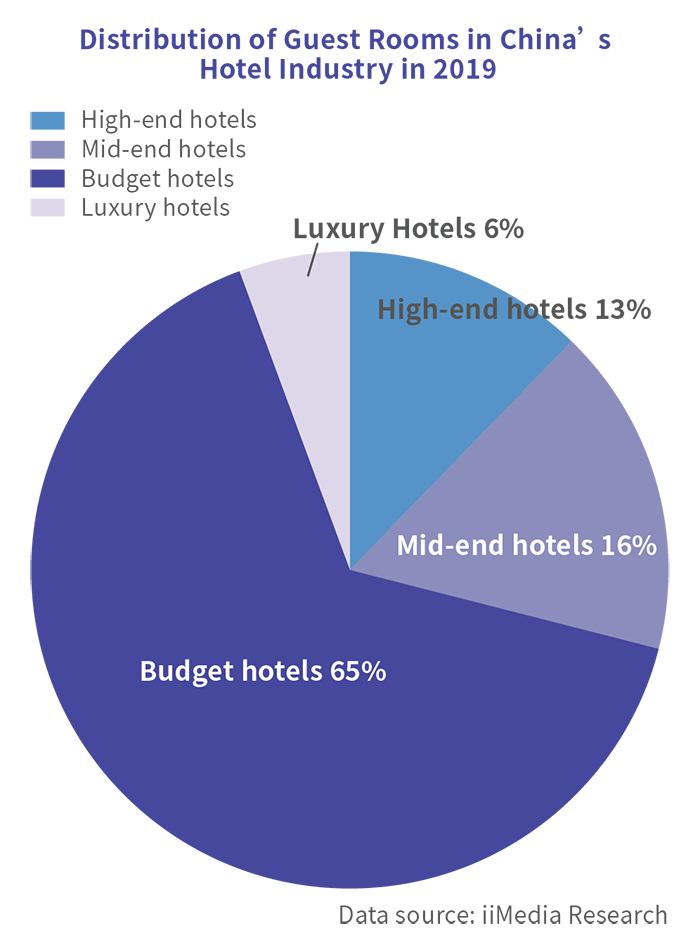
Data source: Subscribing to data sources
With regard to the operation, the traditional hotel industry has low profit margin due to the high staff & operational cost, and serious product similarity. In 2017, the hotel industry’s profit margin was only 1.0%, down 9.1% from 2016. Therefore, the industry urgently needs to make a major breakthrough in reducing the cost, increasing the efficiency, adopting digital management, improving guests’ services experience, and increasing non-room revenue.
2. Definition and Status Quo of the Smart Hotel
2.1 Definition
Smart hotel aims to manage hotels in a highly efficient way, reduce energy consumption and improve the guests’ services experience through intelligent promotion and marketing, digital asset management, intelligent process management and accurate performance management, relying on the new generation of information technologies of cloud computing, IoT and AI.
2.2 Advantages
The traditional hotel industry is facing problems such as weak marketing, inefficient management, high staff costs, and serious service similarities. Smart hotel has a competitive edge in these regards:
1. Excellent Customer Services
Through the use of diversified smart devices, smart hotel provides one-stop services that are contact-free, high-tech and user friendly to improve customer satisfaction and loyalty.
2. Operational Cost Reduction
The use of smart devices and information systems can effectively improve the operation management and service efficiency to reduce the human cost and energy consumption.
3. Operational Data Collecting
Smart platforms and devices could collect and manage guest data and operation data to improve the operation and service efficiently with the big data and AI.
2.3 Status Quo
The development of China’s smart hotel can be traced back to 2001, when some high-end hotels began to develop the smart hotel mode according to Standard for design of intelligent building 2000. In the scheme, a large number of information technology capabilities such as “5A” automatic control system were applied, and information systems and equipment began to replace human operation partially.
In recent years, as the new generation of technologies such as IoT, cloud computing and big data grows, the influence of “smart hotel” is further verified in terms of the technical capacity, the market demand and the transformation effect. More mid- and high-end hotels have increased their investment into smart development. Accordingly, the tech giants, such as Baibu, Alibaba and Tencent, and start-ups have entered the smart hotel industry, which has become a hot outlet for investment.
According to the China National Tourism Administration, the market investment of intelligent transformation in hotel in major cities exceeds 100 billion yuan. Besides, the number of hotels increase by 20% each year, meaning the promising prospect of the application of smart systems.
3. Smart Hotel Solutions
Smart hotel aims to provide intelligent and accurate services for guests based on the data collected from right before check-in to after check-out.
Before Check-in
Membership System: Guests are able to become hotel member through the OTA channels, hotel WeChat official account, official websites, or marketing activities to follow the updates and enjoy the benefits of membership.
Online booking: Guests are able to inspect and choose rooms and make reservations at any time through the OTA channels, hotel WeChat official accounts and official websites, and prepay the hotel rooms by the third-party payment methods, such as UnionPay, WeChat pay and Alipay.
Self-Check-in: Guests are able to complete the identification through the WeChat Small Program, the self-check-in machine or the robot in the lobby, or they could come to the front desk to complete the check-in on iPads or computers. After getting the authorization from hotel’s PMS, guests can open the door automatically by using mobile phone, fingerprint and face recognition.
In-room
Smart Elevator: It is very safe and convenient for Guests to take the smart elevator through QR code scanning or facial recognition.
Smart Door Lock with Facial Recognition: Guests are able to open the door with the convenient way of facial recognition.
Voice-control Room: After entering the rooms, guests are able to enjoy a great welcome experience. The lights, curtains, air conditioning, and stereos will be switched on as programed to create the most comfortable environment. In addition, guests could use the robots, mobile apps, iPads or specific control devices to control the smart devices (lights, air conditioning, curtains, ipTV systems, stereos and etc.)
Social Entertainment: Guests are able to use the devices such as robots, phones, iPads and stereos to interact with their friends; they could also watch TV and play the game, watch on-demand movies, order food, book cars or tickets, make laundry appointments, go shopping in the hotel’s online shopping center, redeem membership rewards, and check the energy consumption.
Room Service: Guests are able to order room services through mobile apps, confirm the visitors through the video doorbells, and book robot delivery services.
Smart Common Areas: At the canteen, guests are able to order the food by iPads, touch screens or QR code scanning, with the food being delivered by robots. The bill can be tied to the room or paid directly through the third-party payment systems. At the meeting room, guests could sign-in and attend the meeting through video-conferencing, phones and iPads. Guests could enjoy the services through the facial or finger recognition, or WeChat at the entertaining area where there are shopping centers, SPA, swimming pools, mahjong rooms, bars and gyms.
Check-out
Quick check-out: Guests are able to check out through the self-check-in machine ( using room card, ID card or facial recognition) or the moblie apps and autopay could be completed with the consumption list printed.
Booking Invoice: Guests are able to get the digital or paper invoice through the WeChat small program.
Reviews after check-out: Guests are able to review expense details, leave reviews through WeChat small programs or official websites, redeem membership points or go shopping on hotel’s online shopping centers.
4. Technology Empowerment of Smart Hotel
The construction of smart hotel prioritizes the solutions that integrate the software and hardware. Hotels can improve the efficiency and reduce the cost through connecting with the third-party information platforms and being compatible with mainstream manufacturers’ hardware equipment. Based on its budget and human resources, hotels could do research by themselves or work with the third-party platforms to choose intelligent platform and scheme, as well as complete construction landing.
- Developing the smart hotel management platform independently is for those high-end hotel groups with adequate budget and R&D capabilities.
- Working with the third-party PaaS platforms is for those hotels that have R&D capabilities to meet specific demands.
- Working with high-quality smart third-party Smart SaaS platforms is for those mid-end hotels or long tail hotel projects, which can carry out branding OEM. The cost of R&D and maintenance is relatively low, and the construction deployment is convenient, and it can achieve the fastest landing.
Smart Apartment
1. Overview of the Smart Apartment Industry
1.1 Definition
Smart apartment aims to meet various needs of renters, increase income, reduce the cost, improve the efficiency, provide personalized and humanistic services for renters and manage the apartment in a highly efficient way through making the management process available online, digital and intelligent with the new generation of the ITs such as the IoT, big data, AI and mobile internet, and with smart devices as the carriers.
1.2 Advantages
The apartment rental industry has been facing problems such as high operational cost, complicated installation procedures, high risk of rental arrearage, complex management process and low digital capacity. In comparison, the smart apartment has the advantages as follows:
1. Cost Saving
Converging the intelligent hardware and management software could reduce the labor costs to the maximum extent and optimize the effectiveness.
2. Management Optimization
Energy consumption can be reduced to the greatest extent through integrating the big data with the digital operation platforms. By collecting data online, the unmanned monitoring can be realized, and management cost can be decreased.
3. Tenant Experience Enhancement
The intelligent devices in the apartments will make tenants feel impressive, simplify the rental process and improve tenants’ satisfaction and loyalty.
In recent years, with the progress of science and technology and the upgrading of consumption, people are no longer satisfied with the basic living needs but pay more attention to the life quality. The majority of renters are people, born in 1980s and 1990s, who have stronger demands for apartment products with technology, experience, scene and customization. Therefore, “Smart apartment” are attracting more attention.
2. Analysis of the Apartment Rental Industry
2.1 Analysis of the Global Rental Housing Industry
According to the international data, by 2018, America had a population of 300 million, with a rental population of about 100 million, and the rent Gmv of about 1 trillion yuan. Japan had a population of 120 million and the number of people there living in rental housing was around 34 million, with its rent GMV bring around 720 billion yuan in total. The proportion of rental properties in developed countries was around 30%, while it was only 12% in China, which shows that there is expected to be significant potential growth in the rental market in future.
2.2 Analysis of Rental Housing Industry in Major Countries
2.2.1 The United States Market
Since 2010, the national average rent in the U.S. increased by $390 with a rising rate of 36%, boosted by increasingly valuable land, progressively sophisticated apartments, and the booming job market.
Figure 15. The Housing Trend of the U.S. in the Decade
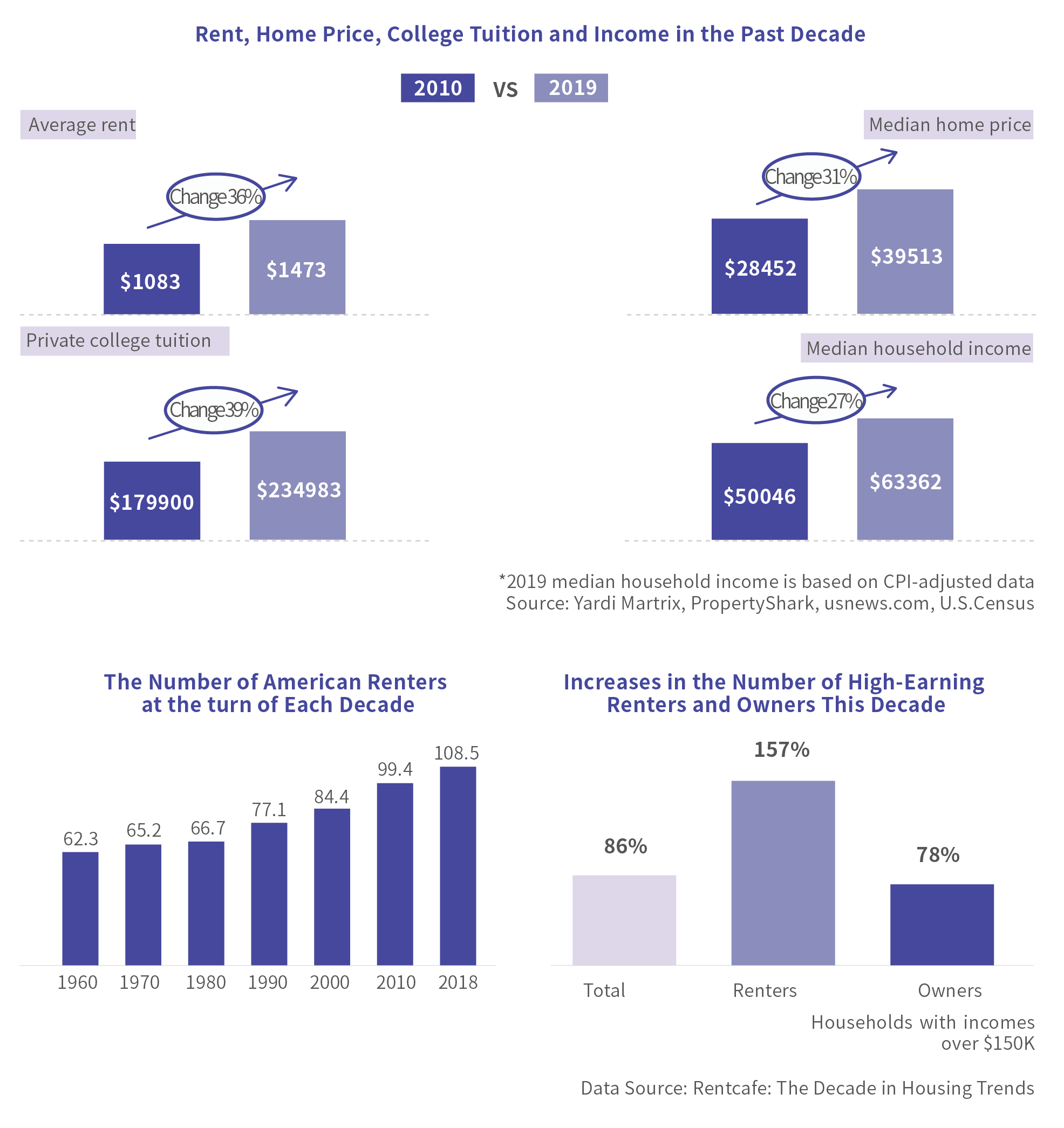
Rent, Home Price, College Tuition and Income in the Past Decade 2010vs.2019
Source: Yardi Martrix, PropertyShark, usnews.com, U.S.Census
RENTCafe
In the U.S., renting gained higher popularity in the past decade. Since 2010, the number of renters increased two times (+9.1%), higher than that of homeowners (+4.3%), showing a considerable shift in the American lifestyle. The growth rate of the number of households with annual income over 15W (+ 157%) is twice as fast as that of high-income households (+ 78%). It represents that more high-income Americans are renting houses, and the rental housing market plays an important role in the social stability and people’s normal life in the United States.
2.2.2 Germany Market
Based on the statistics of the Eurostat, the proportion of rental population in Germany was 48.3%, while only 51.7% of the population had the ownership of housing. This country with a large rental housing market, has the highest proportion of renters in the EU.
German government’s rental laws and policies play a critical role in the industry, which regulates the rental fee, the supporting facilities, usable space and housing safety for guaranteeing the habitability. At the same time, in order to manage the real estate brokerages strictly and protect the interests of both landlords and tenants, Germany introduced Housing Brokerage Law, regulating the behaviors of brokerage agencies.
One of the important characteristics of German’s rental housing market is that most people prefer to rent.
2.2.3 China Market
According to the Report on China’s Long-term Rental Housing Market Outlook and Investment Opportunity 2020-2025 released by ASKCI Consulting Co., Ltd, the rent GMV in 2015 exceeded 1 trillion yuan in total, paid by approximately 160 million people. It is expected that the number could reach 2 trillion yuan in 2020 with 200 million renters, 3.2 trillion yuan in 2025 with 250 million renters. In addition, accoeding to the research report published by the Oriental Securities, in 2030, the number of renters is expected to be 270 million with the market value of 4.2 trillion yuan.
Figure 16. China’s Rental Housing Market Forecast
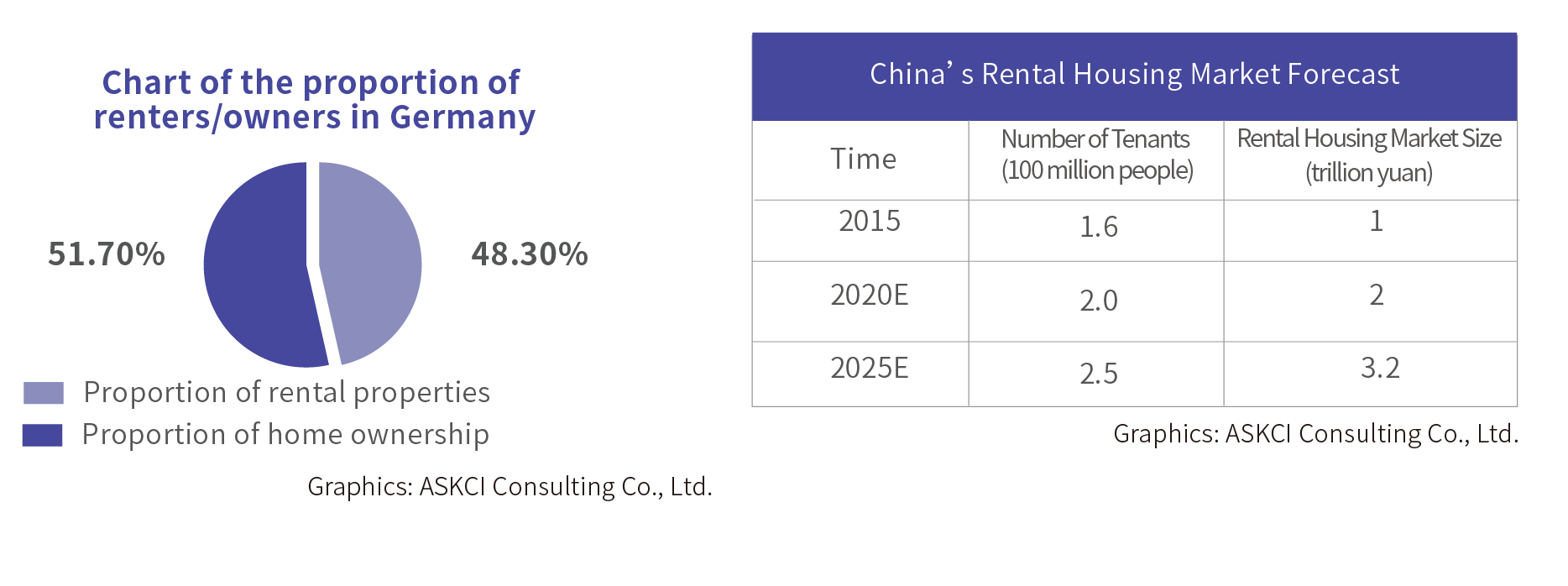
Graphics: ASKCI Consulting Co., Ltd. (www.askci.com)
China has a large population and a rapid growth in demand in rental housing market, which is still in the primary stage. Chinese people’s attitude towards housing rent has changed, and there is an unprecedented potential growth in the apartment rental market.
3. Smart Apartment Solutions:
“Improving apartment management efficiency and enhancing the tenant experience” is the fundamental purpose of the smart apartment solutions. The efficiency is improved mainly through online management, centralized control and simplified procedures. For example:
- With the connection of smart door lock and property management software, the password to open the door can be sent to renters through messages. Tenants are able to visit the rental properties with no need to deliver the key.
- The water and electricity meter reading can be done remotely with the intelligent water-energy meter systems.
- One-button power cut can realize smart collection of fees and allocation of water and electricity charges, which reduces the burden of tenants.
- With connecting to sensing equipment, the most energy-consuming appliances or lights could be turned off when there is no one in the public area for a long time to meet the needs in use and avoid wasting energy.
- Smart devices in the apartment can supply tenants with better experience by making life more efficient, secure, comfortable and intelligent.
The essential demands of smart apartment are:
Technological empowerment
In the solution of software and hardware integration, the high compatibility with the third-party devices can help improve the debugging efficiency, so as to reduce the investment in the software and hardware in the preliminary stage.
Cost Reduction
For clients who hope to rent the apartments, guest houses and other properties, various measures such as adopting unmanned monitoring system, energy consumption control, low-cost upgrading and sustainable development, are trying to reduce the operational cost and increase competitiveness.
First, renters can reduce the manual labour expenditure and realize the operation with low labor cost through the self-service check-in and online payment of tenants.
Second, no rewiring is required with the wireless solution of smart devices, and the maximum operating income can be obtained with the least time cost at the same time of operating and upgrading.
Thirdly, the unmanned automatic cut-off of high-power electrical appliances could save energy consumption.
Lastly, the data generated by the smart devices can be checked online, so as to detect anomalies and take preventive actions.
HUIYI TECHNOLOGY
As a national chain commercial IT comprehensive service provider, HUIYI TECHNOLOGY can realize the high-efficient response model (24 hours *7days a week) in 300 cities of 31 provinces nationwide with the advantage of more than 200 professional operation and maintenance team of service engineers stationed in 48 cities. Meanwhile, focusing on the development philosophy of using smart innovation to empower society, HUIYI TECHNOLOGY has long been dedicated to providing smart scenario solutions that caters to actual needs for apartment rental industry.
Previously, it’s challenging to refashion smart apartments. What’s more, it usually requires high cost and complex wiring construction. A common challenge facing the whole industry is how to renovate traditional apartments into smart apartments with low cost and high efficiency.
In terms of construction, by applying the apartment’s universal SaaS construction model, HUIYI TECHNOLOGY can finish the essential work online including distribution of construction work, management of project progress, whole project acceptance and management of builders so as to finish batched installation and operation of the apartments’ equipments with high efficiency.
By using the API capabilities of smart apartments’ PaaS, HUIYI TECHNOLOGY can seamlessly integrate apartments’ SaaS functions into clients’ backend without changing software, thus realizing unified backend management and reducing the cost and time in software developments.
By establishing its own backend auditing system on brands owners, HUIYI TECHNOLOGY can audit clients that already registered on the system so as to better manage its clients, including developing new clients, managing clients and providing service for clients.
Through smart apartments’ PaaS on AIoT platform, HUIYI TECHNOLOGIY’s construction team have already finished the installation of smart door locks, intelligent access control of townhouse’s doors, smart water and electricity meters and smart indoor appliances controlled by customers in the boutique apartments of Sunshine Hotel. The construction team also assist the apartment team in providing guidance for the daily operation and management of equipments by using apartments’ SaaS platform, which has not only improved customer’s living experience and boosted brand names, but also greatly reduced the management burden of the operation team.
Currently, HUIYI TECHNOLOGY has already finished installation service work for 106 boutique apartments in Sunshine Hotel.
Nanjing LuYi Apartment
Located in the college town of Jiang Ning District of Nanjing, LuYi Apartment strives to create Internet+Youth Venture community which covers both long and short rental smart apartments and various patterns including internet fitness, online gaming and online teaching forums with the objective to establish a community in the college town that combines the function of living, studying and entertainment.
The three phase projects in total contains 500 apartments and it is expected to finish 62 long rental apartments and 65 short rental apartments for phase I project this year.
By introducing one-stop solution including smart device (smart door locks) and apartment management software, LuYi Apartment makes it possible for the apartment management team to remotely send the password to tenants through the apartment SaaS so that they can independently view apartment without housekeepers. The apartment management team can also remotely send temporary password to the house cleaners and maintenance man to help them deliver quick door-to –door service.
By installing smart electricity and water meters, the apartment management team can remotely control the meters through the apartment’s SaaS for power outage so as to remind tenants to pay their electricity bills. Meanwhile, the apartment management team can provide reasonable charge in public areas to help accommodate tenants’ concerns of the charge sharing in these areas and can realize digitalized energy consumption and smart energy management by remotely calculating statistics.
Equipped with a whole set of interior smart devices including intelligent switch, PIR, curtain, air conditioner, TV, temperature and humidity sensors, the apartments can present different automated scenarios with the help of the management team by using the apartments’ SaaS. The management team can then expand the scenarios to other apartments to ensure tenants can experience smart scenarios (lights on when they open the door) at the start of their occupancy.
After their occupancy, tenants can use App (Zugo) to remotely control and check the status of the smart devices and choose the automated scenarios according to their preferences.
Based on various scenarios including available apartments management, house viewing before occupancy, tenants occupancy, tenants service, LuYi Apartment further integrates smart door locks, electricity and water meters, interior smart devices and management system, which has not only greatly improved the operation efficiency of the management team and reduced human cost and management risks, but also provided young tenants with smart devices, thus, the quality of the apartments was boosted and it has also provided a safer, more comfortable and more convenient living experience for tenants and helped clients to have their own apartments with different features and establish the brand name of the youth venture community.
2.2.3 Smart City
As a promising business scenario in the application of AIoT, smart city that counts on plenty of cross-sector technologies and solutions consists of smart real estate, smart security, and smart commercial lighting.
Smart Real Estate
1. Overview on the Development of Smart Real Estate Sector
According to the report by Prospective Industry Research Institute, China’s property sales exceeded 10 trillion for the first time in 2016. The country’s commercial housing sales reached 15 trillion in 2018. Although the trend is continuing, the growth rate declines sharply, and the growth was 1.5% slower than 2017.
Fueled by massive demographic dividend, traditional housing sector has witnessed continuous breakneck growth over the past two decades. But due to policy tightening, the disappearance of demographic dividend, fierce market competition, and the serious problem of homogenization, the sector has been facing the risk of transforming from a growth market to inventory market. The traditional development mode of purchasing land for house selling has been phasing out of the mainstream, while the real estate operation mode is now a breakthrough point in the sector. Operation mode applied in the property sector drives the transition of players from physical space provider to digital home service operator. The downstream’s digital transformation in the real estate sector featuring a huge market volume has explicitly created impressive smart business value for the upstream players.
Given the macro policy, the principle of “house for living in, not for speculation”, and the recently-announced “three red lines”, the housing sector is forced to shift more attention to product and operation for competitiveness.
The housing sector is required to innovate products, reduce costs and improve efficiency, and evolve from house development to operation. First, the sector is increasingly concentrated with more fierce competition, which makes it necessary to innovate products continuously to stand out. Intelligent technologies should be the focus. Second, due to the increase of labor cost, it is urgent to reduce the cost and improve the efficiency of property management. Last but not the least, the sector expects to get exposed to and understand customers, so that they can do more accurately in product development and project planning.
In terms of technological development, in the post-internet era, cloud computing, big data, AI and IoT technologies are on the highway of development, which drives the application scenarios more mature.
With higher expectations on “living” a pleasing life, customers are looking forward to more healthy, convenient, comfortable and intelligent life experience.
In this context, the leading housing developers have established their technology subsidiaries, for example, Vayi Tech and Vanrui Tech in Vanke, Evergrande High-tech and Xingluo Technology in Evergrande, HSUNION in China Overseas Land & Investment, and Shimao IoT in world Trade Center (Shanghai) Group, etc. Most of these tech companies were set up in the past two years.
Smart property has been turned into a group standard from a regional pilot project. The housing sector has been including smart home into group purchase. Besides, the developers have started to establish an integrated IoT platform for whole-house intelligent/smart community. For instance, Vanke, CIFI, Languang, and other house developers have built up an integrated real estate IoT platform.
Leading tech companies are dedicated to developing smart property business. The smart property sector mainly consisted of companies focusing on smart home and community previously. In recent years, prominent tech companies including Tuya Smart, Sense Time, Megvii, and iFLYTEK, etc. begin to make progress in the area of smart property.
Driving force of Smart Property Development
2. Industrial Chain and Roles in the Smart Property Sector
Hardware suppliers. The basic hardwares mainly consist of lights, door lock, security products, curtains, environment-related products; and the additional products include all kinds of home appliances.
Whole-house intelligent technology providers. There are two kinds, namely start-ups and traditional companies, mainly focusing on video door phones and switches.
Integration suppliers. The integration business is devoted to developing whole-house intelligent solutions and establishing intelligent community.
Smart property platform. For example, Tuya Smart, Sense Time, and iFLYTEK, etc.
Tech Companies Affiliated to Property Developers. Over the past years, tech subsidiaries established by house developers have been playing three roles. They are solution providers to facilitate projects, official functional departments to develop and uphold intelligent technology standards in real estate groups, and players in exploring and implementing the strategy of property + intelligent technology.
Smart Property Solutions
3.1 Pain Points of Smart Property Business
Devices do not interact with each other, provide bad experience, and can’t be extended. Power and lighting, security sensors, and small and big home appliances from various brands need more than one App, thus generating unpleasant experience. The basic and additional devices fail to interact, resulting in failure to meet owners’ needs on extending intelligent device.
Indoor and outdoor scenarios are little integrated. There is the absence of effective interaction between home space and public space. Smart home is isolated from smart community, leading to data silos. In the end, households have no access to one-stop smart life experience.
Design, construction and operation are expensive without any management. When scheming intelligent solutions, designers are faced with high threshold and are low-efficient; a number of projects are delivered at the same time, and device debugging is low-efficient and impossible to be controlled; after moving in, home owners find that a vast number of device operation and aftersales problems are out of control.
Due to the lack of data, house developers find it impossible to manage users. Intelligent solutions are isolated from community services, since the data is in the hand of equipment suppliers instead of real estate companies who can’t get aware of proprietors’ experience and feedbacks. Meanwhile, without data collection and analysis, developers can only fine it hard to figure out owners’ needs, thus failing to provide them with accurate operation services.
3.2 There are two mainstream modes in the sector. Take smart home as an example:
One-stop solution. Whole-house intelligent solution supplier provides one-stop solution consisting of software and hardware, as well as project implementation, featuring a main strength of responsibilities clearly defined.
Division of work. Work is distributed among platform providers, tech companies affiliated to property developers, and hardware and device suppliers. The developer tech subsidiary, playing a critical role, provides project solutions, with three strengths as follows:
First, deliver user experience. All users are using the same interaction gateway, such as App. Diversified brand ecosystem on the platform, and property management and life services extended from “living” work together generating an integrated and rich intelligent experience.
Second, realize group-level management and control, reduce cost, and increase efficiency. The whole-chain management covering planning, construction, debugging, and equipment operation, as well as the all-in-one management platform that integrates intelligent devices, intelligent public areas, and whole-house intelligent solutions, enables to reduce the cost while increasing the efficiency of property management, and to facilitate the operation and profit earning for property management business.
Finally, empowers house developers to lay a foundation for data enablement business. Smart home data is collected as a reference for evaluating the improvement of real estate product quality and customer experience, and to support community service operation.
3.3 Value of Smart Property Business
Improve product competitiveness. User focused, people, devices and services are connected in a certain space to create intelligent scenarios and pleasing experience, so as to enhance the competitiveness of property products, yield premiums, and improve absorption rate.
Reduce the cost and increase the efficiency. A unified management platform linking the whole house with public areas can realize integrated and intelligent management on information, devices, and services, thus reducing cost and increasing efficiency.
The second building-up curve. Adopt intelligent solutions as an entrance to your “home” to connect with users, reaching and understanding them to offer them precision products and services, and to set up an all-new business mode, in turn increasing value and profits. Shaping a second building-up curve allows real estate companies to upgrade from developers to operators.
Commercial Lighting
1. Overview on Commercial Lighting Sector
As people cannot live without lighting, and spend part of their time at home, a set of smart and flexible home lights is a must. The other part of people’s time is spent on work and commercial activities, for example work, shopping, studying, traveling, etc. Therefore, commercial lighting can cover multiple application scenarios, including office buildings, schools, commercial space, warehouses, parking lots, exhibition halls, libraries, factories, stations, etc.
Nowadays, people spend 90% of their life in buildings, so green and healthy buildings are what people lay the greatest attention to. It is reducing building energy consumption that is critical for the construction of green buildings. The dominant energy consumer in a building is HVAC that accounts for 45%. The second highest is lighting that normally takes up 30% of the total energy consumption.
There are lighting stipulations both in the US LEED green building certification rules and China’s green building certification standards. Due to the new LEED standard, lighting control system that is playing an increasingly significant role, has been regarded as a must-have and included into the prerequisites in some projects. Furthermore, the control system has been extended from the traditional artificial lighting to cover daylighting, measuring, monitoring, innovation, etc., creating an integrated system, which helps to win a higher scoring in LEED evaluation and obtain a higher-level LEED certification. According to the Energy Saving from Networked Lighting Control (NLC) Systems report by the US DLC, smart lighting control system has a notable effect in reducing energy consumption. On average, 47% can be saved. Most notably, warehouse can consume 82% less. In offices, the system helps to save energy by 63%.
Figure 17. Summary of inferred NLC savings by building type results
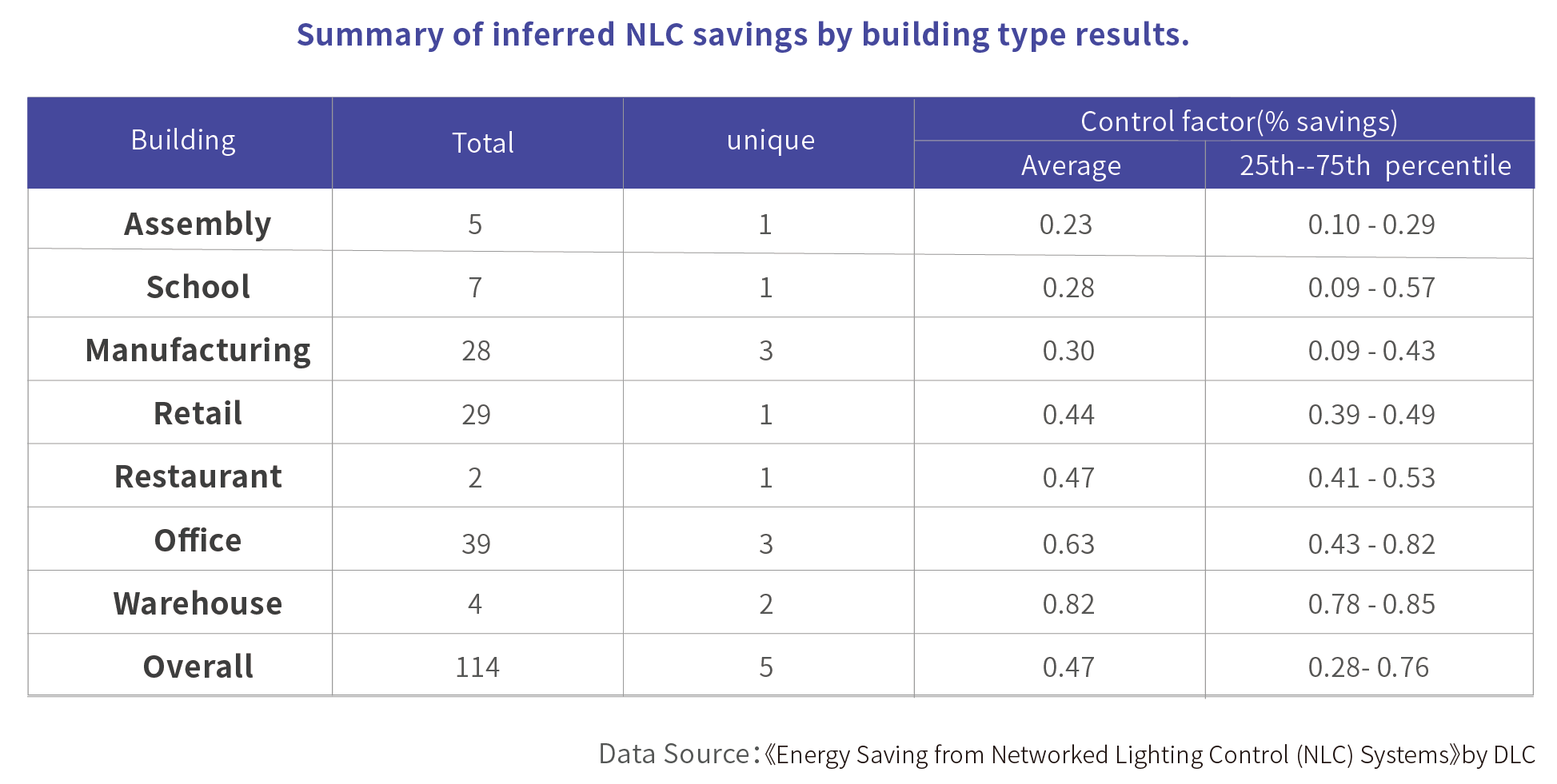
Source: Energy Saving from Networked Lighting Control (NLC) Systems by DLC
Buildings can shelter people from danger, and impact people’s health. In May, 2018, IWBI launched the trial version of WELL v2 globally to promote the development of healthy buildings based on edge-cutting scientific and medical know-how, and counting on healthy building standard and certification system. WELL has been adopted by more than 30 countries. In WELL, the light solution advocates people’s exposure to light, which is meant to create a luminous environment beneficial to vision, psychological and physical health. Playing a significant role in healthy buildings, light control system provides solutions pertaining to circadian lighting, automatic control, on-off and dimming, daylighting and shading, indirect illumination, scenarios, etc. As the prerequisite in WELL certification system, light control system is also recognized and playing a role. Global Lighting Association has clearly depicted the development roadmap of future lighting. In the future, lighting will gradually evolve to service-oriented and upgradable intelligent lighting system, and ultimately to the human centric lighting that is beneficial to people’ s health.
2. Commercial Lighting Solutions
As lighting should be people-centered, its products, design and application should be focused on health and comfort. Currently, specifications can make a difference in realizing good luminous environment, including reflectivity, luminous flux, color temperature, glare, and CRI for lamps and light sources, as well as environment-related indicators like illuminance, evenness, brightness contrast, consistency, shadow, etc. Some software are able to simulate and compute the quality of illuminous environment.
But natural lighting is not consistent throughout the day. Sun’s position, color temperature, and illuminance are different in the morning, at noon, and at nightfall, thus exerting various impacts on people’s psychological and physical conditions. Similarly, it is impossible to rely on unchanging artificial lighting to deliver the best and comfortable illuminous environment. Besides, people’s requests for the light environment vary in application scenarios. For example, the light environment is needed to refresh people in studying for a higher learning efficiency. In a restaurant, a comfortable and elegant light environment is necessary for working up an appetite, facilitating communication, and ensuring privacy. In other occasions, different behavior settings have different requirements for light environment. For instance, a small meeting room needs to have the settings of greeting, speaking, discussion, summarizing, etc. Sensitivity to light varies among age groups, for example, the old and the young have varying degrees of sensitivity for light with different requirements. Therefore, only the intelligent lighting control system featuring dynamic lighting can generate a people-centered illuminous environment.
The needs of light environment for commercial use depend on the place and settings of application:
- There are multiple subsectors in commercial building industry, whose needs are different from each other. Office buildings, transport connections, stadiums, performance centers, museums, hospitals, schools, factories, street lamps, landscape lighting and other application scenarios have their own uniqueness.
- Given the professional aesthetic requests, a specialized design team will be needed.
- Safe-to-use is rather critical. In case of an accident, not just an individual will be impacted. So there are high requirements on the reliability of products and systems.
- There are higher demands on energy saving, in particular in the application scenarios previously using a number of high-power light equipment and lamps.
- The IoT-based commercial smart lighting system can give a boost to many benefits.
Firstly, in terms of professional aesthetic needs, visual effects for lighting can be created, typically the light levels in certain application scenarios, and focus on highlighted objects. The expression is realized not solely through parameters or software simulation, but also needs adjustment according to the real environment. The whole process can be enabled by a smart lighting control system.
Secondly, to meet the need of multi-scenario application, a smart lighting control system can rely on pre-setting, sensors, and other approaches.
Thirdly, clock manager, and smooth dynamic control methods help to control timing, time sharing, and zoning, thus realizing various scenarios at different time, and dynamic lighting effects such as color temperature, illuminance, and even color adjustment.
Fourthly, detecting state parameter and monitoring software are used to warn on to-be-scrapped devices, inform of lighting devices out of service, and implement a range of lighting control strategies like soft start, delayed start, soft shutdown and power supply voltage surge protection, easy for centralized management and equipment maintenance.
Fifthly, energy can be saved with the help of the control system. Energy saving strategy can be pre-set, so that light will be turned on when people are coming, and will be turned off or down when people leave. Light balancing, a control method making use of natural light helps to save energy by 15-75%, and extend the lifespan of light sources by 2-4 folds.
A systemic intelligent lighting control system takes an effect in three visualized ways, namely on-off, dimming, and color adjustment (including color temperature and color). But in the system, various technologies are adopted such as light source, electrical, microelectronic, computer, automatic control, communication, and networking technologies. In existing bus and wireless protocols, there are 485, KNX, Longworks, DALI, and DMX512, the relatively long-life wire protocol; Zigbee, Wi-Fi (TCP/IP), Bluetooth, and Zwave, the flexible protocol; and Lora, NB-IoT, POE, LIFI, GPRS, and 5G, the emerging protocol. Devices include smart switches/relays, dimmers, dimmable electronic drivers, smart lamps, control panels with CPU, computer software, wireless modules, etc.
The current main dimming methods consist of: leading edge phase control, trailing edge phase control, PWM pulse width control, 0-10V control, DALI control, etc. To achieve perfect dimming effects, it is necessary to ensure a wide dimming range and create a perfect atmosphere; deliver excellent dimming consistency and overall effect; have a smooth dimming curve without jitter or flicker; protect drive circuit and light source; and use safer and more reliable lamps.
Apart from the basic control functions listed above, a complete smart commercial lighting system is based on IoT platform, and suitable for the new and inventory commercial lighting market. It provides the market with a complete solution ranging from devices to software control and to construction, and realizes green and healthy buildings through device management, energy control, and human centric lighting. Besides, a digital and visualized management platform is offered for product maintenance and operation after sales, so as to enable users to have access to intelligent business, and reduce management cost.
An IoT-based smart commercial lighting system should be developed to cover the five function modules of monitoring, sensing, measuring, managing and controlling. “Monitoring” stands for the functions of equipment failure alarming, life alarming, data analysis, etc. “Sensing” means the functions of human centric lighting, automatic illuminance balancing, movement detection, etc. “Measuring” covers the functions of energy consumption measurement, equipment usage time gauage etc. “Managing” represents the functions of access management, construction management, centralized management of projects at various places, etc. “Controlling” indicates the functions of graphic control, scheduled appointment control, scenario-based control, and basic functions including single light control and group control for on-off, dimming, and toning.
Furthermore, an IoT-based smart commercial lighting system should be a one-stop solution applicable to various scenarios using pluggable installation without complex wiring, which can help to increase application and management efficiency, thus realizing green and healthy buildings. The system consists of client interface to meet end users’ needs on integrated control; management interface to provide data overview, and device visualized management, and energy management platform to realize equipment centralized management; and construction management platform to achieve construction management, rapid network distribution, and convenient deployment. An ideal IoT-based smart commercial lighting system boasts the features as follows: 1. Impressive functions, 2. Compatible with multiple network protocols, 3. Powerful ecosystem, 4. Digital operation management, 5. Security of network data, 6. Sustainable service supporting system.
The system can be integrated with natural lighting, air quality monitoring, environment temperature monitoring, visitor management, safety management, and AI computing and prediction to establish a comprehensive solution for smart buildings and community. Using BIM-based three-dimension system for three-dimension presentation and visualized operation management allows to improve customer experience and effects, and accelerate the development of green and health buildings.
Construlita Group
Construlita Group is one of the largest domestic lighting brands in Mexico and Central America, providing solutions for residential, commercial, and industrial applications.
A 35-year veteran in the lighting industry, Construlita has created a brand image driven by innovation, creativity, and design. The company does businesses in nine countries, including Mexico, Colombia, Costa Rica, El Salvador, Nicaragua, and Honduras.
Through its brands Tecnolite Connect and Construlita Connect, Construlita provides smart solutions for residential, telecommunications, and professional services firms, empowering significantly enhanced customer experiences through behavioral data analysis.
Traditional wired lighting systems face problems such as complicated wiring work and high installation costs. Although wireless lighting solutions are gradually becoming mainstream, upgrading from wired to wireless lighting also brings new challenges such as dealing with a distribution network and figuring out how to manage multiple devices at one time.
Using the Tuya AIoT Platform, Construlita has been able to make this essential transition to wireless commercial lighting and develop a commercial lighting PaaS solution via a new brand: Construlita Connect. Construlita Connect offers the full range of lighting products and easily incorporates different types of devices, including sensors, switches, circuit breakers, water meters, and cameras.
Construlita Connect can also transform traditional solutions. Wireless smart commercial lighting solutions greatly improve efficiency and significantly reduce upgrade costs, relieving companies of the burdensome installation and repairs involved with using wires.
Through the flexible, automated solutions and intelligent control of its commercial lighting PaaS offering, Construlita helps its partners and customers save on energy and labor, improve user experience and management efficiency, and reduce operating costs.
Lighting & Equipment Public Company Limited.
Founded in 1993, Lighting & Equipment Public Company Limited. (L&E) started with an initial capital of 25 million Baht, marketing fluorescent luminaries to electrical contractors and reaching out to governmental agencies. In 2018, the annual revenue was 2,923 Million Baht, and 69% of that came from project business. Now, L&E ranks No. 1 in project lighting industry in Thailand, with a 20% share of the overall lighting market of Thailand, and an influence covering most SEA countries such as Vietnam, Cambodia, Indonesia, Malaysia, Myanmar, etc.
L&E has been working with Tuya since 2018, and started with retailing business. L&E expanded rapidly from Bluetooth & Wi-Fi lighting products to electrical outlets, sensors, IP cameras, promoting ICON Link as its smart home brand. Soon, L&E stepped up to the second place in retailing channel of smart lighting, as most attempts from Thai brands, including L&E itself, failed due to high costs, lacks of variety, and poor customer experiences.
For the first time, L&E is able to introduce affordable smart home products to its customers, as Tuya has helped provide various options in terms of multiple communication protocols, more than 200 thousand ready-to-go products from more than 30 thousand competitive manufacturers, and most importantly, a stable and cost-friendly Cloud service. All these helped L&E to shorten its development cycle, to lower its development fee, and to minimize its operational cost.
In 2019, L&E faced challenges from some smart building solution providers such as Lutron and Signify. The top management team of L&E saw Smart Lighting with great significance, and decided to go deeper with Tuya for the potential IoT technology, that could add to its project lighting business. L&E knows what kind of solution works in the Thai market, but it took quite a long time for L&E to start forging its own from scratch, and by then the market share had already been grabbed by its competitors. As a result, L&E reached out to Tuya for a solution, and Tuya, in return, provided a Lighting SaaS for smart building scenarios. There are in total 6 things Tuya provided with Lighting SaaS:
- Lighting Luminaires including light tubes and panel lights
- Multiple sensors such as humidity, temperature, luminance, and human motion
- A control App for its users
- A web system for monitoring and management of the whole building
- An installation app for builders to connect all the devices when Internet is not in place
- A robust and powerful cloud service
This wireless system enabled L&E to compete against other bidders, as the overall cost was reduced by more than 90% comparing to that of a wired solution. With the automation capabilities, light will automatically go off when no one is in this room or area, lighting condition will be adjusted according to the specific time of the day and the readings of luminance sensors. A heat map will inform managers which area generated most human activities, and administrators and technicians will know the running status of all devices, and if there’s a maintenance needed to be arranged. L&E has a great foundation of customer base, and now L&E could help its customers to improve management efficiency, to save energy, to bring down installation costs, and to boost user experience for every person who works in these buildings.
Sichuan Languang Development Co., Ltd
Sichuan Languang Development Co., Ltd (“BRC” or the “Company”) is a TOP30 enterprise in Chinese real estate industry. Languang Development strives to provide innovative solutions for living and lifestyles, and to create happy living environments for people. The Company was restructured and listed in the Shanghai Stock Exchange in 2015, since then the brand value has reached RMB24.28 billion in 2019, making it one of the “TOP100 Chinese Real Estate Development Enterprises” for the 13th consecutive years. The Company was ranked as one of the “TOP20 Chinese Real Estate Development Enterprises 2020”, and “TOP11 Brand Value for Chinese Real Estate Enterprises 2020”. In 2019, BRC’s sales value exceeded RMB100 billion for the first time, amounting to RMB101.554 billion.
As the demand for smart living continues to strengthen among Chinese consumers, real estate projects of premium quality rolled out new properties that incorporated a wide range of high-tech smart home designs in order to seize a larger market share, to increase customer stickiness and to provide value-add potentials. Smart home design has become a selling point for developers to facilitate sales and enhance properties’ value-add and competitiveness.
Smart living has gradually become a tailwind for the real estate industry. BRC, as an enterprise incorporating technological development in its genes, we have already constructed a scalable blueprint for smart living. With the central mission of developing real estate projects, BRC has constructed cloud platforms for AIoT smart living and smart marketing, and has launched intelligent solutions and digitalization across the entire properties industry’s value chain, including smart living, smart communities, smart business and smart marketing.
In 2019, BRC has preliminarily completed the construction of its self-developed AIoT Smart Living Platform. There are, however, a wide array of products available for the platform, making cross-brand integration and compatibility just unavailable yet. Since cloud services, product manufacturers and system integrators in the real estate industry offer mostly customized products and services, and given the lack of ready-to-use products, BRC has to invest more to improve the AIoT Smart Living Platform, which would mean a longer time horizon for payback.
To upgrade real estate products for smart living, and to cater to the increasing demand for the same, BRC sees the urge to expand its internet of things offerings quickly, especially for household appliances, large or small.
BRC collaborates with Tuya Smart, a globalized AIoT platform, to jointly established the "BRC & Tuya Smart – IoT Innovation Lab". After being integrated into the Tuya App SDK, AIoT Smart Living Platform can configure network and manage all Powered by Tuya products, including the IoT devices developed by BRC, thus expanding the BRC product matrix rapidly. BRC is poised to meet the demand for fully smart living homes both in the factory-installed and aftermarket-installed products market.
Okura. Co., Ltd
Established in 1962, Okura. Co., Ltd is a real estate company with extensive influence in the Japanese real estate industry. Its business involves comprehensive real estate related businesses such as land acquisition, home development, housing construction, housing sales, and housing renovation. Over the past 50 years, Okura has developed more than 60,000 homesteads and independent houses, and about 512 apartments. Based on such a huge housing construction and zoning foundation, Okura is vigorously promoting smart city planning to seize the development opportunities in the era of intelligent connection of things.
In business, Okura focuses on life basics, "housing", and develops business in Japan around one-family construction, apartment, new town development, apartment, real estate renovation, and other fields. Also, in 1974, with the goal of "providing customers with a fast and comfortable life", a membership-based resort and recuperation business was launched, and it was actively expanded nationwide on a large scale. In the new era, in order to provide customers with a more comfortable, safe, and secure life, Okura is actively introducing the latest technology. In recent years, Okura has actively promoted the smart city plan to maintain the initiative in the AIoT era.
To fulfill this, Okura has built smart whole-house model rooms in Chiba, Wakayama, Okayama and Aichi prefectures, so that more Japanese people can experience the convenience of smart real estate. At present, Okura’s real estate businesses, such as residential and apartment under construction, will gradually introduce whole-house smart solutions to provide a smart experience of intelligent connection of things. With the same mobile app or smart speaker, users can operate the smartest devices in the house, including lights, curtains, air conditioners, etc.
For real estate developers, AIoT technology is becoming a new decisive point in the real estate industry. More and more consumers tend to choose projects that bring their own smart whole-house solutions or houses that can combine smart cities, security, and smart elderly care so that the aging Japanese population will have a safer and more independent residential environment in the future.
In the future, Okura also plans to build smart whole-house model rooms in Hokkaido, Sendai, Kyoto, Gifu, and Okinawa to make the concept of smart real estate be popularized in Japan more quickly.
Smart Security
1. Overview on Smart Security Industry
With the rapid development of global economy and people’s standard of living, people have paid more attention to the security of their private wealth, as it is not pursuing wealth but safely owning wealth that is the concern. Among the public, security means protection, while the industry players believe security stands for high tech-based protection in which information tech-based service, picture transmission, and storage technology are counted on to avoid health and wealth risks.
As recent research reports suggests, global intelligent security market size will go up from $12 billion in 2018 to $45 billion in 2023 at an CAGR as high as 30.26%. Currently, the physical security market is playing a dominant role, accounting for 65%. In the global Top 50 intelligent security companies in 2019, Chinese players had an eye-catching performance.
In China, security industry planning is a national strategy. Traditional security systems have witnessed the increase in penetration. The industry has undergone four stages: beginning, growth, explosion, and saturation.
At the beginning stage in 2003, the Golden Shield Project was initiated, and the infrastructure of the public security communication network and computer information system was established, which laid an application foundation for the security electronic equipment, and delivered development opportunities for the industry;
In 2005, the industry was at growth period when the real opportunity for the industry to bloom up was the launch of the Skynet project. The large-scale distributed video surveillance network layout led to a surge in the demand for surveillance equipment;
Since the start of the Xueliang Project in 2016, the security facilities in big cities have become increasingly saturated, and security monitoring platforms have begun to penetrate counties and villages. The smart security industry, which focuses on home security and public safety, quickly caught the first train empowered by AIoT and began to innovate the traditional security industry.
In recent years, driven by the principle of a safe city project strongly supported by the government, many technology giants have laid out a diversified footprint to seize the blue ocean market in face of the cake of AI+ security. AI+ security is one of the main tracks with the fastest commercial deployment of artificial intelligence technology and the largest market capacity. AI technology began to be adopted in 2015. Self-monitoring and active identification have become the mainstream for video surveillance products. Various vertical applications based on AI technology are constantly emerging. China’s security industry has already transitioned from strategic investment to a highly mature situation.
Compared with the highly mature security industry in China, there are still many new scenarios in the international security market that has not been fully developed, and there are huge market opportunities to be explored. Although the security industry originated in the United States, after more than half a century of development and evolution, it has gradually developed into a large-scale mature industry covering the global market.
Most of the international security hardware suppliers are from China. The service models of American security operators are mostly monopolistic, their services are expensive, and their hardware options are not diversified and are mostly sold in the form of kits. But some international small and medium-sized security service providers and channel providers are in need of a more cost-effective platform or need to build up their brands, so the customized service providers of Chinese security App and SaaS management platform have flooded into the international market. Notably, due to the huge economic, cultural, and political differences among countries, the mature security market is only in Europe and the United States. The smart security market in many regions is still in its infancy. For the Chinese security enterprises, the international security market has much more to be tapped than the Chinese market.
Since smart homes are still a kind of user experience demand, there are still certain market differences between smart home market and the just-needed security market, and the market and user habits need to be cultivated and impacted.
By comparison, the international security market has greater opportunities. “Going out” to the global market can generate more profit in a faster manner than “staying” in the mature Chinese security market for companies to provide hardwares, software and complete solutions. Video surveillance, access control, and anti-theft alarm are the three major products in the security industry. However, in terms of current market trends, video surveillance is still the mainstream product in the security industry.
AI security industry has many players, a large market and a long track.
Core players in the smart security industrial chain:
Upstream: Chip manufacturer, hardware manufacturer
Midstream: Security vendors, AI companies, cloud service vendors
Downstream: System integrator, project integrator, engineering construction service provider
Most companies only play one of these roles, and it is rare to see such platform companies as Tuya Smart that integrates diverse hardware ecologies, AI technology and cloud services into one.
Smart Security solutions
1. Mainstream Solutions in the Smart Security Industry
From security hardware to software, aiming at the distribution market, companies rely on 2B/2G (business-oriented/government-oriented) resources, and the security business and cloud platform strategy are strongly coordinated.
Companies provide enablement from the bottom of the industry, work along both lines of investment and merging, focus on foundation-started cloud development, and advocate secondary development of Paas layer.
Intelligent development, and unified establishment and planning of smart city structure are the trend. It is a must to avoid repeated underlying architecture, to share data and resources in real time, and to maximize the use of computing resources.
The applicable mainstream security solutions at home and abroad, and their highlights are as follows:
1. There are self-developed systems. It is hoped to expand the hardware product ecosystem, but the cost of docking one by one is high.
Solution: Integrate smart hardware ecosystems, and only need to dock PaaS to support device access.
Highlights: Based on years of practice in the IoT industry, a wealth of open interfaces has been deposited, which completely covers multiple business scenarios such as authorization management, user management, distribution network management, equipment control, and scene automation.
2. Existing security product channels/brands have a certain degree of influence, and are expected to be used to increase revenue.
Solution: Intelligently upgrade existing products by inserting cloud modules to expand sales channels at home and abroad.
Highlights: Save the cost of hardware development, and expand the channel market with the help of the brand image of the solution provider.
3. There is a rigid need for security scenarios in business, which drives to seek suitable solutions.
Solution: Build a complete set of smart security system at low cost, and coordinate with hardware sales, operation services, and software value-added services to support profit earning in all aspects.
Highlights: Flexible device authorization mode, support integration of App SDK, OEM App, public App scan code and other authorization methods. Developers obtain user and device data by using OpenAPI, and control devices through permissions.
Video surveillance: Alarm message feeding and operation: trigger the alarm from the alarm device, visualize the alarm push, perform alarm verification through video review, and make alarm processing based on the video content feeds.
Non-gateway single-product devices (Wi-Fi, BLE, NB-IoT) can be virtualized as a security gateway in the cloud, so that they have the ability to deploy and withdraw security devices, and provide flexible configuration of pan-scenario security capabilities.
Highlights: Based on the huge smart hardware ecosystem, App and platform support flexible customization, adapt to multiple scenarios, and meet the needs of subsequent expansion.
Relying on the ecosystem of AI + IoT platform, big data and huge hardware product, smart security is a comprehensive smart security solution for families, communities, zones, buildings and business scenarios, covering security operations, elderly care, campus protection, smart fire protection, property management, chain commerce and other smart security fields. This is to enable global security industry partners to quickly enter the global market. Therefore, the smart security solution that is most in line with the big security trend in the industry currently has the characteristics of full-stack SaaS, zero development and visualized security.
Under the background of AI, big data, and the Internet of Things empowering the security industry, it is now the beginning of the outbreak of artificial intelligence in the security industry. Companies will use this opportunity to transform and upgrade their traditional business models to get closer to the general trend in the overall security industry. The polarization in the industry will also become increasingly obvious. Some companies that have not kept up with technological development will fall behind, and those companies that understand the lifeblood of the market will have more opportunities in the future.
Intelbras
Founded in 1976, Intelbras is a leading Brazilian smart home security brand and one of the top three IP camera manufacturers in the world. They’re a one-stop home security solution provider offering the full range of home security devices—including sensors, door locks, energy saving systems, and connectivity¬—to create safer living and working environments for people worldwide.
Intelbras serves customers across Brazil with over 200 dealers and 120,000 agents. Intelbras also has four factories in South America and more than 3,300 global employees. The company generated around $372 million in revenue in 2019.
COVID-19 has brought new opportunities to the world of smart security, and Intelbras has responded by creating a new human temperature monitor.
Launched in early 2019, this new monitor is being used in different communities and office buildings to remotely detect people entering buildings who have a high temperature or fever. Combining its capabilities with those of a smart camera, the detector can warn and directly send a notification to the security guards or medical workers as soon as someone with a fever is detected.
Intelbras has also formed a strategic partnership with global leading AIoT platform provider, Tuya Smart, to realize smart transformation and device controlling across different product categories, as well as offer a better user experience.
Intelbras’ app, Izy Smart, can control all Intelbras smart home products. It also supports smart scene linking and smart scene automation for users to enjoy a truly convenient smart life.
Intelbras has also launched its top-rated smart light bulb in Brazil. It features voice control with smart speakers, where users can select different colors and modes, such as reading mode, leisure mode, and music mode.
Zebronics—Connecting to Global IoT Capabilities
Founded in 1997 and headquartered in Chennai, Zebronics is India’s top IT peripherals, audio/video, LED TV, healthcare, mobile accessory, and surveillance brand, providing products that are designed well but also affordable for any household.
The company has over 1,100 employees across 31 offices and 127-plus Zeb Care service centers. These central offices are backed by strong network of dealers, resellers, and integrators that add another 50,000-plus retail locations across the country. The Zeb Care centers provide support to the consumers and the channel network.
The demand for home audio and video products has increased with the rise of smart homes in India, and Zebronics has responded by developing a comprehensive home smart video product line, including PTZ cameras, IP cameras, a four-in-one camera, a fisheye camera, and a smart Wi-Fi camera.
Tuya has enabled Zebronics to have quick access to intelligent oice platforms such as Amazon Alexa and Google Assistant, and, through this, Zebronics has created a smart home app named ZEB Home. They have also launched a smart IP camera based on Tuya’s platform and will soon add more IP cameras to their existing line.
Zebronics is committed to becoming a leading brand in the field of smart security and surveillance in India. The company has an in-house R&D department monitoring the latest developments in the field of technology and innovation to find best possible products and services for the Indian smart home market.
Thanks to the continued quality of products and services it provides, the loyalty of country-wide dealers, these dealers’ faith in Zebronics as a brand, and the backing of Tuya technology, Zebronics has been able to find and maintain success in the Indian smart home market.
2.2.3 Smart Home
1. Overview of the Smart Home Industry
1.1 Trend in Smart Home Product: From Wired to Wireless
The global economy was in the Electrical Age from 1920 to 1980, when the development of electrical technology laid a solid foundation in hardware control for the smart home industry. Households around the world began to have access to electricity, and the growing residential demand led to the booming development of automated home devices. Various kinds of electrical appliances were invented, creating the early form of smart home. With the coming of the Information Age from 1980 to 2018, smart home technology and solution evolved more rapidly, and smart home product began to transform from wired to wireless.
The communication technology used in the smart home control system iterates continually, from power line communication to fieldbus communication, and then to wireless communication. Based on these three methods, three major ecosystems of smart home communication were formed. Starting from 2019, as the global economy enters a new cycle and the Digital Age, devices with human-machine interaction are becoming smarter and better. Meanwhile, connecting device to the cloud under wireless protocol and processing high-value in cloud through edge gateway have become a major trend for smart products.
1.2 Trend in Smart Home Communication Technology: Cross-Protocol Communication
Currently, there are mainly three categories of communication technology for smart home applications.
These three communication technologies can also be divided into only two categories: wireless and wired. In reality, wired solutions have high data transmission speed, low sensitivity to external environment, and strong anti-interference capability. However, they also have drawbacks, namely, the long construction period, the need of complicated wiring in advance and the fixed location of device, which lead to the wired solutions unsuitable for house remodeling or later decoration. In contrast, wireless solutions are smarter and simpler, which can automatically network, expand and change terminals flexibly. With the development of wireless communication technology, wireless solutions’ performance in power consumption, transmission distance, transmission rate, and anti-interference capability has been greatly improving.
With the global deployment of cloud base stations, wireless protocols, apps and device-to-cloud connectivity have become the mainstream forms of smart home products. Developers adapt different communication protocols according to type of device and application scenario.
Most smart home appliances, large and small, now support human-computer interaction, and the iteration of home appliance is faster than that of pre-installed product. As home wireless routers and mobile devices with Bluetooth module are widely accessible, Wi-Fi and Bluetooth are often used for smart upgrades, which can be completed and used immediately without complicated network configuration.
Meanwhile, most pre-installed devices, such as smart electrical products, lighting, home theatre control panels, often adopt the Zigbee protocol with strong anti-interference capability, low power consumption, excellent networking performance, and low latency, and thus short-distance signal transmission is relatively stable. They also support the scene linkage control of different equipment combinations through the smart gateway hub.
With the advancement of 5G mobile base stations, 5G technology is about to bring a new round of leaps and bounds in communication technology for the smart home industry. According to the 2019 Analysis Report on Development and Trend of China’s 5G Industry, written by Forward Industry Research Institute, one of 5G’s key strengths is that it can deliver speed of 1Gbps for mass mobile users in hotspots. Also, according to IMT-2020, compared with 4G, 5G has better performance in user experience rate, traffic density, latency, mobility and peak data rate.
As technology evolves from 1G to 5G, more functions have been realized. 3G began to support video, and 4G began to support VR, while 5G’s peak data rate will reach over 10Gbps with its average data rate being between 1Gbps and 2Gbps. As 5G offers faster data transmission, it will enhance the flexibility of smart home. Through mobile communication technology, more hardware will become smart and connected to smart home devices, ushering the world into the age of “cross-space IoT” and “mobile IoT”.
Changing from wired products to wireless products, from power line carrier technology to 5G+AIoT, the new era of Internet of Everything, the smart home product is now entering a new era of great connectivity, when everything is connected. Cross-protocol connectivity is an important trend for the coming development of IoT devices. Devices with different protocols will become fully digital and interact in the cloud, so as to help businesses to make smart decisions in production, manufacturing, operations, sales, etc., and provider users with more personalized “ID-based service”.
1.3 From Smart Device to Smart Scenario
The development path of smart home clearly indicates that China's smart home technology and solutions are 3-5 years later than those of developed countries. For instance, Amazon launched the smart speakers Echo in 2014, which led to the rise of voice speakers in the world. But in China, the promotion of smart speakers took place between 2017 and 2018. Speakers were the most popular items back then as it was the first carrier of AI technology in smart home. After 2015, major domestic manufacturers began to join the race and vigorously promote their own hardware as entry-level products for smart home, including those specialized in smart lighting, smart electrical devices, smart door locks, and smart home appliances. After several years of promotion, Chinese consumers’ acceptance of integrated smart home solution gradually increased. Around 2019, smart panels that are more in line with the habit of Chinese household gained more popularity in the market, and became a major entry-level product of smart home central control system. Nevertheless, the centralization of market demand has led to product homogeneity and intensified competition, and thus manufacturers began to focus more on design, materials, processes and the form of touch-control.
The COVID-19 pandemic in 2020 gives the entire world a huge blow. In China, the epidemic has been basically under control since the second quarter, and many Chinese manufacturers that used to focus on exports began to turn to domestic market, competing as the “New Made-in-China”. Such trends have led to the diversification in products, and needs for greater connectivity between people and communities, between communities and urban management units. Governments have speeded up the application and management of behavioral big data on living environment. Smart home is expanding from indoor scenarios to outdoor ones, as well as scenarios that are interconnected with human behavior, such as communities, commercial buildings, automobiles, hotels, etc. More manufacturers are now aware that large-scale user growth cannot be achieved by only one company, but by breaking the boundaries and realizing connectivity. Digitalization of the living environment and various scenarios can only be achieved with the help of global smart platforms such as Tuya Smart, and a more open smart ecosystem.
Products Replaced by Scenarios
2. Smart Home Solution
2.1 Whole-House Smart Solution
Whole-house smart solution aims to provide multiple control methods, connect different devices and scenarios, improving the quality of the house and creating smart, safe, comfortable, healthy and convenient living experience.
Subsystems of Whole-House Smart Solution
The diversification of whole-house smart products offers various product combinations, allowing the flexible product combinations can be carried out according to functions, scenarios, and purchasing power.
2.2 Software for Smart Home
When bringing a smart home solution to reality, the efficiency and labor cost of the process is determined to a large extent by the standardization level of each process step, including pre-sales communication, solution design, quotation, installation, commissioning, after-sales, etc. In order to address the common needs of smart home designers, service providers, integrators and other businesses, industry ISVs (Independent Software Vendors) have launched a series of software for the smart home industry, which is conducive to helping practitioners quickly get started, and master standardized operation and implementation. These applications and tools have greatly enhance the efficiency of materialization. For example, Tuya Smart’s Whole-House PaaS provides one-stop solution covering the entire smart home business process, and aggregates capabilities in design, construction, operation and maintenance onto one platform, cutting labor cost and raising efficiency.
Advanced Info Service Public Limited Company
Advanced Info Services Public Limited Company (AIS) is a “Digital Life Service Provider” which consists of three core businesses namely mobile, fixed broadband, and digital service. Established in 1990, AIS is a company with revenues of over 180,000 million Thai Baht in 2019 and global workforce of over 10,000. As Thailand’s largest GSM mobile phone operator, AIS has maintained its leading position with 45% revenue market share and is serving 41.1 million subscribers nationwide.
AIS has been in collaboration with Tuya since 2019, and is now Thailand’s leading IoT brand. AIS IoT system brings a brand-new life experience to people with rich smart products and a perfect smart system. Smart devices from AIS include lighting, electrical products, home security kit and home appliances, etc. with Wi-Fi, Zigbee and NB-IoT protocols to meet various business demands, such as Wi-Fi protocol devices target at consumer retail business for individual home use, Zigbee protocol devices for real estate project and NB-IoT protocol devices for smart city projects etc.
“AIS Smart Life” App is a super App with integrated AI + Big Data to offer the user an interconnected and interactive Experience. With “AIS Smart Life” App, people can connect devices of different brands, categories and communication protocols which use Tuya solutions, remote control and voice control smart devices. All the devices which connect with “AIS Smart Life” App work with each other and realize many kinds of smart scene. For example, with Geofence function of “AIS Smart Life” App, when people are 2 kilometers away from home, the air conditioner will automatically turn on, rendering the space cool, when you arrive. AIS IoT system makes life easier, safer, and helps link AIS service and security system, automatically. With Tuya operation and maintenance service, when the devices have issues, AIS can lock the device location immediately, quickly view device information, locate problems and help the user solve the problem in a very quick time. It helps AIS offer a very good after sales service for smart solution.
AIS also uses Tuya security SaaS for various projects. AIS security system offers protection in and around your home. With security sensor kits, cameras, doorbell devices, you can keep a watch anytime and everywhere. You get a notification and call whenever there is a stranger break in. All you have to do is, open “AIS Smart Life”, see what has happened and call the police. AIS security system also helps connect with the police center, so as to alarm them of something happening at your home, thereby helping them get the information and also so that they can come and check.
AIS and Tuya will continue the in-depth cooperation in the IoT field for different smart solution such as smart commercial lighting system, smart hotel system etc. and make different fields smarter.
Schneider Electric
As a Fortune 500 company, Schneider Electric has been leading the digital transformation of the energy automation sector. Its digital products and solutions which have a significant global influence, cover five end markets,that is, building, data center, infrastructure, industry and home. This global company has 140,000 employees in over 100 countries.
In recent years, Schneider has been collaborating with enterprise IoT platforms within the industry, actively building an open ecosystem and a smart home ecosystem, which move closer to end users by extending its business from infrastructure to smart home and whole house smart solution, so as to realize full coverage of businesses within the ecosystem.
In 2012, Schneider launched wireless smart home products based on first-generation Zigbee. At the same time, it introduced a smart home control system to the Chinese market, which could control speakers, home theater, air conditioning, curtain lights, security alarm and other appliances and applications.
In September 2019, Wiser, Schneider Electric’s smart home automation platform that offers a consistent user experience by integrating products and functions from third-party partners through its "Works with Wiser" mechanism was released. Moreover, Wiser brings together Schneider's strengths in energy management, security, lighting control and temperature control into a single platform, creating new value for users. For partners such as developers, system integrators and electricians, it offers a comprehensive experience and one-stop end-to-end solutions covering multiple aspects including configuration, selection and installation.
Wiser Smart Home Automation Platform is designed to serve the real estate industry and its end customers. As projects with smart whole house solution gradually gain popularity, smart whole house solution has become an important parameter for builders’ competitiveness. To better serve buliders’ needs in smart home and produce better smart whole house solutions, Schneider Electric adopts the open cooperation strategy, collaborating with platforms and manufacturers from various fields.
So far, Schneider’s whole house solutions have been materialized in China, Vietnam and many other markets. Throughout this process, Schneider has been working with global AIoT platform Tuya Smart, making smart whole house construction more efficient and easy by connecting to Tuya’s whole house PaaS. The partnership has enabled Schneider Electric to batch deliver its smart products, and builders to manage all projects with only one application. In a best-case scenario, LAN-based installation and deployment at a single household can be completed within 10 minutes. Such connectivity also allows customers to control all devices with one app.
Kogan Australia Pty Ltd
Kogan Australia Pty Ltd was founded in 2006 by Ruslan Kogan, now is the most significant local online business brand in Australia and New Zealand, with over more than 8 million active subscribers. Kogan.com is an Australian portfolio of retail and services businesses, including Kogan Retail (the Kogan.com and DickSmith.com.au retail websites), Kogan Marketplace, Kogan Mobile, Kogan Internet, Kogan Insurance, Kogan Health, Kogan Pet Insurance, Kogan Life Insurance and Kogan Travel.
According to the research from Telsyte, nearly 5 million Australian families--half of the country’s households--have installed at least one smart home device in their homes by the end of 2018. As one of the largest e-commerce platforms in Australia, Kogan has partnered with Tuya Smart, the global AIoT Developer Platform, to launch smart light bulbs, smart sockets and smart plug-ins of its own brand. Kogan is Tuya’s only partner who has sold more than 200 SKUs smart products with Tuya solution. All the smart devices are connected to the Alexa and Google voice platform, that users can voice control of the connected devices.
Kogan Smart LED turns your home into a party lounge, a mini-movie theatre, an office, a yoga class, even a campaign spot for your kids. It's 16 million color combinations create mood lighting suitable for every occasion. The “Kogan Smarter Home” App is a cross-protocol and scalable app to control smart lighting and other category products, including electrical devices, lighting, security & sensors, small appliances, white appliances, healthcare & entertainment and outdoor products. This gives end-users benefits that no matter Wi-Fi, Bluetooth or Zigbee products, they can use the same app to connect and configure.
Kogan is the bellwether of Australia’s smart range. All the brands will check their website every day to see if new smart products are coming. Its online business advantage can sell the products directly to the end-user without any middleman profit, and its smart globe is already sold at AU$6.33 price, which is the lowest price in the whole market. It is believed this price will increase its sales a lot soon and will affect the entire market to an aggressive environment in the smart range.
Since the Corona-Virus issue, online business is booming in 2020. As the biggest online website in Australia and New Zealand, Kogan share is four times higher than before in the stock market, continues increasing based on the current situation. We do believe Kogan will do a more fantastic job in the smart range in the following days.
Baiseniao
Baiseniao Smart Home is a subsidiary of Baiseniao IoT Technology (Zhejiang) Co., Ltd.. Established in November 2018, Baiseniao is committed to becoming the world’s leading provider of smart home products and services. Through the service of one-stop smart home products, it aims to provide overall solutions to the intelligent life in the future for customers.
Baiseniao enables the intelligent upgrading and transformation of traditional home building materials industry by integrating more smart home solutions, thereby building a new retail scenario of smart home. Smart home is a natural strongly correlated network for home building materials industry: whole house customization can realize the linkage of the whole house intelligent home scenario, and customization of ceiling, cabinet and bathroom can create the intelligent kitchen and bathroom.
If a traditional home building company intends the intelligent transformation but does not know where to start, Baiseniao is here to help. As its name suggest (Baiseniao’s literal translation is birds with hundreds of colours), Baiseniao can provide rich and diversified smart scenarios on the base of different home scenarios, ranging from bedrooms, kitchens, living rooms to bathrooms, with everything included. Baiseniao works with real estate developers and traditional home building materials companies to carry out intelligent upgrading starting with the supply chain-end. And ileadsun, an integrated wall panel manufacturer, is one of its partners.
Baiseniao now offers a wide assortment of smart hardware products and allows customers to control all smart home products across brands and categories, only by means of one App, which addresses customers' pain points that they have to use different APPs to manipulate different brands of equipment. Baiseniao from software to hardware sides provides intelligent solutions for the whole house.
Since its establishment, Baiseniao has been working in the field of smart home and continued to perfect its products. Collaborating with Tuya Smart, Baiseniao has been developing its AIoT eco-platform and has contributed to projects such as smart real estate, smart office, smart hotel and smart nursing home, which enable its industry application solutions to come true. It serves hundreds of projects in China, and provides the ultimate whole house intelligent experience for tens of thousands of families.
BARDI
The two most important considerations for smart home adoption, according to a recent survey by Global Web Index, are: 1. Can the devices be interlinked? And 2. Can they be remotely operated and monitored?
BARDI Smart Home Indonesia (BARDI), being powered by Tuya, can answer both of these questions with an emphatic “yes”. All of BARDI’s products are compatible with all other Powered by Tuya products and can be controlled via a single mobile app, and that has been key to the company’s success in the smart home market.
“We’re growing at our own speed with Tuya ready to support us on scaling the business,” said Ryan Maurice Tallulah, CEO of BARDI. “Our technical support was initially provided by Tuya, and now we have our own after-sales team of four members.”
“We believe it does not stop there,” Ryan continued. “Since Indonesia is still in the relatively early stages of smart home adoption, Wi-Fi is the best protocol for penetration. However, as the market matures, we foresee that Zigbee or Bluetooth mesh will be the protocol of choice. Tuya provides all three protocols and many more.”
With the background of being Indonesian digital marketing agency with Google Premier Partner badge, BARDI is one of a select group of Indonesian businesses that has managed to actually grow during the COVID-19 pandemic.
Next Digital, BARDI’s parent company, specializes in SEO, Facebook advertising, social media, video content creation, and website building, has decided to start its own brand as a way of verifying its own digital marketing strategies.
“We wanted to focus on products historically done by service providers that can now be done DIY, like car detailing, pest control, and smart homes,” said Ryan. “We eventually decided that smart homes are the most visually marketable with the widest demographic target. Also, we checked on Google Trends and saw that the search volumes for smart home are growing exponentially.”
With close to zero investment on technology, BARDI was able to grow from three simple smart home SKUs, launched in the fall of 2019, to more than 30. They also created a BARDI-branded Powered by Tuya smart home app that integrates with Google Home, Alexa, Siri, and SmartThings, and was able to deploy this app within a week of its creation.
Also, with Tuya’s connections in the smart home market, BARDI has was able to launch a soft bundle package with Google Nest Mini and have privilege consideration to exclusive exposures in JD.ID, one of the leading ecommerce platforms in Indonesia.
Smart Community
1. Overview of the Smart Community Industry
In the past two decades, China’s reform and opening up with its rapid economic growth has greatly promoted the development of residential construction. In the 21st century, residential construction in China will enter a new development stage with focusing on the quality. The focus of the real estate industry is also shifting from large-scale land acquisition and property construction to property management featured with “high quality”, “good experience”, and “comprehensive service”. Making residential construction and community smarter is becoming the trend, and smart communities have mushroomed. As the smallest construction unit of the smart city, smart community will inevitably become one of the indispensable components of smart city.
With new infrastructure projects, the governments of China are paying more attention to promote intelligentization, digitalization and informationization of communities. Such efforts are based on the basic needs in community governance, namely, using AI, IoT, cloud computing, big data, edge computing and other cutting-edge technologies, taking community management and community services as the entry point, and aiming to realize people’s aspirations for a better life. As a result, a unified community management and community service platform is built, creating a new model of modern community management and community service.
At the same time, several ministries and department at various levels such as the National Development and Reform Commission, Ministry of Science and Technology, Ministry of Housing and Urban-Rural Development, Ministry of Public Security have introduced policies, plans and standards to promote the building of smart community, which also highlights the importance of this task.
Smart community integrates information of people, places, things, situations, events, organizations and housing, and coordinates resources in public management, public services and commercial services. Relying on a comprehensive service platform and the moderately advanced infrastructure construction, it promotes the modernization of community governance and community management, and the intelligentization of public services. It serves as an innovative model of community management and community service, and is one of the important ways to achieve the goals in China’s New Urbanization Plan and to build a community service system.
According to China’s plan, preliminary demonstration projects of smart community should be built by leveraging modern technology comprehensively based on local conditions, integrating various community resources, and strengthening capacity building in community service. These display sites should have sound infrastructure, efficient community services and governance, diversified public services, and the ability to serve local residents with smart technology, as well as sufficient support in policy, organization, human resources, and fund.
2. Smart Community Solution
Smart community system is a system with smart information technology as its foundation. It aims at integrating various community resources. The overall structure of the system consists of the infrastructure layer, platform layer, application layer, security and operation and maintenance system, open system and other parts.
Figure 18. Business Structure of Smart Community
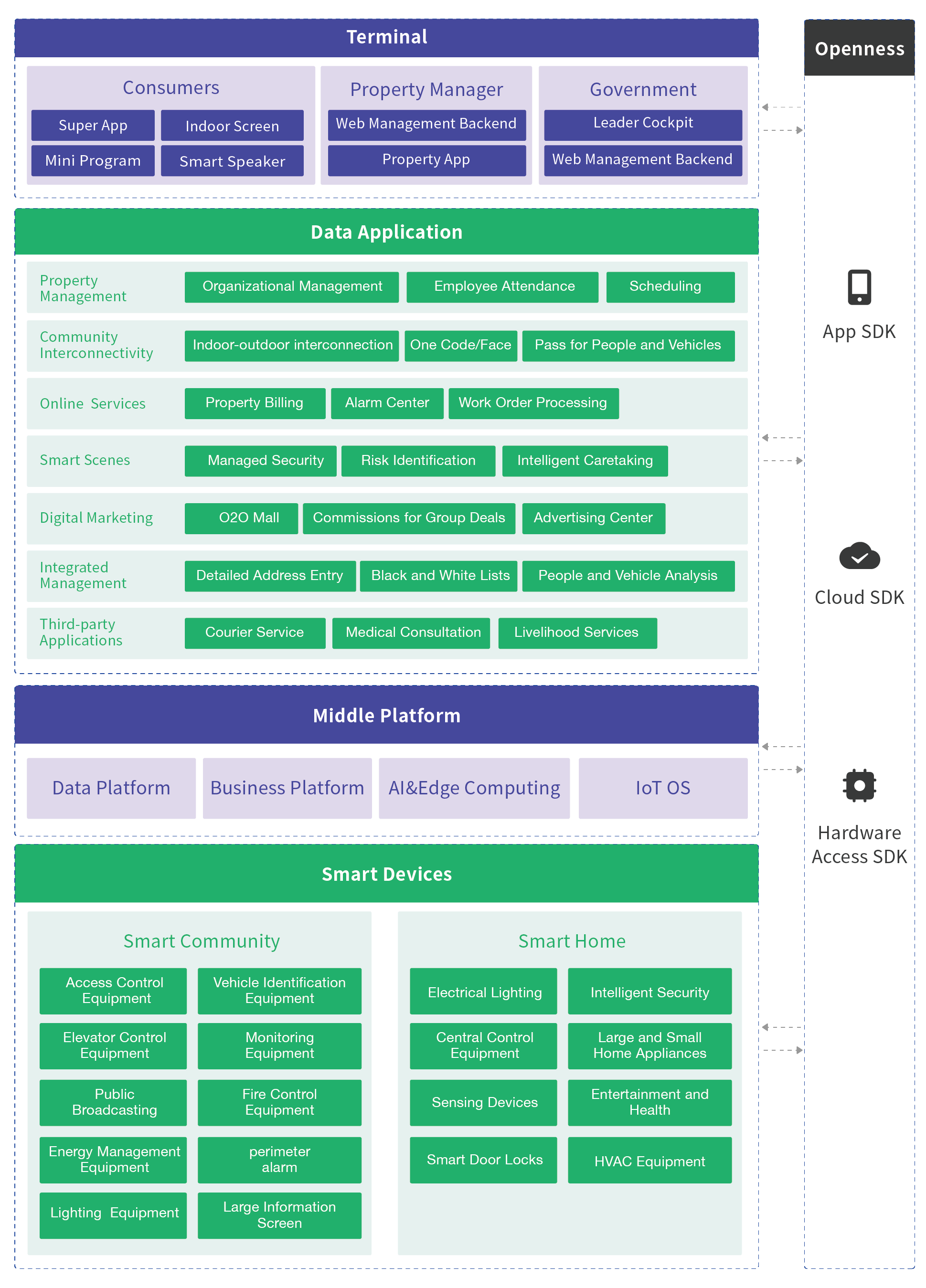
Infrastructure Layer: The infrastructure layer provides smart perception of people, things and objects in the community. By means of a unified IoT base platform and the sensor networks, this layer connects and manages devices in smart homes and smart communities, including facial recognition entrance, vehicle recognition access barrier, elevator control, monitor device, lighting, smart well covers, fire protection system, smart whole-house system and other commonly-seen hardware, so as to perceive, identify, monitor, control and collect data from these infrastructures within the community.
Digital Platform Layer: The digital platform layer is responsible for the convergence, governance, storage, analysis, smart modeling and the exchange of data, including those of basic objects, dynamic perception and other businesses. It unifies and standardizes the building of basic and common services related to access, device, event, scenario, project, and space. Through the platform open interface (open API), the upper application can be uniformly enabled to assist the standardization of the upper application construction and realize the data exchange and ability sharing.
Smart Application Layer: The smart application layer mainly consists of smart community platform and property owner control terminal (App / small program, etc.). The former is used by property manager for digital, smart and online management of community property, with the goal of improving community governance and service efficiency, as well as community service applications. The latter is used by residents, who are able to use and control smart devices and services in their own houses and in the community with this platform. Meanwhile, it realizes the connectivity and linkage of both indoor and outdoor devices.
System Operation and Maintenance Layer: The system operation and maintenance layer guarantees the security of the smart community platform. A unified end-to-end security system, including multiple mechanisms such as user privacy, data security, cloud platform security, secure development lifecycle, security operation and maintenance, business security and risk control, terminal security and others.
Zhejiang Uniview Technology Co., Ltd.
Zhejiang Uniview Technology Co., Ltd. is a solution provider and pioneer in the fields of global public security and intelligent transportation with panoramic, digitally intelligent, IoT technologies as its core. Within 8 years from 2011 to 2019, its sales revenue has increased by 15 times. In 2018, Uniview ranked fourth in the global intelligent video surveillance market. The R&D staff accounts for 50% of the total number of employees working in research institutes in Hangzhou, Shenzhen, Xi’an, Jinan, Tianjin and Wuhan. The global intelligent manufacturing base in Tongxiang produces 10 million high-end video security surveillance equipment annually with clients spanning 145 countries and regions.
By the end of 2019, Uniview has completed 249 Xue Liang Rural Surveillance Programs, 741 Ping An Programs, around 450 Smart Transportation projects and 280 landmark complex projects. In recent years, Uniview has been an active partner in the building of Smart Community, and has provided solutions in Yuhang District in Hangzhou, Sanhe, a county-level city in Langfang, Hebei Province, and Jinnan District in Tianjin.
Take Yuhang District in Hangzhou as an example. It has 14 subdistricts, 6 towns, 184 villages and 159 communities with a registered household population of 1.04 million and registered floating population of 1.65 million. The total area of the district is 1,228 square kilometers. For the past few years, with the increasing influence of land acquisition and housing demolition in its surrounding areas and intensified support for the industrial upgrading, the industries, featuring low productivity, small scale, loose structure and poor capacity has moved inside quickly and the inflow of migrant workers accelerated. Yuhang has the largest floating population in Zhejiang Province, which creates huge problems for the grassroot social governance and public safety.
Therefore, Uniview designed and developed a Smart Grid Management Platform with an interface of five function modules. Through the functions of information gathering, risk identification, conflict resolution, coordination and livelihood services, the capacity and efficiency can be improved while the burden reduced for the grid administrators.
18 pilot communities in Yuhang District have deployed the Uniview’s system, including subsystems such as for video surveillance, vehicles management and personnel access control. Various types of Uniview’s products have been installed to provide three protective circles. In the first circle, Face Recognition Access Control Terminal and Intelligent Monitoring and Recording System of Vehicles were deployed at the gate entrance/exits. By providing the authentication mechanisms and real-name management system, the public safety can be further increased. In the second circle, Uniview installed IP cameras to monitor the main roads and public areas to avoid disputes through recording. In the third circle, its face detection system was installed on the gate to units for only allowing people living in the unit to go in and out for enhancing the security. It can also help avoid the awkward situation of forgetting keys and improve the convenience for the residents. In this way, the legalized, scientific, refined and organizational level of urban and rural community’s management can be improved in a comprehensive way.
Aurine Technology Co., Ltd.
Established in 1993, Aurine Technology Co., Ltd. in Fujian Province is a leading provider of smart community products and solutions that integrates R&D, production, sales, and service in the IoT industry. It has been awarded as “Top 100 Security Defense Enterprises in China”, “Top 10 Competitive Video Door Phone Suppliers for Real Estate in China” and “Top 10 National Brands of China’s Security Defense” and has been on the “Forbes China’s Up and Comers List”.
As an important promoter of smart community and smart home, with the ability of in-depth application development of high-tech chips, Aurine is able to create new values for community life by providing the paradigm of hardware + software + platform. Based on its deep understanding of the industry and innovative application of products, Aurine provides a complete solution, products and services to partners and clients.
At present, Aurine has 2500 new smart community projects annually, and has empowered 30,000 communities, providing services to over 30 million users nationwide. Through launching smart community projects with well-known real estate enterprises such as China Overseas Property, Luneng Property, Country Garden and China Vanke, Aurine provides a complete solution and technological service to thousands of clients.
There are four pain points in managing traditional community, including low efficiency in operation and maintenance, high complexity in application, information silo and complicated management process. The top priority of community is to ensure public security. However, the traditional security model obviously fails to meet the needs of property owners nowadays.
In order to meet the demands raised by the Comprehensive Management Bureau and Public Security Bureau, Aurine’s Xue Liang Smart Community Solution, integrating the Face Recognition and Intelligent Access Control System, License Plate Recognition System based on Video images, and Wireless Sniffing System, focuses more on access control monitoring and makes sure everything is traceable, so as to effectively strengthen the community’s security capacity and emergency response capabilities. In the meantime, through the connection with the databases of Public Security Bureau and Comprehensive Management Bureau, the data that is related to people, vehicles and houses can be managed in real time and the alarm linkage can be enabled. In this way, “people, houses, vehicles, parking lots and internet” can be monitored in a three-dimensional, visible and manageable way.
In addition, through deploying the “Aurine’s Smart Community Integrated Devices Management Platform” in the community’s Integrated Control Center, applying the Internet Technology and Software Engineering Technology on the basis of community’s intelligent and integrated system, and deploying the software platforms, the intelligent systems, information systems and all devices can be united as one “organic” system.
In the implementation stage of smart community projects, Aurine found out that it is difficult to deploy multiple smart devices. In the process of project implementation, typical applications cannot be used for multiple devises, rooms, networks and etc. By cooperating with the third party, the AIoT platforms, for its solutions that are dedicated to the project implementation, Aurine is able to help complete a series of deployment operations such as smart device join, room completion, scene configuration, and so on in a complex on-site environment, so as to establish a fast and batch implementation capability. The AIoT platforms, through connecting with the smart community’s PaaS, managing and operating all the business data and devices data that does not violate the user privacy, can get through the security information system of the community, and help improve the self-management function.
Smart Industry
1. Smart Industry Overview
In the context of Made in China 2025 (MIC 2025), which aims “to accelerate the integration of next generation IT into manufacturing industry and to make intelligent manufacturing the main priority”, “Smart Industry” came into being. Based on cloud computing and combined with edge computing, Smart Industry adopts multiple cutting-edge technologies, such as AI algorithm, big data, digital twin, etc., and applies internet to different aspects of industries, including equipment, control, data, etc. to achieve industrial intelligence. Compared with traditional industries, Smart Industry puts emphasis on integration, connectivity, data drive and mesh collaboration.
Currently the mainstream manufacturers in this field include:
- software manufacturers including MES (manufacturing execution system);
- equipment manufacturers;
- operators;
- cloud services providers;
- AIoT manufacturers;
These manufacturers either use their own advantages to expand upstream and downstream, or seek changes in other fields. Both are because of the bright prospect of Smart Industry. According to a report released by the China Academy of Information and Communications Technology, the market size of the Industrial Internet will reach 3 trillion RMB by 2020.
Figure 19. Industrial Internet Market Size
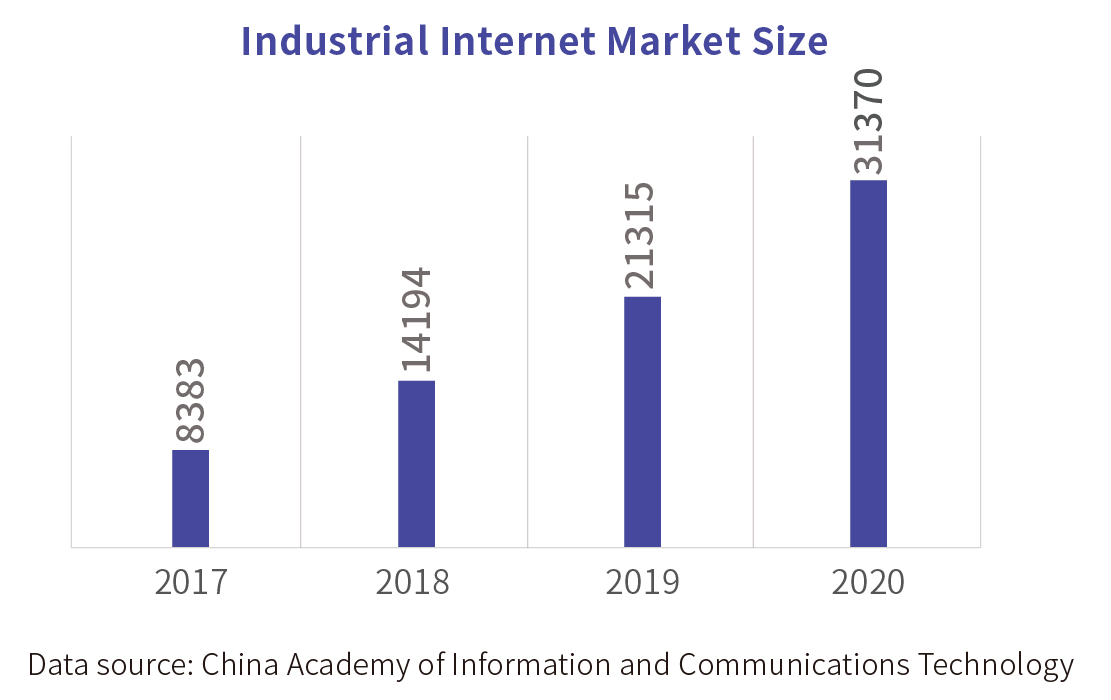
There are many factors that factories need to consider when building production lines, mainly including: (1) product attributes, (2) product life cycle, (3) the volume of orders, (4) production process, (5) production efficiency, (6) input-output ratio.
But even after considering all these factors, there are still many problems in production:
- Growing product differentiation, which makes it difficult to scale up production and keep manufacturing costs low in order to meet the users’ personalised needs;
- Frequent product upgrades, which result in constant updates or replacements of production lines;
- Higher requirements for better quality, demanding a better control and traceability system.
- Labor-intensive enterprises, most of which depend on workers to record the information, easily leading to errors, bringing low efficiency, and lacking data analysis;
- Data silos, which delays issue handling process;
Considering the problems listed above, Smart Industry needs to develop in below areas in the future: bring manufacturing to cloud and digitalize manufacturing; improve edge computing and increase availability of terminal capabilities; enhance device connectivity and data sharing. The goal of all manufacturers in Smart Industry is to integrate upstream and downstream manufacturers, tear down data silos, and achieve efficient collaboration.
2. Smart Industry Solutions
Manufacturers are now offering different solutions according to their own strengths. Software manufacturers like MES have expanded their business horizontally and vertically to cover more part of supply chain and offer software solutions; equipment manufacturers have a strong advance on data collection and control; operators focus on “connectivity” and provide additional services while promoting solutions like 5G; cloud service providers emphasize the application of cloud computing in all kinds of industrial scenarios, while bringing other types of vendors to clouds to provide services; AIoT vendors build interactive platforms based on IoT, focusing on the construction of an ecological chain, and often offer platform-based services (PaaS). Here are a few examples of specific solutions to Smart Industry.
1. Smart Industry Platform with smart infrastructure
A Smart Industry platform needs to address common problems in traditional manufacturing, such as poor planning and processing, low efficiency, low traceability and poor quality control, in order to view, track and control production and gain real-time production data. The platform needs SaaS capabilities to provide on-demand applications for production, and PaaS capabilities to provide infrastructure, and the construction of the platform should be based on production equipment.
Take electronic manufacturing industry as an example: equipment data collection includes collecting raw data from a local server or data acquisition devices, data processing (edge computing), and data uploaded to cloud; visual technology can be used for code scanning, testing, production monitoring and shape recognition; procedure and process control is on cloud and not limited by the physical location of the server; complete production information query and varied electronic dashboards fully demonstrate the value of real-time data in production and provide basis and guidance for future production.
In addition, the platform offers a range of PaaS capabilities: advanced planning and scheduling engines that are continuously optimized by algorithm and that can make best use of production resources, digital twins for industrial equipment to create a real-time replica of physical equipment on cloud, and AI algorithm-based analysis to predict future maintenance and other things.
2. Integrated supply chain and manufacturing
More integration between upstream and downstream manufacturers is needed to share business insights and data for better decision-making. The optimal production is not only manufacturing but to fulfill the needs of all players of the supply chain within limited time and resources. Smart Industry focuses on overall improvement and the local optimization brought by overall improvement.
The relationship between upstream and downstream manufacturers in traditional industrial production is linear and closely dependent. A common problem is that a delay in the upstream manufacturer can hold up the production in the downstream manufacturer and it’s difficult to change that. Meanwhile, product lifecycle management and traceability along the supply chain is often merely a concept and rarely get addressed. Integration can turn this “linear structure” into a “chain”. All nodes on the chain therefore are visible to every player to avoid problems caused by one single issue, reach “a dynamic equilibrium” and control risks. In this way, the synergy of the collaboration will be enhanced as more players join in, instead of “the longer supply chain, the more problems” in the traditional supply chain, and therefore the whole industry becomes “smart”.
Of course, the driving force behind this change comes from the demand side that wants to create an industry centered on services rather than manufacturing. So even after a product is sold, it can still affect the supply chain, and give feedback to improve the system, growing “smarter”.
3. Large-scale Product Customization
The traditional way of mass production with assembly lines is driven by supply side, and it meets customers’ requirements through standardization. While large-scale product customization combines “scalability” with “non-standardization”, two seemingly contradictory concepts in the past, and are demand-side driven. This new production method requires more flexibility in production, shorter response time for new requirements and better prediction. And it needs big changes in organizational structure and product R&D. The benefits of large-scale product customization are also evident: less pressure in inventory and more flexibility for manufacturers.
4. Virtual Production
Virtual production refers to the remote production management and remote equipment operations based on virtual models, using technologies like AR/VR. There aren’t many real cases that actually are adopting virtual production, but as automation develops this is a trend, especially for high-risk or remote operations since virtual production is a perfect solution to ensure safety and timeliness. However, it’s worth noticing that this process requires extensive data collection and precision control technologies.
Hangzhou Hongshi Electrical Co., Ltd
Established in 1973, Hangzhou Hongshi Electrical Co., Ltd is specialized in the production of electrical accessories based on British BS standards and Chinese GB standards and series of smart home products. It has excellent capabilities of design and development, mold making, manufacturing and quality management. It owns a provincial-level company research institute, a research center cooperated with Hangzhou Dianzi University, a national-level laboratory and an innovation and creative design center in Shenzhen.
The company produces over 80 million pieces of electrical accessories, selling products across regions in Europe, America, Middle East and Southeast Asia. Series of British BS Standards electrical accessories designed and developed by the company has been respectively approved by BSI, ASTA, NSAI, PUB, ITS and 11 testing agencies in other countries and regions and received quality approval certificates from these agencies. With the help of CCPIT, the trademark of the company “SWE” has been registered in more than 120 countries such as members of the Madrid System, members of the African Intellectual Property Organization and countries in the Middle East.
In 2017, the company, which firstly was concentrated on the production of traditional electrical appliances, noticed the development smart home appliances and started its journey of R&D on smart products. In recent years, it has launched series of smart home products, including some new categories such as universal remote controllers, single smart sockets and wireless switches. Its products are sold in more than 50 countries in the world. However, during the production and R&D, the company find it challenging to use traditional production lines to produce smart products which require a more intelligent manufacturing approach.
By using the PMS cloud smart manufacturing system, the company has managed manufacturing plants more effectively. It establishes a production line information management system based on the status of current production lines;it collects, supervises and manages manufacturing information online;it supports to track product quality and ingredients, and reserves the access for the enterprise resource planning. Meanwhile, the company effectively controls the manufacturing process to realize the paper-less and visualized manufacturing process, which improves the management of production lines extremely well.
Also, the company uses data sharing to facilitate the development of business, which further makes full use of enterprise resources. It quickly allocates outside resources, adjusts excess capacity and sensible allocation of resources by visualizing and sharing cross-region resources, establishing the whole product supply chain, and creating the information sharing network for all business activities. In the map mode, it can directly see the distribution and capacity of professional production units in different regions and the detailed information about these units, which makes it more convenient to choose outsourcing. It cultivates a healthy and benign environment for competition based on data, which creates a win-win situation for both suppliers and customers.
With intelligentization of production lines and plants, the company not only increases its efficiency and capacity for producing smart products, but also realizes two intelligent transformation in terms of products and production lines.
Source: Tuya