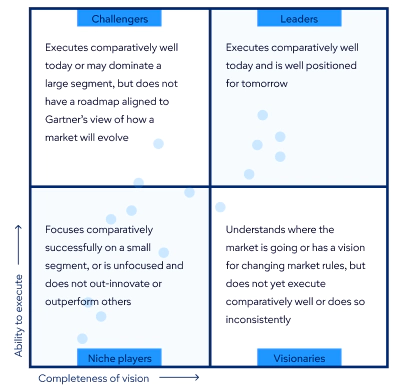
How do I use a Gartner Magic Quadrant?
Use a Gartner Magic Quadrant as a first step to understanding the technology providers you might consider for a specific investment opportunity.
Keep in mind that focusing on the leaders’ quadrant isn’t always the best course of action. There are good reasons to consider market challengers. And a niche player may support your needs better than a market leader. It all depends on how the provider aligns with your business goals.
How does a Gartner Magic Quadrant work?
A Magic Quadrant provides a graphical competitive positioning of four types of technology providers, in markets where growth is high and provider differentiation is distinct:
- Leaders execute well against their current vision and are well positioned for tomorrow.
- Visionaries understand where the market is going or have a vision for changing market rules, but do not yet execute well.
- Niche Players focus successfully on a small segment, or are unfocused and do not out-innovate or outperform others.
- Challengers execute well today or may dominate a large segment, but do not demonstrate an understanding of market direction.
Interactive Magic Quadrant features
Gartner’s interactive Magic Quadrant features enable you to create a view of the Magic Quadrant to reflect your own business goals, needs and priorities. Most significantly the interactive features enable you to adjust the weightings applied to each of the evaluation criteria to generate a new, client-specific Magic Quadrant graphic for that market. You can then save and share these customized Magic Quadrants for your internal analyses and decision making.
Gartner’s interactive Magic Quadrant also brings together our analyst opinion and the Peer Insights user-contributed reviews into one experience. User Review tab enables you to read and evaluate what your peers have to say about the enterprise IT solutions they have implemented and use in their enterprise on a daily basis.
Additional perspectives
Contextualization enables you to view a Gartner Magic Quadrant through a specific lens, providing high-impact additional perspectives by key industry, region and company size. This enhancement provides analyst commentary on the market and notable vendors from key client contexts. The interactive Magic Quadrant experience provides you with a customized view of the market based on the criteria most important to you.
Magic Quadrants help you:
- Get quickly educated about a market’s competing technology providers and their ability to deliver on what end users require today and in the future
- Understand how a market’s technology providers are competitively positioned and the strategies they are using to compete for end-user business
- Compare a technology provider’s strengths and challenges with your specific needs