Rise to the Challenge and Reap the Benefits
Research from Gartner
Market Guide for CRM in Pharmaceuticals and Biotechnology
CRM usage in pharma and biotech is expanding beyond traditional use cases, with greater focus on holistic customer engagement programs and advanced analytics. CIOs should use this Market Guide in identifying notable solutions that increase their business agility and field sales effectiveness.
Overview
Key Findings
- The ongoing COVID-19 pandemic has disrupted traditional face-to-face selling models and fueled unprecedented demand for virtual healthcare provider engagement. In response, virtual engagement experiences, such as video conferencing, approved email, integration with regional social media platforms and persistent microsites, have significantly grown in both capabilities and usage by sales representatives.
- CIOs’ recognition of the value of customer experience among biotechnology and pharmaceutical companies is accelerating. The ability to effectively orchestrate and optimize a healthcare providers’ journey along multiple interactions is becoming a critical success factor as biotechnology and pharmaceutical companies seek to sustain and scale virtual engagement services during the pandemic and beyond.
- Predictive analytics tools for field sales teams continue to gain prominence, through stand-alone products, capabilities embedded in CRM platforms or external custom-built machine learning (ML)- enhanced analytics tools.
- Many CRM systems offer limited process automation, often requiring the sales representative to use external tools for day-to-day functions.
- Usage of digital channels to access medical information is growing and CRM platforms have begun to offer new capabilities in this area, such as marketing automation integration, augmented reality (AR), virtual reality (VR) and conversational analytics.
Recommendations
Life science CIOs advancing healthcare and life science digital optimization and modernization in pharmaceutical and biotechnology segments should:
- Strengthen IT’s alignment with business partners by starting with an expected customer journey in mind and working backward to determine target technology architecture and optimal business processes.
- Guide sales representatives with specific insights and lasting behavioral change by using AI-driven customized and actionable alerts.
- Optimize and automate sales processes by deploying AI-related technologies across your sales organization. For example, you can utilize natural language processing (NLP) to capture and analyze sales representatives’ call notes compliantly or leverage voice-based assistants to provide an update as part of the precall process.
- Evaluate the strength of each vendor’s partner ecosystem to support additional capabilities for your organization by seeking those with advanced artificial intelligence (AI) capabilities and ability to orchestrate customer journeys across multiple channels.
Strategic Planning Assumption
By 2024, demand for life science sales representatives will be reduced by 30% through deployment of biobots — which will in turn increase prescriptions by 5%.
Market Definition
Gartner defines CRM for biotechnology and pharmaceutical (biopharmaceutical) companies as systems that support the automation of sales activities, processes and administrative responsibilities for companies’ sales professionals. Gartner considers CRM to be foundational technology, implemented to automate a company’s core sales enablement processes — those that are integral to its selling model and to ensuring regulatory compliance.
The market consists of vendors offering technologies to enable the biopharmaceutical selling model. Foundational functionality includes account management, call planning, call reporting, sample management (including electronic signature capture), time-off territory management, offline functionality, mobile reporting and remote engagement capabilities. Selling to healthcare institutions also requires functionality for account planning, team selling, tactic management and analytics.
Emerging capabilities include advanced decision support for sales, facilitating sales performance management functions and interoperability with marketing automation tools. More detailed information on these functions is presented later in this document.
This Market Guide focuses on the needs of biopharmaceutical companies. Medical device and diagnostics manufacturers also implement CRM for their selling teams, but their needs extend beyond those of biopharmaceutical companies. Specifically, medical device companies leverage configure, price and quote, and contract life cycle management solutions, which are not addressed in this Market Guide.
Gartner’s Magic Quadrant for Sales Force Automation covers vendors that provide services to all industries, including medical device and diagnostics manufacturers.
Market Description
The biopharmaceutical CRM market comprises vendors providing a diverse set of tools and services that enable sales representatives to efficiently and effectively engage with customers to inform and influence their prescribing decisions.
Since biopharmaceutical companies do not sell directly to patients, thus for the purposes of this research we define customers as “prescribers” who are key decision makers and influencers for the prescription of the therapeutic. Customers then include all stakeholders with prescribing authority, such as physicians, physician assistants and nurse practitioners. This also includes primary targets for key account management (KAM) teams, such as executives from healthcare systems and integrated delivery networks who influence prescribing decisions for network-based medical and other business considerations.
Biopharmaceutical companies promote their products during sales visits (called “detailing”) with healthcare providers (HCPs) to share information about their product’s benefits and side effects. HCPs may also receive “items of value,” such as meals and product samples, as part of the visit. The CRM system must be able to capture all the necessary information from this interaction (usually referred to as a “call”), so that the causality of the interaction can be understood. Biopharmaceutical CRM systems have proven to be essential in facilitating sales representatives in engaging with their customers, documenting interactions, maintaining regulatory compliance and creating an understanding of the effectiveness of sales efforts. Table 1 describes the core biopharmaceutical CRM functionality in this market.
Table 1: Core Pharma CRM Functionality
| Function | Definition |
|---|---|
| Account Management |
|
| Basic Field Analytics |
|
| Calendar Management |
|
| Call Planning and Reporting |
|
| Consent and Preference Management |
|
| Field Coaching Report |
|
| Sample Management |
|
| Territory Management |
|
| Visual Detail Aid Presentation |
|
| Source: Gartner (November 2020) | |
Tablet and mobile phone usage in the industry is extensive. These devices have enabled sales representatives to improve their engagement with HCPs by delivering a more visually engaging message electronically, instead of using paper collateral. However, since the vast majority of biopharmaceutical companies have now adopted iPads and other tablets, the extent of competitive differentiation is greatly reduced. Vendors have extended CRM solutions to operate on smartphones primarily in response to requirements from emerging markets. Table 2 describes extended and advanced functionality included in the biopharmaceutical CRM solutions in this market.
Table 2: Advanced CRM Functionality
| Function | Definition |
|---|---|
| Virtual (Remote) Engagement |
|
| Multichannel — Email |
|
| Multichannel — Web (Self-Serve) |
|
| Multichannel — Web (Co-Browse) |
|
| Multichannel — Contact Centers |
|
| Event Management |
|
| Social Media |
|
| AI-Driven Decision Support |
|
| Home Office Analytics |
|
| Voice-Driven Sales Apps |
|
| Source: Gartner (November 2020) | |
The global healthcare industry is evolving in terms of how healthcare is administered and paid for, especially as innovative new therapies enter the market. This change has brought downward pressures on biopharmaceutical companies’ pricing and brand growth strategies. In response, the industry has both innovated in terms of new therapies and how it addresses this pressure through KAM functions.
Modern CRM systems have evolved to address these evolving needs as well.
Market Direction
Even before the COVID-19 pandemic affected global business, sales and IT leaders were collaborating to deploy tools that would optimize sales efficiency and effectiveness by enabling their sales representatives to:
- Capture data about their sales execution (for example, by enabling entry of free-text notes and monitoring them for compliance via AI technologies).
- Engage with HCPs through digital channels, such as email.
- Provide enhanced insights and recommendations through AI-driven decision support engines (for example, recommending optimal content to present).
These initiatives were not about the technology per se, but rather related to the following business questions:
- How do we get to know our customers better?
- How do we determine which sales actions are the most effective?
- How can we improve sales enablement with new content, training and coaching solutions?
None of these questions were new, but they continued to reinforce heavy reliance on the face-to-face, sales-representative-driven engagement model. The COVID-19 pandemic disrupted this decades-old sales strategy. To ensure the safety of their patients, HCPs and healthcare administrators immediately minimized nonessential traffic flow in their facilities, forcing sales representatives to engage through virtual engagement channels. Common sales representatives activities were soon replaced by digital equivalents, such as online sample fulfillment, on-demand meal delivery and virtual meetings and webinars for information exchange.
The pandemic represents more of an inflection point for the sales-representative-driven model than most biopharmaceutical companies realize. The disruption to normal business operations instigated by COVID-19 has accelerated the adoption of virtual care and engagement solutions by HCPs worldwide. In fact, HCPs’ virtual engagements with sales representatives during the pandemic are longer and more in- depth — lasting on average 22 minutes, versus the anecdotal two to three minutes for in-person discussion. 1 Expectations and behaviors of HCPs are already changing, with multiple industry surveys highlighting that about one-third of previously accessible HCPs will prefer to continue with virtual-only engagement once the pandemic ends. 2
As new expectations set in, biopharmaceutical companies will need to accelerate their multichannel engagement strategy (also called “hybrid” engagement), providing HCPs choices about how they prefer to interact with sales representatives — whether through in-person, digital or blended channels. The movement to multichannel engagement will exponentially increase the number of touchpoints, interactions and transactions that biopharmaceutical companies have with HCPs. This increase means that biopharmaceutical companies will need new technology capabilities, including AI, hyperautomation and digital scalability, to support those evolving sales representative roles and sales enablement processes — which many biopharmaceutical companies are unprepared for.
The Future of Sales
Gartner defines “The Future of Sales” as a “permanent transformation of organizations’ sales strategies, processes and allocation of resources. This means moving from a seller-centric to a buyer-centric orientation and moving from analog sales processes to hyperautomated, digital-first engagement with customers” (see Figure 1 and The Future of Sales in 2025: A Gartner Trend Insight Report). For biopharmaceutical companies this means moving from brand-centric, “bullhorn” communication tactics to establishing an emotional connection to, and value-added relationship with, the HCPs they covet (see Life Science CIOs Must Accelerate Deployment of Physician Experience Solutions to Brand Growth).
Figure 1: Future of Biopharmaceutical Sales
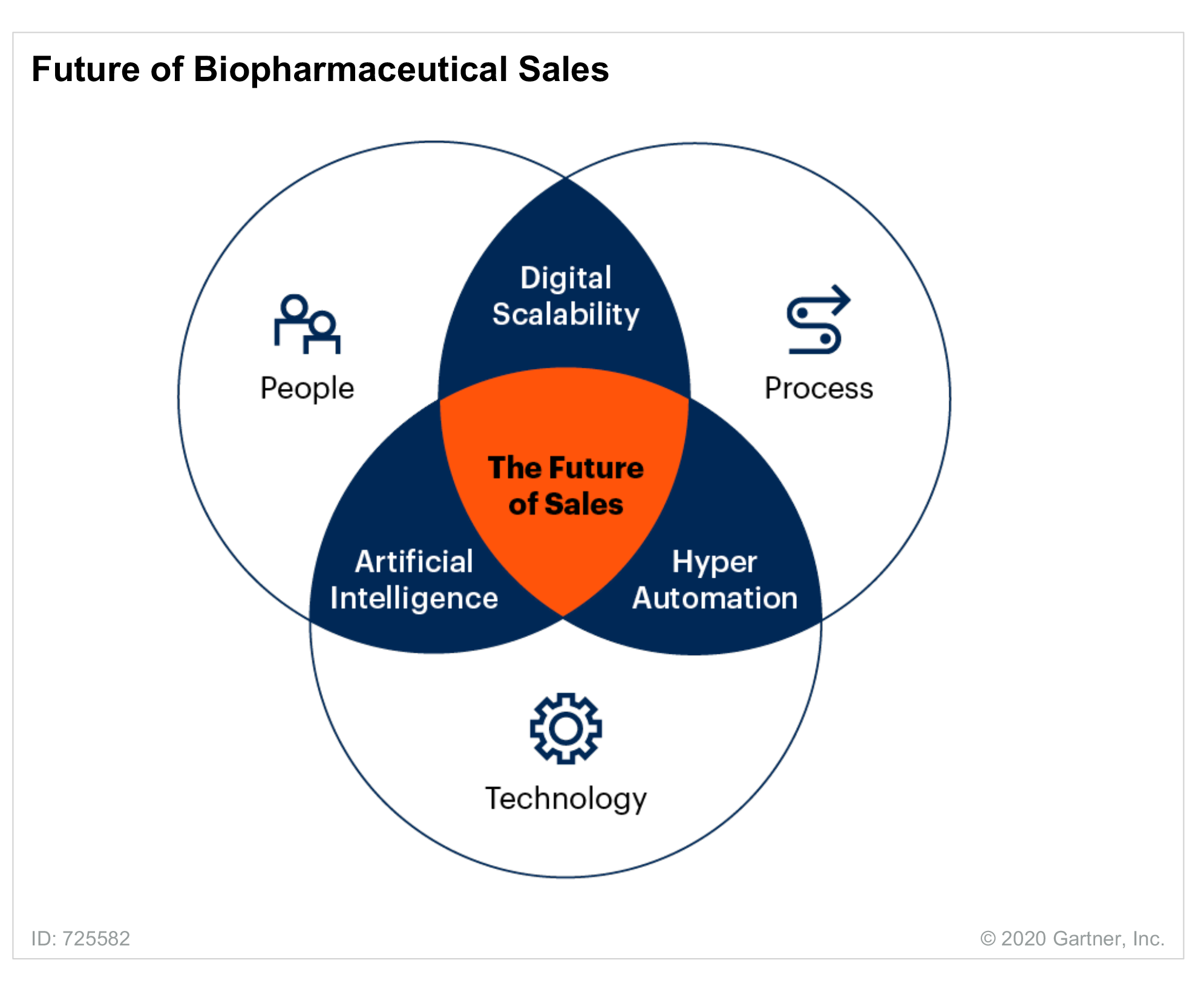
The “Future of Sales” is the convergence of three technologies that to date have not been widely embraced in business-to-business (B2B) selling models:
- Hyperautomation. Hyperautomation is a Gartner-coined term that refers to an effective combination of complementary sets of tools that can integrate functional and process silos to automate and augment business processes. For biopharmaceutical CIOs and sales leaders, this means automating sales process steps that were previously manual, such as call plan refinement.
- Digital scalability. Digital scalability is the concept of using digital tools to handle the increasing volume of customer interactions. For biopharmaceutical CIOs and sales leaders, this means introducing new tools that facilitate digital engagement, such as self-service portals and conversational agents.
- AI. AI is a concise catch-all term that denotes the shift from highly analog decision making to automated, algorithm-based decision making. For biopharmaceutical CIOs and sales leaders, this means that every decision sales representatives make will be informed by AI-based decision support tools.
Sales Representative Role Morphs From “Influencer” to “Concierge”
The COVID-19 pandemic has forced even the most ardent traditionalists to accept that the role of the biopharmaceutical sales representative will need to evolve in line with their customers’ preferences.
While Gartner introduced the idea of a sales “concierge” representative a decade ago, it never gained mainstream adoption, as many biopharmaceutical brands preferred not to change their business models in fear of revenue disruption. The pandemic has changed this calculus. A “digital concierge representative” won’t be asked to drop off samples or engage in two-minute elevator speeches, but rather will invest significant time nurturing long-term relationships with their customers. Face-to-face engagement will change from the inside-out “I have a presentation for you” to the outside-in “what do you need from my organization and how can I facilitate that?”
CRM applications, being a foundational technology in any sales technology stack, have an important role to play both now and in the postpandemic recovery period. CRM systems should be used to engender, cultivate and enforce consistent sales execution. To that end, Gartner recommends that all biopharmaceutical companies examine their CRM implementations in 2021 to make the tools better support multichannel sales execution.
Vendors delivering on this model to transform the sales experience will shine brightly as an optimal choice. The new method of driving optimized and successful engagement with HCPs links AI-driven analytics directly into the customer’s multichannel journey.
Market Analysis
Technology Trends
In the past year, Gartner analysts have spoken with hundreds of biopharmaceutical leaders about the CRM market. Two trends have emerged from these conversations:
1. Biopharmaceutical CIOs and their business peers increasingly want and need to build data-driven sales organizations.
Even before the COVID-19 pandemic, biopharmaceutical CIOs were partnering with their business peers to pilot and scale advanced technologies, such as AI to assist their sales forces, in achieving consistent operational excellence and call plan goal attainment. Some CRM vendors have now started to offer AI-based decision support capabilities. It should be noted, however, that such native capabilities are still some distance from being offered as turnkey dynamic, AI-driven, next-best-action functionality.
Some vendors have begun offering advanced customer engagement functionality, such as NLP-driven conversational agents and robotic process automation. Gartner also expects chatbots and voicebots to become valuable UIs, reducing the amount of manual data entry expected of sales representatives.
2. Multichannel engagement capabilities are becoming foundational to the biopharmaceutical engagement model.
Beyond the traditional face-to-face engagements, biopharmaceutical companies have increased deployment of digital interactions, such as multichannel email (or sales-representative-triggered email) and virtual (or remote) engagements. Yet at the same time, biopharmaceutical companies continue to segregate sales-representative-based customer interactions from multichannel marketing interactions executed through marketing campaigns. Such marketing campaigns are expected to reach the same target customers through websites, email marketing programs, mobile and social marketing, direct mail and programmatic advertising endpoints. This disconnected approach leads to the customer being bombarded by the same messages too often, or worse, through nonpreferred communication channels.
Some vendors, such as IQVIA and Omnipresence, have implemented a journey module as part of their CRM platform. This journey-based approach includes sales representatives as part of the overall journey and provides marketers a set of tools to manage engagement across channels and journey stages. This paradigm shift is still in its very early stages, but Gartner believes this approach will accelerate the shift toward customer-centricity by enabling the company to engage the right customer via the right channel at the right time.
The COVID-19 pandemic forced CIOs to rapidly deploy virtual engagement tools to mitigate loss of in- person engagement between field representatives and HCPs. These tools are intended to replicate the ability of face-to-face meetings to build engagement with one or more stakeholders, with many CRM vendors including them as part of their core platform.
Market Trends
Biopharmaceutical market share is measured by the number of sales representatives using the CRM platform as a system of record, with most vendors having transitioned to a per user per month licensing model. Furthermore, vendors continue to introduce add-on modules to base CRM software, such as events management, sales representative initiated email and remote engagement modules. The add-on modules are also typically licensed under the per-user, per-month model. As a result, overall market growth or reduction is directionally correlated with the number of sales representatives added or removed within the industry, globally. Another growth stream for most vendors is through their business and IT services offerings, such as leading implementation of their solutions and providing ongoing business and technology support.
Many Gartner biopharmaceutical CIOs highlight that achieving value from the CRM investments is now more important than ever as they assess COVID-19’s long-term impact on the sales-representative-based engagement model. While definitions of the term “value” vary, for many CIOs it means getting advanced capabilities at a reasonable price. Gartner believes that this view represents a significant market trend because it fits with the natural life cycle of enterprise technology. As the current generation of CRM technology approaches this maturity curve, vendors that do not modernize their offerings with advanced technologies and reimagined sales enablement models will face commoditization. Multiple vendors have mature offerings, and even the smallest CRM vendors have strong capabilities that optimize sales enablement efficiently. If these commodity capabilities come with premium prices, as is the case with some vendors, then the movement toward finding value will accelerate.
Market Segmentation
The CRM solution market is currently made up of vendors that fall into three segments:
- Cross-industry vendors
- Industry-focused global vendors
- Industry-focused regional vendors
While cross-industry vendors, such as Microsoft, Oracle and Salesforce, support B2B sales processes within their CRM platforms, their overall market share in the biopharmaceutical industry remains negligible. Most biopharmaceutical companies seek to use industry-specific solutions to meet their requirements without extensive customizations. Many industry-specific vendors have built their solutions on top of cross-industry enterprise platforms, such as Microsoft Dynamics 365 and Salesforce Cloud.
Cross-industry vendors are covered in Magic Quadrant for Sales Force Automation.
Veeva continues to lead the biopharmaceutical CRM market and recently announced that, in its estimation, nearly 80% of industry sales representatives utilize its platform. 3 Veeva continues to grow by onboarding new sales representatives on its platform and deploying add-on modules to existing installations. In 2019, Veeva made two acquisitions complementing its CRM offerings: Crossix (providing an analytics platform to help biopharmaceutical brands maximize media and marketing effectiveness) 4 and Physicians World (providing speakers bureau services). 5
IQVIA occupies the second spot, and continues grow market share after rearchitecting its CRM product in 2017 using a “platform of platforms” strategy on the Salesforce, Amazon, Box and Heroku platforms. 6 IQVIA’s product, Orchestrated Customer Engagement (OCE), combines Salesforce CRM and marketing cloud to integrate all personal and nonpersonal touchpoints across customer-facing roles. IQVIA also leverages its native AI/ML capabilities to provide sales representatives data-driven recommendations to nudge them with specific insights on how to reach and exceed their performance expectations. IQVIA continues to reports robust growth since launching its new platform. 7
Omnipresence (formerly Indegene Omnipresence) has worked closely with Microsoft on its next- generation CRM platform, Life Sciences Customer Experience Management (CXM). Life Sciences CXM combines journey orchestration, marketing automation, event management, contact center advanced analytics, self-service, conversational agent and AI capabilities supporting multiple user roles.
Omnipresence accomplishes this by verticalizing multiple Microsoft platforms and clouds, including Microsoft Azure, Microsoft AI, Microsoft Dynamics 365, Microsoft Power Platform, Microsoft 365, Microsoft Power BI and Microsoft Teams to deliver intelligence-driven personalized customer experience and productivity.
IQVIA and Veeva remain the dominant global vendors, with a significant presence in all regions. Other vendors, such as Omnipresence and Pitcher, also have a global presence and are looking to accelerate their growth. Regional vendors are still attempting to grow into global providers, but challenges remain and are increasing as established global vendors continue to invest in and add new capabilities. Even though a subset of regional vendors will evolve their capabilities, Gartner does not expect these remaining vendors to become major global players during the next three years.
Many regional vendors focus on solutions that address the needs of specific regions. Euris, for example, is developing advanced WeChat integration specifically for Asian markets. These vendors have greater depth of expertise, experience and relationship within their target regions. End-user clients consider regional vendors due to multiple factors, such as cost or the need for a specific solution to address local requirements. This has caused regional differences in functionality to emerge as these vendors continue to advance specific functionality targeted to these needs.
While IQVIA and Veeva remain the major global vendors in the pharma CRM, many other regional players strive to win business at the country or business-unit level. Even global biopharmaceutical CIOs with strategic relationships with IQVIA or Veeva may select another vendor for emerging markets, or to solve specific needs, such as key account management. This is key to aligning vendor expertise and implementation experience against geographic or global requirements. Since vendors continue to expand functionality and supported regions, you must confirm a vendor’s experience during your due diligence phase.
Representative Vendors
Market Introduction
This research covers select providers offering CRM products for the pharmaceutical, biotechnology and medical device manufacturer market (see Note 1). Table 3 shows the representative vendors in the CRM solution market listed in alphabetical order, along with the vendor solution name.
Table 3: Representative Software Vendors With CRM Solutions
| Vendor | Product, Service or Solution Name |
|---|---|
| Aurea | Aurea Customer Relationship Management |
| Cirrius Technologies | Phyzii Pharma CRM |
| Close-Up International | sfNet Rep’s |
| Creatio (formerly bpm’online) | Pharma CRM |
| Euris | SmartReps |
| GEDYS IntraWare | GEDYS IntraWare CRM |
| Infonis International | CBIM |
| Interactive Medica | CRM/KAM |
| IQVIA | Orchestrated Customer Engagement (OCE) |
| Media-Soft | Sales Vision CRM |
| Oracle NetSuite | NetSuite CRM |
| Omnipresence (formerly Indegene) | Omnipresence |
| Pitcher | Pitcher IMPACT |
| PROLIFIQ | PROLIFIQ CRUSH |
| StayinFront | StayinFront EdgeRx StayinFront TouchRx |
| Synergistix | Customer Analysis and Targeting System (CATS) |
| TikaMobile | TikaPharma TikaMarketAccess |
| Trueblue | BLUE CRM Pharma Operational Suite |
| Veeva | Multichannel CRM |
| Source: Gartner (November 2020) | |
The vendors listed in this Market Guide do not imply an exhaustive list. This section is intended to provide more understanding of the market and its offerings.
Market Recommendations
Biopharmaceutical CIOs procuring CRM solutions to enable their companies’ sales enablement and customer engagement strategies should:
- Shift investments away from traditional sales enablement initiatives by reimagining customer relationships and journeys based on effortless experience design that includes digital touchpoints and interaction modalities.
- Build knowledge and expertise in multichannel processes and technologies as new channels are added to the marketing mix.
- Educate your business peers on the value of providing customized, actionable recommendations to sales representatives by using AI to nudge them with specific insights on how to reach and exceed their performance expectations. These insights can lead to behavioral transformation in the long run.
- Identify the geographies where you need to deploy CRM capabilities as one of the first steps in your strategy. There are only two established vendors with global footprint options: IQVIA and Veeva. If you seek something more regional, there are other options, but with trade-offs in terms of functionality, local support and market expertise.
Use this Market Guide to create a shortlist of vendors that are appropriate for your organization by narrowing down vendors that are appropriate for your requirements and strategic visions multichannel engagement:
- Begin with multichannel engagement when evaluating CRM solutions, including, representative face- to-face, virtual, social, email, web, co-browse, contact centers, events and e-details. Partner with sales and marketing business leaders who are defining and building an organization around this shifting commercial model.
- Prioritize vendor integration or native capabilities for digital engagement that include capabilities such as approved email, microsites, virtual meetings and webinars. Assess vendors’ capabilities or partnerships for AR/VR to support product demonstrations.
- Assess the maturity of CRM vendors’ integrations between their solution offerings and multichannel marketing hubs, content management systems and journey orchestration tools to ensure optimal end- user experience.
- Assess the vendors ability to integrate with your customer 360 initiatives with your CRM platform to complement your efforts to capture customer preferences through sales representatives.
Determine which vendors’ data and analytics approach fit your strategy by asking vendors specific questions about managing data pipelines, ML development and deployment model, data interoperability and cloud architecture:
- Seek vendors with a holistic approach — native or through integration — to optimize channels and marketing message through predictive analytics and algorithms. The opportunity exists to leverage new analytic capabilities to deliver value.
- Match your implementation approach to your overall AI strategy; portfolio of built, bought and outsourced AI solutions; and organizational capabilities as part of assessing the benefits and challenges of a preferred approach.
- Prioritize vendors with systematic operationalization processes to ensure the integrity, transparency and sustainability of deployed analytical models.
- Evaluate how a CRM platform integrates information from external sources and interoperates with other systems. Prioritize a transparent approach with a defined toolset. If your organization is looking to own the integration process, ensure that the vendor has an open environment so that your team can access and manipulate data without requiring costly support from the vendor.
Acronym Key and Glossary Terms
Customer - In many of our discussions with biopharmaceutical leaders, there is no clear answer to the very basic question “Who is my customer?” The complex supply chain to deliver drugs and medical devices to the ultimate consumer — the patient — includes a diverse community of stakeholders. They include wholesalers, pharmacies, physicians, nurses and insurance companies as well as a broad array of government entities. For the purposes of this research, we will focus on the healthcare provider as the primary customer, major stakeholder and influencer for prescribing and recommending drugs and devices. In this context, the term represents all healthcare providers with the authority to prescribe or recommend medical devices, such as physicians, physician assistants and nurse practitioners.
Chatbot - A domain-specific conversational interface that uses an app, messaging platform, social network or chat solution for its conversations. Chatbots vary in sophistication, from simple, decision-tree-based marketing stunts to implementations built on feature-rich platforms. They are always narrow in scope. A chatbot can be text-based or voice-based, or a combination of both.
Source: Gartner Research Note G00725582, Animesh Gandhi, 24 November 2020
Evidence
1 Life Sciences Accelerates Use of Remote Meetings to Connect With Healthcare Professionals, Business Wire.
2 Medtech and Pharma Sales Go Virtual, Bain; Is COVID-19 Altering How Pharma Engages With HCPs?, Accenture.
3 Veeva Systems Pursues New Growth Initiatives Both Inside and Outside of Life Sciences, Forbes.
4 Veeva to Acquire Crossix, the Leader in Privacy-Safe Patient Data and Analytics, Veeva.
5 Veeva Acquires Physicians World, Veeva.
6 QuintilesIMS Announces Alliance With Salesforce to Build Next Generation Solutions for Life Sciences Firms — From Molecule to Market, IQVIA.
7 IQVIA Holdings Inc. (IQV) Q3 2020 Earnings Call Transcript, The Motley Fool.
Gartner’s healthcare analysts periodically survey the CRM market space to keep our data current and provide the fact base for Gartner research. We regularly review company revenue, vendor capabilities, quotes for clients and third-party reports. We also attend industry conferences and user group meetings, and interview customers and CRM consultants to inform our analysis and form our judgments.