Rise to the Challenge and Reap the Benefits
Research from Gartner
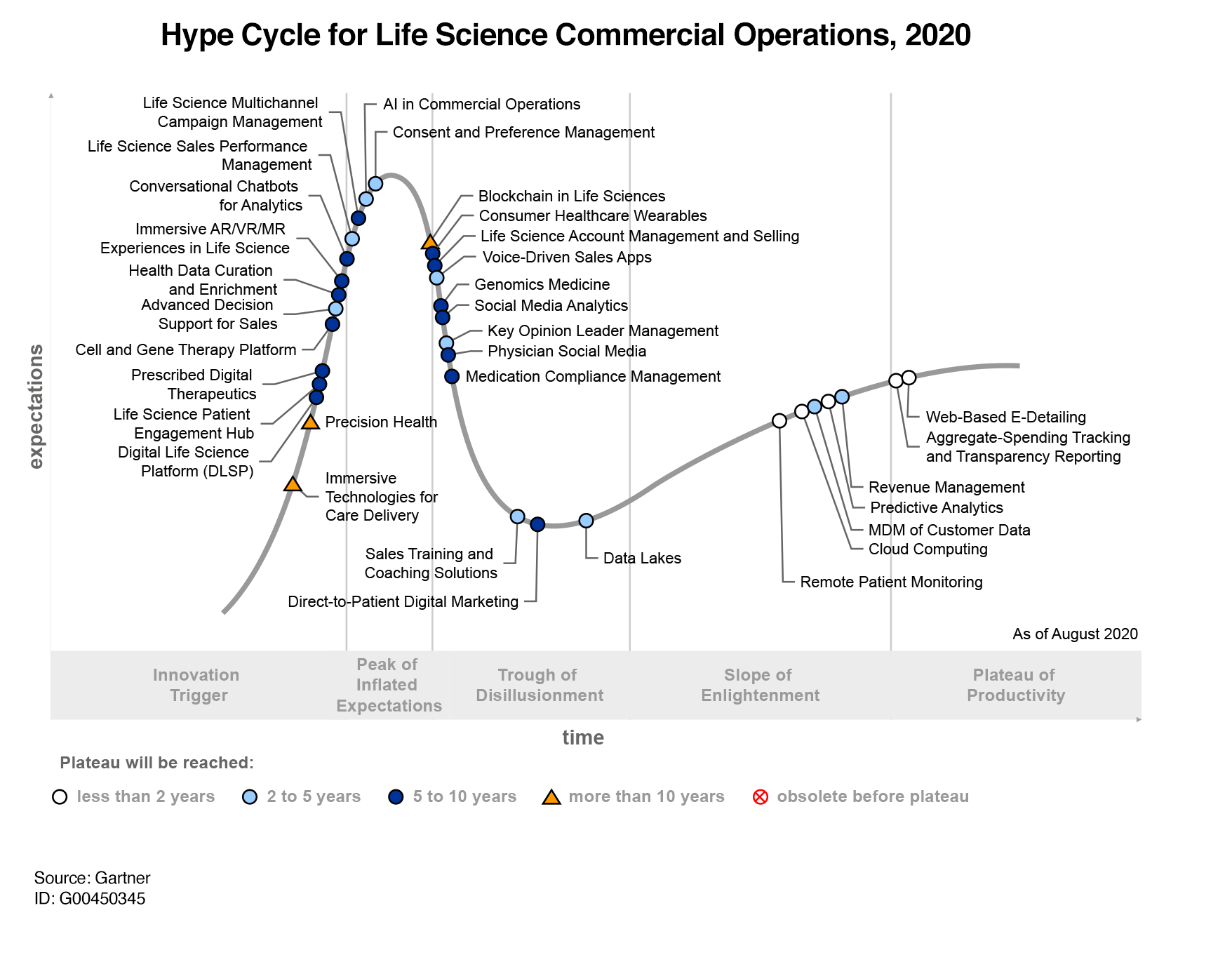
Hype Cycle for Life Science Commercial Operations, 2020
This Hype Cycle helps life science CIOs identify and prioritize the most strategic and relevant technology investments to transform the commercialization of therapeutic products. CIOs should use this research to understand the business value, maturity levels and adoption rates.
Analysis
What You Need to Know
In 2020, we have revamped this Hype Cycle to focus strictly on technologies and technology-related ideas that will yield the greatest revenue growth and commercial efficiency gains. They support life science commercial operations functions, such as sales, marketing, market access and patient assistance. All noncommercial-focused profiles have been moved to “Hype Cycle for Life Science Manufacturing, Quality and Supply Chain, 2020” and “Hype Cycle for Life Science Research and Development, 2020.”
Life science companies are facing unprecedented commercialization model disruption due to the COVID-19 pandemic. This has forced companies to rapidly shift their digital initiatives from planning to execution, highlighting the need for agility over completeness. In a matter of weeks, life science CIOs and executive leaders overcame cultural, financial, technology and regulatory barriers to progress, adapting to new market conditions and sustain operations. Business as usual was no longer effective, and life science leaders reacted quickly. Key catalysts for COVID-19-related digital acceleration this year include:
- Loss of interpersonal connection between sales representatives and healthcare professionals.
- Cancellation of in person events, such as peer to peer events, congresses, symposia, sales training, national events and launch meetings.
- Rapid rule changes from regulators like the U.S. Centers for Medicare & Medicaid Services (CMS), such as delaying all elective medical and surgical procedures during the pandemic, matching virtual care reimbursement to in-person visits and allowing provider credentialing across states. These changes have led to greater adoption of virtual care as well as revenue implications to life science companies due to reduction in new patients diagnosed with chronic conditions, access to care and postponement of elective procedures.
COVID-19 has accelerated transformation activities as many business models that have not adapted are now under threat. Business operations leaders feel the pressure from constraints placed on existing revenue models. While we expect life science CEOs and CFOs to begin cost optimization efforts, you as CIO must invest in emerging technologies that will enable your organization to nimbly adapt at a rapid rate of change.
The Hype Cycle
This Hype Cycle tracks key technologies and trends that support and drive commercial effectiveness. We include 33 innovation profiles affecting sales and marketing, patient engagement, market access, and data and analytics in the life science industry (including pharmaceutical, biotechnology, medical device and life-science-related service firms).
Life science CIOs and IT leaders recognize the importance of data and analytics and the role it will play in the evolution of clinical care and operations around digital health and pervasive real-time use of data and advanced analytics. Simultaneously, CIOs face significant cost pressures, dynamic and uncertain regulatory hurdles, cultural barriers to change and new digital competitors. To “go beyond the pill” and embrace patient centricity, you must align your IT enterprise approach and plans for emerging technologies with your company’s chosen role in an overall digital healthcare ecosystem (see “Best Practices for Reimagining Your Life Science Company as a Digital Business Technology Platform”).
Life science business outcomes are increasingly dependent on faster-paced insights derived from the convergence of varied external and internal data analytics capabilities to drive strategic and tactical decisions. This theme of data and analytics mastery runs through many of the innovation profiles we track. Leading life science business and IT executives realize that advanced data analytics competency is essential to orchestrate personalized customer engagements with both patients and providers, participate in outcome-based care models and accelerate sales and marketing effectiveness. These executives have begun to modernize their technology architecture, refresh team talent and skills and address governance deficits. Their challenge is now how to scale analytics and algorithms to extract the intelligence from a diverse range of data to optimize existing digital products and services, and enable and commercialize new ones.
The Hype Cycle for Life Science Commercial Operations reflects the following trends:
- Some business strategies and associated technologies we profile on this Hype Cycle move very slowly from the Innovation Trigger, over the Peak of Inflated Expectations, through the Trough of Disillusionment and onto the Plateau of Productivity. For example, aggregate-spend tracking and transparency reporting profile has progressed only slightly as the technology becomes mature and is just now on the cusp of being widely adopted.
- Innovation profiles in the Peak of Inflated Expectations are foundational technologies to enable business and operating model transformation. For example, artificial intelligence (AI) in commercial operations tracks multiple AI technologies that can enable CIOs and commercial operations leaders to leverage their ability to deal with a large amount of multidimensional data and positively impact their business performance.
- Innovation profiles near the Innovation Trigger, such as prescribed digital therapeutics and precision health, offer exciting opportunities to increase business and patient value. Game-changing new digital therapies in treatment areas, such as for substance abuse disorder, epilepsy monitoring and depression, are receiving commercial approval or in the final stages of regulatory review. Likewise, new companion apps will make existing drugs and therapies more effective. Thus, commercial teams will need new and innovative ways to educate and engage healthcare providers (HCPs) and patients about these advances.
Additions and Adjustments to This Year’s Hype Cycle
We added 13 innovation profiles to the Life Science Commercial Operations Hype Cycle this year. All of these technologies have important direct or influential impact on commercial strategies and execution.
New profiles that have been added to this year’s Hype Cycle include:
- Advanced decision support for sales
- AI in commercial operations
- Cloud computing
- Consent and preference management
- Conversational chatbots for analytics
- Data lakes
- Digital life science platform (DLSP)
- Immersive technologies for care delivery
- Life science patient engagement hub
- Life science sales performance management
- MDM of customer data
- Medication compliance management
- Predictive analytics
- Remote patient monitoring
- Sales training and coaching solutions
- Voice-driven sales apps
We have also replaced two innovation profiles with new combined ones that more specifically address the needs of commercial operations functions:
- AI for commercial operations replaces multiple AI technology innovation profiles that were sourced from the “Hype Cycle for Artificial Intelligence.” AI for commercial operations provides life science commercial context and use cases as well as strategic and implementation guidance and replaces augmented analytics, insights engines, machine learning and NLP profile.
- Life science patient engagement hub replaces healthcare consumer engagement hub and health information exchange profiles. Life science patient engagement hub provides life-science-specific context and use cases.
Figure 1. Hype Cycle for Life Science Commercial Operations, 2020
The Priority Matrix
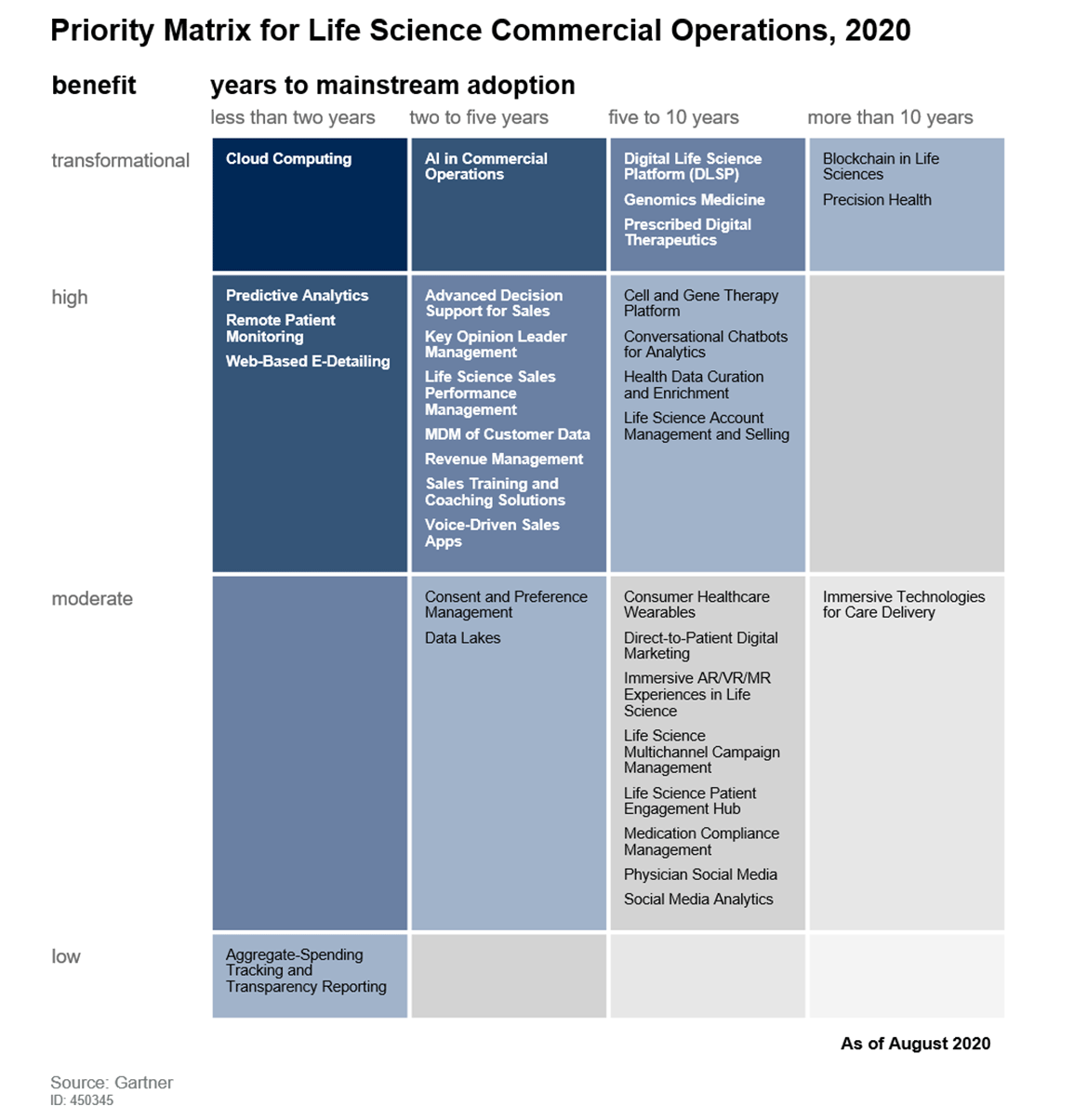
The 2020 Hype Cycle for Life Science Commercial Operations includes key technology areas that will enable CIOs and IT leaders to build and execute their digital transformation strategies. You as CIO must be able to communicate the business benefit range of various technologies to prioritize resource plans and investments. Innovative technologies early on the Hype Cycle are excellent targets for proof-of-concept (POC) projects to accelerate digital business pursuits. More mature technologies are safe bets for initiatives at scale.
Life science leaders need to look at each of the technologies in their portfolios and make a determination on how those technologies support their digital strategies. For example, do they increase the commercial impact of digital business optimization or transformation? Use this Hype Cycle as a tool to guide the alignment of IT with business processes to develop an effective digital strategy.
Transformational — In the next two to five years, AI in commercial operations will have significant impacts on organizations. We expect digital life science platforms to be mainstream in the next five to 10 years, enabling them to nimbly adapt their business and operating model in response to external disruption and change in business strategy. Likewise, we expect prescribed digital therapeutics to be mainstream in the next five to 10 years, forcing life science commercial operations to implement new technologies for distribution, pricing and value measurement. We expect blockchain in life sciences will take more than 10 years before it becomes mainstream in use cases, such as revenue management, health records and communications.
High Moderate — In the next two to five years, multiple profiles will enter mainstream adoption, including life science account management and selling, direct-to-patient digital marketing, life science multichannel campaign management and revenue management. A variety of other profiles, such as advanced decision support for sales, will not become mainstream for five to 10 years or more. For example. clients that create value using these technologies will see opportunities for differentiation, such life science patient engagement hubs that enable organization to engage with patients longitudinally over multiple modalities.
Low — Technologies in this category are primed to help optimize businesses and represent lower-risk projects, but may not offer as much differentiation or opportunities for business transformation. For example, aggregate spending tracking and transparency reporting systems perform an essential compliance function and have matured over the years.
Figure 2. Priority Matrix for Life Science Commercial Operations, 2020
Off the Hype Cycle
We made a number of changes to this year’s Hype Cycle. Our additions, subtractions and revisions reflect the rapid pace at which new technologies are entering life science companies’ strong business need to apply them at scale.
Graduated profiles:
- Life science commercial analytics, as they have achieved widespread adoption.
We removed, modified or consolidated several profiles in 2020 with the following rationales:
- Manufacturing and production-related profiles were removed to focus this Hype Cycle on commercial operations. These profiles can now be found on “Hype Cycle for Life Science Manufacturing, Quality and Supply Chain, 2020”
- 3D printed drugs
- AI augmented safety vigilance
- Compliant GxP cloud services
- Controlled substance ordering system
- Electronic batch records
- Enterprise laboratory informatics
- Industrial operational intelligence
- IoT-enabled laboratory
- Model-based manufacturing
- MOM application suites
- Pharma PLM
- Process analytical technology (PAT)
- QMS applications
- SaaS-regulated EDMS
- Structured content and component authoring
- Track and trace/serialization
- Unique device identification
On the Rise
Immersive Technologies for Care Delivery
Analysis By: Pooja Singh; Mike Jones
Definition: Immersive technology for care delivery is the application of virtual reality (VR) and augmented reality (AR) technologies to provide patients and clinicians with an ability to experience, practice and prepare for real clinical interactions. It has applications in medical education, preparing patients for treatment, clinical event simulation (e.g., surgical planning), improving the patient experience, clinical diagnostics and treatment.
Position and Adoption Speed Justification: VR has had a significant impact on several industries as a means of engaging consumers and professionals in a more immersive experience for a range of use cases (e.g., in increasing the safety of assembly line processes in car manufacturing). The adoption of VR solutions in HDOs is starting to show signs of promise with real-world examples and clinical evidence emerging of small-scale and innovative applications, such as:
- Reducing anxiety and preparing cancer patients for treatments by virtual walk-through. It also provides an alternative point of focus for patients during unpalatable treatments such as chemotherapy, and as an alternative form of pain management.
- Gamification for children undergoing surgery to engage them and help manage their anxiety toward upcoming procedures. See the CHARIOT program by Stanford Children’s Hospital.
- Improve success rate of intravenous injections by projecting a patient’s veins on the skin to quickly locate the optimal injection site for the procedure.
- Treating exaggerated fears (phobias), post-traumatic stress disorder (PTSD), social anxieties and psychosis.
- Helping patients rehabilitate themselves after a stroke by providing a means of focusing on rehabilitation activities and applying motivational techniques. See "Immersive Virtual Reality for Stroke Motor Rehabilitation."
- Effectively treating pain management, eating disorders, and cognitive and motor rehabilitation in hospitalized patients (a 2017 review of 2,024 citations).
See "Virtual Reality and Medical Inpatients: A Systematic Review of Randomized, Controlled Trials."
AR and VR are combining in novel ways for use cases. VR headsets like Oculus Rift or HTC VIVE offer fully immersive experiences, and AR headsets like Microsoft HoloLens or Magic Leap allow the overlay of virtual objects onto the real world to create mixed reality experiences. Surgical Theater’s patient-specific 360-degree CT/MRI/DTI allows patients and surgeons to step into a virtual reality reconstruction of a patient’s anatomy for presurgical education and planning. Surgeons at St Mary’s Hospital in the Imperial College Healthcare NHS Trust are using HoloLens to look inside patients before they operate on them. For example, surgeons can see a projection of blood vessels, bones and muscles overlaid on the patient’s leg, along with annotations providing operational guidance enabling more-precise procedures.
Despite early innovations demonstrating significant outcomes, we believe the rate of adoption will be relatively slow. Efforts, so far, have been on a small scale, depend on expensive technology, and lack a sufficient body of evidence on clinical effectiveness and cost-effectiveness necessary for publications to publish. Consequently, investment rationale can be difficult to quantify.
We have positioned it early in the Innovation Trigger phase on the Hype Cycle. With a few exceptions (e.g., “experiential” VR and medical education), the use for direct patient care is mostly still being piloted and evaluated primarily in academic or specialist centers.
User Advice: Actively follow academic literature and the clinical community’s acceptance and adoption of these technologies to help determine how quickly you can integrate these innovations into practice. Engage your early adopters in following the international consensus on best practices for the development and testing of VR treatments to bring rigor into research for patients, providers, payers and regulators to assess the validity of VR treatments. See “Recommendations for Methodology of Virtual Reality Clinical Trials in Healthcare by an International Working Group: Iterative Study.” The U.S. FDA conducted a public workshop in March 2020 for discussing evaluation needs, gaps and approaches for VR and AR in medicine.
Where clinicians are interested in piloting solutions, the HDO should do this within a tightly scoped and controlled “innovation” pilot that evaluates the results in terms of patient or clinician benefit, and experience and ease of integration into clinical workflows. As this technology is in the early stage of hype, seek reference site confirmation that the vendor has, in fact, achieved the benefits claimed.
Ensure commercial terms, data privacy and security are evaluated where patient- or clinician-identifiable information is traversing or being stored in a vendor cloud environment.
Business Impact: This technology is currently relevant in a small number of specific applications. Typically, these will be focused on providing an alternative (preevent) clinician or patient experience for an event they will later experience in the real world. In this regard, the aim is often to develop familiarity with that event and reduce anxiety or provide educational material.
The benefit rating is moderate, as there are now over 2,000 citations to study use cases and benefits. However, the use cases covered are generally more experiential and educational in nature, with small sample sizes. This may change in the future as the strength of the evidence improves and case studies are published with independently verified results.
Benefit Rating: Moderate
Market Penetration: Less than 1% of target audience
Maturity: Emerging
Sample Vendors: KindVR; Medtronic (Touch Surgery Labs); Microsoft; MindMaze; Surgical Theater; Virtually Better; VR Education Holdings
Precision Health
Analysis By: Mark Gilbert
Definition: Precision health improves an individual’s health by predicting the likelihood of future illness and recommending actions or interventions that lower risk. It analyzes a wide range of data including genetics, lifestyle, real-world environments, behaviors, biometrics, genomes, medical history and social determinants of health. It builds on technology advances in genomic medicine, precision medicine, social and behavioral science support, and technology surrounding consumer data capture to identify the optimal health pathway for individuals.
Position and Adoption Speed Justification: Precision health continues a slow advance through the Hype Cycle following its introduction at the Innovation Trigger in 2018. Early research in the field has demonstrated precision health’s potential for revolutionizing the health industry by identifying health risks at the earliest possible time so that the least invasive, least costly and frequently the most effective intervention can be used. We see increased activity in the field by researchers, vendors, academic medical centers and health systems to identify proactive health actions that can improve health and prevent illness. Evidence of efficacy is increasingly being presented at conferences and published in journals. The research consistently demonstrates the revolutionary impact that precision health can have on the prediction, early diagnosis and treatment of a disease or illness.
Although the evidence is mounting, it will take years to develop the technologies required to capture precision health data elements, standardize their recording and analysis, and create evidence-based health pathways at scale. It will take more years to develop AI enabled insights from the massive volume of data required for each individual. It will also take time to create public policy and develop reimbursement models linking the value of preventive interventions to the successful elimination of a condition that may occur over 50 years in the future. Additionally, precision health may depend on patient behavioral changes that have proven to be difficult to achieve. For these reasons, precision health will continue to rise on the Innovation slope, but we project it to be still at least 10 years away from the Plateau of Productivity.
User Advice: CIOs, business executives, clinical service line leaders in life science, healthcare delivery and healthcare payer organizations should become collaboratively engaged in monitoring precision health technology developments. They should track the leading indicators of adoption for precision medicine including;
- Decreases in the cost of sequencing and companion testing
- Reductions in the cost of treatment
- Increasing rates of reimbursement for treatment
CIOs should look for opportunities to leverage developing organizational competence in responding to genomic and biomarker analysis and consumer engagement to amass the data and analytics required for precision health initiatives.
CIOs should keep precision health concepts in mind as they establish population health management and they invest within precision medicine platforms. They should consider the extensions that are possible based on more-robust data outside of typical care processes today. They must take the long view in capturing more data than less, positioning the organization for its use in research or AI-driven initiatives to see precision health business opportunities.
Business Impact: Precision health breakthroughs will eventually disrupt the business, operational and technical models of healthcare companies. The ability to predict risks for specific illnesses enables proactive health, wellness and behavior interventions using minimally invasive treatments. Optimally, precision health interventions will cure illnesses before they happen through wellness and prevention efforts — increasing lifespans, decreasing the incidence of lifestyle diseases, and reducing chronic illness.
In a precision health future, healthcare organizations will find themselves increasingly focused on monitoring the health of individuals, identifying risks, and performing wellness and preventive interventions, radically changing primary and secondary care as we know it. The implication is that the business model of today’s healthcare organization that relies on repair care episodes will necessarily change. The result will be revenue risk to organizations relying on ill patients and an opportunity to seize more health value upstream of the illness onset.
Benefit Rating: Transformational
Market Penetration: Less than 1% of target audience
Maturity: Embryonic
Sample Vendors: 2bPrecise; DNAnexus; Molecular You; Orion Health; Precision Digital Health
Digital Life Science Platform (DLSP)
Analysis By: Michael Shanler
Definition: A digital life science platform (DLSP) is an architectural approach that enables companies to nimbly adapt their business and operating model in response to external disruption and change in business strategy. The DLSP sources and integrates functionality from internal and ecosystem partners to create packaged business capabilities (PBCs). Nontechnical and IT staff can use PBCs to compose new experiences.
Position and Adoption Speed Justification: Life science (LS) organizations realize the limitations of monolithic ERP-centric and heavily customized or niche business applications portfolios. The siloed nature of current architectures (as seen in research informatics packages, clinical development tools, sales CRMs and manufacturing suites) has stifled innovation and slowed the pace of digital transformation. Customer frustrations are exacerbated by feeble attempts at interoperability by vendors resulting in a bloated total cost of ownership (TCO). More recently, COVID-19 has exposed significant gaps in core capabilities when it comes to scaling new ways of working.
The DLSP approach will remove some critical existing technological barriers to digital innovation and transformation (see “Best Practices for Reimagining Your Life Science Company as a Digital Business Technology Platform”). The end result will be an organization that delivers business outcomes and adapts to the pace of business change by delivering packaged business capabilities (PBCs). PBCs are application building blocks that have been purchased or developed internally or with third parties.
The DLSP enables:
- A composable life science enterprise (or perhaps a “Digital Therapeutech”) that is realized through business user focused application experiences that are independent of the underlying set of COTS or legacy monolithic applications.
- A more effective means of bringing together different domains (e.g., clinical and AI SMEs) to provide a focus for democratized innovation among a range of stakeholders (see “Fusion Teams: Cross-Functional Collaboration for the Digital Era”).
Leading vendors in this space will be those that can provide a means of rapidly producing composable digital products and services from different sources (not just their own marketplace or product offerings).
We expect this innovation profile to reach the Peak of Inflated Expectations in three years as new visionary platform entrants and large sponsors force incumbent vendors to open up their architectures. Hyperscale solution providers and channel partners, and the open platform movement will lead to many monolithic solutions becoming marginalized as these more nimble, cost-effective and scalable digital capabilities that resonate with business and IT leaders.
User Advice: Central to the principle of the composable life science enterprise is the ability to adapt and change applications in the portfolio. The dynamic experience of the composable enterprise will become the prevailing architecture, integration and delivery model for digital innovation.
Life science CIOs must:
- Align digital and IT strategy with existing business strategy through the power of people from business and IT backgrounds in the form digital fusion teams (see “Fusion Teams: A New Model for Digital Delivery”).
- Take appropriate actions on vendor and key technology sourcing across the current and future enterprise application portfolio (see “A CIO’s Hype Cycle Reference Guide for the Healthcare and Life Science Industries”).
- Drive technology and data architecture decisions and organizational models that redefine the relationship between the business and IT.
- Many legacy applications will need to be modernized toward the PBC model.
The DLSP will create PBCs from a range of existing digitized business (e.g., with clinical trial workflows, physician engagement, safety and signaling) and events — but some are more difficult than others. Both legacy vendors and new market entrants earn their place in your application portfolio by making the work easier and more affordable by having robust API libraries, event stream participation, compatibility with enterprise master data management (MDM). Taken together, this attribute of “composability” should be a high priority in making and renewing vendor relationships.
Business Impact: The DLSP can impact many areas of the LS business. Depending on the digital ambition and scope of each organization or ecosystem the DLSP will typically enable new digital business capabilities across a variety of areas. Example areas include:
- Digital consumer and patient engagement for individualized or personalized experiences for drug regimens, device usage, and therapies, using plug-in-play capabilities from external ecosystem players.
- New models for patient-centric care delivery — where multiple parties contribute to creating greater health value, augmented by AI and connected devices.
- Decentralized, digital clinical trials — where new devices, sensors, technologies, and data sources drive clinical operations and findings.
- Advanced health analytics using tools leveraging data sources from R&D, precision medicine, and real world evidence.
The benefit to the business is the ability to rapidly adapt to changing business requirements/capabilities supporting both optimization and transformation activities. It heralds a new era in which clinical and consumer capabilities drive technology. In contrast, today we see vendors dictating what the next set of business and consumer capabilities should be. Over time, we would also expect decreased TCO for core systems and increase in ROI for the overall technology investment of a LS firm.
Benefit Rating: Transformational
Market Penetration: Less than 1% of target audience
Maturity: Embryonic
Sample Vendors: Amazon; Google; IBM; Microsoft; Salesforce; SAP
Life Science Patient Engagement Hub
Analysis By: Animesh Gandhi
Definition: Life science companies directly engage patients to increase awareness about their product, ensure access to therapy through their patient support program, and provide education to improve adherence and persistence to therapy. The life science patient engagement hub (LSPEH) is a technology that integrates multiple patient engagement touchpoints to improve patients’ experience and clinical outcomes from prediagnosis through ongoing care management.
Position and Adoption Speed Justification: The emerging shift toward outcomes-based care, especially with higher priced specialty pharmaceutical products, has emphasized life science companies’ need to deliver improved clinical results. Empowered patients who seek greater control of their treatment plan and the growing availability of digital health technologies collectively present a new opportunity for engagement. A LSPEH includes proactive and reactive communication; allows personalized, contextual engagement with patients across all interaction channels; and orchestrates interactions across the patient journey.
LSPEH differs from current patient support services, advocacy group platforms or education programs in that it is an end-to-end approach to manage the entire patient journey with the commercial life science organization, not just provide a specific service. LSPEH is an essential tool for companies to design an omnichannel patient engagement program that measurably increases therapy initiation, therapy adherence, and persistence. Examples of such patient engagements include:
- Marketing communications to raise brand awareness of products on the market.
- Provide training and education to improve initiation and compliance to prescribed treatment.
- Manage patient adherence and collect and analyze data to monitor patients’ conditions through integrated medtech devices.
- Gather and analyze real-world evidence (RWE) that demonstrate product value and streamlines development of new treatments and services.
- Orchestrate precision medicine delivery programs that leverage digital therapeutics and biosensors for improved clinical outcomes. For example, in immuno-oncology, life science companies are building and piloting integrated ecosystems consisting of symptom management applications, biosensors and medtech devices that enable them to intervene during course of patient journey.
The LSPEH acts as a centralized data hub, connecting with functional applications — such as patient support services, medical adherence applications, patient education portals and “beyond the pill” applications — to the extent needed to act as the enterprise orchestrator.
However, LSPEH solutions, and more broadly, the patent support programs they enable are costly to design, operate and manage. Many life science companies struggle with designing numerous components of the program and ideal patient experience, especially given that the needs of patients are dependent on the therapeutic area and the product. For example, certain therapeutic areas such as hypertension have greater need for helping patients with awareness and testing rather than reimbursement and access challenges whereas neurological disorders typically require greater human-based social support.
We expect this trend to accelerate as life science companies without LSPEH initiatives start building business cases and planning for pilots. As a result, we position LSPEH moving toward Peak of Inflated Expectations and anticipate mainstream adoption in five to 10 years.
User Advice: CIOs cannot spearhead a patient engagement strategy on their own. Establishing a LSPEH strategy requires coordination with patient support, market access, brand marketing and compliance peers to ensure a coordinate organizational vision.
The specific strategy will vary based on which patient journeys are important to the enterprise. In 2020, the LSPEH should be positioned with business stakeholders as the key mechanism for delivering improved clinical patient outcomes. Thus, start today by:
- Assessing the needs of patients for your specific therapeutic area and your products and get up to speed on patient engagement trends and technologies.
- Establishing a data and governance strategy to centralize all patient engagement touchpoints are captured in LSPEH.
- Advocating for a pilot program with your executive peers that addresses the needs of a specific therapeutic area.
Business Impact: Life science companies have traditionally focused on “beyond the pill” moniker in an attempt to engage patients and reinforce medical adherence, but companies are increasingly realizing that a broader definition is required to address the needs of modern complex therapies. Life science companies have sketched patient journey maps and developed ambitious plans that call for interventions at key movements of that journey. In contrast, LSPEH enables life science companies to operationalize those plans at scale, globally.
LSPEHs are gaining traction with life science companies because they hold the promise of activating patients and maintain ongoing engagement with them throughout their therapeutic journey. For example, Novartis has partnered with Biofourmis to develop and commercialize a digital therapeutics program that follows patients home after they’ve been recently diagnosed with heart failure, with the goal of improving patients’ clinical outcomes through remote monitoring. Please see “Novartis Taps Growing Biofourmis for Digital Heart Failure Project” for more details.
Benefit Rating: Moderate
Market Penetration: 1% to 5% of target audience
Maturity: Embryonic
Sample Vendors: Accenture; AssistRx; Conduent; Deloitte; IQVIA; Mavens; Salesforce
Prescribed Digital Therapeutics
Analysis By: Animesh Gandhi
Definition: Prescribed digital therapeutics (PDTs) are evidence-based, software-driven therapies that require a provider’s prescription. PDTs optimize health outcomes by treating physical and mental health conditions independently or in conjunction with medications, devices or other therapies. PDTs are distinguished from broader digital health technologies, as their creators must conduct randomized clinical trials to demonstrate PDT safety and efficacy to earn regulatory approval (such as FDA, EMA, MHRA) for all marketing claims.
Position and Adoption Speed Justification: Life science companies are looking to expand digital services that “go beyond the pill” and that deliver better health outcomes. PDTs treat medical conditions, supplement traditional therapy and assess adherence to prescribed treatment plans. These apps provide a mechanism to both treat patients and to capture and analyze real-world data on engagement, disease progression and therapy effectiveness to help providers “close the loop.”
Life science companies continue to announce new partnerships that augment their existing drugs with digital solutions or complement their therapeutic portfolios. Examples include:
- In 2019, Sanofi and Happify Health, which provides evidence-based mental health digital therapeutics, announced their collaboration to develop and study an app to help manage and improve psychological outcomes in people with multiple sclerosis.
- In 2019, Akili Interactive partnered with Shionogi & Co. (a pharmaceutical company focused on infectious diseases and pain/central nervous system [CNS] disorders) to develop treatment for pediatric attention-deficit/hyperactivity disorder (ADHD) delivered through video game experience.
- In 2018, Click Therapeutics partnered with Otsuka Pharmaceutical to develop software as a prescription medical treatment for CNS disorders through cognitive and neurobehavior mechanisms.
Regulatory bodies have begun working toward streamlining regulatory oversight. For example, In 2017, the U.S. Food and Drug Administration (FDA) initiated a precertification program to help streamline regulatory oversight for manufacturers of software as a medical device (SaMD) and began collaborating with key industry players. In 2019, the Precertification (Pre-Cert) Program entered its test phase, meaning companies seeking to approve new products will go through the Pre-Cert pathway. Also in 2019, the FDA commissioner announced further development in the program that enables qualifying SaMD developers to utilize FDA’s De Novo classification request framework.
It should be noted that PDTs are still early on the Hype Cycle, implying a level of maturity and risk, but have a transformational impact as novel solutions. The success of PDTs depends on identifying the right commercial model and right partners that have aligned incentives, cultural fit, defined expectations and open communications. Lack of such alignment may result in partnership failure. For example, Pear Therapeutics and Sandoz dissolved their partnership due to misaligned commercialization strategy. Gartner believes such failures do not reflect the viability of PDTs, but reinforce the need to have stronger partnership frameworks.
The core technology behind PDTs is becoming increasingly advanced, but commercialization strategy and reimbursement model challenges remain. Therefore, in the Hype Cycle, the technology is still in the Innovation Trigger phase, and should reach the Peak of Inflated Expectations within the next two years.
User Advice: CIOs should partner with their digital medicine and R&D teams to enable new PDT opportunities. Ensure that potential development challenges (such as stringent validation and regulatory requirements) will support PDT commercialization.
Life science CIOs should:
- Partner with development peers to formulate digital therapeutic strategy focused on how digital health innovations can, either separately or in combination with physical product, improve or enhance treatment outcomes and patient experiences.
- Seek and manage partnerships with technology vendors that have the capabilities to develop and scale the technologies and methods to deploy.
- Develop platform architectures and roadmaps, including support for data interoperability, managing patient privacy, data security and data and analytics platforms that can withstand incredibly heavy and unpredictable demands for data generated by PDTs.
Business Impact: By combining technology and clinical validation, PDTs have the potential to redefine personalized medicine, enable new revenue streams and launch new partner models for life science organizations. These therapeutic interventions will, in many cases, provide an interactive way of administering therapy, such as tailoring experiences and providing feedback in real time, based on mental as well as biological markers. PDTs will also increase access to clinically validated therapies, given their frictionless, software-only distribution model.
Collectively, this will result in better efficacy for therapies, improved safety signaling and increased medical adherence, and positive impact on revenue, especially as companies explore payment models based on health value outcomes. PDTs will generate tremendous amounts of real-world evidence data and pave the way to value-based outcomes. For these reasons we rate the benefits of PDTs as transformational.
Benefit Rating: Transformational
Market Penetration: Less than 1% of target audience
Maturity: Embryonic
Sample Vendors: Akili Interactive; Amalgam; Apptomics; Click Therapeutics; Happify Health; Pear Therapeutics; Welldoc
Cell and Gene Therapy Platform
Analysis By: Michael Shanler
Definition: Cell and gene therapy (CGT) platforms are systems designed to help collect, analyze and prepare biological samples as therapies for patients. The American Society of Gene & Cell Therapy defines gene therapy as the use of genetic material to manipulate a patient’s cells for the treatment of an inherited or acquired disease. Cell therapy is defined as the infusion or transplantation of whole cells into a patient for the treatment of an inherited or acquired disease.
Position and Adoption Speed Justification: While the first gene therapy was tested by the National Institutes of Health in 1990, and research organizations have experimented on and put cellular therapies into practice for decades, software for managing the end-to-end process did not exist until recently. In fact, the vast majority of CGT today is supported using heavily customized supply chain and logistics software or custom software. It wasn’t until the last 10 years that new entrants started to support the growing market of CGT trials and commercial operations with a CGT platform, for example:
- TrakCel was established in 2012 as a joint enterprise between AwenID, a technology company spun out from Swansea University and Biotec Services International, a specialist provider of ultra-low temperature-controlled supply chain management services to the biotechnology industry. Today, TrakCel focuses on managing cell, gene and immunotherapies through clinical trials to manufacturing and commercialization.
- In 2016, GE Ventures and the Mayo Clinic launched Vitruvian Networks, an independent platform company committed to accelerating access to cell and gene therapies through advanced, cloud-ready software systems and manufacturing services with a focus on supporting T-cell therapies (see “GE Ventures, Mayo Clinic Launch New Personalized Cell and Gene Therapy Biz,” FiercePharma). In 2017, the company was renamed Vineti.
- There are a handful of vendors that address different elements of CGT, albeit with different capabilities. Be The Match BioTherapies has cell therapy donor logistics software, while companies like McKesson and IQVIA offer CGT services. There are a bevy of clinical trial supply chain management vendors, such as Catalent, wading into the CGT space.
Two key autologous chimeric antigen receptor (CAR) T-cell therapies were launched in the U.S. and Europe in 2017 through 2018. Novartis launched KYMRIAH and Kite Pharma launched Yescarta for B-cell lymphoma. Today, there are over 250 CAR-T drugs in trials, and numerous other types of CGTs (see “Cell Therapy Manufacturing: The Supply Chain Challenge,” Genetic Engineering & Biotechnology News).
While only a handful of CGTs are available as therapies, R&D and supply chain organizations see significant opportunities and challenges as CGTs become more essential in life science (LS) portfolios. LS organizations and other researcher institutes can expect further complexity and challenges however, as organizations evaluate different types of models:
- Allogeneic (the donor is different than the recipient)
- Autologous (the donor and patients are the same)
- Variations of stem cell and T-cell therapies
In each of these cases, clients have unique needs and wildly different interventions and touchpoints they must orchestrate among R&D staff, healthcare professionals, lab technicians and supply chain personnel.
We position this technology in the Innovation Trigger phase, given its early stage of maturity and adoption.
User Advice: Find out from leadership (such as the chief science officer) if CGT platforms will be necessary to support your business strategy, and focus on the touchpoints between CGT and major systems, such as ERP, manufacturing execution system, electronic batch record, quality management system, and patient and healthcare-facing systems. Then evaluate whether the new established vendors can provide the capabilities you need versus building a custom solution. Also, inquire about the commercial challenges (such as high price per therapeutics) and guidance for deals with payers that may affect architecture and CGT-related information communication.
Supporting CGT requires CIOs to ensure extensive process, clinical and IT system validation is performed by their organizations and vendors. CIOs must ensure that governance and policy are in place to maintain vigilant compliance and that patient privacy is protected.
Business Impact: As demand for CGT clinical trials accelerates, having a CGT platform that matches the therapy area will be essential to streamlining trials and getting commercial products to the market. The data associated with CGT has broad uses across the business throughout the product life cycle — R&D, as well as commercial, as well as specialized manufacturing and supply chain operations. Those requirements become the most acute for organizations supporting a “personalized medicine” approach, where markets consist of individuals. Once patient, manufacturing, operations and clinical data policies are updated, CGT systems will be more scalable for supporting different kinds of CGT scientific and medicine programs.
Benefit Rating: High
Market Penetration: 1% to 5% of target audience
Maturity: Emerging
Sample Vendors: Autolomous; Be The Match BioTherapies; CellPort Software; Cytiva; FarmaTrust; Hypertrust Patient Data Care; L7 Informatics; Skyland
Analytics; TrakCel; Vineti
Advanced Decision Support for Sales
Analysis By: Animesh Gandhi
Definition: Advanced decision support for sales (ADSS) tools apply predictive and prescriptive machine learning (ML) algorithms to interpret data, identifying best-possible actions to execute that will meet the objectives of brand teams and their customers. Life science companies use these tools to guide their sales representatives in achieving consistent operational excellence and goal attainment by providing personalized and actionable insights to drive their next best action.
Position and Adoption Speed Justification: We are adding ADSS on this year’s Hype Cycle due to:
- An abundance of vendor solutions
- A mix of excitement, confusion and skepticism from end users
- The serious potential to alter efficiency and effectiveness of life science sales representatives
ADSS tools provide life science sales representatives with the next step beyond traditional business intelligence (BI) reporting by transforming how an organization generates and delivers insights to them. Traditional BI methods require sales representatives to data mine static, retrospective information scattered across reports and dashboards to identify anomalies, correlations and underlying trends essential to their business performance, and to personalize their engagements with healthcare professionals (HCP). ADSS tools modernize traditional BI methods and deliver insights using predictive and prescriptive guidance. Examples of ADSS personalized guidance to sales representatives include:
- Tactical, operations-driven alerts on how their targeted customer universe is performing
- Assistance with precall planning and optimal content to present
- Personalized summaries of market events, such as a formulary win and its impact on sales representatives and their target customers
The market for ADSS tools is still developing, but rapidly improving. Algorithmic rule-based tools have been on the market for several years providing guidance via customer relationship management (CRM) or BI platform for sales representatives.
These tools are rapidly improving the type and quality of guidance delivered to sales representatives due to their improved predictive and prescriptive models. Some CRM vendors, such as IQVIA and VEEVA, have made ADSS part of their core capability, although several third-party tools, such as Aktana and ZS VERSO, have been in the market longer and provide richer AI functions. Because CRM technology always gravitates toward higher levels of automation to improve sales effectiveness, Gartner expects ADSS capabilities to increasingly become foundationa
Based on these factors, we initially place ADSS technology in the Innovation Trigger phase, accelerating toward the Peak of Inflated Expectations, and expect it to reach the Plateau of Productivity in five years.
User Advice: Life science CIOs must equip brand and operations teams with advanced analytics tools to improve experiences of their HCPs and drive brand growth. These tools will continue to mature and incorporate ever more sophisticated predictive and prescriptive algorithms, allowing sales representatives to connect seemingly uncorrelated data points to improve their efficiency and effectiveness.
CIOs and commercial IT leaders should:
- Evaluate the latest ADSS tools to drive insights and suggestions directly at the representative level in the field.
- Partner with business stakeholders to establish usage of analytics in their commercial operations to provide a significant competitive advantage. CIOs should highlight benefits that include personalizing engagement and optimizing interaction time with their HCPs.
- Assess both CRM and third-party vendor tools. Evaluate their deployment model (accelerator or productized or as a service) and their roadmap.
Business Impact: ADSS tools have a high positive impact on experience delivered to HCPs and enabling the sales force to achieve consistent operational excellence and call plan goal attainment. For example, ADSS tools will enable sales representatives to:
- Identify optimal periods to visit HCPs to deliver the most appropriate message based on HCPs’ preferences.
- Assist with diagnosing key performance issues and developing tactics for remediation.
- Learn from and institutionalize best practices from top-performing sales representatives as part of the guidance process, helping newer and underperforming sales representatives improve their performance.
Increasingly, as life science organizations reduce the size of their field sales force, advanced analytics will be required to drive greater ROI from existing investments in people and technology.
Benefit Rating: High
Market Penetration: 5% to 20% of target audience
Maturity: Emerging
Sample Vendors: Aktana; Axtria; Omnipresence; IQVIA; TrueBlue; Veeva Systems; ZS
Health Data Curation and Enrichment
Analysis By: Laura Craft
Definition: Healthcare data curation and enrichment gathers clinical, research, demographic, social determinants and lifestyle data from across the consumer/citizen/patient health and wellness continuum. These technologies then apply cleansing, normalization and other data services to appropriately organize the data for downstream value, consumption and use. They automate the ingestion of data from all identified and permissioned sources; provide tracking and traceability; manage identity, compliance and security; and facilitate agile data governance.
Position and Adoption Speed Justification: As the need for real-time health insights across a growing digital ecosystem accelerates, so too does organizations’ need for tools that enable that nimbleness. Data curation and enrichment tools, and the data services they offer, are becoming critical components of the digital architecture of HDOs and other health-focused organizations. We have advanced this profile forward, from the trigger to closer to the peak, in line with this growing need. However, we don’t expect a converged mature market to develop for five to ten years as there are ample new entrants into this market introducing approaches (such as using graph technology). Two approaches to this market exist: stand-alone data specialty vendors (such as a Clearsense or Verinovum) or incumbent vendors (such as analytic vendors, EHRs, HIEs) expanding their capabilities to include more robust data services.
User Advice: This technology responds to the vast amounts of data that are essential to sustaining health and wellness, containing healthcare costs, and ensuring the customer/patient/person is engaged and satisfied. Corralling that data is an enormous and daunting curation and integration undertaking. Organizations that assess health and health risk rely on data sources that historically have been beyond the reach of any one healthcare organization, such as social determinants of health and genomic profile data. In addition, care delivery is increasingly dependent on coordination across an integrated community network. The result is an expanding ecosystem of care coordination and data exchange demanding complex governance and policy enforcement.
The data needed to support all the healthcare actions is increasingly needed in real time and demands the aggregation of many data points to provide the holistic picture of the patient. This broadening ecosystem of data collection, sharing and delivery taxes traditional data exchange integration methods (HIEs and ETLs) that have been implemented for purpose-specific reasons and do not have the depth of function needed to manage new data demands. Healthcare organizations that are executing a digital health strategy are already experiencing the gaps, bottlenecks and delays created by poor data movement.
Healthcare CIOs must make sure that integration and data challenges do not become a weak link to organizational progress and transformation:
- Proactively assess what the data integration demands across the healthcare organization will be over the next three to five years. Cull insight from the organization’s strategic plan and through other deliberate short- and long-term visioning exercises. Determine if today’s data integration strategies will be sufficient in three years.
- Create requirements by mapping out the patient, provider, and administrative journeys, and document the ideal movement of data across the enterprise. Update the enterprise and information architectures to reflect the future state. Develop your five-year roadmap.
- Evaluate your existing vendors (including the EHR, population health, analytics and/or integration vendors) to determine if they have a roadmap and strategy to meet your demands. Understand the specialty vendors in the market and track their evolution.
Business Impact: Successful deployment of a comprehensive health data curation and enrichment capability is a foundational component of the real-time health system, conducting digital healthcare, and the ability to execute population health and community care management. These strategies are central to efficiency, effectiveness, quality and cost management in healthcare. The future success of both payer and provider organizations in achieving their digital health ambitions is dependent on optimizing the use and liquidity of the data is amasses.
Benefit Rating: High
Market Penetration: Less than 1% of target audience
Maturity: Emerging
Sample Vendors: CareEvolution; Clearsense; DataMotion; DXC Technology; Health Catalyst; IMAT Solutions; Innovaccer; Verinovum
Immersive AR/VR/MR Experiences in Life Science
Analysis By: Michael Shanler
Definition: Augmented reality, virtual reality and mixed reality in life science is applying those technologies to create an immersive environment for R&D, quality, manufacturing, therapeutic, or commercial purposes. AR/VR/MR, sometimes called extended reality (XR), technologies are used by both LS firm employees and stakeholders in the LS value chain for use cases spanning lesion detection to training to molecular modeling.
Position and Adoption Speed Justification: Augmented reality (AR), virtual reality (VR) and mixed reality (MR) technologies are finding their way into the life science (LS) domain, albeit more slowly than in other industries. This is due to long LS product life cycles, high barriers to regulatory compliance and lack of direct contact with stakeholders, customers and patients. In many cases, individual business groups have created niche applications. Nonetheless, leading examples include:
- AR has been packed into an iPhone-based skin cancer lesion detection companion app. It has also been integrated into a lab informatics environment for laboratory execution systems, supported by “Lab of the Future” (LoTF) initiatives.
- VR has been widely used for molecular modeling, optimizing facilities, physician training and patient education. We also see it in some clinical therapies such as cognitive behavioral exposure therapy, PTSD, depression and dysmorphia, stroke, attention deficit and autism spectrum disorders.
- MR is being piloted by a number of companies for medical devices (such as robotic surgical instruments), and field service engineering on analytical equipment. It is currently used in limited plant operations and warehouses, where engineers make virtual changes to substrates (bodies, tissues, software and hardware), with automation updating the changes in reality.
In isolation, AR, VR, and MR would have wildly different locations on the Hype Cycle:
- After the smartphone revolution and several AR-enabled mainstream applications (like Yelp and Snapchat) grew in consumer popularity, many in the LS field have discussed how AR will revolutionize business, science, and medicine. Today, many clients have high expectations for AR, and it would be positioned just past the Peak of Inflated Expectations.
- VR applications are more mature and have been in use at LS organizations for nearly two decades with narrow applications. While the majority of enterprises are not using VR, it is not a foreign concept and clients often talk to us about the limitations of VR at scale. Alone, it would be located in the Trough of Disillusionment.
- MR is relatively new for all industries, including the life science space. It is positioned much further back on the Hype Cycle. On its own, it is still climbing the Innovation Trigger phase.
We have grouped AR/VR/MR since all three (or portions) of the technologies are typically used in concert or in complementary fashion to create an immersive experience often in combination with other technologies such as modeling, digital twin, and IoT. Immersive experiences using the aggregate XR for staff, patients, and physicians, as well as new UX approaches and experiences are on the rise and expectations are still increasing, while often unrealistic. For these reasons, the aggregate AR/VR/MR, applied together to create an immersive experience, is positioned climbing the hype curve near the Peak of Inflated Expectations.
User Advice: We recommend the following:
- Evaluate with business peers the business justification for building an AR/VR/MR capability. Many groups make the mistake of piloting the technology without clear business impacts or a route to scaling the technology in mind.
- Look at adjacent industry spaces to see where the innovations are delivering value. Specifically, LS clients have a lot to learn about how to pilot and scale AR/VR/MR from aerospace and defense, retail, and healthcare providers.
- Many AR/VR/MR vendors (hardware and software) do not have specific capabilities in the LS industry, and would need to be educated on issues like PHI, HIPAA, GxP and LS-specific validation. Thus, when planning these projects, consider the extra effort required for handling non-native LS vendors.
Business Impact: AR/VR/MR today has selective and limited impacts on LS business. AR and VR have narrow value for companion apps, adding context to information within R&D, manufacturing, and commercial operations. Some clients currently use AR and VR to drive innovation metrics, improve design of leads and devices and increase patient and subject engagement. Clients have shared metrics for throughput, collaboration, quality, compliance, and insights in the areas of labs (such as LoTF), molecular design, inventory, storeroom and stockroom logistics and planning. MR, as it is just evolving, still doesn’t have many clear business benefits yet, beyond some narrow applications, including robotics and field service. This technology won’t evolve as quickly due to the limited number of applications, form factors, and vendors that understand how to operate in the life science domain.
Benefit Rating: Moderate
Market Penetration: 1% to 5% of target audience
Maturity: Emerging
Sample Vendors: Accenture; Apprentice; ARDVRK; EON Reality; FundamentalVR; Goodly Innovations; Nanome; NNIT; SightCall; Simplifier
Conversational Chatbots for Analytics
Analysis By: Rita Sallam
Definition: Conversational chatbots for analytics allows any user to ask voice or text questions of their data via a mobile device and receive back a natural language and, potentially, an AI augmented visual analysis of the most statistically relevant and actionable insight for that user. These chatbots apply natural language processing (NLP) and natural language query as a means of interacting with a range of analytics technologies.
Position and Adoption Speed Justification: Expanding access to insights from analytics to all workers where and when needed will be key to driving transformative business impact. However, access to analytics content from analytic and BI and data science platforms has mostly been limited to power users, business analysts and specialist data scientists with varying degrees of analytical and technical skills.
Conversational chatbots for analytics addresses this challenge by enabling any employee to interact with data to gain the most relevant, optimized and actionable insights for their role and context where and when needed — including being embedded seamlessly into business processes. For example, instead of logging into a dashboard, any user — from the C-suite to analysts to operational workers — can interact with chatbots on their mobile phone via text or voice to ask for an analysis that is relevant to them. In combination with augmented analytics capabilities, sales manager might, for example, ask for an analysis of sales or pipeline or the system may have learned that the sale manager also looks at this information. Based on that person’s role and/or behavior, he or she will be served up an explanation or narrative in text or voice of statistically important drivers of change and could be sent visualizations that show important trends, patterns or outliers related to the question and based on their role. Conversational chatbots for analytics will also be embedded in the workflow of applications that every employee uses.
Today, conversational chatbots for analytics applications are not available out of the box from most analytics and BI vendors and early integrations are immature. Qlik acquired chatbot vendor CrunchBot and offers a product that integrates with Qlik Sense. Oracle offers this capability through its Day by Day product, iGenius, Marlabs and Unscrambl are innovative small specialist vendors with these capabilities. Promising technology is available from Wolfram|Alpha (Enterprise), although the number of customer deployments is still limited. Most other analytics vendors are using APIs and building integrations through partnerships to make them easier to deploy. We expect these to become more out-of-the-box and enterprise-ready over the next two to five years.
User Advice: Data and analytics leaders should:
- Prototype current APIs to VPAs and bot engines to show the art of the possible to business stakeholders.
- Evaluate capabilities, roadmaps and partnerships of their analytics and BI platform vendors, as well as those from startups and other innovators.
- Assess solutions’ maturity and scalability, particularly in terms of integration and ease of use, upfront setup/configuration requirements, language limitations, and types of analysis.
- Evaluate current business processes to identify challenges that could be addressed by this technology.
Business Impact: Conversational chatbots for analytics changes how users interact with data from what is currently mainly “drag and drop” elements onto a page, to more of a natural language processing that is supported by voice. This can dramatically improve the adoption of analytics by every employee rather than by predominant power users and business analysts, resulting in higher business impact.
People like to have at work what they have at home. This is a natural extension of integrating tech we use in our personal life into our work life. This is particularly true now that the number of people remote working from home has grown exponentially due to the current global pandemic.
As both a query mechanism and interpretation of results, conversational analytics represents the convergence of a number of technologies including VPAs, mobile, bots, AI, augmented analytics, and analytics and BI. For these reasons, there are a limited number of vendors which will provide a turnkey solution and, instead, conversational chatbots for analytics will mostly be an integration of technologies from multiple vendors in the near term.
Benefit Rating: High
Market Penetration: Less than 1% of target audience
Maturity: Emerging
Sample Vendors: iGenius; Marlabs; Oracle (Analytics Cloud); Qlik; Sisense; Unscrambl; Wolfram|Alpha (Enterprise)
Life Science Sales Performance Management
Analysis By: Animesh Gandhi
Definition: Life science sales performance management (LSSPM) is a suite of operational and analytical functions that automate and unite sales planning and operational sales processes. It is implemented to improve sales execution and operational efficiency. Capabilities include targeting and call planning, territory planning and optimization, alignment management, roster management and incentive compensation, and may include additional capabilities such as advanced analytics and market intelligence analytics and reporting.
Position and Adoption Speed Justification: Life science companies invest in transactional CRM systems that provide basic account management, call planning and reporting capabilities. But many have not deployed sales effectiveness tools that optimize their CRM and sales force investments. LSSPM tools enable efficient and effective execution of key sales operations processes — from sales force planning and deployment to incentive compensation and reporting — to meet the growing demands of a complex selling environment.
Over the years, the commercial selling environment has evolved from utilizing homogeneous sales teams focused on a single product to complex organizational structures and reporting hierarchies that reflect current market conditions. Yet, existing processes and workflows do not reflect the current realities. Companies still utilize combinations of custom homegrown systems and email-based manual processes that are time-consuming, error-prone and frustrating to sales representatives. For example, some companies still execute their sales planning process by distributing Excel-based worksheets through email, which takes weeks to complete.
In contrast, LSSPM tools apply technology to streamline the sales operation processes through automation, intuitive workflows, advanced analytics and cloud-based connectivity. In turn, this reduces manual effort on sales representatives, enabling them to focus on delivering value to their healthcare professional (HCP) customers. LSSPM tools provide numerous benefits to sales operations teams, including capabilities that:
- Manage employees to territory and product assignments with flexibility to assign in the past, present and future
- Automatically execute alignments to sales models based on predefined business rules and an intuitive user interface to override rules as needed
- Model and analyze the impact of business decisions through what-if scenario planning capabilities — for example, analyzing the impact of territory design or model alternative employees to territory assignments
- Approve alignment change requests through secure, intuitive user interface and workflows
- Integrate with enterprise systems through APIs to maintain data accuracy throughout the process — for example, integrating with HR systems to source new and terminated employees or with CRM to execute alignment changes as new customers are added to a territory
Given the maturity of many LSSPM solutions, as well as the level of life science companies’ interest in adopting LSSPM themselves, we place this profile near the Peak of Inflated Expectations. Because of the opportunities for life science companies to quickly realize value from LSSPM tools, we believe these solutions will achieve mainstream adoption in two to five years.
User Advice: The top three reasons that enterprises deploy an LSSPM solution are to gain new operational efficiency and effectiveness, improve sales planning and execution through embedded analytics, and respond with agility due to business changes. These capabilities allow users to gain greater transparency, coordination and operational efficiency across their sales operations processes. CIOs should partner with sales operational peers to:
- Assess and measure the end-to-end processing cycle time to benchmark the current state
- Prioritize acquisition of the LSSPM tool based on the use-case scenarios, requirements and business value implications unique to the organization
- Implement the LSSPM program to streamline the delivery of new business capabilities, optimize business performance and facilitate enterprise integration
Business Impact: By adopting LSSPM tools, life science CIOs can achieve a number of goals at various levels within the organization — including achieving operational efficiency and decrease in costs associated with LSSPM execution. Other measurable benefits include:
- Measurable reduction in the cycle time of sales operation processes
- Reduction of administrative burden to sales representatives, enabling them to spend more time in the field and their customers
- Increase in data accuracy and timeliness due to real-time API-based integration with HR, CRM and other systems
- Improvement in collaboration and transparency due to intuitive user interface and streamlined workflow
- Reduction in IT service desk interactions due to fewer field disputes and inquiries
Benefit Rating: High
Market Penetration: 5% to 20% of target audience
Maturity: Adolescent
Sample Vendors: Axtria; IQVIA; P360; Veeva Systems; ZS
Life Science Multichannel Campaign Management
Analysis By: Animesh Gandhi
Definition: Life science multichannel campaign management (MCM) combines technology and processes, enabling marketers to provide a contextualized engagement with their customers — defined as physicians, providers, payers, pharmacies and group purchasing organizations, and distributors. MCM capabilities enable marketers to orchestrate promotional and educational content across direct and indirect channels such as mobile, web, social networks, SMS, email, video and face-to-face interactions, creating an omnichannel engagement experience.
Position and Adoption Speed Justification: Life science CIOs’ interest in these technologies continues to accelerate as life science organizations look to transition from brand-centric engagement to highly personalized omnichannel engagement experience. Marketers aim to leverage MCM capabilities to execute highly choreographed campaigns focused on sales promotions, reputation-building, brand-building, informational, revenue-oriented or relationship-building goals to drive customer engagement and brand growth. Furthermore, marketeers are driven to adopt these technologies by the need to improve marketing measurement, reduce time to market and personalize customer journeys.
Multichannel campaign management capabilities are mature in other industries (such as retail and financial services) with demonstrated use cases to engage their customers seamlessly across channels and provide timely and relevant information. Life science companies are much earlier in the adoption cycle. Although marketeers are looking to adopt best practices from other industries they must address challenges beyond heavy regulatory burdens. Challenges to the broader adoption of this technology include a brand-centric mindset, continued reliance on and deference to in-person sales tactics and limited coordination between external channel partners, internal marketing and sales teams. Organizationally, barriers include life science companies’ internal structures along channels and brands instead of customers. Very few life science companies have an internal role focused on experience of their end customers, such as a chief customer officer. There is a growing interest in establishing customer-centric engagement through coordinated multichannel marketing across channels, but the adoption pace is still slow.
Examples exist of larger life science companies using these tools on an enterprise level across divisions and brands, but most companies still market and engage on a brand-by-brand basis. Companies have conducted pilots and local rollouts, but full implementations across all brands, customers, channels and geographies at global life science organizations have not yet happened.
Due to the COVID-19 pandemic, the adoption of this technology has significantly accelerated since social distancing requirements resulted in loss of interpersonal relationships between sales representatives and healthcare professionals. Life science organizations have the opportunity to define a new customer-centric approach led by a digital-first engagement model. We anticipate this technology reaching the Peak of Inflated Expectations within the next two years as adoption and usage accelerates.
User Advice: CIOs and commercial technology leaders who are tasked with increasing the efficiency of their marketing spending — and leveraging their sales and marketing assets on a global basis — should strengthen their capabilities in multichannel campaign management. CIOs should look to streamline and automate marketing processes in order to enhance engagement, reduce costs, improve time to market, have a system of record for all marketing operations and overcome slow-moving industry culture and change barriers.
Life science organizations with digital marketing or similar teams that cut across multiple channels are the best places to test these solutions. A sequential approach is recommended, with marketers first assigning an owner, creating a centralized campaign management strategy and then expanding their projects to include growing provider-aware channels (the web and social media have the greatest propensity for campaign interaction). Making use of the measurement functionality is key to demonstrating ROI and expanding the use of the technology. Leading organizations are moving to a customer-focused approach and introducing personalized journeys aligned with the customer interests, needs and preferred channels.
Business Impact: Multichannel campaign management offers life science companies greater marketing and customer journey effectiveness via capabilities that deliver a contextualized engagement message and support customers’ channel preferences at the most appropriate time. Additional benefits include a central system for conversations and interactions with stakeholders, an enhanced understanding of customer preferences, affinities, and behaviors and enabling companies to become more customer-centric versus product-centric.
Benefit Rating: Moderate
Market Penetration: 5% to 20% of target audience
Maturity: Emerging
Sample Vendors: Adobe; Epsilon; Omnipresence; IQVIA; Marketo; Salesforce; Veeva
AI in Commercial Operations
Analysis By: Animesh Gandhi
Definition: Artificial intelligence (AI) in commercial operations represents the use of the many AI disciplines to optimize aspects of commercial activities. Enabling techniques include machine learning (ML), deep learning (DL), rule-based systems, natural language processing (NLP) and natural language generation (NLG), and knowledge graph techniques. This profile is an umbrella profile for tracking AI progress. Discrete use cases include advanced decision support for sales and social media analytics.
Position and Adoption Speed Justification: In previous Hype Cycles, we have included profiles from the “Hype Cycle for Artificial Intelligence.” This is a new Hype Cycle entry this year that provides life science commercial context and use cases, as well as strategic and implementation guidance.
AI continues to be the buzzword used to describe a host of features to augment the functions performed within commercial operations. Vendors continue to liberally use AI in their marketing material, when it often is only a repackaging of more traditional computational approaches, statistical models or rule-based algorithms. Some of this confusion may be because AI is not a singular technology, methodology or tool, but a collection of technologies and approaches used to apply advanced analytic and logic-based techniques to:
- Support and automate decisions.
- Offer interpretation of events.
- Take actions.
We believe that AI, if appropriately applied, is a value multiplier in which the measurable return can be many times the investment. Aspects of AI, such as ML and DL, enable better predictive capabilities based on patterns in static data supplemented by ongoing learning from evolving datasets. This learning typically validates or invalidates assumed relationships or enables the discovery of new relationships. Other types of AI, such as NLP and NLG, enable interactions between companies and customers that mimic human dialogue and do so at scale. Applying ML in operations automates, streamlines and enhances the quality of business processes that were previously manual, time-intensive and prone to error.
However, commercial operations teams face key obstacles as AI-powered capabilities creep into their existing technology deployments and they implement narrow AI solutions to solve specific problems. The black box nature of certain AI techniques like DL poses accountability issues, especially in the regulated industry of life science, in which tight guardrails and audit trails of marketing activities matter. Scaling AI is another challenge, and AI’s inherent complexity inhibits business users from understanding when and how to use it, as well as how to measure its effect.
As hype around AI continues to increase, CIOs and commercial operations leaders should identify appropriate use cases that can best leverage AI’s ability to deal with a large amount of multidimensional data. For these reasons, we place this profile within the Peak of Inflated Expectations, just shy of the Peak of Hype. We expect it to reach the Plateau of Productivity in three to five years.
User Advice: Defining an AI strategy is key to guiding the commercial organization’s understanding of AI, and to shaping the strategic opportunities enabled by effective AI deployment. CIOs will need to collaborate with business leaders to align and develop an enterprise AI approach. This will require patience and persistence to identify the appropriate strategic use cases; manage stakeholder expectations about the maturity of the technology; and build trust by delivering business value.
To successfully scale AI capabilities, CIOs will need to align specific technologies and required datasets to expected business outcomes, and draw a connection between a proposed investment and expected business value. As part of this strategy, CIOs must:
- Evaluate potential applications of AI in specific disciplines.
- Specify the leading technologies.
- Determine deployment strategy that matches their culture and internal capabilities.
The practical, longer-term step will be to:
- Assess and modernize enterprise analytics architecture.
- Build technical abilities.
- Address organizational maturity and culture.
Also consider that data science and engineering capability must run in parallel with AI technology acumen.
Business Impact: There are many possible discrete applications of AI across commercial operations, examples include:
- Brand performance insights: Use ML-based data processing techniques to arrange and interrogate commercial data from a variety of new and existing sources, develop insights on multichannel resource allocation and message sequencing and dynamic targeting to improve commercial effectiveness.
- Patient identification: Use a combination of AI technologies to facilitate identifying rare disease patients and providing timely clinical information to their physicians that can lead to faster diagnosis and subsequent improved outcomes.
- Claims adjudication processing: Use AI-based intelligent automation to streamline or fully automate claims adjudication by increasing accuracy, reducing cycle time and limiting manual data errors.
AI in these areas can improve commercial effectiveness and efficiency, resource utilization and, most importantly, end-user experiences with their customers — healthcare professionals and patients.
Benefit Rating: Transformational
Market Penetration: 5% to 20% of target audience
Maturity: Emerging
Sample Vendors: Analytical Wizards; Axtria; Beghou Consulting; IntegriChain; IQVIA; Mu Sigma; ZS
Consent and Preference Management
Analysis By: Andrew Frank
Definition: Consent and preference management platforms consolidate end-user choices regarding how their personal data should be handled. Choices are synchronized across a variety of legacy, active and incoming repositories, both on-premises and in the cloud. The intent is to extend visibility and control to consumers, allowing them to determine and change at will how much of their data to expose, to whom and for what purpose. This also empowers marketers to respect their choices with a minimum of manual overhead.
Position and Adoption Speed Justification: The EU’s General Data Protection Regulation (GDPR), California’s Consumer Privacy Act (CCPA) and a global wave of privacy legislation initiatives coupled with deprecation of browser-based tracking mechanisms are driving peak demand for consent management solutions. Offerings have evolved rapidly to meet demand but the details of implementation prove challenging for many organizations.
Obstacles include legal frameworks that vary materially by region, compliance requirements that make for challenging customer experience design, and integration challenges that span multiple legacy systems and lack standard metadata definitions and guidelines. Organizations adopting consent and preference management platforms (CPMPs) face the challenge of assembling cross-functional teams consisting of legal, technical, and marketing resources.
CPMP projects are frequently underscoped as vendors overpromise what can be accomplished with out-of-the-box solutions and integrators confront the complexity of managing granular consent options and satisfying rights requests that can impact multiple internal and external datasets. Marketers, meanwhile, seek an elusive balance. Forcing too many privacy choices on consumers can degrade user experience and lead to high opt-out and abandonment rates. Offering too few privacy choices can limit the legal ability to process data to understand customer behavior and offer tailored experiences, or raise compliance questions when data is processed without unambiguous consent. CPMP providers have generally left front-end design solutions to their customers, where applicable skills and experience are in high demand. Lacking such skills, many marketers are tempted by “dark patterns” that attempt to trick or frustrate a user into opting in.
None of these challenges is conducive to a rapid solution. The legislative process is slow and most governments are preoccupied with coronavirus crisis management. Without consistent laws and enforcement, organizations must treat solutions as stop-gap while solution providers and standards bodies struggle to anticipate the details of controversial legislative outcomes. We anticipate a plateau horizon near five years with an extended journey through the Trough of Disillusionment as economies rebuild and power struggles among internet giants, privacy advocates, and commercial interests fail to find easy resolutions.
User Advice: Marketing leaders and security and risk management leaders responsible for collecting and using consent should:
- Avoid oversimplifying consent management requirements and assemble sufficient resources from across the organization to document requirements and evaluate solutions.
- Develop a consent matrix that defines types of communications granularly, and port existing customer databases into this new model. Use it to determine if a packaged CPMP solution is justified by assessing requirements against market options and internal costs.
- Break out consent collection and fulfillment requirements from subject rights request automation and treat them as complementary initiatives.
- Implement a formal review process for consent flow designs and work with designers and customer experience experts to create prototypes and test alternatives.
- Treat consent as a contextual and progressive customer experience. Test and optimize design trade-offs and quantify costs of consent flow options in terms of user abandonment and consent decline rates.
- Shift focus from legal requirements toward user-centric design. Long-term engagement between consumers and brands is only achievable if CPMP aligns with consumer goals and values.
Business Impact: Consumer brands face a growing trust crisis that threatens profitability and depletes brand value. As privacy regulations force brands to obtain advance consent for each instance of personal data processing, the risk of habitual declines threatens to deprive marketers of their ability to offer personalized services and anticipate customer needs based on observed behavior. This further diminishes the value of brands to customers. The commercial impact of privacy regulation hinges on marketers’ abilities to craft compliant solutions based on articulating benefits to consumers. CPMPs are thus critical to building a trust-based relationship between consumers and brands that put consumers in control of their personal data. Business benefits include increased brand loyalty, customer satisfaction and retention levels, and competitive differentiation.
Meanwhile, consumer-facing digital platforms such as Google, Facebook, and Amazon are the most visible targets of privacy complaints and have the most at stake as governments contemplate how to reign in their massive personal data collection and processing operations. These providers devote massive resources to honing their consumer consent collection designs and justifications. The outcome of their efforts, along with the success of brands, directly influences whether personalization and ad targeting based on personal data will be concentrated in a digital oligopoly, distributed among brands in competitive markets, or simply disappear.
Benefit Rating: Moderate
Market Penetration: 5% to 20% of target audience
Maturity: Adolescent
Sample Vendors: BigID; Consentua; Crownpeak; LiveRamp; OneTrust; PossibleNOW; Salesforce; SAP; Tealium; TrustArc
Blockchain in Life Sciences
Analysis By: Michael Shanler; Andrew Stevens
Definition: A blockchain is an expanding list of cryptographically signed, irrevocable transactional records shared by all participants in a network. Each record contains a time stamp and reference links to previous transactions. A blockchain is one architectural design of the broader concept of distributed ledgers. Blockchain in life sciences is contextualized for the pharmaceutical and medical device industries in which value exchange transactions (in bitcoin or other token) are sequentially grouped into blocks.
Position and Adoption Speed Justification: Today, the primary potential applications include serialization, track-and-trace, genomic and clinical data sharing. It has become an extremely popular topic and strategic conversation with Gartner clients.
In 2020, there are a growing number of active blockchain projects within the life science industry. Even though “blockchain” is a top search term by clients at Gartner, less than 10% of life science organizations have blockchain in their roadmaps and even fewer are working on funded projects today. Gartner clients still express some uncertainty in blockchain’s fit in maturing supply chain strategies but they are preparing for their own use cases.
The majority of the interest is in blockchain projects for anti-counterfeiting efforts. Lower levels of supply chain maturity in the life science sector provide more opportunities for blockchain exploration around applications. Some clients are exploring concepts where blockchain would streamline clinical trials, extended regulatory filings, exchange genomic information, manage intellectual property generation, handle payments to drug distributors, conduct health record and exchange transactions, and more.
Today, there are very few vendors, IT consultant firms and sponsor organizations that have a deep life science capability (for example, supply chain and R&D) and that also understand a wide array of blockchain models and underlying technologies. There have been a handful of recent successes with scaling blockchain pilots for track and trace, verification services, and wholesalers, much of which is driven by Drug Supply Chain Security Act (DSCSA).
Blockchain is extremely hyped across many industries, and life sciences is no different. However, the life science industry continues to be slower than others to develop use cases. Blockchain is accelerating through the Peak of Inflated Expectations phase. While the technology shows promise and continues to refine, we expect to see technology pilots encountering new challenges. These challenges will come up while moving into full scale POCs for areas such as counterfeits, healthcare reimbursement, diversion and parallel trade in the pharma supply chain.
User Advice: CIOs and functional IT leaders supporting blockchain strategies should:
- Recognize that the terminology surrounding blockchain is in flux. This uncertainty masks the potential suitability of technology solutions to meet business use cases. Consequently, use extreme caution when interacting with vendors that have ill-defined/nonexistent blockchain offerings.
- In your planning efforts, ensure you are clearly identifying how the term “blockchain” is being used and applied, both internally and by providers, to better understand the return on capital employed, especially compared with existing, proven technologies.
- Take this opportunity to proactively understand the differences between the four implementation options as part of your organization’s strategic planning efforts, especially as they relate to specific business use cases and operational risk assessments.
- Closely monitor the evolution of blockchain across industries, including related initiatives, such as consensus mechanism development, sidechains and distributed ledger, as well as DSCSA and other consortium activities.
- Monitor the vendors that are marketing their solutions. Vendors are currently peddling concepts with few active proofs of concept.
Business Impact: Blockchain and distributed-ledger concepts are gaining interest because they hold the promise of transforming industry operating models; however, multiple business use cases are yet to be proven. This is an opportunity for life science industry stakeholders to learn and to refine existing models as they evolve. The potential of this technology to radically transform economic interactions should also raise critical questions across the health value chain, including regulators, suppliers, patients and consumers, for which there are few clear answers today. As life science companies get more serious about blockchain, it will become critical to ensure that the right type of governance is applied to drive innovation, collaboration and more efficient supply chains. The benefits, if the technology can be applied correctly, are very clear. Blockchain will enable efficiencies for reaching new customers, extending relationships with supply chain partners, better quality and more complete links between events, and it should expand the boundaries of traditional life science businesses.
Benefit Rating: Transformational
Market Penetration: 1% to 5% of target audience
Maturity: Emerging
Sample Vendors: Blockpharma; Bloqcube; EncrypGen; EXOCHAIN; Genecoin; Hyperledger; iSolve; IBM; Nebula Genomics
Consumer Healthcare Wearables
Analysis By: Mike Jones
Definition: Consumer healthcare wearables refer to the use of consumer-grade devices as recommended by a clinician to inform and track compliance with a prescribed treatment plan. They are separate from the use of medical-grade devices for the purposes of clinical diagnosis, treatment and monitoring.
Position and Adoption Speed Justification: Wearable electronic devices are designed to sense the human body or the environment around the wearer. Most can wirelessly send information to a smartphone or computer, but it could also be sent to the cloud or connected to an Internet of Things (IoT) platform. They have embedded intelligence such as a microcontroller or digital signal processor and, increasingly, will incorporate AI capabilities to assist with treatment protocol management and alerting.
Healthcare delivery organizations’ (HDOs’) use of lower-cost consumer wearables is expected to grow alongside that of medical-grade remote monitoring devices for the following reasons:
- They offer an engaging user interface and user experience to help drive self-management and compliance with HDO-prescribed lifestyle regimens.
- They are offered at an affordable price point.
- They can help differentiate the HDO through improved patient engagement and experience.
- They can provide an additional source of data for case managers to check in with patients to see how they are coping with their treatment regimens or to respond to periods of inactivity.
- They can provide an incentive to patients to change behaviors.
The speed of adoption will depend on proof of effectiveness and the cost and ease of integration of such devices into clinical workflow and analytics capabilities. Platforms in this space now offer a means for HDOs, insurers, pharma/life sciences companies, government agencies and the vendors of EHRs and enterprise virtual care clinical platforms to offload the complexity and risk of managing numerous device types and protocols. More recently, there has been a heightened awareness and interest in home-based monitoring for patients in the COVID-19 vulnerable risk category.
There is a range of wearables available in this space at different levels of maturity and application by the HDO. These include:
- Wristband-style devices (e.g., Garmin, Fitbit, Apple Watch and Samsung) for measuring exercise patterns and intensity
- Consumer-grade blood pressure (BP) monitoring devices
- Pulse-oximeters — vital for measuring lung efficiency and a leading indicator of COVID-19 progress in the body
- Sleep monitoring and brainwave monitoring
- Clothing that senses blood flow and respiratory rates
We see this information being visible to the clinician through consent and data-sharing mechanisms controlled by the patient. In many cases, the data will sit outside the EHR, reside on the patients smart device or in the cloud, and be integrated into clinical workflow.
Recent announcements include Apple Watch Series 5, incorporating FDA-approved ECG and an integrated heart rate app for continuous monitoring, along with menstrual cycle monitoring capability.
User Advice: CIOs should:
- Evaluate the application and effectiveness through peer-reviewed case studies, focusing on applications for lifestyle, rehabilitation, and patient engagement and retention.
- Discuss the potential and socialize the concept of use of these devices within clinical practice through the chief medical informatics officer/chief nursing informatics officer (CMIO/CNIO) in order to determine the most appropriate forms of monitoring and tracking.
- Ensure piloting takes place in a tightly scoped project with clear metrics for measuring clinical and patient feasibility, and be sure to consider the issues of ownership of data and consent to collect and use data.
- Be aware of security/data protection requirements of your region where this information is traversing the cloud environment of the vendor platform that aggregates and presents the information.
Business Impact: Consumer-grade wearables offer HDOs the opportunity to use lower-cost wearables as a complement to medical-grade remote-monitoring devices. This will lower the costs of monitoring patients, while improving clinical outcomes through the additional data generated by the devices.
The expected benefits for the HDO of wearables for digital care delivery include:
- Greater compliance with prescribed lifestyle regimens
- Differentiation in the market because of focus on services that deliver better user experience and increased customer intimacy
- An ability to monitor effectiveness of a prescribed lifestyle and exercise regimen at a relatively low cost per user when compared to medical-grade monitoring equipment
We have assessed the benefit rating as medium, as evidence of both clinical- and cost-effectiveness is growing. Also, there is currently no market-leading platform to capture, analyze and present the data from multiple devices to a clinician in a meaningful way.
Benefit Rating: Moderate
Market Penetration: 5% to 20% of target audience
Maturity: Early mainstream
Sample Vendors: Alphabet; Apple; Fitbit; Garmin; Google; iHealth; Omron Healthcare; Panasonic; Samsung; Validic
Life Science Account Management and Selling
Analysis By: Animesh Gandhi
Definition: Life science account management and selling tools, also called key account management (KAM) solutions, help manage the sales process with physician practice groups, payers, clinics, hospitals, healthcare systems and governments. The desired outcome is gaining approval for a drug or medical device to be prescribed or recommended by doctors. This approval means a drug becomes part of a payer or PBM’s formulary, resulting in insurance coverage and lower patient cost sharing. The process is also referred to as “market access” in many organizations.
Position and Adoption Speed Justification: Interest in account-based selling tools continues to grow, as the need to drive demand through payer and provider influencers is a major revenue driver for life sciences companies. Vertical integration through mergers and partnerships in the payer market shifts leverage and negotiation power toward payers, requiring life science organizations to strengthen the depth and breadth of key account engagements. Life science and medical device companies are adopting core CRM solutions and configuring these systems to optimize their selling processes. The growth of large physician practices adds an important account segment for life science sales organizations driving a greater number of reps using these tools. Likewise, the growth of high-cost drugs requires deeper negotiation with payers to ensure coverage and reimbursement — another factor driving growth in this area. With a higher concentration of total sales under systemic formulary management in healthcare, it is a competitive necessity for life sciences companies to build capabilities in this category. The pharmaceutical side of the industry is more heavily penetrated with these solutions. Medical device companies are later to adopt these solutions, leading to a relatively low penetration, overall. Medical device companies are showing interest, especially those organizations with higher-dollar products.
Life science organizations often use the same CRM tools used by sales teams calling on individual doctors, and their suitability to the task for KAM needs is lacking. Although existing CRM vendors are increasing functionality to meet the growing need, Gartner believes the pace of innovation needs to be accelerated, especially around personalization and ability to leverage analytics to inform decision making. For this reason, the technology is sliding down from the Peak of Inflated Expectations and into the Trough of Disillusionment.
User Advice: CIOs and commercial IT leaders should collaborate with market access leadership colleagues to accurately gauge the maturity and consistency of current account management and selling practices and tools. For example, marketeers continue to deploy geography-based, state or MSA level, content and basic formulary information to healthcare providers (HCPs). CIOs can partner with marketeers to deliver highly personalized digital content to HCPs by blending multiple data sources, such as blending medical claims and formulary that will enable HCPs to understand coverage level of your specific product. Document your future state use cases and requirements to compare best-of-breed solutions against what may be available from your core CRM provider. Evaluate the business case for both options in light of the importance of effective account planning and negotiating market access for your company product portfolio. Keep in mind that account-level selling processes are more complex than selling to doctors to influence prescribing and, hence, require tools that are suited to the task. Key functions to look for when evaluating best-of-breed solutions compared to your core CRM platform are:
- Account planning along with associated tasks and objectives.
- Fact-based selling and simulation, based on cost versus best care, including the ability to integrate other data sources.
- Organizational profiling to understand the buyer organization’s needs and who the players are (by account, department and contact) including influence and affiliation mapping.
- Team selling to enable multiple people to collaborate on the account plan.
- Offer and proposal generation using internal (such as sales and market share) and external (such as real-world data) data sources and integration with contract management solutions.
Business Impact: Governments and institutions are the biggest pharmaceutical and medical device customers, and have the most influence globally over what gets prescribed, infused or recommended for use as a medical device. Therefore, the impact of securing favored status and streamlined distribution through those entities is essential. These tools can directly affect market share because they align factual information assets from clinical and market studies into a business and clinical case necessary to secure access in an increasingly competitive marketplace. With the pace of consolidation accelerating and the number of independent physicians dropping, the KAM function becomes more important in both need and the impact it can have on organizations’ revenue. To reflect this changing influence on the commercial sales model, we have increased the benefit rating for this capability from moderate to high.
Benefit Rating: High
Market Penetration: 5% to 20% of target audience
Maturity: Adolescent
Sample Vendors: BaseCase; Elandas; Omnipresence; Interactive Medica; IQVIA; Prolifiq; Veeva Systems
Voice-Driven Sales Apps
Analysis By: Theodore Travis
Definition: Voice-driven sales apps feature conversational UI design principles and AI speech recognition technology for improving sales data retrieval and executing discrete selling motions. Sales functions supported by this technology include creating new contact records, entering a new appointment on a calendar or changing the disposition of an opportunity in a sales pipeline. The most common feature is note capturing, where users’ comments about a meeting are translated into a text field.
Position and Adoption Speed Justification: This market matured considerably in the past year, due to product improvements from the leading sales force automation (SFA) vendors. Salesforce and Oracle, for example, offer voice-command functions for updating CRM data records, as does Microsoft. Based on the rapidly improving capabilities for data capture coming from these vendors, and given the fact that these features will soon be embedded in the SFA offerings, Gartner predicts an earlier maturity point than was previously predicted.
User Advice: Application leaders supporting sales with significant investments in mobile field sales forces should evaluate this technology. This is also very relevant for companies struggling to improve SFA adoption, because these systems work best for reducing manual data entry or manual data retrieval, helping to replace inefficient user interface patterns such as manual pick lists and manual data entry forms. Before proceeding, however, note that these systems currently only operate in English. Functionality is limited to only a few predefined set of skills, such as updating opportunities or entering call activities.
In addition, confirm whether the accuracy of the proposed systems in capturing details is sufficient to enable field sales to easily use these systems without errors. This point is significant, because speech-to-text engines are still not accurate 100% of the time and, in fact, may render only about 70% of communication correctly for activities involving relatively well-defined vocabularies. And some systems only capture and convert audio-to-text for text fields. This means that they do not create new data objects or execute functions, such as creating new contact records.
Lastly, if your organization already has a substantial investment in SFA technology, check with your provider to determine its plans for providing this technology as part of its native mobile application.
Business Impact: This adolescent technology has a high benefit rating. It has the potential to significantly increase the adoption of SFA systems by the sales force. It improves the timeliness, quality and relevance of data residing within those systems by providing a convenient way to register common actions, details and observations from the field via mobile applications. Overall, when effectively deployed, such implementations can improve individual productivity by offering a more accessible alternative for documenting sales activities and outcomes, thus freeing up more time for selling.
Benefit Rating: High
Market Penetration: 5% to 20% of target audience
Maturity: Adolescent
Sample Vendors: Bridgei2i; Microsoft; Nuance; Oracle; Salesforce; Tact.ai Technologies; Zoho
Sliding Into the Trough
Genomics Medicine
Analysis By: Sachin Dev; Michael Shanler
Definition: Genomics medicine technology enables the use of genetic information for medical research and treatment (e.g., diagnosis, therapy, risk management). It is a component of precision medicine and focuses on leveraging genomic data and insights derived to treat patients. Technologies include gene sequencing, variance calling, high performance computing, artificial intelligence (AI)-informed risk assessment and clinical decision support.
Position and Adoption Speed Justification: Genomics medicine is an important advance in modern medical science, and its promise to improve health outcomes is driving its adoption among healthcare and life science organizations. The upstream technologies supporting research and gene sequencing data collection are well developed and yield increasing amounts of efficiency in genomics. However, technologies that use genetic information in clinical care delivery (such as those translating genetic information into actionable information) are still maturing but comparatively at a slower pace.
We position this innovation profile near the Peak of Inflated Expectation because of its variability in maturity across the broad domain of medicine. Also, considering the variations in maturity level for upstream technologies for genetic data collection and usability of genetic information in downstream care delivery, our current position represents an aggregate of both upstream and downstream technologies.
Health systems and life science organizations with notable success in genomics medicine demonstrate many genomic programs and studies to utilize the molecular level insights from genes to personalize treatments and improve healthcare outcomes. Technology and services related to genomics are steadily progressing as the cost of genomic sequencing continues to go down and as research has identified more practical uses in diagnosing and treating patients. For example, companion diagnostics is rapidly expanding in biopharma whereby an individual’s receptivity for a specific medicine is measured by matching a specific genetic biomarker. Research in the field is investigating many other uses of the genomics ranging from genetic testing for rare and undiagnosed diseases, gene therapy, testing for treatment receptivity, precision cancer treatment and gene editing to “correct” for abnormalities, among others.
It has required decades of extensive research to translate genomic data into these beneficial practices. Progress proceeds at the pace of scientific discovery. It is equally challenging to make this knowledge actionable by physicians, as many are not well trained to incorporate an actionable insight from genomics within their workflows. Another major barrier responsible for slow adoption is the gap in the reimbursement model for these experimental therapies. These are significant barriers, and they hinder the development, clinical trial and regulatory approval of new tests, drugs and therapies. Bioethical issues also surface through the use of new technologies that make gene editing techniques like CRISPR possible. Pace of adoption will slow even further due to the complexity of discovery process with early innovations continuing to occur in oncology and genetic testing. Academics and oncology-focused organizations will continue to lead adoption again this year.
User Advice: Healthcare provider CIOs, CMIOs, and medical and population health leaders:
- Establish a surveillance process to stay updated with the practical use of genomics in diagnosis and treatment and the implications for IT. Initiate discussions with peers as to whether it is worth pursuing an in-house genomics center of excellence, or outsourcing this function.
- Architect an infrastructure, inclusive of outside services, that supports the acquisition, storage, collaboration and analytics requirements demanded by genomic datasets and therapy delivery.
- Evaluate your electronic health record (EHR) vendor for their plans to support genomics medicine needs. This includes the ability to record, store, secure and access genetic marker data from patients, and their ancestors and family members, within the individual patient’s record.
- Understand that enhanced genomics decision support for diagnosis and treatment will likely come from a combination of traditional evidence-based content vendors, precision medicine platforms, government sources, genomics data banks and bioinformatics providers.
Life science CIOs and IT leaders:
- Outline business process, compliance, laboratory regulatory and IT implications when including genomics medicine disciplines for decisions about research, therapies and business opportunities, while ensuring patient privacy.
- Plan to provide data and analytics tools that support distributed innovation and data-driven hypothesis generation quickly and at scale.
- Understand the emerging technology needs to manage the cell therapy supply chain for newer treatments such as CAR T-cell therapy.
All healthcare and life science stakeholders:
Determine how to service curating, analyzing and processing genomic data by modeling capabilities and resourcing to support in-house development, software-based or partner contract services.
Business Impact: The value of genomics medicine is clearly demonstrated in areas like creating accurate diagnosis tools, the development and application of better-targeted therapies for cancer and rare diseases, genetics-directed chemotherapy, prenatal care and genetic counseling. In the long term, the business and population health impact of genomics medicine will be substantial and an integral ingredient to the precision medicine movement. Researchers, life science companies, healthcare providers and consumers variously will require genomics raw sequencing data, analysis and recommendations from sequencing data, results integration with EHR system and therapy selection support. Information exchange is needed among scientists, providers, patients and families for collaboration and counseling. Increasingly, medication prescribing will be based on the presence or absence of enzymes suggested by genetic testing. Disease diagnosis and advising patients on managing health risks will rely more and more on genetic analysis. New genetic markers are constantly being discovered, requiring frequent reanalysis of patients’ sequencing data.
Benefit Rating: Transformational
Market Penetration: 5% to 20% of target audience
Maturity: Adolescent
Sample Vendors: DNAnexus; Genedata; Helix; IBM Watson; Igenbio; Illumina (GenoLogics); L7 Informatics; NantHealth; Sema4; Seven Bridges
Social Media Analytics
Analysis By: Animesh Gandhi
Definition: Social media analytics collects, measures, analyzes and interprets the results of digital interactions and engagements among people, topics, ideas and content in social communications. As government regulations limit life science companies’ ability to communicate directly with patients, social media analytics provides a view into patients’ needs, sentiments and behaviors.
Position and Adoption Speed Justification: Social media is embedded in daily routines and lives of people globally, yielding unprecedented insights about what life science customers think about their treatments. Marketeers use social media analytics to understand customer sentiments about their company or brands in social media that can harm them and to gather insight to optimize marketing messages. Some companies host their own disease-oriented sites in social media environments like Facebook, opening up the opportunity to gain direct insight from customers. Social media analytics is different from social marketing management clouds and suites that may include social analytics capabilities as part of a broader platform, including content publishing, distribution, and engagement and customer service capabilities. Social analytics vendors enable capabilities such as near-real-time monitoring of relevant social posts through keywords, like brand or product names and topics, as well as text, image and sentiment analysis.
While marketeers continue to cite that getting actionable data and insights remains a key challenge when proving social marketing effectiveness, it remains an important measurement tool to understand customer perceptions. Companies recognize that patients’ social media posts hold the potential of insight that could help companies gain a better understanding of patients’ needs, doctor sentiment and the opinions of key influencers in a particular area of medicine.
The adoption of social analytics continues to be slower than other industries due to regulatory constraints and the generally risk-averse culture in life sciences. Adoption has steadily progressed commensurately with overall growth in social media platforms and the ingrained use of these platforms by consumers. The social analytics space is marked by few new developments from analytics vendors. The area is further challenged with limits on what social media data vendors can access using APIs from Facebook (which owns Instagram) and Twitter, due to continued focus on past data misuses. For these reasons, the technology continues heading toward Trough of Disillusionment, and should reach mainstream adoption by 2023.
User Advice: It is essential for life science companies to embrace social media analytics as part of a comprehensive social media strategy that enables them to indirectly stay connected with their customers. Social media analytics is capable of supplying valuable near-real-time attitudinal indicators higher in the purchase funnel than metrics such as click-throughs. In marketing and advertising, especially on the web channel, metrics such as unique and repeat visitors, conversations, registrations, value of sale and cost of campaigns are already appreciated and measured within web analytics or campaign analysis tools.
Many life science organizations utilize more than one social analytics vendor, typically segmented by brand or therapeutic area. CIOs should examine opportunities to consolidate platforms across brands, business units and geographies, if they already have multiple social analytics solutions in place. For organization that do not yet utilize social media analytics, CIOs should investigate developing a social analytics strategy to help their marketing teams optimize social media activity and complement social media metrics with broader brand analytics. CIOs should maintain consistency with their organization’s social media strategy and policy as they look to develop such a strategy.
To have long-term value, CIOs should look to utilize social media analytics to correlate with some business value, such as precision marketing targeting, brand and competitive tracking and medical adherence. CIOs should evaluate the fit of vendor solutions to their business needs. Most vendors have updated their solutions to utilize natural language processing (NLP), text analytics, trend analysis, and geospatial and location analysis. Most solutions support advanced reporting and visualization and can be easily integrated with third-party business intelligence reporting platforms.
Business Impact: With social distancing and remote working effecting most of the world, pharmaceutical marketeers are assessing how to optimize their marketing spend. Social media analytics provides a near-real-time measurement to marketeers on effectiveness of their digital tactics and associated spend. Social media analytics becomes an even more important component of success measurement methodologies, along with surveys and focus groups due to the COVID-19 pandemic. Social media analytics is designed to measure brand recall, brand preference and purchase intent, which have historically supplied proof points for brand advertising campaigns (in contrast with sales promotions). For example, social media analytics is used by marketeers who want to measure the impact of their patient advocacy campaigns. These marketeers can also look for behaviors among current customers or prospects that can enable them to spot trends such as a demonstrated interest in specific medical conditions or wellness topics.
Benefit Rating: Moderate
Market Penetration: 5% to 20% of target audience
Maturity: Adolescent
Sample Vendors: Brandwatch; Cision; IQVIA; Liquid Grids; Synthesio; Talkwalker
Key Opinion Leader Management
Analysis By: Animesh Gandhi
Definition: Key opinion leader (KOL) systems provide for the identification of, and relationship building with, individuals who are influential in shaping peer healthcare physicians’ views on therapies. KOLs may be physicians, epidemiologists or researchers with organizational geographical or global influence. KOL systems are used by “medical science liaisons” (MSLs) as they engage in scientific dialogue with physicians to educate them on company products.
Position and Adoption Speed Justification: Life science organizations’ adoption of KOL solutions is necessary as more scientifically complex and high-priced products enter the marketplace. Field-based MSLs do not easily accept systems tracking their activities, but they do need better information and digital tools to optimize engagement with physicians. KOL management is an integral part of multichannel management of the physician relationship and is critical to fulfilling physicians’ need for peer medical and scientific information and conversation. KOL systems are often operated independently of other solutions because control of this function resides with medical affairs, where there is an intentional partitioning from the sales and marketing function.
Major CRM solution vendors recognize the need for integrated KOL data and functionality and have expanded their solutions to meet those requirements. We expect adoption to continue to accelerate as physicians express stronger preferences for scientific and medical content delivered by medical peers, as opposed to promotional materials delivered by sales representatives. Medical device companies have also started to deploy these solutions, furthering the growth of this market. Vendors are continuing to expand usage of artificial intelligence technologies to identify KOLs and map their influence across geographies — globally, regionally, and locally. This enhances their ability to provide depth (level of influence on peers) and breadth (number of peers that may be reached) of their influence network. We also observe acceleration of adoption as regulations barring transfer of value to covered recipients — such as physicians — have spread through the U.S. and are now going global. KOL systems must be integrated into aggregate spend and global transparency reporting systems to contribute to, and help satisfy, the greater purview of compliance processes, guidance and regulations.
Based on these trends, we are advancing this profile further down the slope of Peak of Inflated Expectations, and it will enter the Trough of Disillusionment phase within next two years.
User Advice: KOL software vendors have increased the usage of advanced analytics capabilities, such as natural language processing (NLP) and machine learning, to optimize the identification and mapping of KOL influencer networks organized by size, depth and reputational expertise. Core CRM vendors such as Veeva and IQVIA are now offering solutions in this category, including KOL data services, and are increasing their focus as the need for KOL increases. Therefore, CIOs should stay abreast of these changes and improvements.
Effective solutions depend on both data and platform integration for medical affairs and commercial engagement and planning, so CIOs should evaluate both areas when looking at vendors. The trend for larger physician groups to reduce access to sales representatives will drive the need for more medically focused company representatives and generate a greater need for the KOL solutions.
CIOs should look toward enabling a technology ecosystem that supports the MSLs with scientific materials and mobile infrastructure for physicians’ engagement across multiple channels. Then, add proper KOL analytic, identification and mapping solutions built on multiple available data sources — internal and external.
Business Impact: When deployed correctly and with the right level of field-based education, KOL impact can be extremely high. Doctors have demonstrated that they will engage with MSLs, while avoiding sales people. Doctors have also demonstrated that engaging with KOLs for gathering information on therapies, instead of researching them on their own, improves treatment and saves time. KOL tools provide value because they facilitate the development of advocacy relationships by helping MSLs with influence mapping, relationship building, content management and physician portals (to support presentation content, proposals for research and honoraria). KOL tools also enable extensive profiling with wide-ranging search capabilities to understand who is publishing what and with whom, who is doing what trials, who is chairing which conferences and so forth. In the absence of these capabilities, it is significantly more difficult to manage the complexity of building KOL relationships.
Even though the medical side of the business doesn’t think of itself as sales or marketing, it is indeed in the business of establishing and managing relationships. KOLs can drive a huge impact through the right therapeutically focused communication and medical education programs.
Benefit Rating: High
Market Penetration: 5% to 20% of target audience
Maturity: Adolescent
Sample Vendors: Aissel; Anju Software; Innoplexus; IQVIA; Monocl; SteepRock; Veeva; Voxx Analytics
Physician Social Media
Analysis By: Animesh Gandhi
Definition: Physician social media sites provide forums for physicians to share information about specific topics, much like any social media platform such as Facebook or LinkedIn. The differentiating factor is that physician credentials are verified prior to granting access. These private, independent professional networks enable credentialed users to interact with peers to learn and exchange ideas, network with each other, and crowdsource medical advice for complex conditions.
Position and Adoption Speed Justification: Physician social media vendors are creating multichannel engagement with solutions that offer engagement options for life science companies to segment and target physicians with educational, promotional and digital messages. Physicians (and other medical professionals of interest to life science companies) have increased participation in private social media platforms over the past few years. Leading platform vendors have introduced engagement opportunities with physicians for life science companies as part of their monetization strategy, enabling life science companies to gain more physicians’ perspectives about their products. Life science companies have also recognized that attempting to create their own social media platforms for physicians is a major challenge for compliance and technical reasons. The adoption rate for physicians in these platforms is accelerating the usage of physician social media by life science companies for educational and promotional activities.
There are many permutations of these networks. For example, Sermo and Doximity are mature sites that require membership. Sermo is often referred to as “Quora for medicine,” whereas Doximity is often referred to as the “LinkedIn for doctors.” Physician social networks help healthcare professionals stay up to date on the latest medical information, connect with specialists for patient referrals and manage their professional profiles. Doximity counts more than 70% (or over 1 million) of all U.S. physicians as members, while Sermo has a network with almost 800,000 physicians. Other examples of such platforms are Univadis (now part of Medscape), QuantiaMD, Among Doctors and DailyRounds. Vendor solutions continue to grow in global reach, functionality and engagement offerings as physician adoption of these platforms accelerates.
Private social networks are continuing to enhance their platforms with user-friendly features, such as a Facebook-like news feed that delivers personalized medical content and features that simplify end-user workflows. For example, Doximity has added communication capabilities for physicians to send/receive faxes on their cellphones, electronically sign them and fax recipients (i.e., pharmacy). Furthermore, the “Doximity Dialer,” connecting physicians with patients through their smartphones while routing the call through their hospital networks, has helped place more than 5.6 million such calls. These platforms are also capturing medically valuable data such as drug ratings. Sermo recently reported that physicians have rated over 625,000 drugs based on Sermo’s drug rating system. Sermo also launched a “COVID-19 Real Time Barometer Study” in late 1Q20, providing medical professionals a real-time view and perspectives of over 200,000 physicians across 30 counties.
As private social networks’ membership and engagement continue to rise, they provide marketers an additional engagement channel. But due to end-user anonymity and limited information sharing by the networks themselves, marketers are challenged to measure ROI from such investments. For this reason, the technology is continuing down the Trough of Disillusionment slope and is expected to reach the Plateau of Productivity within five years.
User Advice: The industry is driving toward using public-facing platforms in this category, since gaining approval to host social media applications internally is extremely difficult to obtain from legal and regulatory teams. CIOs should look to understand how public physician social media sites can be used as an engagement channel. In addition, they should ensure interactions are captured, added to the 360-degree view of the doctor and are a key step on the overall customer journey.
User organizations will need to have consistent guidelines and procedures to ensure compliance in all situations while engaging with physicians via these social media platforms. Leveraging a private social media platform to engage with physicians would involve a lesser degree of compliance compared to consumer-level engagement and will become an accepted form of engagement across the globe. Organizations should continue to monitor the U.S. Food and Drug Administration (FDA) and other regulatory bodies in order to understand the regulatory guidance related to social media and promotional activities in the U.S. and globally.
Business Impact: We have increased the impact from low to moderate as more physician interactions move from face-to-face to other channels, and as life science companies seek to compensate for the insight lost from these interactions. As more physicians become active on these platforms, the opportunity to “fill gaps” and optimize the overall physician journey and customer experience is real. Even if physicians are “no-see” doctors, their need for education and information is still significant and important to service.
Benefit Rating: Moderate
Market Penetration: 5% to 20% of target audience
Maturity: Adolescent
Sample Vendors: Among Doctors; Doximity; InCrowd; Networks in Health; Sermo; The Rounds; WebMD
Medication Compliance Management
Analysis By: Mark Gilbert; Pooja Singh
Definition: Medication compliance management systems are designed to remind patients and clinical trial participants to take their medications on schedule by monitoring the act of taking a medicine as prescribed. These systems collect data from multiple sources and aggregate and present it to multiple entities (for example, individual patients, physicians, care teams and drug suppliers) that participate in the medication compliance process.
Position and Adoption Speed Justification: Medication compliance management systems can be used by provider organizations, healthcare payers, population health management programs, pharmaceutical companies and retail pharmacies, and for research and clinical trials. They are most important in clinical trials where noncompliance can lead to inaccuracies in observed efficacy or drug safety. They also play a role in chronic condition management and behavioral care where noncompliance can lead to worsening clinical status, readmissions, more emergency department visits and increased costs.
Medication compliance programs’ adoption is expected to increase, aligned with the increased adoption of value-based care and digital clinical trials. This profile does not include medication compliance support services like calls, in-app messages or text messages initiated by care managers, or simple calendar-based refill reminders. Postpeak positioning is based on penetration in the U.S., which has higher adoption than we observe in other countries. There are multiple ways to monitor and manage medication compliance, including patient portals, mobile phone apps, home TV messaging systems, text messages, electronic pill boxes programmed with a schedule, smart pill bottle caps and RFID-tagged smart pills. The various methods, or combination of methods, monitor compliance and alert the patient, family members or caregivers that the patient has failed to take the medication, or they notify the pharmacy that the patient needs a refill.
Despite the availability of multiple technologies and sponsorship by multiple sponsors, adoption of medication compliance systems is still limited to only a small percentage of patients — predominantly within clinical trials. Given this adoption rate, we estimate this technology’s time to mainstream adoption to be five to 10 years.
Medication compliance is an increasingly popular use case for virtual nursing visits, particularly among the frail elderly.
User Advice: First, recognize the difference between compliance and adherence, and approach initiatives to improve compliance and adherence accordingly. “Medication adherence,” as defined by the World Health Organization, is the degree to which the person’s behavior corresponds with the agreed recommendations from a healthcare provider. Medication compliance management focuses on monitoring and enforcing a doctor’s medication prescriptions. It does not address the causes that may prevent a patient from adhering to the prescription. For example, causes include being unable to afford the cost of the prescription, having an inability to fulfill the prescription due to lack of transportation, and decisions by the patient to stop taking the medicine — perhaps due to side effects.
These adherence gaps must be addressed through other capabilities like shared decision making, behavior economics, consumer persuasion analytics, medication reconciliation or online medication fulfillment. Some of the vendors listed include many of these adherence features and support services within their medication compliance products.
Payer, provider and life science CIOs:
- Assist the organization in investigating medication compliance management systems as useful tools to improve patient outcomes, lower costs and enable more-efficient resource utilization.
- Consider undertaking a pilot with a platform solution. Use pilot data as the basis for a larger rollout.
- Consider partnering with community pharmacists who have their own medication adherence programs.
- Provide patients with access to compliance tools, such as smart dispensers, digital medication calendars, online compliance history and mobile apps to improve regimen compliance.
- Provide the care team with compliance data to support educating patients on the importance of taking their medication as directed, potential risk factors, and guidance if side effects emerge.
- Investigate adding medication reminders to other mobile apps that you may be rolling out to patients.
Business Impact: Medication compliance management systems are designed to enforce patients taking their medications correctly. This can result in more efficient and effective use of medications, improved patient outcomes, and reduced costs due to fewer patient readmissions as poor medication compliance is a common reason for readmissions.
Compliance with medication is a critical determinant of the outcome of clinical trials. Compliance management will also be a critical part of risk-sharing contracts where a pharmaceutical company is paid based on outcomes from the medication. Compliance also has a material impact on the reduction of readmissions following a procedure.Benefit Rating: Moderate
Market Penetration: 1% to 5% of target audience
Maturity: Adolescent
Sample Vendors: AdhereHealth; AdhereTech; AiCure; Cureatr; emocha Health; Information Mediary Corp. (IMC); Philips Healthcare; Propeller Health; Xhale
Sales Training and Coaching Solutions
Analysis By: Melissa Hilbert
Definition: Sales training and coaching applications enable organizations to improve sales productivity and performance while personalizing learning by roles and practice time by streamlining and automating the process. They identify gaps in performance and their causes; suggest skills, actions or content; and continuously evaluate the results and effectiveness over time. These solutions include agile learning, LMS, guided selling, content libraries, video recording, speech-to-text translation and analysis, skills scoring, monitoring and analytics.
Position and Adoption Speed Justification: Sales training and coaching is moving steadily through the Hype Cycle. Gartner continues to field inquiries where the two are discussed as one process. Many vendors are incorporating the two capabilities natively. Some are utilizing an ecosystem approach to partner to solve for a single view of training and coaching. B2B sales continue to lag behind B2C sales.
B2C companies with call centers have already adopted telecommunications technology that records and optimizes representatives’ sales execution by monitoring, advising on and scoring sellers’ performance. Live call monitoring can now be found in some vendors’ products. Vendors’ capabilities vary but to a lesser extent than last year. Most sales enablement vendors have training and coaching tools that capture and document progression. They include dashboards for scoring, best practices (including peer-to-peer) and follow-up, which are mostly implemented for complex B2B environments although breadth and depth of capability vary between vendors. Some vendors include attribution analysis where training results are correlated with business outcomes such as lead conversion or pipeline trends.
Vendors have invested heavily in including and improving the use of video. Users can record sales pitches and submit them to peers and managers for assessment and feedback for both practice sessions as well as live call analysis. Speech-to-text translations with rule-based analytics including sentiment analysis are evolving. Based on these improvements, Gartner expects that sales training and coaching systems will move into the mainstream of sales enablement technology within the next two years.
User Advice: Application leaders supporting sales will implement training and coaching to augment their sales force automation (SFA) implementation as these tools support significant increase in productivity and performance. Onboarding and continuing education include internal systems and material needed to sell, as well as coaching and evaluating skills. Machine learning algorithms drive more personalized content and training recommendations that can be linked to increased productivity and proficiency for sales when used with active reinforcement and directed coaching of skills. Some also incorporate third-party sales methodology into the solution. Use cases appear in a wide variety of verticals.
Business Impact: Many enterprise sales organizations are looking to focus on significant productivity improvement through sales development. Application leaders can use training and coaching solutions to help focus sales management on utilizing best practices. Enterprises that adopt sales training and coaching initiatives include organizations with high churn or significant growth. Also included are those that sell complex and lengthy sales cycle solutions and companies that rely on relationship influence to increase sales. The applications are of importance to inside sales teams, field sales organizations and call centers. They can be tailored to add and modify workflows, set up notifications, and create reporting and analytics around different segments of the sales coaching process and its execution. These solutions are built to manage activities at the individual salesperson level. They have been deployed to sales teams in midsize and large enterprise sales organizations.
Benefit Rating: High
Market Penetration: 20% to 50% of target audience
Maturity: Early mainstream
Sample Vendors: Allego; Brainshark; Lessonly; MindTickle; NICE; Qstream; SAP Litmos; Showpad
Direct-to-Patient Digital Marketing
Analysis By: Animesh Gandhi
Definition: Direct-to-patient digital marketing technology and services enable a life science company to develop a direct relationship with the patients who either use its products or have diseases that the company targets its medicines or devices for. Marketing tactics and strategies can take many forms, such as controlled distribution programs, patient communities, mobile applications, wearables, educational websites and social media.
Position and Adoption Speed Justification: Life science companies continue to be highly interested in using digital marketing to establish direct relationships with patients. The trend in life science companies is to move to a greater patient focus, which will further the adoption of direct engagement with patients. The goal of direct-to-patient digital marketing programs and technologies, often referred to as “beyond the pill” solutions, is to establish meaningful engagement with patients, differentiate the company’s brand and extend value beyond the label or device. Leading companies have developed active programs that leverage common social media platforms (like Facebook, Instagram and WeChat) to engage directly with patients and caregivers.
We have seen several “beyond the pill” examples of expanding patient engagement solutions deployed by life science companies, including an educational game modeled within Minecraft that aims to teach kids the importance of staying on their treatment plan for hemophilia. The program also includes a wearable wristband device and companion mobile app to track activity metrics, heart rate, infusions and bleeds to better manage hemophilia. These engagement approaches are starting to show consistent benefits regardless of the drug, illness or geographic location. These successes, in turn, create additional reasons for life science CIOs to accelerate their efforts.
However, direct-to-patient digital marketing — especially using social media — continues to face significant adoption hurdles due to diverse and sometimes conflicting regulatory restrictions on how a life science company can engage with patients. Life science companies’ risk-averse tendencies are an internal barrier to more aggressive adoption, even while these companies strive to be more patient-centric. Furthermore, patients and caregivers will continue to seek advice and support for themselves using various methods available to them via non-life-science social and mobile platforms. Life science companies cannot control everything a patient sees or does, but they can meaningfully educate patients using digital means.
Life science companies will also need to overcome patient and caregiver trust barriers. We see business leaders pushing for demonstrable return on investment for these patient engagement efforts. For these reasons, this technology continues descending in Trough of Disillusionment. With still considerable trust barriers and difficult ROI, we see only very slow progress and anticipate that direct-to-patient marketing will reach the Plateau of Productivity near the latter part of the five- to 10-year time frame.
User Advice: Life science CIOs should prioritize their direct-to-patient digital marketing initiatives by:
- Strengthening patient engagement mobile app deployment and inventory by partnering with digital natives to deliver cross-therapeutic solutions regardless of brand, geographic region or business unit.
- Engaging with brand, legal and regulatory teams early and with regularity as initiatives and projects kick off.
- Partnering with brand marketing teams to develop and coordinate multichannel marketing program to communicate with patients at all points in their customer journeys. Where possible, integrate healthcare providers along these journeys.
- Enabling customer 360-degree-view capabilities to capture interactions, preferences and behavioral attitudes to deepen understanding of patients’ motivations and requirements, and deliver superior engagement experiences with life science organizations.
- Actively engaging with providers, payers, pharmacies and new digital entrants to participate in the overall healthcare ecosystem. Look for opportunities for content delivery and patient engagement via mobile and other technologies.
- Having robust privacy and security processes and technologies in place to ensure that patient information is not improperly released or breached.
- Deploying governance processes and technology methods to keep assets, such as mobile apps, fresh and content current.
Business Impact: Direct-to-patient digital marketing enables life science manufacturers to establish direct relationships with its products’ users, which can translate into improved medication adherence, improved brand loyalty, improved outcomes and an improved patient experience. CFOs will not always be able to directly tie revenue increases to any specific digital patient outreach campaign or method. While this clouds ROI calculations, the business value for a life science company can be compelling when patient engagement results in therapeutic value for the patient. For life science companies, engaging with patients who use its products provides invaluable sources of information on existing and new products and services; a channel for focus group participation and peer influence; and a source for clinical trial recruiting. For patients, this relationship results in increased value derived from a drug or medical device.
Benefit Rating: Moderate
Market Penetration: 5% to 20% of target audience
Maturity: Adolescent
Sample Vendors: Ayogo; Facebook; HealthPrize; Human Care Systems; Liquid Grids; Medullan; Salesforce
Data Lakes
Analysis By: Nick Heudecker; Henry Cook
Definition: A data lake is a concept constituting a collection of storage instances of various data assets combined with one or more processing capabilities. Data assets are stored in a near-exact, or even exact, copy of the source format and in addition to the originating data stores.
Position and Adoption Speed Justification: Though data lakes have started emerging from the Trough of Disillusionment, a majority of the market still exhibits significant confusion over the data lake concept, how it compares to concepts like data warehouses and data hubs, and how it supports different user groups and service-level agreements. Another portion of the market is embracing packaged data lake offerings from cloud providers and other vendors. These packaged offerings help enterprises conceptualize both what a data lake is and where the data lake fits into their data estate. Adoption of these products has pushed data lakes through the Trough of Disillusionment and toward the Slope of Enlightenment.
This progression has come at a cost. Data lakes have already run their course for many organizations. Some companies struggled to determine the return on investment for their data lake projects, failing to uncover a single meaningful outcome that originated from their lake. Others found some success in their experiments but struggled to evolve those experiments into production for a variety of reasons. Many of these organizations gave up on their data lakes, preferring to use infrastructure that accommodated diverse analytics consumers, rather than solely accommodating data scientists.
Despite progression along the Hype Cycle, data lake success is far from guaranteed. Infrastructure is only one part of the data lake equation. Data and analytics leaders must design and implement a pipeline to move projects into production, ensure high quality, reproducible outcomes, and develop highly skilled individuals that can derive value from datasets with varying levels of context, quality and format.
User Advice:
- The fundamental assumption behind the data lake concept is that everyone accessing a data lake is moderately to highly skilled at data manipulation and analysis. Before implementing a data lake, ensure you have either the necessary skills, such as data science or engineering, or a plan to develop them.
- Recognize that results will likely be difficult to reproduce between analysts. By definition, data stored in data lakes lacks semantic consistency and data governance of any kind. This makes data analysis highly individualized (a consumerization of IT goal) at the expense of an easy comparison or contrast of analytic findings (also indicative of consumerization of IT).
- There are certain SLA expectations that can be served by data lakes. However, most end-user SLAs for analytics rely on repeatability, semantic consistency and optimized delivery. Once data lake efforts confront these SLAs, it is time to explore alternative information management architectures, such as the logical data warehouse, to rationalize how information is stored with how it is used.
- Evaluate a variety of implementation options. Cloud-based data lake offerings are increasingly popular choices and provide a simple pattern for data ingestion and consumption, but no two data lakes are the same. Your users’ needs may require a radically different implementation than prepackaged services. Expect your data lake to be a portfolio of processing capabilities.
- Many organizations think of a data lake to share data within the organization, roughly equivalent to data as a service. This frequently results in multiple copies and lineages of data — exactly what many data lake advocates said wouldn’t happen. Alternative architectures, like data hubs, are often better fits for such use cases (see “Use a Data Hub Strategy to Meet Your Data and Analytics Governance and Sharing Requirements”).
Business Impact: The data lake concept has the potential to have a high impact on organizations, but its effect is only moderate at present. To get full value from a data lake, its users must possess all the skills of a system analyst, data analyst and programmer. They should also have significant mathematical and business process engineering skills — otherwise it will still have a significant impact, but a highly undesirable one.
Depending on the method of implementation, a data lake can be a low-cost option for massive data storage and processing. Processed results can be moved to an optimized data storage and access platform, based on business requirements and tool availability. However, the potentially high impact of this will be diluted by vendors seeking to use the term “data lake” merely as a means of gaining entry to the highly mature analytics and data management markets. This presents the potential for some very real lost opportunities and large sunk costs, as a balanced warehouse/services/lake architectural approach would be the better solution.Benefit Rating: Moderate
Market Penetration: 5% to 20% of target audience
Maturity: Adolescent
Sample Vendors: Amazon Web Services; Cambridge Semantics; Cazena; Google Cloud Platform; IBM; Informatica; Microsoft; Oracle; Zaloni
Climbing the Slope
Remote Patient Monitoring
Analysis By: Sharon Hakkennes; Mark Gilbert
Definition: Remote patient monitoring (RPM) is the use of medical-grade mobile devices, information and communications technologies to actively monitor patients’ conditions. Patients use mobile and wearable sensors and monitoring devices that capture biometrics and physiological data, such as vital signs, blood glucose levels, ECGs and weight. The devices then transmit or stage this data to a remote clinician for analysis, review and appropriate intervention.
Position and Adoption Speed Justification: RPM emphasizes the monitoring of a patient under the care of a clinician. We are changing the name from remote medical monitoring to remote patient monitoring this year to better reflect the expansion of scope in monitoring to also include health and wellness. Advances in monitoring hubs, smartphone platforms, sensor technologies, cellular networks, cloud computing, and mobile and wearable medical devices have removed many of the technical barriers to RPM.
The COVID-19 pandemic has accelerated adoption and scaling of RPM globally. Prior to the pandemic, many HDOs had been successful in their deployment of RPM for the top 1% of patients with complex care management needs. However, the case for expanding these services to the top 5% of high-cost healthcare users was proving more difficult. The overwhelming demand on clinical services driven by COVID-19 has pushed HDOs to prioritize execution of their RPM strategy — fueling rapid scaling and deployment of RPM solutions to enable:
- Monitoring COVID-19 positive and those suspected of being positive with mild to moderate symptoms in their own home, avoiding the need for hospital admission.
- Monitoring patients at home postacute admission to facilitate an earlier discharge from acute care.
- Monitoring patients with chronic conditions who are unable to visit care facilities for regular follow-ups.
Changes in funding models, including easing of restrictions such as the conditions eligible for RPM, have facilitated the deployment of these services. For example, in the U.S. prior to COVID-19, Medicare RPM coverage was restricted to patients with one or more chronic conditions. Funding reforms introduced for the duration of the public health emergency now provide coverage for acute and chronic conditions as well as new and established patients. As a result of the surge in interest and deployment of RPM solutions related to COVID-19, we are advancing this profile positioning further past the Trough of Disillusionment to the trough-plateau midpoint. We believe that as HDOs move from their initial tactical response to COVID-19 to building out mid to long-term strategic plans for virtual care, RPM will be a consistent feature. Assuming funding models continue to support RPM as a core component of clinical care into the medium term, adoption will continue to accelerate over the coming 12 months.
User Advice: Regardless of whether the HDO has an RPM program currently in place, all CIOs should now be engaging clinical and operational leaders to review or develop their organization’s RPM strategy. This should include identification of both medium-term opportunities to support the HDO’s ongoing response to COVID-19 and longer-term opportunities for care transformation in line with the overarching strategic priorities of the organization.
To sustain RPM services that have been deployed or scaled in response to COVID-19 over the long term, HDOs will require evidence that they support the delivery of high-quality clinical care, are financially viable and are accepted by clinicians and patients. Where these measures have not yet been implemented, CIOs must work with the CMIO, CNIO and clinical leaders to do so now.
The eventual goal should be cost and clinically effective monitoring of all patients enrolled in remote monitoring programs. To achieve this, CIOs should consider:
- Using a mix of medical-grade monitoring and consumer-grade medical devices.
- Automating workflows using artificial intelligence
- Making continuous improvements within the integration with existing clinical workflows and HDO-based clinical technology platforms.
Business Impact: RPM enables closer monitoring and faster intervention in the care of certain groups of patients. It can detect deterioration of patients with chronic conditions and after an acute care episode, improve patient engagement, enhance the patient experience and increase adherence to care plans. Evidence continues to build that HDOs can achieve clinical, cost and quality-of-life improvements using remote patient monitoring. RPM can also enable an HDO to negotiate shared-value-realization contracts for large numbers of patients.
Benefit Rating: High
Market Penetration: 5% to 20% of target audience
Maturity: Early mainstream
Sample Vendors: Aerotel Medical Systems; Ambio Health; Health Recovery Solutions; Medtronic; Philips; Raziel Health; Roche; Tunstall; Vivify Health
Cloud Computing
Analysis By: David Smith
Definition: Cloud computing is a style of computing in which scalable and elastic IT-enabled capabilities are delivered as a service using internet technologies.
Position and Adoption Speed Justification: Cloud computing is a very visible and hyped technology, and has passed the Trough of Disillusionment. Cloud computing remains a major force in IT. Every IT vendor has a cloud strategy — although some strategies are better described as “cloud inspired.” Users are unlikely to completely abandon on-premises models, but there is continued movement toward consuming more services from the cloud and enabling capabilities not easily accessible elsewhere. Much of the cloud focus is on agility, speed and other benefits beyond cost savings.
“Cloud computing” continues to be one of the most hyped terms in the history of IT. Its hype transcends the IT industry and has entered popular culture, which has had the effect of increasing hype and confusion around the term. In fact, cloud computing hype is literally “off the charts,” as Gartner’s Hype Cycle does not measure amplitude of hype (meaning that a heavily hyped term such as “cloud computing” rises no higher on the Hype Cycle than anything else). Although the peak of hype has long since passed, cloud still has more hype than many other technologies that are at or near the Peak of Inflated Expectations. Variations, such as private cloud computing and hybrid approaches, compound the hype and reinforce the conclusion that one profile on a Hype Cycle cannot adequately represent all that is cloud computing. Some cloud variations (such as hybrid IT and now multicloud environments) are now at the center of where the cloud hype currently is. And, of course, there are different types of cloud services such as IaaS, PaaS and SaaS, each at various stages of industry hype.
New and advanced use cases for cloud introduce even more terms such as distributed cloud, multicloud and cloud-native. These add to the overall cloud hype as well as the applicability of cloud to more and more scenarios, including enabling next generation disruptions.
User Advice: User organizations must demand clarity from their vendors around cloud. Gartner’s definitions and descriptions (which align with other useful ones such as NIST) of the attributes of cloud services can help with this. Users should look at specific usage scenarios and workloads, map their view of the cloud to that of potential providers, and focus more on specifics than on general cloud ideas. Understanding the service models involved is key — especially the need to understand the shared responsibility model for security.
Vendor organizations should focus their cloud strategies on more specific scenarios and unify them into high-level messages that encompass the breadth of their offerings. Differentiation in hybrid cloud strategies must be articulated. This will be challenging, as all are “talking the talk,” but many are taking advantage of the even broader leeway afforded by the term. “Cloudwashing” should be minimized. Gartner’s Cloud Spectrum can be helpful. Adopting cloud for the wrong reasons can lead to disastrous results. There are many myths surrounding cloud computing as a result of the hype (see “Revisiting the Top 10 Cloud Myths for 2020” for details and advice).
Business Impact: The cloud computing model is changing the way the IT industry looks at user and vendor relationships. Vendors must become providers, or partner with service providers, to deliver technologies indirectly to users. User organizations will watch portfolios of owned technologies decline as their service portfolios grow.
Potential benefits of cloud include cost savings and capabilities related to the flexible and dynamic usage models of cloud (including concepts that go by names such as “agility,” “time to market” and “innovation”). Organizations should formulate cloud strategies that align business needs with those potential benefits. Agility is the driving factor for organizations embracing cloud most of the time.
Benefit Rating: Transformational
Market Penetration: 20% to 50% of target audience
Maturity: Early mainstream
Sample Vendors: Amazon; Google; IBM; Microsoft; Oracle; Red Hat; Salesforce; SAP
MDM of Customer Data
Analysis By: Sally Parker;
Definition: Master data management (MDM) of customer data enables business and IT organizations to ensure the uniformity, accuracy, stewardship, governance, semantic consistency and accountability of an enterprise’s official shared customer master data assets (including for example, customers, patients, and citizens). Such implementations enable the authoring of customer master data in workflow-, batch- or transaction-oriented processes that conform to one or more MDM implementation styles (or a hybrid of those styles).
Position and Adoption Speed Justification: The need for consistency of customer master data across business silos continues to drive the MDM of customer data market. Digitalization requires a unified view of the customer, which in turn depends on trusted customer master data. Organizations must integrate new data sources (often externally generated) to traditional customer activity. The race toward digitalization of business is, therefore, putting increased pressure on MDM of customer data efforts. MDM vendors are creating MDM-based business applications and continue to develop cloud-based offerings and integration to commercial business applications, along with social networks, big data and mobile initiatives.
MDM of customer data continues to progress along the Hype Cycle as interest and adoption increases. COVID-19 has prompted increased interest in MDM as organizations acknowledge the benefits of establishing an enterprisewide, trusted, view of their customer master data — greater agility to predict and respond to changes in customer buying patterns for example. But progress continues to be inhibited by failures due to inadequate program preparation and justification. Domain-specific MDM solutions and implementations are approaching the Plateau of Productivity more rapidly than MDM in general is, but will require at least two more years to reach it. Domain-specific implementations continue to progress toward being part of a larger MDM program or ecosystem. Additionally, confusion over what is master data, versus application, transaction or relationship data, continues to be a drag on effective scope and progress toward a successful implementation.
User Advice: Organizations with customer data (including concepts like patient/provider in healthcare and citizen in the public sector) that is fragmented across systems should implement MDM of customer data. They should use a style that integrates with established source systems and provides a system of record for customer master data. MDM of customer data programs typically focus on improving operational business processes but can also benefit downstream analytical environments.
A successful MDM of customer data program requires more than technology. It requires a business-driven vision and strategy that focuses on key business problems. It is important to pursue a long-term MDM vision above any downstream technology strategy or solution capability, and to approach the individual projects of an MDM of customer data program based on business priorities. An MDM of customer data strategy should be part of a multivector MDM implementation strategy, which adds capabilities to a multidomain approach:
- The ability to meet requirements spanning multiple usage scenarios, implementation styles and data domains
- Any governance and organizational models supporting MDM
An MDM program is a key part of data and analytics, enabling greater enterprise agility, and should complement application-specific data governance requirements.
Evaluate solutions based on capabilities for data modeling and quality, integration, data stewardship and information governance, business services and workflow, measurement, and manageability. Ancillary technologies, such as enterprise service bus or an analytics platform, may also be required to accomplish your business goals. Be aware of well-hyped technologies in adjacent categories, like Customer Data Platforms (CDPs), which claim to offer customer MDM features, but often lack the capabilities Gartner expects from enterprise MDM platforms such as data quality, integration, stewardship and governance capabilities.
Business Impact: Trusted customer data and a trusted 360-degree view of the customer are fundamental to the success of any digitalization of business strategy or supporting element, such as a CRM or CX strategy. MDM programs and solutions are key components of these initiatives. The ability to identify customers correctly, and to draw on a trusted, accurate and comprehensive single customer view in customer-centric processes and interactions, is valuable for marketing, sales and service functions, and for other functions that interact with customers. In times of uncertainty such as COVID-19 the benefit of a holistic and trusted view of customer on which to base business decisions is invaluable. It can help organizations:
- Deliver the appropriate CX
- Cross-sell across products and markets
- Retain customers
- Execute end-to-end processes in an efficient and effective manner
- Manage risk and enable regulatory compliance
In the era of social networks and other forms of big data, MDM of customer data is key to managing the linkages across the silos of customer data in these new data sources. It enables a trusted understanding of customers’ sentiment and behavior.
Benefit Rating: High
Market Penetration: 5% to 20% of target audience
Maturity: Early mainstream
Sample Vendors: Ataccama; IBM; Informatica; Profisee; Reltio; SAP; Semarchy; Talend; TIBCO Software
Predictive Analytics
Analysis By: Peter Krensky
Definition: Predictive analytics is a form of advanced analytics that examines data or content to answer the question, “What will happen?” or more precisely, “What is likely to happen?” It is characterized by techniques such as regression analysis, multivariate statistics, pattern matching, predictive modeling and forecasting.
Position and Adoption Speed Justification: Current interest in predictive analytics is largely driven by hype around AI, data science and machine learning. High levels of adoption and execution can be found at all maturity levels. Levels of project underperformance and ROI failure are low and this technology has quickly crossed Trough of Disillusionment as the rate of evolution and underlying value of predictive analytics drives the technology rapidly toward the Plateau of Productivity in the near future.
From those just getting started with predictive analytics to enterprises with mature data science labs, organizations are evangelizing the value and potential impact of predictive models. Interest is also driven by improved availability of data, lower-cost compute processing (especially in the cloud) and proven real-world use cases. Predictive models are no longer just produced by data science platforms; predictive analytics is embedded in more business applications than ever before. Client searches on gartner.com for “predictive analytics” continue to trend steadily upward.
User Advice: Predictive analytics can be quite easy to use if delivered via a packaged application or a cloud AI developer service. However, packaged applications pretrained models do not exist for every analytics use case. Packaged applications and AI cloud services may also often not provide enough agility, customization or competitive differentiation. In these situations, organizations are advised to build solutions either through an external service provider, or with typically highly skilled in-house staff using a combination of open-source technologies and a data science platform. Many organizations increasingly use a combination of these tactics (buy, build, outsource) and some vendors have hybrid offerings. Finally, to secure the success of predictive analytics projects, it is important to focus on an operationalization methodology to deploy these predictive assets.
Business Impact: By understanding likely future outcomes, organizations are able to make better decisions and anticipate threats and opportunities, being proactive rather than reactive (for example, predictive maintenance of equipment, demand prediction, fraud detection, and dynamic pricing). Interest and investment continue to grow in both new use cases and more traditional applications of predictive analytics (for example, churn management, cross-selling, propensity to purchase, database marketing, and sales and financial forecasting).
Benefit Rating: High
Market Penetration: 20% to 50% of target audience
Maturity: Early mainstream
Sample Vendors: Alteryx; DataRobot; H2O.ai; IBM; KNIME; MathWorks; Microsoft; RapidMiner; SAS; TIBCO Software
Revenue Management
Analysis By: Animesh Gandhi
Definition: Revenue management systems help manage and sell medical device and life science products through contracts and government programs. These systems manage pricing, promotions, contracting, tendering, rebating, administration fees, government program compliance and government pricing. Revenue management systems provide the operating environment for contract performance, utilization, and discounts and rebates to entities such as hospitals, pharmacy benefit managers, retailers and other customers.
Position and Adoption Speed Justification: Revenue management systems are at mainstream adoption among the top 50 global life science companies. Adoption is also accelerating in smaller and emerging organizations through SaaS delivery models. They are in demand because of life science companies’ need to control revenue leakage, respond to globalization of the industry, manage contract complexity and put renewed attention on performance in the industry. In a growing number of countries, a public price process involves government entities and life science companies engaging in negotiations and participating in tender processes to reach contract prices for products. About one-third of countries globally utilize International Reference Pricing (IRP) solely for pricing decisions. As global pricing and tender management processes continue to grow, many organizations utilize pricing governance and management modules to optimize global market access strategies, thus driving adoption.
Significant investments continue from several representative vendors as they focus on strengthening cloud-based deployment models, as well as adding business process as a service (BPaaS) delivery models and process automation. Mergers, acquisitions and resulting systems consolidation fuel demand for advanced analytics capabilities such as deal optimization and gross-to-net forecasting.
Adoption of cloud-based deployment and BPaaS service models that can meet the needs of smaller companies is changing this paradigm and introducing revenue management platforms to more organizations. We continue to observe more companies choosing to migrate to outsourced service providers nonstrategic capabilities, which can encompass contract administration, chargeback processing and government pricing. For these reasons, revenue management systems are ascending the Plateau of Productivity, and we expect mainstream adoption within two to five years.
User Advice: Life science CIOs should consider the implementation of revenue management systems as a means of creating a proactive capability to prevent revenue leakage, manage complexity and defend against compliance issues with government programs. CIOs should also consider implementing a tendering system for countries with a public price process that involves government entities and manufacturers engaging in negotiations and participating in tender processes. A key element of the final negotiated pricing scheme can be references to other countries as part of international reference pricing scheme. As national negotiators secure better pricing for their health systems, those new and lower prices cascade throughout the region based on how countries reference each other in their agreements with manufacturers.
As a life science CIO you should:
- Evaluate the fit and customization requirements of these products based on their specific deployment and delivery model strategies.
- Consider that the effort to switch from one system to another or upgrade from on-premises to cloud is typically very complex and requires significant change management, training, system integration and data conversion and migration efforts.
- Determine which functions are candidates for outsourcing based on their strategic importance and operational performance impact.
- Evaluate vendors’ ability to scale BPO capabilities against your business growth projections.
- Assess global, regional and local differences when evaluating revenue management systems, especially in light of tender and IRP requirements.
- Ensure that local needs are not compromised to avoid locally developed shadow IT systems.
- Partner with finance and market access teams to assess existing processes for gross-to-net processing.
- Evaluate if automating existing processes and implementing scenario modeling capabilities to better predict commercial and government rebates and improve forecasting accuracy is a need within your organization.
Business Impact: Revenue management applications are critical for identifying and correcting revenue leakage that can reach into the billions of dollars. These leakages might include identifying and preventing unearned discounts and rebates, avoiding incorrect pricing, enforcing performance terms in contracts, and maintaining compliance with government programs. These systems also facilitate tender management and centralize a database of global prices by product, geography and customer. They embed highly specialized knowledge of contract management, pricing and channel activities, and they have rapidly become critical sources for making smart decisions on pricing optimization.
Some Gartner life science clients claim millions of dollars in savings through better revenue management. Given the life science companies’ growth challenges, more-complex pricing terms in contracts and ever-higher standards in government programs, these systems are necessary capabilities that need to be leveraged for optimal net revenue yield.
Benefit Rating: High
Market Penetration: 20% to 50% of target audience
Maturity: Early mainstream
Sample Vendors: Apttus; BPI Technologies; Feedback Processi Logici; iContracts; IntegriChain; Model N; Vistex
Entering the Plateau
Aggregate-Spending Tracking and Transparency Reporting
Analysis By: Animesh Gandhi
Definition: Aggregate-spending tracking and transparency reporting (ASTTR) applications support the monitoring and reporting of “transfer of value” required to comply with regional transparency regulations. Transfers of value include expenditures for honorariums, materials, meals and travel expenses related to interactions with covered recipients. Applications consist of databases for tracking regulations by reporting geography, tools for manually capturing actual expenditures, automated importation of data and reporting to satisfy governing authorities.
Position and Adoption Speed Justification: Momentum in this space continues across the globe as more countries seek to monitor the content and things of monetary value that life science organizations give to physicians. The U.S. was an early entrant, starting in 2010, with the passage of the Affordable Care Act (ACA), which contains provisions for tracking and reporting spend called the “Physician Payments Sunshine Act.” What started in the U.S. ACA continues to grow globally for this now mature technology. Examples of other major global reporting regulations include:
- European Federation of Pharmaceutical Industries and Associations (EFPIA) adopted similar provisions in 2013 under the Code on Disclosure of Transfers of Value.
- Mexico require capture and reporting of certain expenditures to HCPs.
- Brazil, Argentina and India are actively working on reporting requirements.
- U.S. state governments continue to actively debate enacting new disclosure rules and restrictions to curb spending on drugs and medical products. State legislators are also actively revisiting local licensure or registration requirements of sales representatives.
Initially, some life organizations chose to build their own capabilities utilizing best-of-breed technology components, but legislation in numerous countries has pushed this requirement into packaged applications capable of maintaining up-to-date reporting requirements. Some packaged applications also address General Data Protection Regulation (GDPR) requirements comprehensively, such as data encryption and user level access control.
Life science organizations disillusioned with their initial technology deployments seek to upgrade, replace or optimize what they have implemented. Many current applications can now address source system gaps, have native data error remediation capabilities, provide prebuilt integration with enterprise systems and maintain currency with minor global regulation updates with ease.
For these reasons, ASTTR technology is on the Plateau of Productivity and is maturing at such a rate toward mainstream adoption that it will likely graduate from the Hype Cycle in 2021.
User Advice: The applicability of ASTTR is now global, but regulations for reporting gift or payment limitations vary by geography, which makes a single, flexible solution necessary. The penalties and potential loss of public trust are significant for companies, so not having a robust, efficient and accurate solution to track, report and alert about spend creates major risk.
As some governments have made physician payment history public, studies are underway by advocacy groups and government organizations to see if spend amounts translate to higher prescriptions by providers. A recent 2019 analysis by Propublica concludes that providers who received financial benefits from manufacturers related to a specific product, prescribed that product more heavily than prescribers without such financial ties. Other countries are introducing similar publicly facing websites (such as CORRECTIV in Germany and ABPI).
As a result, CIOs should:
- Investigate spend transparency applications that capture and report on transfer of monetary value to covered entities, which includes physicians.
- Partner with compliance peers to institute spend threshold alerts and proactive monitoring to avoid unnecessary media scrutiny.
- Assess ASTTR applications that enable life science organizations to benchmark their spend against industry peers through publicly available open payments data.
- Subscribe to compliance monitoring services from vendors such as Porzio Life Sciences, MediSpend or IQVIA to keep track of the various global regulatory requirements.
- Integrate transparency reporting application to source systems, such as CRM, employee expense reporting and master data management system to reduce data errors and maintain compliance.
Current generation of ASTTR applications match typical requirements for tracking spend and global reporting. We do not recommend building an internal solution.
Business Impact: The upside business impact of aggregate-spending tracking and reporting solutions is low, but the downside and potential risk can be significant. It is all about being compliant and avoiding fines and public scrutiny while capturing relevant data, with the internal enterprise experiencing as little angst and compliance work as possible. Although it is possible to leverage data captured during this compliance exercise by comparing investments to business results, performing this type of analysis may run afoul with government regulations and should be guided by internal compliance policies.
Benefit Rating: Low
Market Penetration: 20% to 50% of target audience
Maturity: Early mainstream
Sample Vendors: Alanda; BMI SYSTEM; IQVIA; MediSpend; Porzio Life Sciences; QPharma
Web-Based E-Detailing
Analysis By: Animesh Gandhi
Definition: E-detailing is the use of digital technologies, such as the internet, chat, videoconferencing, tablets and interactive voice response, to promote pharmaceutical and medical products to healthcare provider (HCPs). This enriches life science company’s access beyond face-to-face interactions between sales representatives and HCPs.
Position and Adoption Speed Justification: Life science companies have partially or completely grounded their field representatives due to COVID-19 pandemic, causing loss of in-person engagement with healthcare professionals. The pandemic forced life science CIOs to rapidly deploy e-detailing, or remote detailing, solutions to maintain engagement. Usage of e-detailing solutions was on the rise prior to the pandemic, as getting access to physicians has been a growing challenge for some time. E-details are much more efficient than traditional sales calls, as life science organizations seek to engage with hard-to-reach physicians. E-detailing continues to gain momentum as more physicians adopt and increase their use of technology (such as web and mobile) to stay informed on therapies. This is particularly true in developing markets such as China, where HCPs have limited or no access to sales representatives or to the internet while at work in a clinic or hospital.
With broader adoption of telemedicine services due to COVID-19 pandemic, web-based e-detailing and remote detailing has become essential channels for reaching prescribers. CRM vendors include this capability as a core element of their solutions and will continue to be enhanced. With significant growth in adoption of e-detailing solutions this year, this technology has entered Plateau of Productivity and we expect it to achieve mainstream adoption within the next 18 months and graduate from this Hype Cycle.
User Advice: CIOs must consider deploying e-detailing solution as part of their CRM suites. CIOs should prioritize their efforts by:
- Partnering with brand teams to develop digital assets with interactive capabilities that capture HCP behaviors while they navigate through the digital information.
- Enabling data capture about what content was viewed and for how long to identify what information affected HCPs behavior through their CRM solution. Work with creative agencies to develop branching logic that is embedded in the content, enabling HCPs to navigate based on their preferences.
- Partnering with brand marketing teams to develop content development best practices to ensure consistency in the layout and navigation across all digital channels (i.e., web, email, tablets and mobile), to improve user experience and acceptance.
- Looking for technology platforms that capture interaction data with HCPs, support analysis and determine response levels to promotional content. Effectively allowing marketers to “close the loop” with their future content development. Also, look to centrally store interaction data across all touchpoints, including remote representatives and medical science liaisons (MSLs), enabling insights across channels and content type.
- Integrating content usage metrics as part of their brand marketing dashboards and providing visibility to brand teams on future content strategies.
Business Impact: Remote detailing has increased almost 6400% from January 2020 to April 2020, according to The Wall Street Journal. Furthermore, remote engagement metrics collected by industry CRM vendors show HCPs spending more time with sales representatives with remote meetings than face-to-face interactions, with one vendor reporting on average a 13-minute increase. We believe e-detailing will continue to persist as a viable HCP engagement channel as many HCPs may prefer remote engagement in the future. It will enable pharmaceutical companies to be more selective in the HCPs they target for face-to-face interaction, and reach HCPs difficult to see during daytime hours.
Benefit Rating: High
Market Penetration: 20% to 50% of target audience
Maturity: Early mainstream
Sample Vendors: Agnitio; Euris; Omnipresence; IQVIA; Pitcher; Veeva
Appendixes
Figure 3. Hype Cycle for Life Sciences Commercial Operations, 2019
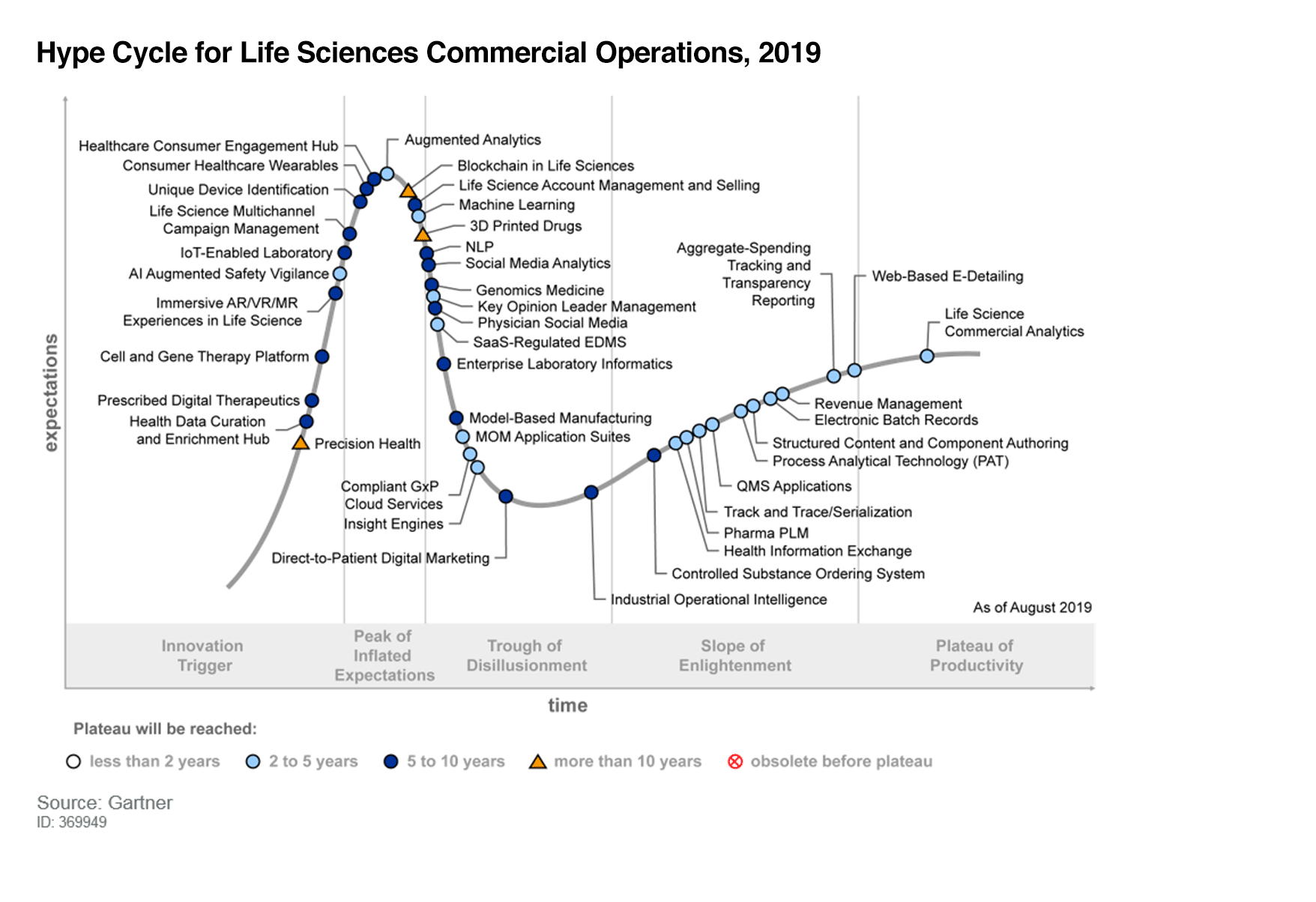
Hype Cycle Phases, Benefit Ratings and Maturity Levels
Table 1. Hype Cycle Phases
| Phase | Definition |
|---|---|
Innovation Trigger |
A breakthrough, public demonstration, product launch or other event generates significant press and industry interest. |
Peak of Inflated Expectations |
During this phase of overenthusiasm and unrealistic projections, a flurry of well-publicized activity by technology leaders results in some successes, but more failures, as the technology is pushed to its limits. The only enterprises making money are conference organizers and magazine publishers. |
Trough of Disillusionment |
Because the technology does not live up to its overinflated expectations, it rapidly becomes unfashionable. Media interest wanes, except for a few cautionary tales. |
Slope of Enlightenment |
Focused experimentation and solid hard work by an increasingly diverse range of organizations lead to a true understanding of the technology’s applicability, risks and benefits. Commercial off-the-shelf methodologies and tools ease the development process. |
Plateau of Productivity |
The real-world benefits of the technology are demonstrated and accepted. Tools and methodologies are increasingly stable as they enter their second and third generations. Growing numbers of organizations feel comfortable with the reduced level of risk; the rapid growth phase of adoption begins. Approximately 20% of the technology’s target audience has adopted or is adopting the technology as it enters this phase. |
Years to Mainstream Adoption |
The time required for the technology to reach the Plateau of Productivity. |
Source: Gartner (August 2020)
Table 2. Benefit Ratings
| Benefit Rating | Definition |
|---|---|
Transformational |
Enables new ways of doing business across industries that will result in major shifts in industry dynamics |
High |
Enables new ways of performing horizontal or vertical processes that will result in significantly increased revenue or cost savings for an enterprise |
Moderate |
Provides incremental improvements to established processes that will result in increased revenue or cost savings for an enterprise |
Low |
Slightly improves processes (for example, improved user experience) that will be difficult to translate into increased revenue or cost savings |
Source: Gartner (August 2020)
Table 3. Maturity Levels
| Maturity Level | Status | Products/Vendors |
|---|---|---|
Embryonic |
|
|
Emerging |
|
|
Adolescent |
|
|
Early mainstream |
|
|
Mature mainstream |
|
|
Legacy |
|
|
Obsolete |
|
|
Source: Gartner (August 2020)
Source: Gartner Research Note G00450345, A. Gandhi, M. Shanler, 06 August 2020
Evidence
Gartner interacts regularly with life science clients. Their observations, challenges and successes inform complementary insight and analysis. Additional evidence was obtained from vendors in this space, industry inquiries, previous Gartner research, public sources and direct experience.
Gartner’s annual survey of CIOs was conducted between 20 April and 26 June 2017. A total of 3,160 respondents participated, including 95 from the life science industry. The respondents were members of Gartner Executive Programs and other IT leaders. Qualified respondents were the most senior IT leader (CIO) for their overall organization or a part of their organization (for example, a business unit or region).
The survey was developed collaboratively by a team of Gartner analysts and was reviewed, tested and administered by Gartner’s Research Data and Analytics team. The survey is published in its entirety in “The 2018 CIO Agenda: Mastering the New Job of the CIO.”