CCOs face accelerating misinformation and disinformation, a rapid pace of change, and AI-induced transformation of their function and the broader workforce. Use Gartner’s five predictions to prepare to manage the disruptions and opportunities that Communications will face in the next four years.
- Gartner client? Log in for personalized search results.
Top Predictions to Inform 2026 Comms Strategies
Introduction
Prediction 1
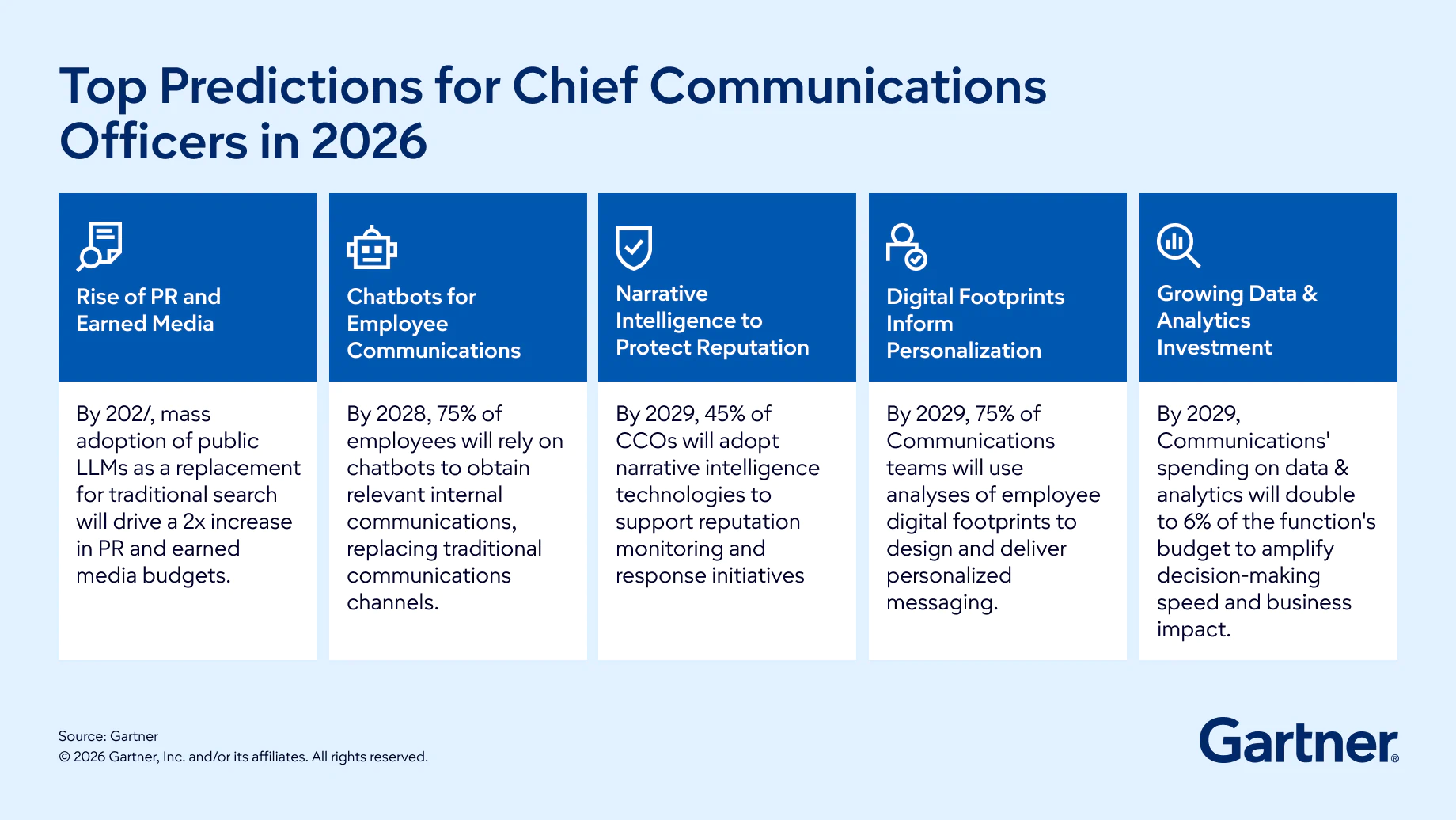
By 2027, mass adoption of public LLMs as a replacement for traditional search will drive a 2x increase in PR and earned media budgets.
Key Findings:
AI search engines favor citing earned, shared, and organic owned content over paid. According to a recent vendor study, more than 95% of links cited are nonpaid mentions and coverage, with 27% originating directly from earned media.
AI-powered chatbots ChatGPT (+608%) and Perplexity (+262%) experienced exponential year-over-year traffic increases between 1H24 and 1H25, while traditional search engines Google (-1%) and Bing (-1%) are trending slightly down, despite retaining the traffic advantage.
When looking across their entire Communications budget in late 2024, CCOs were already most likely to consider increases to PR and earned media budgets. The areas with the highest likelihood for budget increases in 2025 were public relations (36% of CCOs anticipating an increase), corporate brand (34%), public website (26%), and external social media (23%).
While traditional SEO efforts are best served by marketing, the growing demand for answer engine optimization (AEO) to build visibility and reputation requires Communications-specific skills to balance stakeholder trust and platform requirements.
Market Implications:
Gartner expects mass adoption of public LLMs as a replacement for traditional search due to audience receptivity and the growing comfort with and utility of tools like ChatGPT. To surface desired narrative and corporate brand positions in AI answer engines, those tools must have visibility into what they deem an authoritative source. Which third-party sources are cited by AI answers can vary by industry, but the makeup is typically high-domain news outlets, government and NGO content, encyclopedic content, and academic research.
Press releases tend to get the fewest number of citations. When AI searches specifically imply recency (e.g., What is XYZ corporation’s most recent stance on sustainability), almost half (49%) of citations are news. This reinforces the need for proactive earned media efforts that facilitate ongoing earned coverage of your desired narratives.
As organizations adapt to new audience search behaviors, PR and earned media budgets must increase to ensure optimal AI search visibility. Reallocating paid budgets to PR and earned media is likely a logical option for most organizations, but it will require investment trade-offs, as well as a clear perspective on measurement and the intended impact on audience behaviors.
Recommendations:
Audit the most commonly used AI answer engines among your target stakeholder groups. Benchmark the sources cited in answers to likely questions and queries, and how well your desired narrative comes through.
Use PR and earned media budgets to drive the coverage necessary for optimal answer engine visibility. Make the business case to cross-functional partners in marketing to reallocate at least some spending from paid media to owned and earned media to ensure visibility in the new search reality.
Commit to building a responsive and proactive earned media function that meets the recency demands of AI search engines. This is particularly key during times of crisis and issue management and organizational shifts like mergers or acquisitions. Invest in building and nurturing relationships with influential third-party sources to ensure optimal quality and quantity of narrative coverage.
Establish new measurement and benchmarking protocols for tracking the progress of increased earned media coverage on AEO. Include competitive and industry tracking to inform strategy and positioning efforts. Upskill and train the team on how AI search engines source and evaluate content.
Prediction 2
By 2028, 75% of employees will rely on chatbots to obtain relevant internal communications, replacing traditional communications channels.
Key Findings:
Employees are open to using AI, with 75% stating they already use AI tools at work and 55% saying they do so regularly. Additionally, managers are supportive of this: 85% of managers believe their team’s work could be meaningfully improved with AI.
The increasing volume of traditional communication channels exacerbates information overload. Employees who report high information overload are 52% less likely to report high intent to continue working at the organization and 30% less likely to report high strategic alignment. Employee chatbots offer an effective solution to the information overload and information burden challenge.
Company hierarchies are predicted to flatten as organizations that integrate AI into their core operations reimagine workflows to leverage AI’s capabilities. This will reduce the number of managers and require CCOs to prioritize employee channel strategies that incorporate AI.
Chatbot capabilities are evolving, integrating generative AI (GenAI), dynamic conversation management, and multiagent orchestration systems. As these capabilities mature, employees will increasingly rely on chatbots as their primary source for on-demand and relevant internal communications.
Market Implications:
With growing appetite for conversational AI and organizations flattening their hierarchies and reducing manager headcount, CCOs will seek out alternative channels to contextualize organizational and strategic information for employees. Namely, CCOs will rely less on traditional channels, such as newsletters, intranets, and even managers, who remain employees’ preferred channel for receiving information.6 Instead, chatbot innovations and capabilities will rise to meet this demand and transform how both push and pull communications are managed, alleviating information overload (especially during change).
Chatbots will improve information accessibility and provide personalized, relevant communications. For pull communications, employees will ask questions and get personalized, curated answers. For push communications, chatbots will send customized push alerts to specific employee segments. The embrace of chatbots means that CCOs should consider scaling down less-engaged channels (e.g., newsletters) in favor of dedicating their efforts toward the development and integration of conversational AI systems.
That said, CCOs can’t disregard the safeguards they will need to put in place to mitigate the risks of hallucinations, misinformation, and a fragmented information landscape that come with AI. CCOs will need a greater emphasis on information quality and hygiene, as well as on optimizing intranet content for AI searchability. CCOs must also partner with IT, HR, and legal to establish robust governance to ensure that chatbots’ responses are accurate.
CCOs will also be heavily involved in the change management efforts to help employees adjust to this shift away from managers and other legacy channels as their primary sources for information. This will require both assisting employees to adopt a mindset change and partnering with HR on targeted upskilling designed to build comfort with conversational AI-led communications. CCOs will need to measure employees’ strategic alignment and their rate of adoption and satisfaction with the chatbots.
Recommendations:
Revise the internal channel mix by prioritizing chatbots and retiring investments in traditional channels to manage information overload. Begin to shift the information cascade away from managers and prepare employees for a more self-service approach to internal communications.
Prioritize investments in conversational AI that integrate with modern intranets. Evaluate potential technology investments on their ability to enhance information accessibility, personalization, and engagement for employees as well as safeguard against potential AI risks.
Establish robust governance structures with IT, HR, and legal to monitor chatbot knowledge bases and their outputs for information accuracy, corporate narrative adherence, and broader ethical considerations. Create escalation protocols to ensure human intervention when necessary.
Partner with HR to plan a change management initiative that encourages employee adoption of chatbots, focusing on building skills that support the use of chatbots to retrieve and receive information. Measure success through employee adoption and satisfaction with chatbot-led internal communications.
Prediction 3
By 2029, 45% of CCOs will adopt narrative intelligence technologies to support reputation monitoring amid an intensifying disinformation landscape.
Key Findings:
For the second year in a row, misinformation and disinformation ranked as the top global risk over the next two years by the World Economic Forum.
The legacy listening and monitoring tools that CCOs rely on to monitor mentions, keywords, coverage, and conversations miss the early warning signs of damaging narratives. These narratives can emerge from both mainstream social media platforms and fringe areas of the internet.
AI serves as both an accelerator to disinformation, making sophisticated technology accessible to an increasingly wide range of bad actors, and a CCO’s best hope in detecting, quantifying, and combating its negative impacts.
CCOs forecast that their investments in technology will increase more than any other spend category in 2025. Some of this investment is expected to go toward narrative intelligence platforms in the next three years.
Yet, only 14% of Communications leaders intend to invest in narrative intelligence platforms in the next 12 to 18 months (by February 2027), signaling either a lack of awareness or a lack of appreciation of the value of this emerging technology.
Market Implications:
AI is fundamentally changing reputation management for CCOs. The onslaught of misinformation and disinformation, coupled with a steep decline in audience discernment and trust, requires new monitoring capabilities and response strategies. While traditional media monitoring will continue to play a role in the CCO’s commstech stack, it cannot sense, map, and predict the velocity of emerging narratives that threaten their organization’s reputation.
In today’s reality, where CCOs must serve as the stewards of truth for their organization, the capacity to identify adversaries’ intent and whether emerging narratives are originating from human stakeholders or synthetic forces (e.g., bots) is crucial. But simply adding a new narrative intelligence tool to your commstech stack will not mean that your organization is suddenly protected from narrative attacks. Adopting actual narrative intelligence, and not just the sensing technology, requires significant operational change.
Not only will CCOs need to unify new monitoring data with existing insights to provide a comprehensive view of narrative dynamics, they will also need to lead their teams and cross-functional partners through an evolution of their reputation management capabilities. For some, this may take the form of leaning on external agency partners or managed services from vendors. But many CCOs will conclude that enhanced reputation management should become a core competency of the Communications function. Regardless, CCOs must continue to build serious analytic muscle across their teams to synthesize and translate narrative data into actionable insights that executives can digest and take action on.
The timeline for sensing and responding to a narrative attack (or, most critically, for deciding not to react in some situations) is faster than ever. CCOs who recognize AI’s role as both their adversary and ally in the era of narrative attacks will build faster, more agile response strategies and a competitive edge over their peers who are left perpetually reacting to narratives they could have anticipated.
Recommendations:
Focus increased technology investments on a narrative intelligence tool and capabilities. Build a use-case story specific to your organization and its nuanced narrative intelligence needs. Assign a product champion to the new tool who can serve as the main liaison with the vendor, collect feedback from users, and share insights across the organization.
Conduct a comprehensive skills audit across the Communications function to inform training and skills-building needs that the team will need to draw on to respond to narrative attacks. Determine short- and long-term needs and whether they’ll be best served by agency partners, a vendor’s managed services, or a combination of both. Don’t forget that teams will need to be able to translate narrative intelligence outputs into actionable insights for executives.
Continuously track and assess how narrative intelligence enables the Communications team and the broader business to sense and respond to emerging narratives. Tie this capability to your Communications value proposition.
Regularly seek roadmap updates from each vendor with adjacent capabilities in your commstech stack, looking for potential vendor consolidation. Gartner anticipates increased M&A activity among vendors in related markets.
Strengthen organizational readiness by building an integrated response playbook that defines when to respond, when to stay silent, and how to coordinate cross-functionally during rapid narrative escalation.
Prediction 4
By 2029, 75% of Communications teams will use analyses of employee digital footprints to design and deliver personalized communications.
Key Findings:
Personalized messaging has the potential to cure information overload by removing inconsistency, duplication, irrelevance, and effort-intensiveness from communications. Alleviating information overload is key to improving employee engagement, performance, and retention.
Effective personalization requires a large amount of data, which is often a limiting factor when writing for external audiences. However, employee data is contained in a closed system, and CCOs may already have more data within their reach than they have previously utilized.
94% of employees use at least one digital channel as part of their jobs, and 89% do so at least once a week. These numbers are nearly as high for nonwired employees — 87% and 80%, respectively. Digital work leaves digital footprints that, if analyzed in context, can provide CCOs with valuable insight into when, where, about what, from whom, and how employees will engage best with corporate communications — on an individually personalized basis.
For frontline deskless or nonwired workers, while digital communications are typically limited to fewer total channels, non-communications-related digital footprint data like badge swipes or breakroom entry time can offer opportunities for individual personalization.
Market Implications:
At present, CCOs collect and measure data on employee information consumption (and associated behavior changes) variably, based on their team’s maturity in analyzing and interpreting data to take action on meaningful insights. Within the next few years, we expect CCOs to turn ambition into reality by upskilling their team’s data and analysis capabilities and investing in commstech partnerships with internal data warehouses in IT, HR, and other operations functions.
CCOs must understand what data is available to them, as well as whom they need to work with to access that data. Employee data infrastructure will continue to mature, as will the integration among (and ease of access to) data collection and analysis tools across the enterprise.
We are already seeing evidence of this growth in data and integration maturity among the following markets, which currently offer variable analytics related to content, channels, individual device access, building access, workforce segment, day/time/location, interaction details, trending analysis, and more:
Employee communications applications (ECA)
Intranet packaged solutions (IPS)
Workstyle analytics (WSA) tools
Collaborative work management (CWM) platforms
Digital employee experience (DEX) management tools
Taken together, these datasets offer an overwhelming opportunity to personalize communications by identifying what, when, from whom, where, and how individual employees are most likely to consume information effectively.
CCOs will need to establish processes to synthesize meaningful insights on content characteristics (e.g., topic, tone) and means of delivery (e.g., channel, format, time of day) that will resonate with different employee segments. They will also need to operationalize at scale to deliver personalized messaging.
Recommendations:
Identify the key stakeholders with whom you will need to collaborate closely to optimize digital footprint data and insights. This will include digital leaders in HR and IT, but may also require collaboration with digital ethics committees, union liaisons, and/or AI governance boards to ensure viability.
Build an understanding of the key touchpoints in your organization’s employee digital journey to include in the digital footprint. In addition to communications data, CCOs should also consider sources of data tracked by other business partners, e.g., badge swipes, room bookings, meeting attendance, etc.
Determine what analytical tools already exist within your organization (e.g., ECA/IPS, WSA, CWM, DEX). Working closely with business partners, assess whether your organization already has the proper data infrastructure in place to collect and analyze digital footprints, or whether you’re better prepared technologically for a “buy it” or “assemble it” approach.
Consider how GenAI tools can help you track digital footprints and tailor communications even before fully developing a one-to-one personalization capability. Consider use cases such as theme detection and categorization, topic modeling, scenario ideation, transcription of speech data, summarization, and root cause analysis.
Prediction 5
By 2029, Communications’ spending on data & analytics will double to 6% of the function’s budget to amplify decision-making speed and business impact.
Key Findings:
CCOs underinvest in measurement and monitoring capabilities, allocating just 2.9% of their budgets, well behind marketing, which commits 8%. The size of this gap underscores an urgent need for CCOs to increase investment in their data and analytics capabilities.
Nearly half (47%) of CCOs report difficulty in demonstrating the impact of their function, while 34% say their teams are still viewed as cost centers rather than value drivers. These figures highlight persistent challenges in articulating Communications’ contribution to enterprise performance and reinforce the urgency for robust, outcomes-focused measurement frameworks.
D&A now ranks among the top three technologies (excluding AI) that CEOs consider critical to enterprise growth, signaling a clear mandate for CCOs to prioritize advanced measurement to meet intensifying expectations for adaptability, speed, and actionable insight.11
Market Implications:
Elevating measurement and analytics in the Communications function will have far-reaching effects on strategy, talent, and technology. As CCOs significantly increase investment, the way that Communications develops and executes strategy will fundamentally evolve. CCOs must develop outcomes-focused measurement frameworks that go beyond tracking outputs to assess how Communications initiatives influence audience behaviors and business outcomes.
AI-driven measurement and analysis will quickly become a differentiator for forward-thinking CCOs. By moving beyond retrospective metrics to embrace real-time analytics and predictive insights, CCOs will anticipate and adapt to shifts in stakeholder behaviors, optimize campaign targeting and personalization, and significantly increase impact on business outcomes. These capabilities will also empower Communications teams to make iterative message and campaign improvements in response to data while also informing more effective future initiatives.
While AI will play a pivotal role in this transformation, the shift isn’t solely about technology. It requires parallel investment in talent through upskilling existing teams and introducing specialized roles, such as data specialists, to close the gap between data science and communications.
As data becomes more abundant and complex, the ability to distill insights into compelling narratives will become a core competency for Communications teams. Effective data storytelling will showcase the function’s value to executive stakeholders and support more strategic enterprise decision making.
As Communications functions adopt new technologies, CCOs will also face the challenge of measuring the impact of these investments. It will be critical to demonstrate how improved decision making for Communications as a function — and ultimately the business — supports the business’s ability to achieve its goals. For example, Communications could generate insights to increase customer, stakeholder, and employee advocacy, as well as measure the resulting incremental growth from those efforts.
Recommendations:
Engage key internal stakeholders, including the CFO and CEO, in dialogue about how enhanced Communications data and analytics capabilities can drive better business decisions. Articulate a clear vision for how advanced analytics will enable more targeted, agile campaigns and faster, data-driven responses to emerging risks and opportunities. To begin, benchmark current spend against other functions to highlight the gap and opportunity.
Proactively identify existing spend that can be redirected to analytics. Conduct an activity value audit to surface low-value or easily automated activities — such as translation, video production, editing, visual design, and manual media monitoring — that are strong candidates for GenAI-driven cost reduction.
Accelerate AI adoption to enable continuous improvement in Communications. Integrate AI-powered analytics to move from retrospective reporting to real-time, predictive insights — empowering teams to iterate within live campaigns, optimize targeting, and embed a culture of ongoing data-driven refinement.
Cultivate an agile, learning-oriented culture and upskill teams, particularly in analytics, visualization, and data storytelling. Introduce specialized roles, such as data specialists, to bridge analytics and communications, enabling teams to translate complex data into actionable insights that inform executive decision making and impact business performance.
Explore more
Ready for what’s next? We can help.
Access objective insights, exclusive peer networks and analyst guidance designed for leaders like you.