Determine which vendors have the strongest combination of disruptive capabilities and execution potential.
- Gartner client? Log in for personalized search results.
Navigate Emerging Technology Markets With Confidence
Gartner Emerging Market Quadrants give technology leaders and providers a clear framework for understanding fast-moving markets, evaluating vendors and making key decisions.
Use Emerging Market Quadrants to:


Evaluate vendors to partner with, acquire or invest in

Assess shortlists for near-term tech buying decisions

Compare established and startup ecosystems
Three critical decisions.
One trusted framework.
How Emerging Market Quadrants work
Each quadrant signals a distinct profile of capability and risk to help you match vendors to your organization’s decision criteria.
1. Market shapers
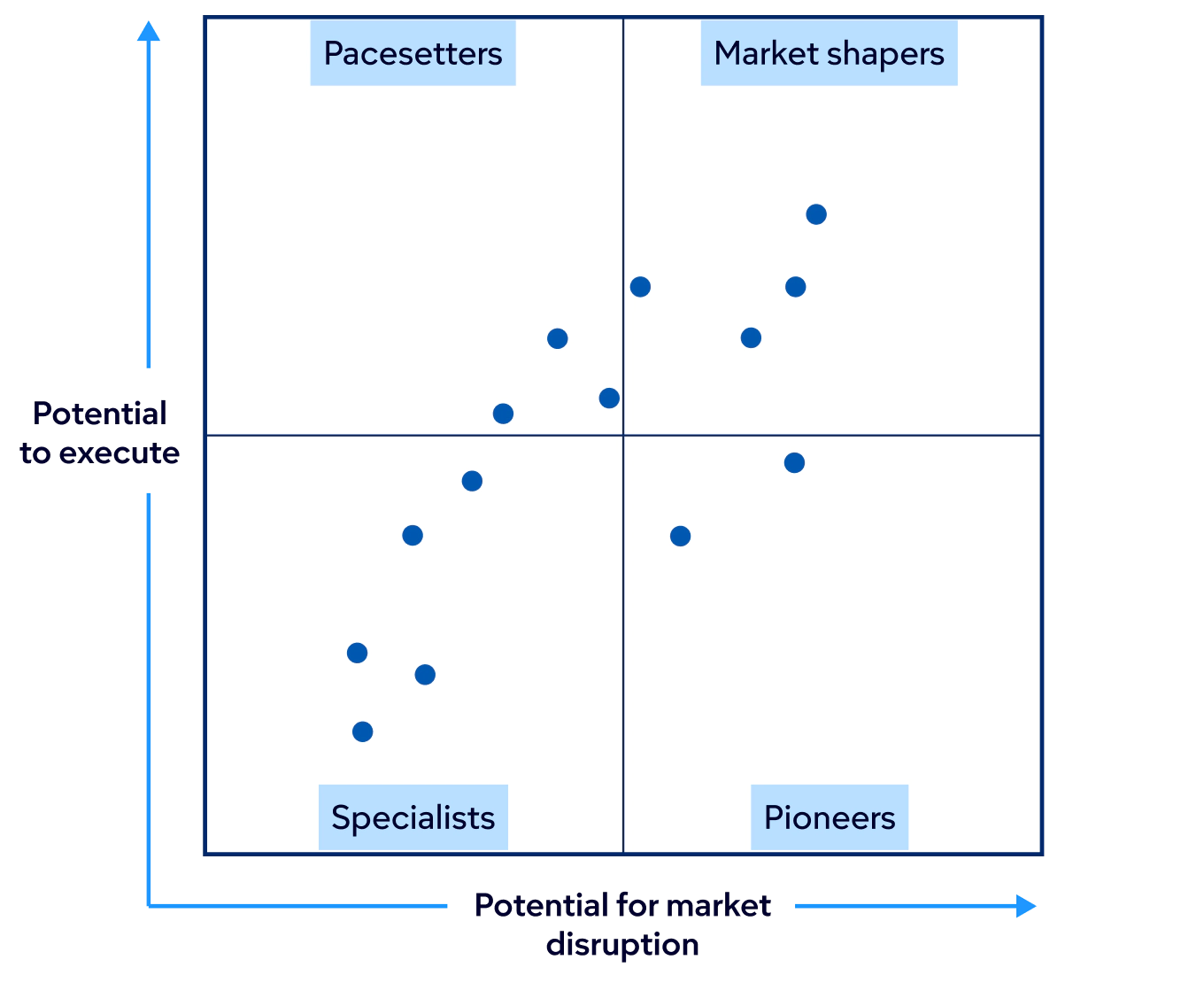
Market shapers are the companies most likely to drive substantial change — if not significant disruption — in an emerging market. They combine strong disruptive capabilities with the operational capacity to bring them to market effectively.
2. Pacesetters
Pacesetters are likely to drive incremental innovations. They bring steady, augmentative evolution to an emerging market.
3. Pioneers
Pioneers are pursuing substantial and potentially disruptive change in an emerging market but have yet to fully prove their go-to-market ability. Their offerings come at potentially lower cost but carry more risk.
4. Specialists
Specialists are generally smaller vendors driving incremental innovations in an emerging market. They are less proven, which may mean more risk, but also more flexibility and lower cost.
Emerging Market Quadrants FAQs
What is a Gartner Emerging Market Quadrant?
An Emerging Market Quadrant is a visual snapshot, analysis and set of insights that describe an emerging technology market, examine key trends and highlight key providers and their capabilities using a two-by-two matrix.
How is an Emerging Market Quadrant different from a Magic Quadrant?
Gartner Magic Quadrant™ reports evaluate vendors in established, mature markets where there is a clear market definition and significant vendor history. Gartner Emerging Market Quadrants are purpose-built for markets still taking shape — those with fewer providers, evolving definitions and rapidly changing competitive landscapes.
What are the four quadrant profiles vendors can be placed in?
Vendors are placed into one of four profiles: market shapers, pacesetters, pioneers or specialists, each reflecting a distinct combination of disruptive capability and execution potential.
What criteria does Gartner use to evaluate vendors?
Vendors are evaluated on up to eight weighted criteria across two categories:
Potential for Market Disruption: measures how likely a company’s innovation is to change the market. It could either improve existing technology in a limited way or completely replace current solutions across a wide range of applications.
Potential to Execute: factors that indicate the provider’s ability to effectively achieve their market disruption potential.
Why aren’t all vendors included in an Emerging Market Quadrant?
Gartner focuses on the most relevant providers based on criteria like value maturity, competitive advantages, financial resources and key partnerships. Exclusion doesn’t mean a vendor is not viable or competitive.
Does being a Gartner client influence a vendor’s inclusion or position?
No. Gartner maintains strict independence and objectivity. Vendor status as a Gartner client does not influence inclusion or placement.
Should I rely solely on an Emerging Market Quadrant for vendor selection?
No. Gartner recommends using Emerging Market Quadrants as a starting point alongside other resources, such as Critical Capabilities, Magic Quadrants, Peer Insights and discussions with analysts.
Does Gartner publish separate quadrants for established and startup vendors?
Yes. Because established and startup vendors have fundamentally different risk profiles and maturity levels, Gartner may publish separate Emerging Market Quadrants to provide a clear view of the full vendor landscape.
Evaluate vendors and markets with Gartner Magic Quadrant, Gartner Emerging Market Quadrant, Critical Capabilities and exclusive insights.