How Markets and Vendors Are Evaluated in Gartner Emerging Market Quadrants


Last Updated 28 September 2026

The purpose of an Emerging Market Quadrant is to help Gartner clients understand the dynamics of relatively new and fast-moving market capabilities and form shortlists of vendors to explore when making tech buying, partnering, acquisition and investment decisions.

Assessing an emerging market and its technology and service providers for effective provider relationship building is a business-critical task. Evolving provider capabilities, differentiation and marketing in fast-moving markets can make tracking market dynamics and comparisons of tech providers highly challenging.

Gartner’s Emerging Market Quadrants help clients address these challenges by offering visual snapshots, analyses and insights that describe an emerging market, examine key trends and highlight key tech providers and their relevant core capabilities.

Emerging Market Quadrants depict fast-evolving markets by using a two-dimensional matrix that evaluates providers based on their Potential for Market Disruption and their Potential to Execute. Eight weighted criteria are used to evaluate the vendors and place them in the relevant quadrant (see Figure 1). Placement is based on providers’ relative capabilities rather than an absolute scale.
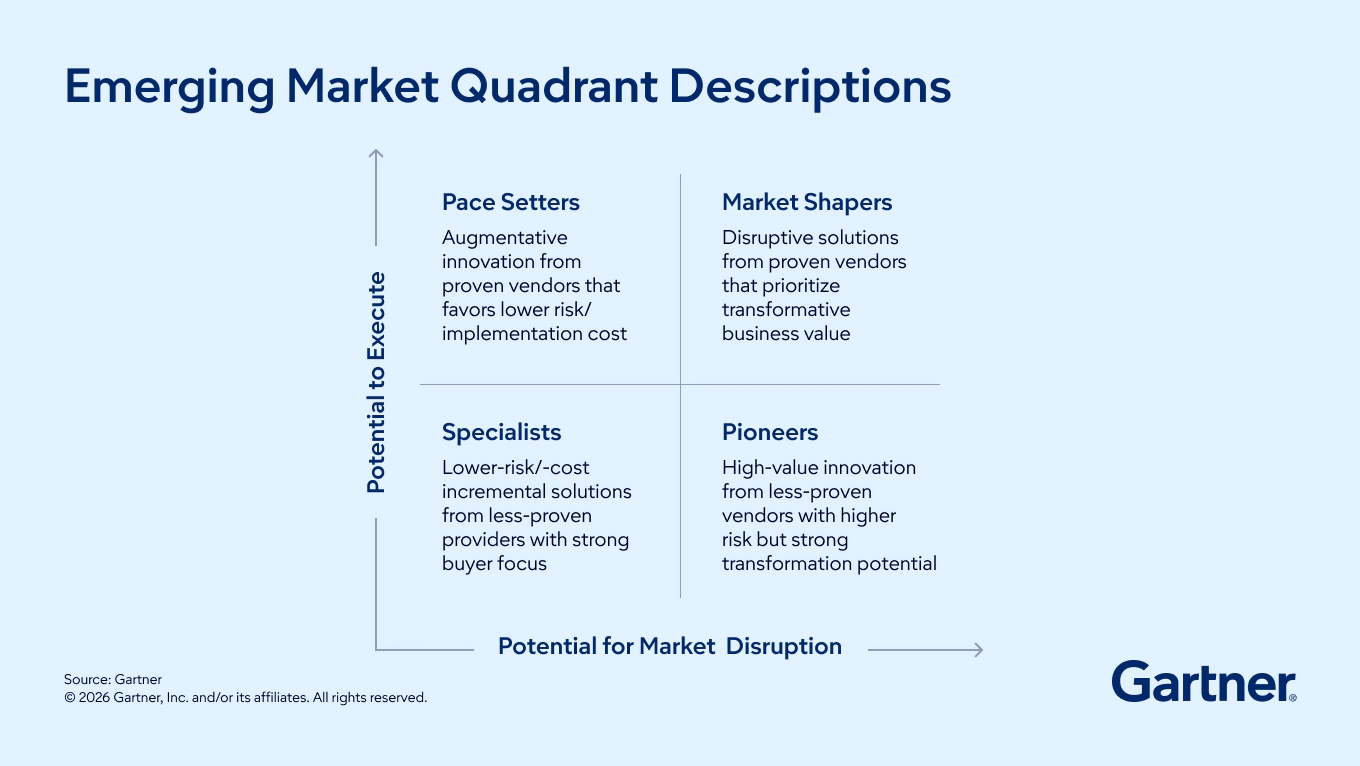
Emerging Market Quadrant Descriptions

Elements of Gartner’s Emerging Market Quadrant Analysis

Market Identification

An emerging market is a set of related emerging technology and/or service offerings that Gartner believes will either have a defining impact on an existing market or emerge as its own market (or both over time).​ A defining impact means the set of offerings could become key capabilities in a market and the basis for a buying decision.

To be considered an emerging market by Gartner, it must contain a set of vendors that are competing by taking similar offerings to the market. An emerging market is most often characterized as having a dynamic set of providers with offerings that are rapidly expanding and evolving. As such, Gartner identifies an emerging market as a meaningful set of technologies that providers assemble into a similar set of solution offerings for sale to a definable customer base.

Separate Emerging Market Quadrant Versions for Startup and Established Vendors

Our research indicates technology buyers and other senior leaders making tech provider relationship decisions most often examine established companies separately from startup companies due to their significantly different risk-reward characteristics. Therefore, depending on the nature of the emerging market being examined, Gartner may produce either an Established Vendor Emerging Market Quadrant version, a Startup Vendor Emerging Market Quadrant version or both.

Gartner defines an established vendor as a more mature entity that has moved past the “enter a market” phase and into the “grow in the market” phase. It is usually a more stable, revenue-generating entity that has solved the fundamental concerns of how to make money. It knows its customers, competitors and unit economics. An established vendor often has a more robust and mature set of proven products that already have significant adoption in a market.

A startup vendor is a less mature entity striving to enter and gain a foothold in a market. It is usually less stable, and even if it is revenue-generating, it often relies on raised capital to sustain operations. It is generally still working to determine a sustainable path to revenue and profitability. A startup vendor most often has a less mature, less robust set of products and is still working on identifying and building a core customer base to achieve significant adoption in a market.

Tech Provider Inclusion Selection

An Emerging Market Quadrant is not an exhaustive analysis of every tech provider in an emerging market, but rather a focused analysis of the providers Gartner believes are the most relevant for Gartner’s technology buyer clients. Relevance is determined by analyst expertise and opinion, influenced by a variety of factors. These factors may include installed base, product/service features, customer interest or other evidence of relevance.

As a foundational criterion for inclusion, a vendor needs to offer the key product and service capabilities identified in the market definition. All included vendors must be innovators in the emerging market, as determined by the authoring analysts. Gartner’s general approach is to include between 10 and 30 companies that best represent the innovation happening in the emerging market. Providers with notable offerings that do not meet the criteria for inclusion may be cited in the research but are not part of the comparative evaluation.

Tech Provider Evaluation

Provider evaluation assessments are performed by teams of expert analysts who collaborate to establish Gartner’s opinions. Analysts consider a variety of market data and information sources including, but not limited to, interactions with end users and providers, peer review, public data, Gartner proprietary data and analysts’ own exploration and knowledge of the market. Gartner may employ artificial intelligence to aggregate, summarize or otherwise process large amounts of market information and data to assist analysts in their evaluation. The analyst teams collaborate to explore, evaluate and rate each provider against the Emerging Market Quadrant weighted evaluation criteria. The final analysis and relative scores are used to establish key trends, describe the four quadrants and place included technology providers on the Emerging Market Quadrant graphic.

Evaluation Criteria

An Emerging Market Quadrant uses standard criteria within two axis categories: Potential for Market Disruption and Potential to Execute. All criteria apply to all vendors in all emerging markets covered by an Emerging Market Quadrant. Gartner may adjust criteria weightings based on relative importance to any specific emerging market.

  • Potential for Market Disruption reflects the possible impact of the provider’s innovation on existing capabilities presently adopted in technology markets. Disruption can range from incremental or augmentative improvement in a relatively small set of market segments to full functionality replacement in a myriad of market segments.
  • Potential to Execute includes an assessment of factors that indicate the provider’s ability to effectively achieve their market disruption potential.

Potential for Market Disruption

This category includes these standard criteria based on analyst opinion:

  • Value Maturity — The business return of tech adoption versus the difficulty and risk of implementation. This is the relative balance of business value return for implementation risk. The assessment exposes the proven adoption value (actual deployments) of a company’s specific offerings (versus the technology in general).​

  • Breadth of Market Impact — The relative potential of a provider’s tech offerings to broadly impact multiple market segments (e.g., industries, business functions, org size, geographies) at the present time and into the near future.​

  • Depth of Market Impact — How relatively deeply the provider’s tech offerings will disrupt existing tech and capabilities (e.g., incremental to replacement) at the present time and into the near future.

  • Competitive Advantage — The provider’s competitive advantage and relative potential to sustain a competitive advantage at the present time and into the near future.

Potential to Execute

This category includes these standard criteria based on analyst opinion:

  • Human Resources — The relative strength of the provider leadership and workforce to deliver on the promise of the emerging tech at the present time and into the near future.

  • Financial Resources — Whether the provider has the financial ability to successfully take the emerging tech to market. This can include investment capital raised and cash being generated by the business to invest into product development and business scaling at the present time and into the near future.

  • Key Partnerships — The relative strength of the provider’s engagement and productivity with partners that are most critical to the success of the emerging market. The assessment will measure the volume and type of partners and the quality and productivity of the relationships at the present time and into the near future.

  • Ecosystem Affinity — The affinity of a provider’s solution with the broader ecosystem characteristics, including geopolitical, social, physical infrastructure and business environment systemic risk.

The Four Quadrants Explained

Each vendor is positioned in one of the four quadrants — Market Shapers, Pace Setters, Pioneers and Specialists.

Market Shapers

Market Shapers are, in general, the companies that are most likely to succeed at driving substantial change, if not significant disruption, in an emerging market. They have a strong combination of disruptive capabilities and the potential to effectively bring them to market. They are characterized as more proven solution providers making them less risky but also potentially more expensive. They often offer solutions that favor more transformative business value over lower implementation costs and risks.​ Clients should explore the providers in this quadrant when looking for a more proven market competitor with a disruptive solution that is significantly different from existing capabilities generally available in the market.

Pace Setters

Pace Setters are, in general, the companies that are more likely to succeed at driving incremental innovations in an emerging market. With a high potential to execute, they are likely to bring steady augmentative evolution to an emerging market. They are characterized as more proven solution providers making them less risky but also potentially more expensive. They often offer solutions that favor evolutionary change with lower implementation costs and risks over more transformative business value and higher risks.​ Clients should explore providers in this quadrant when looking for a more proven competitor with a solution that augments their current technologies and ways of working.

Pioneers

Pioneers are, relatively, less proven companies that are pursuing substantial change, if not significant disruption, in an emerging market. They have disruptive capabilities but a lower potential to effectively bring them to market. They are characterized as less proven solution providers that are more risky but also potentially less expensive. They most often offer solutions that favor more transformative business value over lower implementation costs and risks.​ Clients should explore providers in this quadrant when looking for a relatively smaller competitor in the emerging market who offers a disruptive solution that is significantly different from existing capabilities generally available in the market.

Specialists

Specialists are, in general, smaller competitors that are driving incremental innovations in an emerging market. They are characterized as less proven solution providers that may be more risky but also potentially less expensive. They often offer more flexible solutions that favor evolutionary change with lower implementation costs and risks over more transformative business value and higher risks.​ Clients should explore providers in this quadrant when looking for a relatively less established market competitor with a less risky solution that complements their current technologies and ways of working.

Market Research Sources

Gartner research used in the Emerging Market Quadrant analysis can include, but is not limited to:

  • Gartner proprietary information such as Gartner client interactions and document reviews, client surveys, vendor customer reviews, vendor briefings, vendor interviews, product demonstrations, conference attendance reports, market surveys, published research and analysis of provider information submissions.

  • Gartner proprietary activities such analyst collaborative sessions, research meetings and peer review.

  • Public sources such as the U.S. Securities and Exchange Commission filings, patent submissions, tech investment data, merger and acquisition data, provider documentation, webpages and articles, speeches and published papers.

Research Publication

The Emerging Market Quadrant is published as static HTML content, which may be downloaded as a PDF. The research describes the state of capabilities in the emerging market, explores top market trends and depicts the key emerging market vendors and their relative positions within the quadrants. Prior to publishing, the research undergoes rigorous internal review and validation as well as a review by those providers included in the research.

Emerging markets tend to evolve rapidly. Therefore, Emerging Market Quadrants are designed for frequent updates. Gartner will update the Emerging Market Quadrant as needed whenever changes have a material impact on the market or the key providers within it. At a minimum, Gartner will review Emerging Market Quadrants quarterly to assess if an update is needed.

How to Use an Emerging Market Quadrant

Clients should use an Emerging Market Quadrant to understand the emerging market and the technology providers that are defining and driving the market. Clients can also use this research to identify technology providers of interest for further exploration. Although technology vendors are evaluated separately, they are not profiled separately in an Emerging Market Quadrant. Instead, the quadrants are profiled and vendors that exemplify the quadrant profile are placed within it.

Different quadrant profiles can appeal to different interested companies based on their technology needs. For example, companies that are interested in buying from, partnering with, acquiring or investing in early-stage, highly innovative companies can look to the Pioneers quadrant, recognizing that working with those providers and their technologies can be higher risk but may deliver higher value for that risk. Conversely, companies looking to form a relationship with a vendor that is more mature with technologies that are innovative, but more augmentative than disruptive, might choose to look into technology providers in the Pace Setters quadrant. Pace Setters can offer more incremental value at a lower risk level.

Although an Emerging Market Quadrant provides valuable information on the capabilities and providers in an emerging market, Gartner does not recommend that any reader make a purchasing decision, or engage in any significant relationship, with an included provider based on Emerging Market Quadrant research alone. Tech provider purchasing and relationship decisions are complex and require a thorough evaluation beyond the information provided in an Emerging Market Quadrant evaluation.

Frequently Asked Questions

For Tech Adopters

The Emerging Market Quadrant and Magic Quadrant both provide a graphical competitive positioning of four types of technology vendors.

Emerging Market Quadrants are a Gartner pilot and focus on what prospective buyers need to know about vendors in fast-moving, emerging markets. They are based on the analysts’ evaluation informed by fact-based data.

Magic Quadrants focus on markets where growth is high and vendor differentiation is distinct. They offer in-depth analyses and actionable advice that provide insight into a market’s direction, maturity and participants.

Market maturity is the most important factor in determining the type of research Gartner will publish. By the very nature of these markets, determining the growth and maturity of a market is not an exact science. The key characteristics of the market outlined earlier in this document are all considered, and the decision is made using that information. As a guiding principle, an emerging market evolves more rapidly and requires more frequent updates.

An Emerging Market Quadrant analyzes a market and can help you focus your search on important criteria. However, clients should use this content in conjunction with additional research, as it will not provide the details needed (during the selection process) to directly align your requirements with a particular provider. Gartner provides an extensive range of complementary research that can assist you further in your provider selection process. Discussions with Gartner analysts can also help during the provider selection phase.

No. Sales contracts, vendor requests and client engagements do not influence or drive inclusion in Emerging Market Quadrant research. More information on Gartner’s stance as an independent and objective research firm is available at Gartner’s Office of the Ombuds and the Ombuds FAQ page on gartner.com.

It means it did not meet the inclusion criteria as defined by the analysts for that Emerging Market Quadrant. It does not imply the provider is not viable or competitive. It might indicate the provider’s strategy or capabilities differ from the inclusion criteria or that it addresses a different target market. Provider inclusion is an analyst decision based on their opinion on the relevance of the provider to our clients, evidenced by the provider’s capabilities aligning with the market definition that includes the identified mandatory features. Gartner publishes the market definition with the Emerging Market Quadrant to help clients understand the boundaries of a market.

Yes. Gartner expects the markets covered by Emerging Market Quadrants for Established and Startup Vendors will evolve and mature to the point where they will require coverage in Magic Quadrants. But note that this is dependent on the way in which the market evolves. For example, emerging markets may integrate with or displace incumbent markets covered in Magic Quadrants, or emerging markets may fail or be displaced by other emerging markets.

The Voice of the Customer represents crowdsourced end users’ views derived from Gartner Peer Insights reviews about the products or services they are using in each market. The Voice of the Customer document provides an aggregated view of those reviews published on Gartner Peer Insights and calculated using the Gartner Voice of the Customer methodology.

Emerging Market Quadrants for Established and Startup Vendors are focused on what prospective buyers need to know about providers within emerging, fast-moving technology and services markets. They provide a visual snapshot based on analysts’ evaluation backed by a scoring framework and fact base of proprietary and public data. This may or may not include Gartner Peer Insights, depending on the data available on that platform at the time of the research effort.

Yes. The authors of an Emerging Market Quadrant report have access to all the reviews for a vendor product/service across the markets listed on Gartner Peer Insights. This means Gartner Peer Insights reviews for markets related to the emerging market analyzed can be one of the many sources of information that analysts might use to inform their evaluation. All Gartner Peer Insights reviews are informative and only one source among many other sources analysts may consider in evaluative insights.

For Tech Providers

When confirmed, publishing plans for new Emerging Market Quadrants will be posted to Gartner.com along with the rolling 12-month Magic Quadrant publishing schedule. This schedule will show estimated publish dates (which are subject to change). Gartner will not communicate refresh dates for an Emerging Market Quadrant following its initial publication.

Once a new Emerging Market Quadrant project is confirmed and scheduled, a Gartner Emerging Market Quadrant project manager will send a Welcome Packet email to candidate vendors. The Welcome Packet will invite the vendor to participate and explain the Emerging Market Quadrant vendor participation process and timeline. The Welcome Packet is emailed to vendors that the Gartner authoring analysts consider important to our technology adopter clients who are exploring the covered market. Analysts determine market relevance by assessing the vendors' products and services fit against the capabilities and features Gartner uses to define the emerging market.

Note that vendor participation is voluntary and that vendor inclusion in a Gartner Emerging Market Quadrant is independent of whether or not a vendor decides to participate.

Yes. Vendors are encouraged to share their business and solution updates by submitting responses to a Gartner questionnaire and by requesting a Vendor Briefing. Note that participation in the questionnaire is optional and is independent from the inclusion of a vendor in the published research.

Once a new Emerging Market Quadrant is published, it becomes always on and is subject to frequent unscheduled updates to keep pace with changes in the emerging market. And so, vendors are encouraged to update their responses whenever they have new information to share with Gartner. Gartner analysts will use all data sources available to them (both public and proprietary) to inform their update evaluation.

The questionnaire is “always open” until Gartner retires the Emerging Market Quadrant or evolves the coverage to a different format, such as a Magic Quadrant. The Emerging Market Quadrant request for information (RFI) contains 9 open-ended questions. Responses can include both quantitative and qualitative information. The RFI questions are the same across all Gartner Emerging Market Quadrant publications. Vendors will not be penalized if they do not answer all the questions.

Gartner is dedicated to the rights of your privacy and data security. Vendors’ responses may be used by Gartner for future insights purposes and in the ordinary course of its business, including in published reports, client inquiries and presentations. The information that vendors share when responding to the Gartner Emerging Market Quadrant questionnaire must be public data and will be treated as such. Please refer to Gartner Privacy Policy for more information.

The offering or set of offerings needs to include the mandatory features identified in the market definition. The threshold for featuring in an Emerging Market Quadrant may evolve over time as the market definition evolves.

Analysts will continually review the emerging market and will update the document when they identify material changes in the market. Gartner will use all data sources available to them (both public and proprietary) to inform the analysts’ evaluation.