No-code agent builders are putting the power of AI agents in everyone’s hands.
- Gartner client? Log in for personalized search results.
Mapping the Emerging Market Landscape of
No-Code Agent Builders
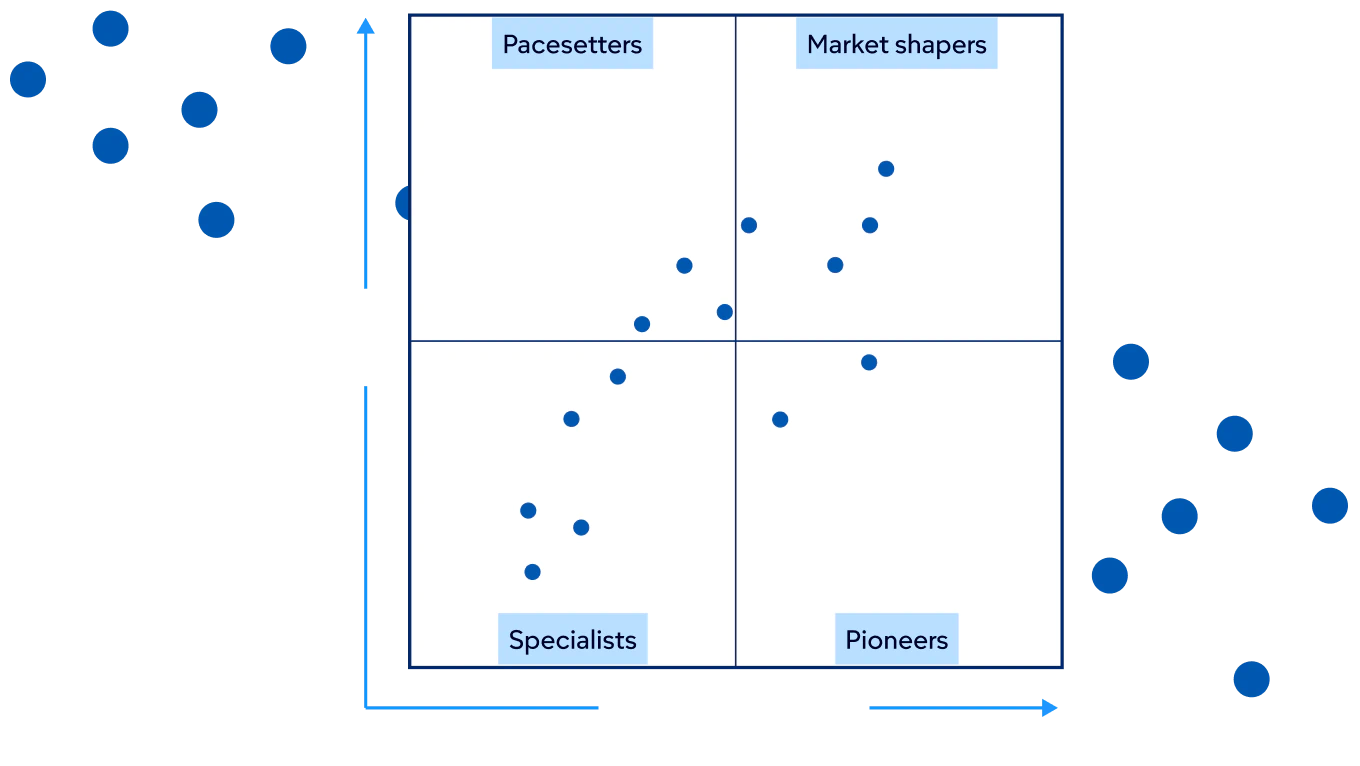
The pressure to scale AI agents is changing the “who” and “how” of building them
No-code agent builders (NCABs) are empowering business teams to create and deploy AI agents without deep technical skills. As enterprises race to automate and agentify workflows, established vendors are offering NCAB tools as add-ons to their platforms.
According to the 2026 Gartner CIO and Technology Executive Survey, 42% of enterprises expect to deploy AI agents in 2026, up from just 17% who report deploying agents in 2025. The Gartner Emerging Market Quadrant (EMQ) for No-Code Agent Builders helps organizations identify leading vendors and strategies in this fast-moving space.
Enterprise megavendors are setting the pace with AI agent moats
Today, Gartner sees enterprise giants as being the pacesetters in this emerging market. These vendors are leveraging their platforms and customer bases to shape the future of no-code agent builders. Vendors in this quadrant are uniquely positioned to drive widespread enterprise adoption, thanks to their deep integrations, established trust and influence across business functions.
Powering advanced use cases through integrated workflows
These vendors have a strong presence in enterprise IT, with applications widely adopted by business users acting as citizen developers. Their NCAB offerings are tightly integrated with their own data services, making them powerful but sometimes less flexible. By combining AI agents with deterministic workflows, pacesetters enable more complex, role-specific use cases that go beyond basic productivity.
Tailoring AI agents to where efficient work is most needed
Pacesetter NCABs focus on streamlining existing business applications and departmental workflows. Their tools are designed to optimize processes in customer service, IT, HR, finance, supply chain and business operations. Rather than targeting general productivity, these platforms help organizations tailor AI agents for specific roles and tasks, driving efficiency where it matters most.
Adoption made easy — at a cost
Many pacesetters already offer low-code and no-code tools, making NCABs a natural extension of their platforms. Their native integrations with business data and established citizen development activities make adoption straightforward for existing customers. However, buyers should be aware of potential obstacles — costly licensing, new services and required upgrades can add complexity to the decision. Still, their experience, resources and partner ecosystems position pacesetters high on the Gartner “potential to execute” scale, as they work to defend and expand their platforms in the age of AI agents.
Startups are also pioneering the NCAB market
The demand for AI agents from the business has incentivized new NCAB startups to enter the market and early-stage companies to pivot toward delivering an NCAB offering. These startups are competing directly with larger, more established enterprise software vendors.
GenAI-native vendors are converging on NCAB capabilities
These pioneer vendors were founded just a few years ago when GenAI started getting attention. They recognized the power of GenAI and applied it in different ways, from development tools to machine learning to governance. Now, they’ve started to converge around their NCAB capabilities, aiming to build and support model-agnostic multiagent systems. Their products have gained traction across a broad set of business domains, industries and geographies.
Enabling diverse front- and back-office use cases
The types of agents built on these NCAB tools vary. Some vendors target front-office processes, such as go to market and sales acceleration, while others focus on back-office operations, such as legal discovery, regulatory compliance and fraud orchestration. Regardless of focus, the vendors have demonstrated business value for customers who are deploying multiagent systems. Their NCABs enable customers to extract, process and reason over massive volumes of unstructured data that previously would have required manual work.
Early-stage vendors face scale, differentiation and funding challenges
These vendors are in the early stages of growth and have secured venture capital to fund their strategy. However, their revenue streams are small. They either have limited partnerships to help them scale sales, or they rely on product-led growth strategies. To succeed, they will need to demonstrate strong differentiation in their NCAB capabilities, such as AI agent orchestration and governance, and engage with more strategic partners. They will also need to raise additional capital to fund growth.
*These tech vendor assessments are performed by teams of analyst analysts who collaborate to establish Gartner’s opinions. Analysts consider a variety of market data and information sources including, but not limited to, analyst consultations with end users and providers, Gartner end user product reviews, Gartner proprietary data, public data, and analysts’ own exploration and knowledge of the market.
Evaluate major tech vendors and markets with tools like Gartner Magic Quadrant™ and Critical Capabilities — and exclusive insights.