Move beyond basic automation to seamless, self-optimizing marketing ecosystems.
- Gartner client? Log in for personalized search results.
What Shapes the Market for AI Agents for Marketing
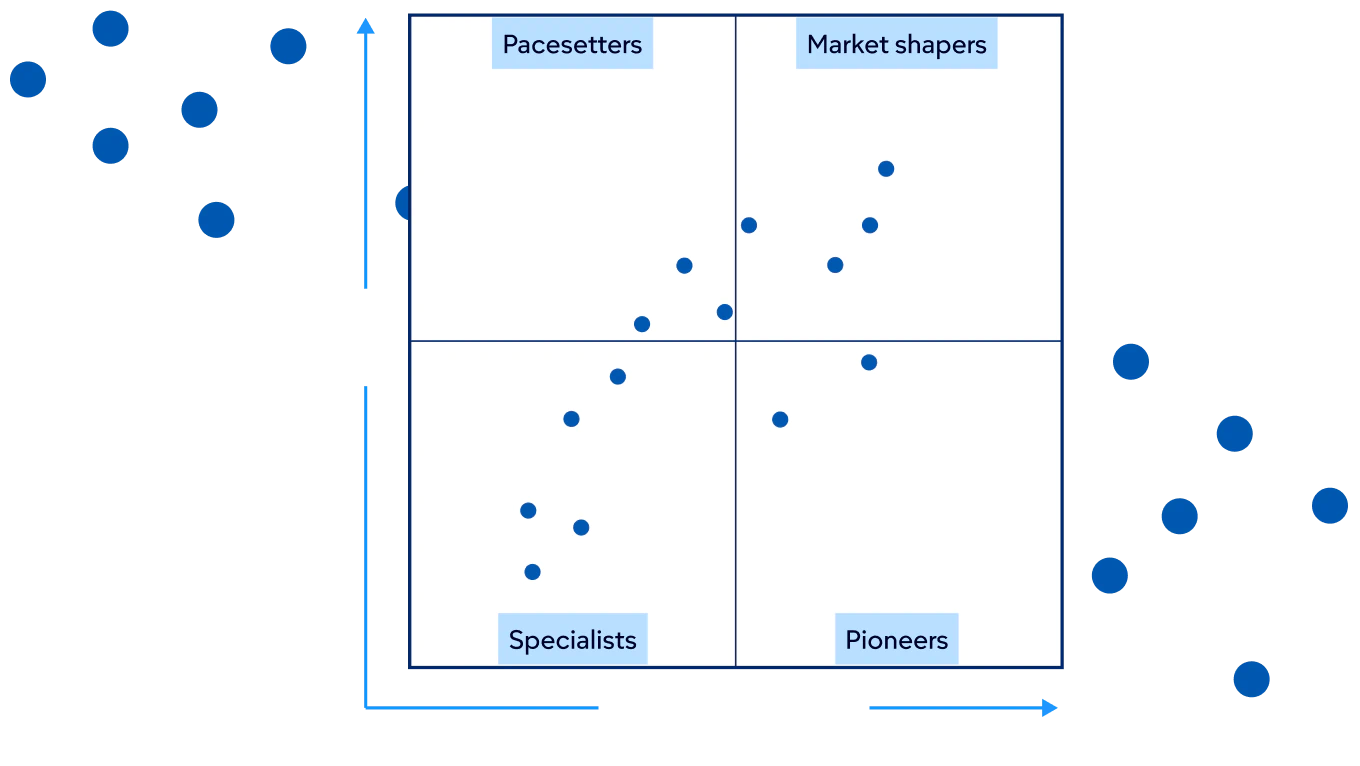
Leading vendors are simplifying AI agent integration to boost marketing impact
Vendors are raising the bar on precision and scale as they develop AI agent platforms to tackle complex workflows and exceed customer expectations. The Gartner Emerging Market Quadrant (EMQ) helps organizations identify leading vendors and strategies in this fast-moving space. While the market features a range of players from established giants to innovative specialists, the market shapers quadrant stands out for its disruptive potential and enterprise-scale execution.
Market shapers set the pace for autonomous marketing ecosystems
Today, Gartner sees the vendors who are building the most disruptive solutions in the field as being the market shapers, shifting from legacy technology to a fabric of AI agents. These vendors operate at the intersection of enterprise scale, deep integration and advanced AI agency.
Deliver seamless, self-optimizing marketing
Vendors in this quadrant orchestrate specialized agents across unified data fabrics, automating complex analysis and decision making. Their platforms enable multistep marketing strategies, integrating agents across multiple vendor environments, not just within closed systems. This approach accelerates revenue growth with minimal human intervention.
Market shapers provide proven, domain-specific AI agents that coordinate across entire ecosystems. They overcome the limitations of fragmented, single-task AI by enabling autonomous execution of sophisticated workflows. Agents divide labor, plan long-horizon campaigns and execute cohesive strategies at scale.
Intelligent interactions and adaptive planning drive results
Market shapers use AI agents for intelligent interactions, adaptive planning and robust interoperability. Agents ensure reliable data exchange across diverse systems, leveraging real-time engagement data and deep connectivity to enterprise platforms. This enables the autonomous execution of campaigns, two-way conversations and seamless updates within the marketing stack.
Marketers can autonomously adapt messaging and connect workflows across third-party applications, turning static funnels into hyperpersonalized, goal-driven journeys. The result: shorter sales cycles and higher conversions.
Market shapers are positioned for enterprise transformation
Vendors in the market shapers quadrant are primed to capture market share with strong partnerships, deep financial resources and established customer bases. Their leadership teams bring industry expertise in both technology and marketing, supporting complex transformations at scale.
These platforms enable AI agents to move beyond execution support, coordinating decisions across marketing, sales and analytics. Market shapers are legacy leaders adopting agent-centric strategies, delivering enterprise transformation value and signaling the future of marketing. However, adoption rates may vary due to client readiness and lack of proven industry-specific execution.
Recommendations for engaging with market shapers
Enter with a clear agentic strategy. Don’t rely on the vendor to define your direction.
Pressure-test each vendor’s interoperability and require proof of integration beyond their native platforms.
Ask for live, production examples of autonomous execution, and clarify how human oversight is structured as agent autonomy increases.
*These tech vendor assessments are performed by teams of analyst analysts who collaborate to establish Gartner’s opinions. Analysts consider a variety of market data and information sources including, but not limited to, analyst consultations with end users and providers, Gartner end user product reviews, Gartner proprietary data, public data, and analysts’ own exploration and knowledge of the market.
Evaluate major tech vendors and markets with tools like Gartner Magic Quadrant™ and Critical Capabilities — and exclusive insights.