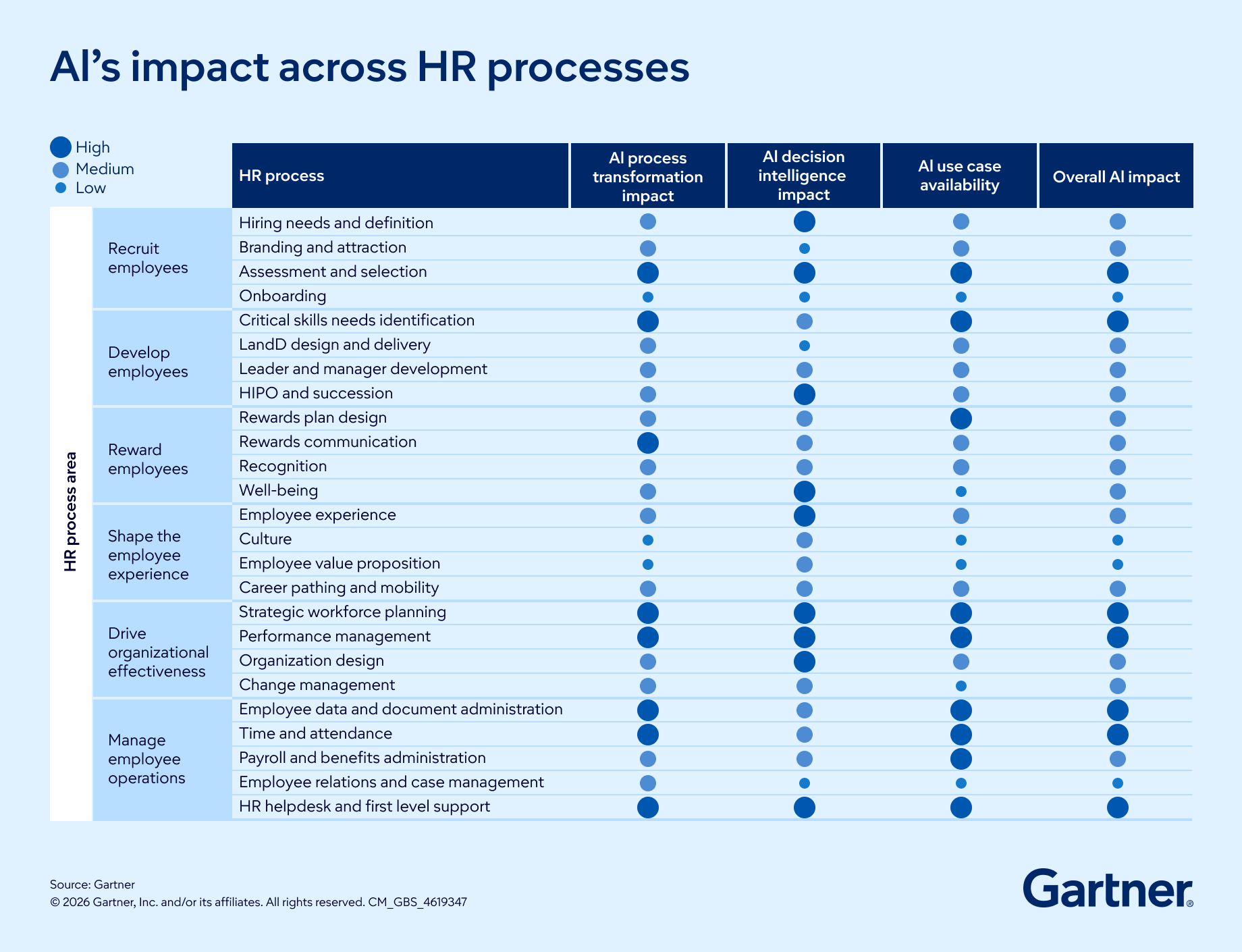
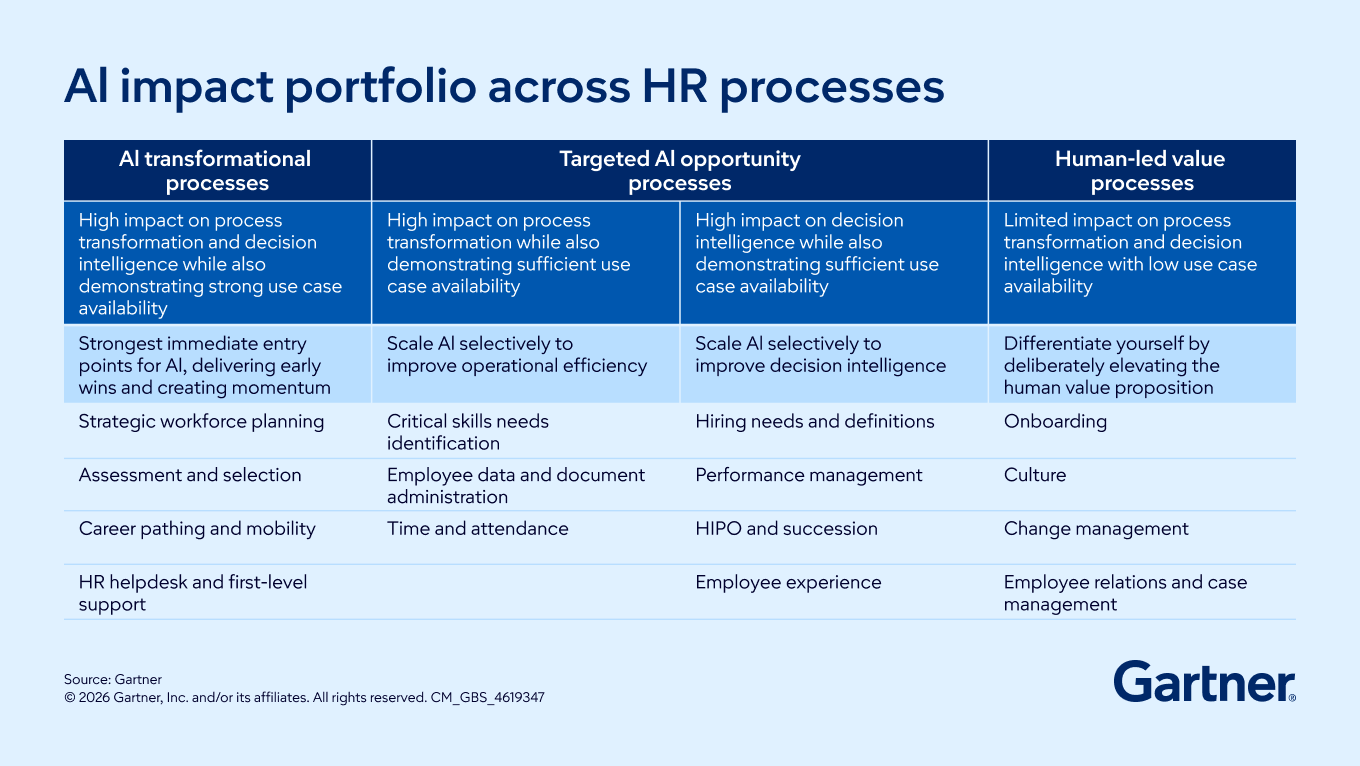
AI offers a significant opportunity to accelerate process efficiency and elevate decision intelligence. Yet, without a clear understanding of where and how AI reshapes HR processes, these investments risk underdelivering on their strategic promises as workflow, role and capability definitions remain abstract and AI investments become less targeted.
Seventy-two percent of HR leaders already recognize that reinventing HR workflows is essential to unlock AI-driven productivity. Yet, many lack the clarity into where AI creates meaningful impact across the HR process landscape. This limits their ability to decide which workflows require redesign, which roles need to evolve, and how HR service delivery will shift to ultimately build the strategy needed for an AI-informed HR transformation.
To get up-to-speed, CHROs need to understand the following dynamics:
- AI has the potential to reshape every HR process, but not in the same way.
AI does not create a uniform shift across HR. Instead the degree and nature of its impact differ by process, driven by varying potential to transform workflows, enhance decision intelligence and deploy mature, scalable AI use cases. While AI accelerates efficiency and decision intelligence in many HR processes, others remain less exposed and continue to rely heavily on human-led value.
Recognizing these differences distinguishes high-performing HR functions and is critical for prioritizing AI investment decisions.
- AI’s impact on processes provides a critical foundation for shaping HR’s transformation path.
Understanding which processes can benefit the most from AI, determines how HR’s service delivery must evolve, which workflows require redesign, which roles are most likely to change, and where targeted capability shifts are needed.
Leveraging process-level insights is essential for grounding AI-informed HR transformation decisions.