AI is ushering in a new era for marketing, one filled with both immense potential and risk. The foundations CMOs once relied on are eroding fast, from how teams operate to how brands earn trust and drive growth. In 2026, CMOs face a pivotal choice: Bolt AI onto legacy systems and risk irrelevance, or embrace the opportunity to build what comes next for an AI-driven world.

Use these findings to inform your strategic planning and lead with confidence in 2026.

Top priorities for CMOs in 2026

1
Lead the shift to hybrid, human-agent teams to find new sources of AI value.
2
Adopt a zero-based approach to channel strategy.
3
Start leading through strategic insight.

PRIORITY 1

Lead the shift to hybrid, human-agent teams

CMOs who simply bolt AI onto legacy systems and processes will fail to drive growth. Those who use AI to reshape the business will lead. 

To stay competitive, CMOs must lead the shift toward AI-native business models — where agentic systems, composable technology and hybrid human-agent teams fundamentally redefine the ways in which marketing creates value.

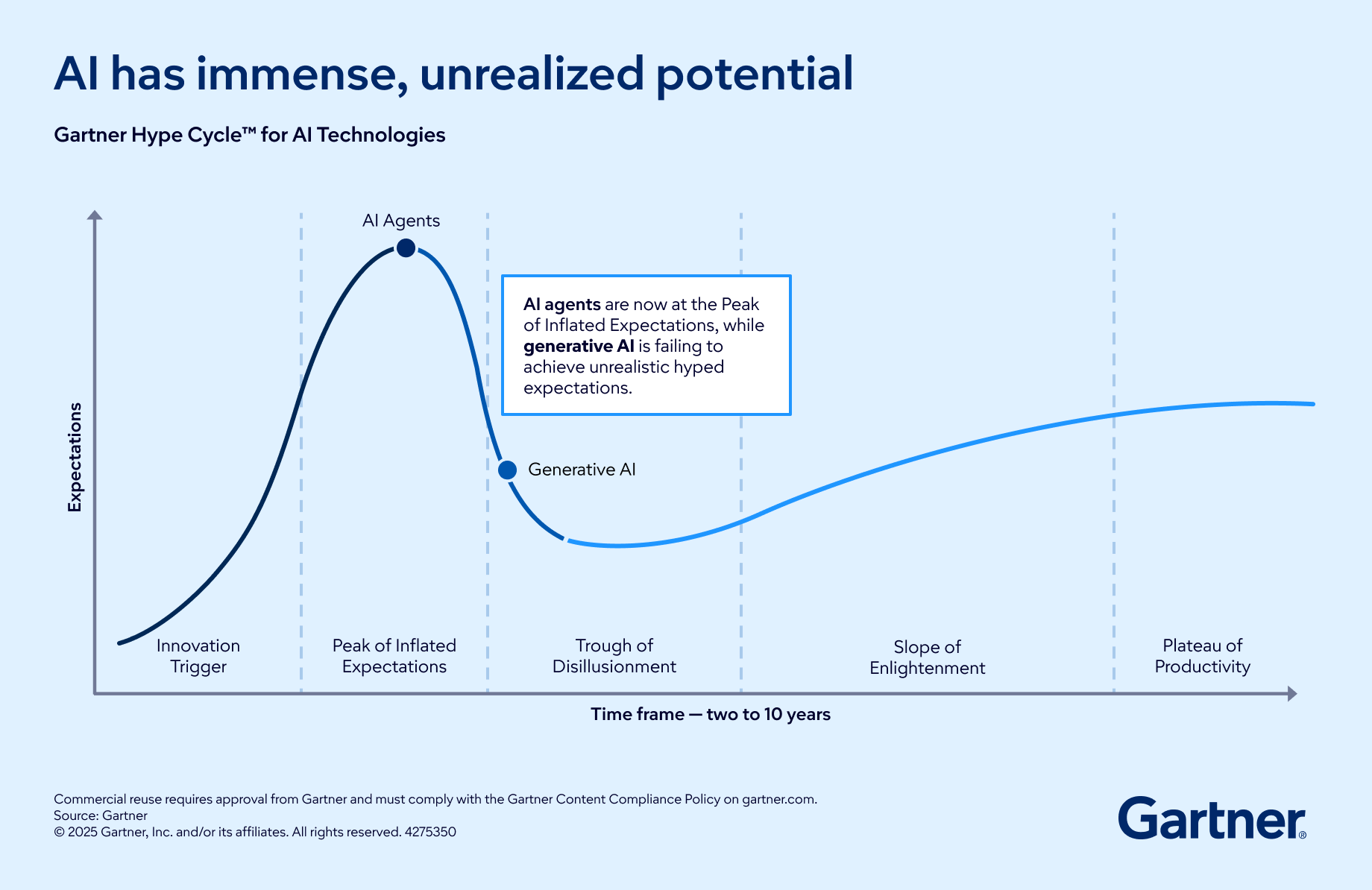
In June 2025, expectations of AI agents were at an inflated peak, while generative AI (GenAI) was failing to deliver on unrealistic, overhyped expectations. This progression is characteristic of technology adoption and points to future challenges around AI agents. Gartner expects GenAI to remain in the Trough of Disillusionment throughout 2026.

What is it that marketers expect of AI, but aren’t getting? 

To start, marketers want to use AI as a tool to create cost and time savings, engage customers and drive revenue. At the next level, marketers want to deploy AI agents to make semiautonomous decisions that rapidly scale value creation. The highest level of value comes from AI as a strategic influencer that enables machine-managed decision making and unlocks new business models. Each of these value levels not only demands transformation within the marketing organization, but requires CMOs to cede control of operational decisions and audiences. 

Unfortunately, this progression isn’t going smoothly. For marketers using GenAI as a tool (those who are early in their journey), only 5% are getting the results they need. Even marketers adopting AI agents at a more mature level still struggle to achieve the results they need. The problem is AI initiatives are starting from a shaky foundation. They seek to integrate AI into ill-defined strategies, with misaligned vendors and use cases, or poorly understood processes.

Before setting agents to work, CMOs must prioritize strategic direction, process mapping and talent implications.

Recommended CMO actions

  • Reimagine processes equipped with AI: All successful transformations start from a clear strategy. Start with the outcome you want to achieve, such as multichannel personalization, and break it down into component pillars. The pillars themselves may not have changed, but AI creates new opportunities and different requirements for marketing technology, talent and process. Armed with the right application of AI capabilities, growth is even more attainable.

  • Map how AI fits into workflows: With your strategic framework in place, map new AI-first processes. Focus on areas where humans and AI must make decisions together, including oversight risks and pain points. You may find process mining approaches and tools helpful for mapping implicit workflows and understanding how work really gets done. This exercise will reveal opportunities to reengineer flawed processes, versus merely automating them.

PRIORITY 2

Adopt a zero-based approach to channel strategy

GenAI is disrupting channels, agentic buying is reshaping decision making and hyperpersonalization is creating markets of one. CMOs must adopt a zero-based approach to channel strategy, designing for a world where discoverability is mediated by machines and trust is earned through human authenticity. 

The search landscape is fragmenting, with Google’s near-monopoly under threat from various new entrant GenAI platforms. AI chatbots have experienced exponential growth in traffic over the past year. 

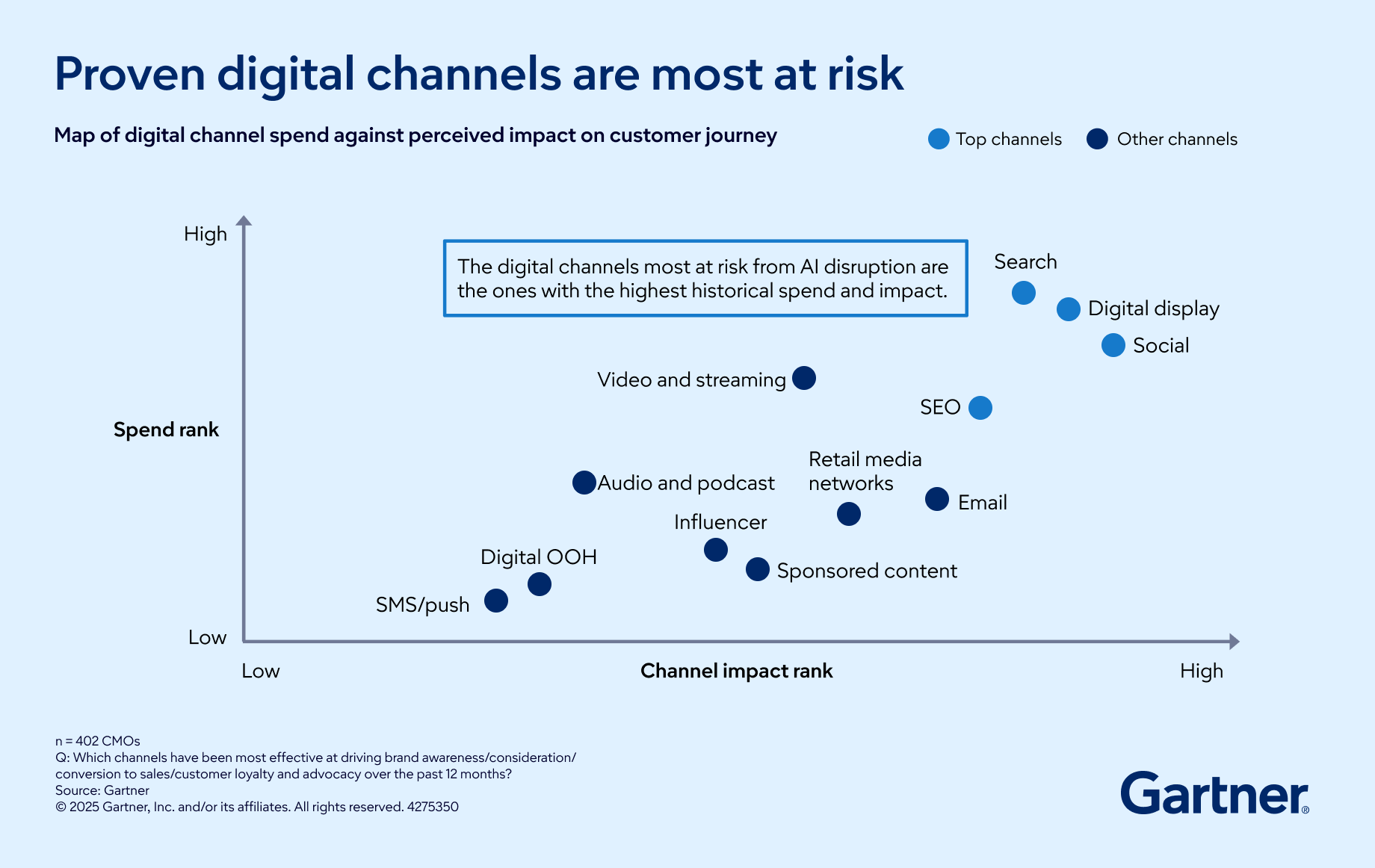
However, the channel investments that delivered customer impact last year won’t be the same ones that prevail in 2026. The digital channels most at risk from AI disruption are the ones with the highest historical spend and impact.

This moment requires a zero-based channel strategy mindset — a reevaluation of all channel investments based on changes in engagement patterns or current business impact. Use methods like marketing mix or attribution models to assess the business value contribution of each channel.

Revisit your channel allocation on at least a quarterly basis. Pressure-test whether proven channels are still delivering at performance thresholds — or if they’re crowding out needed experimentation to reach new audiences and create long-term value. A zero-based mentality prepares your organization for the upcoming transition to agentic buying, when workhorse channels like email could be replaced by AI touchpoints. You’ll need agility to pivot skills, workflows and agency relationships. Be intentional about realistic channel experimentation, including budget and staff time allocation. Prioritize based on RICE: (Reach x Impact x Confidence) / Effort.

CMOs can experiment most effectively by shedding legacy assumptions and reorienting around rapidly evolving, AI-driven buying journeys.

Take multichannel personalization as an example. AI is supercharging our ability to personalize. It promises reduced costs and effort in content production, stronger identification of target customers and enhanced optimization insights available from synthetic data.

Still, personalization isn't the right move for everyone. Consumers and B2B buyers who’ve encountered personalized messages felt 2.8 times more pressured, twice as overwhelmed by information, 1.7 times more likely to delay decisions and 3.2 times more likely to regret purchases. If marketers just turn up the dial on personalization, it could threaten the entire customer experience.

To get personalization right, focus on the uniquely human elements of human touchpoints.
Recommended CMO actions

  • Understand and plan for dual customer journeys: Those of GenAI tools and AI agents on side, and those of humans evaluating their output on the other. Educational content will increasingly be consumed by AI, so optimize for the information needs of your AI persona. For your human customers, emotions are key. Human touchpoints will continue declining in prevalence, so it matters to get each one right. In doing so, CMOs can drive an emotional connection to their brand that influences not just one decision, but many choices over time.

  • Create catalytic brand experiences: The most compelling brand experiences are more than memorable. They change audiences. You need to play at least one of these four components: Sensory, Emotional, Active and Reflective (SEAR). These elements matter for both consumer and B2B purchase decisions, fueling powerful experiences for individuals or a buying group.

  • Reinforce your brand in human journeys: Create a contextualized brand promise or experience vision statement. Start with the emotion that the customer is feeling (e.g., uncertainty or vulnerability). Then, translate that into design principles relevant to the specific situation and the elements that would enable the customer to feel a desired way.

  • Reflect your brand promise in journey maps: Use an experience vision statement to inform the development of key customer journeys, providing a blueprint for service delivery that reinforces the brand promise. This degree of focus and intentionality helps you maximize the impact of your investments in building your brand and remaining differentiated. This approach also reveals parts of the journey that aren’t emotional or brand-aligned, which are better ceded to AI-optimized content or AI-mediated experiences. 

Brand is no longer just a marketing asset — it’s a strategic lever for navigating disruption, guiding innovation and building trust between humans and AI. In a world of collapsing differentiation and rising disinformation, CMOs must reclaim brand’s value with a direct connection to business strategy activated across the enterprise.

PRIORITY 3

Stop emphasizing execution and start leading through strategic insight

AI, market disruption and cross-functional demands are expanding the CMO’s remit — but not their resources. To stay relevant, CMOs must stop prioritizing execution and instead lead through strategic insight.

CEOs and CFOs plan to increase marketing accountabilities, from today’s average of five to a projected eight in 2029. In particular, CEOs expect marketing to take on more ownership of CX, commercial alignment and product/service strategy. However, CMOs can’t expect these additional responsibilities to come with more budget.

In a Gartner study of CMO leadership, two distinct profiles emerged: enterprise operators and market shapers. Enterprise operators focus on working effectively across various functions in the enterprise to deliver strategic priorities. Market shapers look outward to their customers and their markets. They're known in the C-suite for their strong innovation and positioning capabilities.

When CEOs and CFOs evaluate CMO performance, it pays to be seen as a market shaper. The average CMO has an 11% chance of exceeding the performance expectations of their CEO and CFO. If a CMO is seen as an enterprise operator, those chances increase to 44%. However, that impact pales in comparison to what happens when the CMO is seen as a market shaper. Market shaper CMOs have an 88% chance of exceeding expectations in their role — eight times higher than the average CMO.

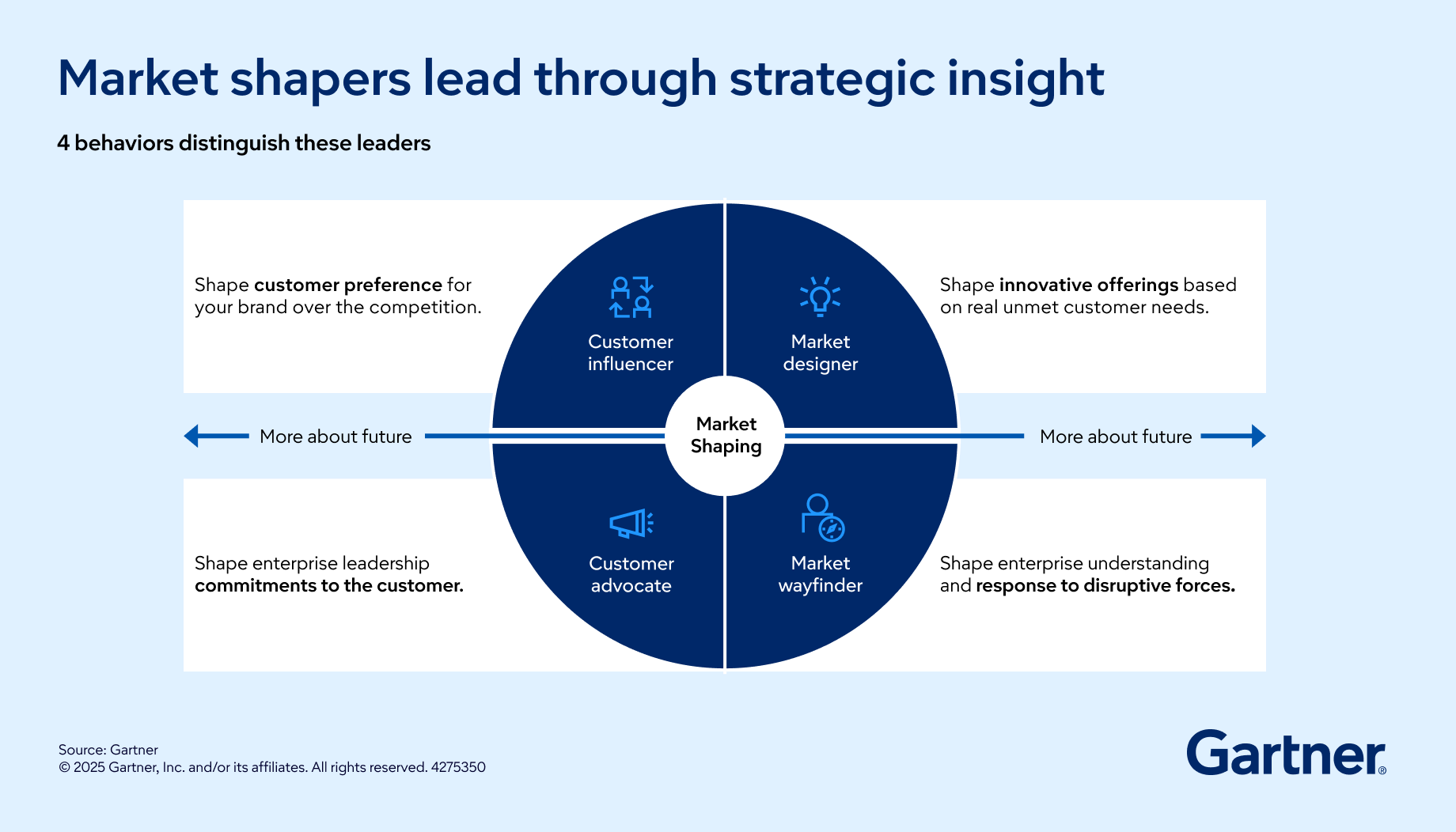
Market-shaping CMOs excel at four interrelated behaviors that focus on understanding and influencing both customers and markets:

  1. Customer influencer  Differentiating your offerings in the market, or shaping customer preference for your brand over the competition
  2. Customer advocate  Shaping how your enterprise leadership makes commitments to the customer
  3. Market designer — Designing product and innovation strategy to anticipate future customer needs
  4. Market wayfinder — Using customer and market insights to anticipate the effects of impending disruptions and plan ahead to mitigate or maximize those effects

A key challenge, however, is all your competitors have the same AI tools. In 2024, 62% of marketing leaders already reported moderate or extensive use of GenAI for market research. Today, marketing leaders cite data analysis and insight generation as the most critical area for AI automation.

Market shaping CMOs require more than AI-generated insights. They rely on empathy, creativity and, above all, critical thinking — which is what allows marketers to reach novel conclusions when armed with equal insights on customers and markets. These skills must be actively managed and cultivated in the AI era, or they’ll erode.

Recommended CMO actions

  • Coach marketers to keep reasoning skills sharp: Managers should coach their teams to apply ethical, strategic, scientific and systems-based thinking as they reflect on the day-to-day insight generation. 

  • Apply human intelligence to AI tools for better insight: Marketers must use AI to hone reasoning, not replace it. A savvy AI-enabled marketer will test specific hypotheses about customer needs and competitor moves, rather than accepting generic answers and taking AI synthesis at face value. Ideation must often be broken down into smaller steps so marketers can critically interrogate and improve on AI output.

Don’t navigate 2026 alone

Work with Gartner to gain clarity, confidence and a competitive edge through personalized guidance, peer-tested best practices and tools that accelerate your impact.