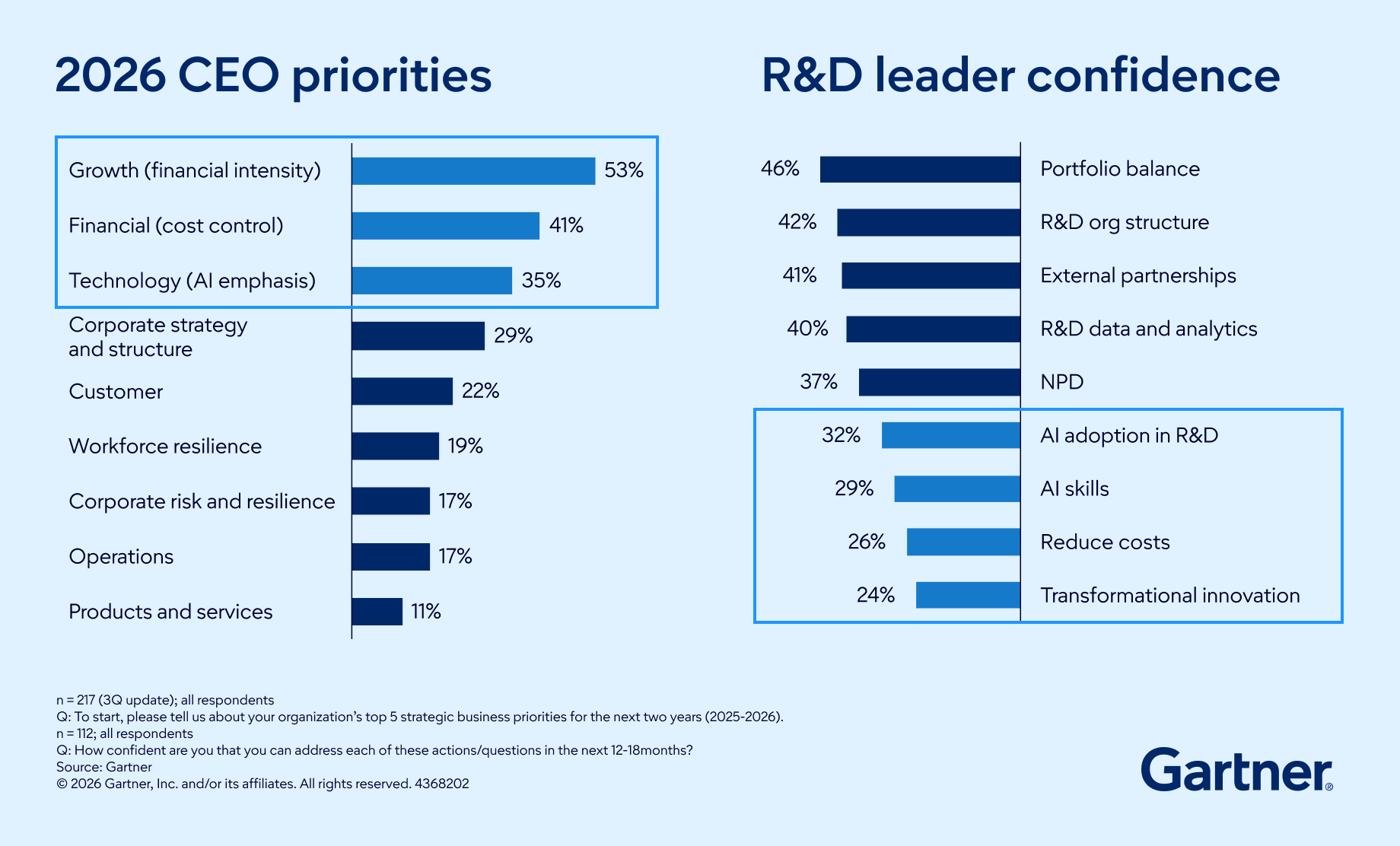
In 2026, a Gartner survey of more than 100 R&D leaders revealed a landscape of shrinking budgets, high growth expectations and waning confidence in their ability to deliver on CEO priorities. To successfully navigate 2026, R&D leaders must address the following strategic imperatives and associated challenges.
- Gartner client? Log in for personalized search results.
Strategic imperatives:
1
Enable long-term growth.
2
Smartly optimize costs.
3
Unlock AI’s impact on innovation.
PRIORITY 1
Enable long-term growth
The top priority for CEOs in 2026 is growth, yet R&D leaders face significant internal friction in delivering it. Approximately 69% of R&D leaders feel pressured to prioritize short-term over long-term innovation investments. This creates portfolio gridlock, where only 3% of resources are being reallocated to more promising transformational projects. Furthermore, R&D leaders struggle to maintain influence at the executive table. Consequently, R&D portfolios often lag in health, failing to align sufficient high-value projects with the organization’s broader strategy.
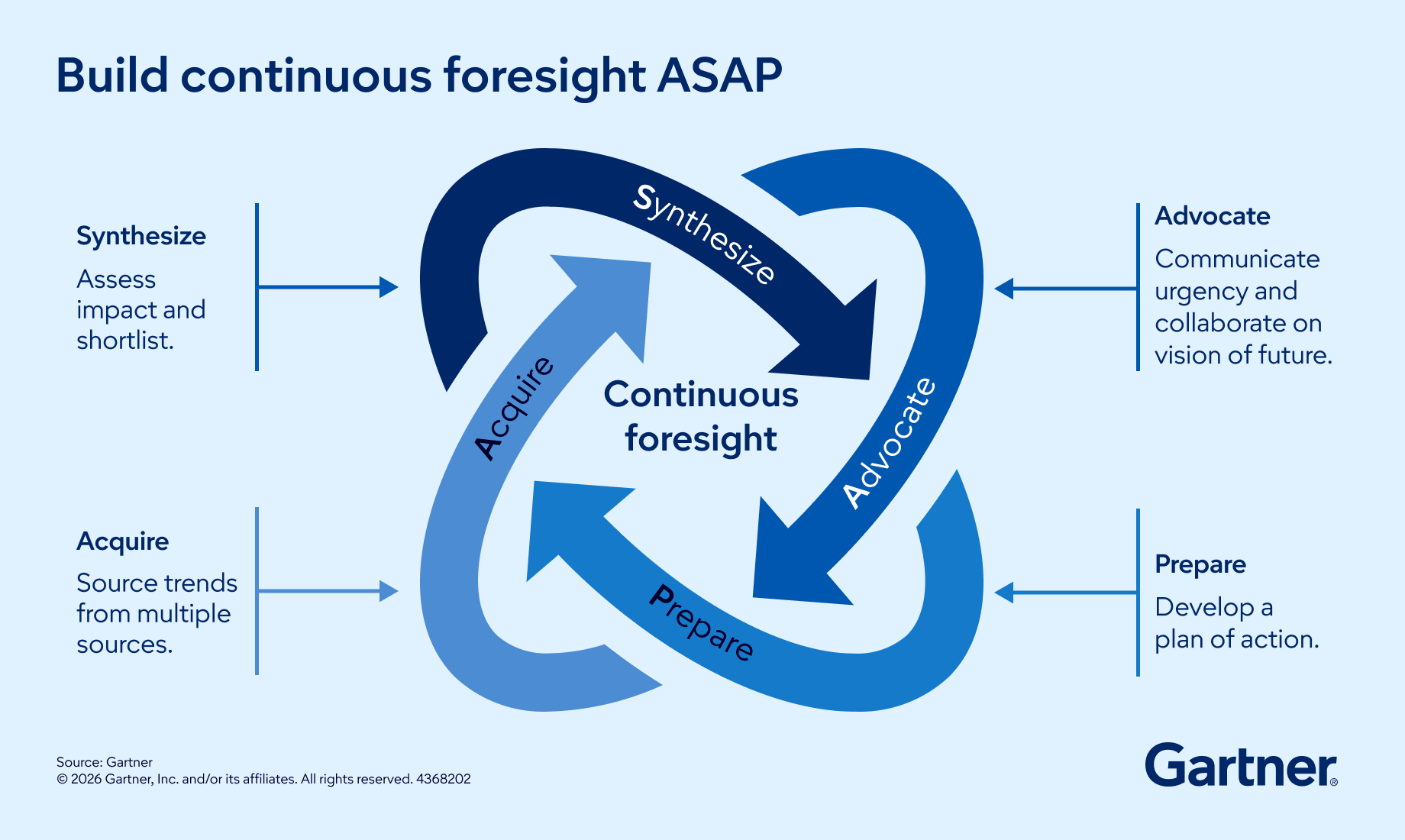
R&D leaders must transition into the role of a “chief future officer.” This involves building continuous foresight capabilities to advocate for long-term bets and return-on-the-future projects — initiatives defined as high risk, high return and potentially controversial, but necessary for strategic differentiation.
PRIORITY 2
Smartly optimize costs
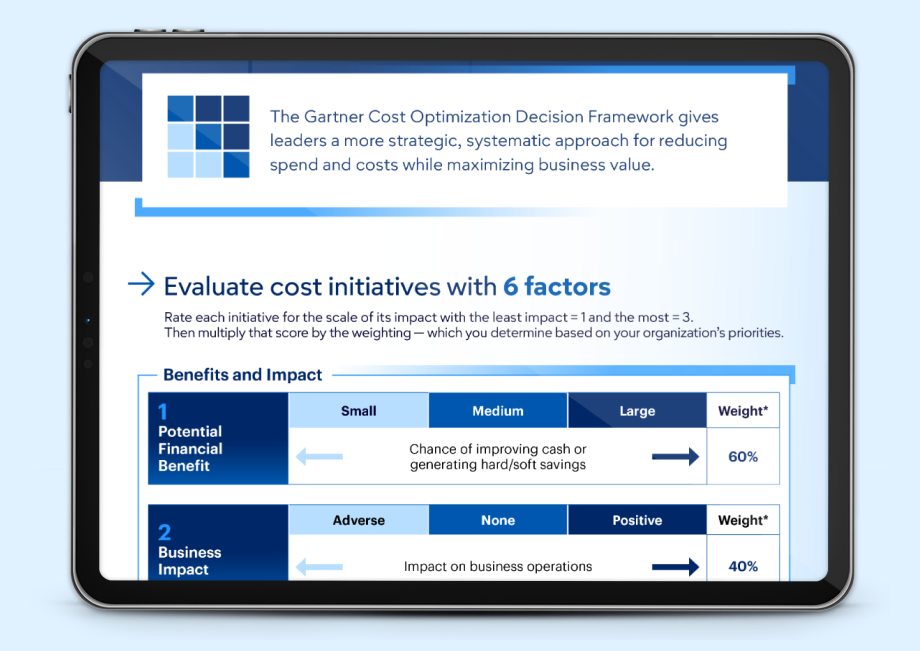
While R&D was already a target for reductions in 2025, the outlook for 2026 is starker: 71% of leaders expect their overall R&D budget to decrease by 5% or more. The challenge is not simply to cut spend but to smartly optimize. This requires identifying the root causes of process inefficiencies and halting non-value-creating activities.
R&D leaders should implement an R&D activity value audit to categorize activities into those to start, stop, sunset or continue based on their ability to provide value in three to five years. The goal is to simultaneously reduce spend (e.g., through automation and workforce cost reduction) while preserving the capacity to invest in business outcomes and differentiated products.
PRIORITY 3
Unlock AI’s impact on innovation
While technology and AI remain top CEO priorities, R&D struggles to prove the value of these investments. Despite a projected $1.5 trillion in worldwide AI spending for 2025, disappointment is widespread. Thirty percent of GenAI projects are expected to be abandoned by 2026 due to unclear return on investment (ROI) and bad data, and 95% of AI integrations are failing to deliver revenue. A significant strategic hurdle is moving beyond the pilot phase and finding genuine value.
R&D leaders must redefine how they measure success by categorizing AI returns into three types:
1. Return on investment (ROI): Operational efficiency and cost savings
2. Return on employee (RoE): Productivity and capability expansion
3. Return on the future (RoF): Strategic differentiation and innovation
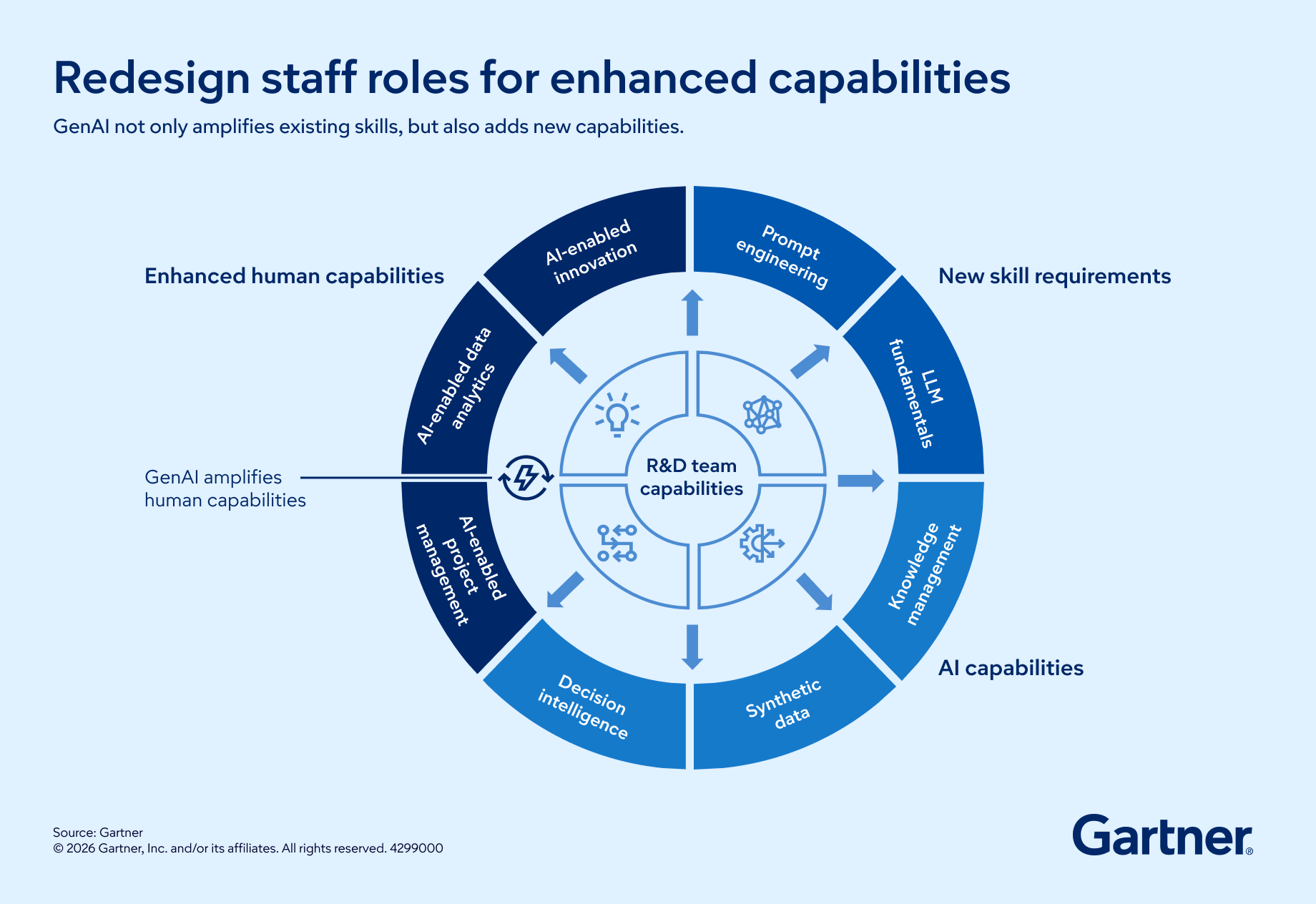
Furthermore, leaders are encouraged to treat AI not just as a tool, but as a “digital colleague” that requires management and trust building to truly amplify human capabilities.


Don’t navigate 2026 alone
Partner with Gartner to gain clarity, confidence and a competitive edge through personalized guidance, peer-tested best practices and tools to accelerate your impact.