Leadership development has reached ​an inflection point. Traditional practices are failing to cultivate the strong leaders and pipelines that chief supply chain officers (CSCOs) need to deliver on strategic priorities.​

  • Leadership turnover destabilizes operations. Fifty-four percent of supply chain leaders report leadership turnover disrupted their function’s ability to operate over the past three years.

  • External hires underperform. Two-thirds of supply chain leaders agree leadership roles are frequently filled by external hires that tend to underperform compared to internally promoted talent.

  • Leadership development programs are outdated. Just one-third of these programs are consistently refreshed, and less than half of supply chain leaders (48%) consider their curricula to be time-sensitive and tailored.​

New technologies — AI in particular — are rapidly changing what’s needed and expected from leaders. The stakes for effective leadership development are rising. Many companies are reducing their middle management teams and expanding remaining leaders’ responsibilities, but this delayering of initiatives risks failure if executive turnover grows and leadership development practices remain stagnant.

A new approach is needed to build the supply chain leaders of tomorrow. 
CSCO leadership development imperatives

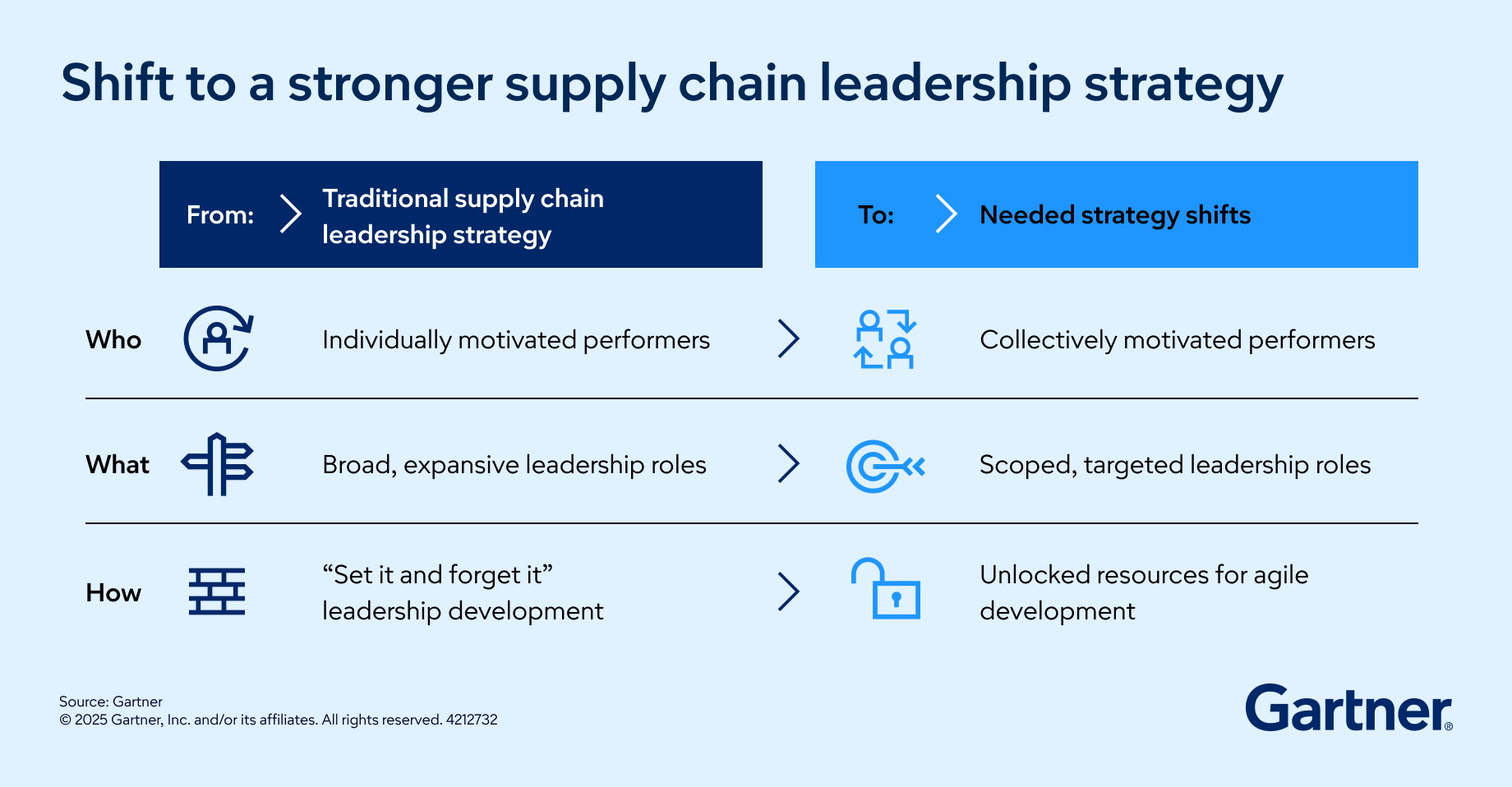
Gartner recommends CSCOs focus on three core strategies to recalibrate leadership development and deliver a new playbook in 2026.

  1. Develop and reward collectively motivated leaders.

  2. Curb unchecked role expansion.

  3. Unlock resources for agile leadership development.

1. Develop and reward collectively motivated leaders

Supply chain leaders, even at the highest levels, are currently optimizing toward individual performance. In fact, 78% of supply chain leaders exhibit individually motivated behavior.

Misaligned incentive structures and conflicting KPIs can foster more individualistic or siloed behavior, which harms supply chain performance. Collectively motivated behaviors — such as prioritizing team success over individual achievement, supporting peers at the expense of personal productivity or valuing feedback from peers/direct reports over direct manager/leader — boost group performance.

CSCOs should refocus incentive structures from individually motivated performance to collectively motivated performance. 

Gartner recommends:

  • Using line-level staff to identify leaders who exhibit qualities that amplify group performance, like collaboration and conflict management skills

  • Recalibrating performance reviews to discuss and reward collectively motivated behaviors

  • Designing well-defined, sustainable leadership roles to avoid overexpansion of leadership positions

2. Curb unchecked role expansion

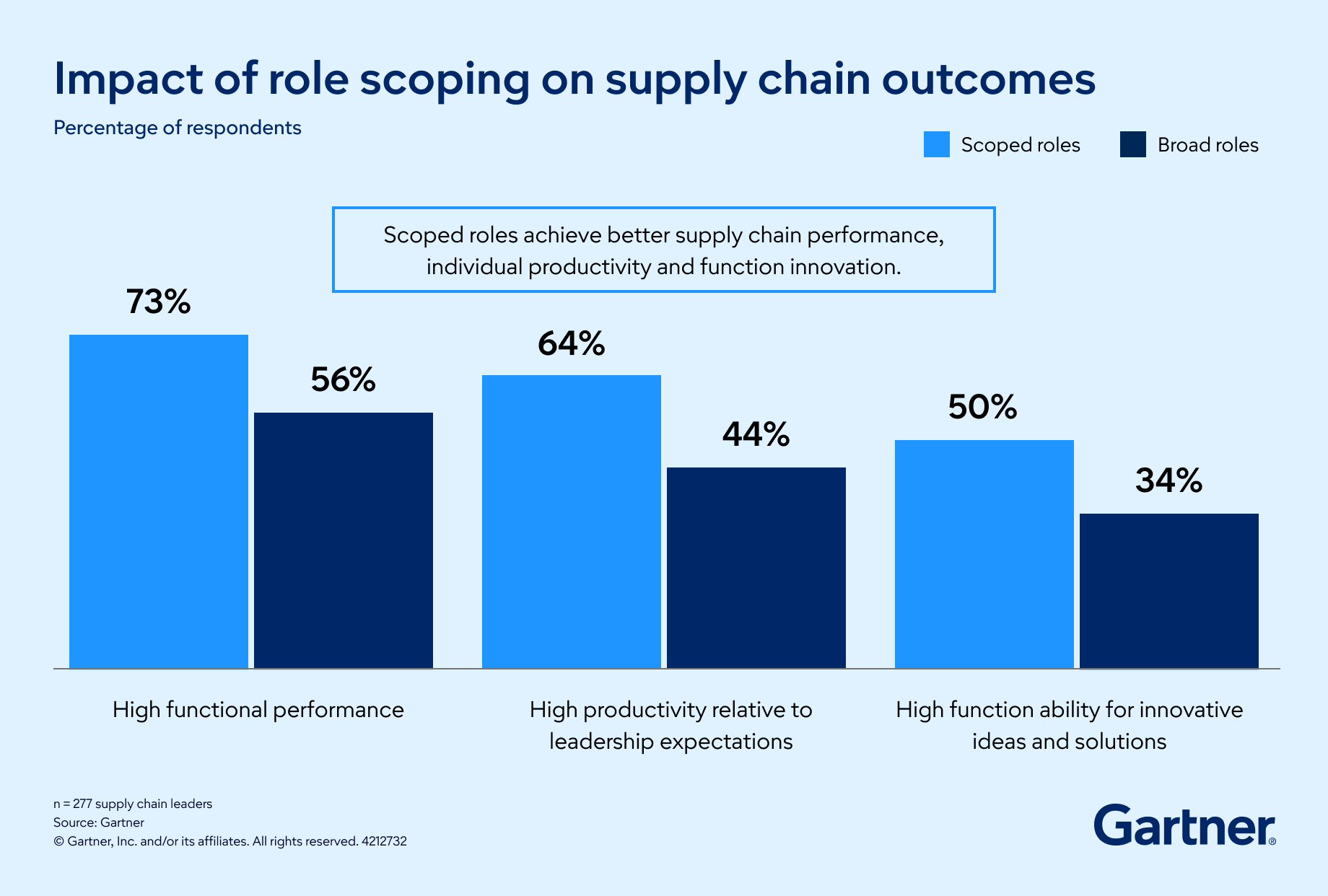
Fifty-nine percent of supply chain leaders report that leadership roles at their organization demand a broad range of skills and competencies. 

Expanding leadership roles to tasks that are not aligned with leaders’ best skills or company priorities can compromise how much a leader contributes to their organization. CSCOs must scope targeted leadership roles to set up leaders for success.

The keys to designing successful leadership positions are:

  • Regularly auditing leadership roles to ensure leaders focus on where their strengths and skills best contribute to organizational priorities

  • Providing transparency and clarity about role expectations, performance priorities and paths to career growth

  • Building bandwidth into leadership roles so leaders can accelerate their development even amid change and volatility

3. Unlock resources for agile leadership development

Supply chain organizations often assume leadership development practices that worked for their current high-performing leaders will also be effective for their incoming cohorts. 

However, effective leadership development programs are consistently refreshed. Use sensitive and tailored curriculums, and consider cohort needs in program design. These programs improve a leader’s performance in their current role, equip them with skills needed at the next level of leadership and strengthen their network to help them get things done. Furthermore, these programs drive increased function performance, productivity and job satisfaction.

Shift away from the “set it and forget it” approach to leadership development by:

  • Embedding learning into workflows, rather than treating it as an additional responsibility

  • Developing strategic partnerships within the function and across the business that can benefit learning

  • Applying “talent sensing” strategies to determine the future needs of supply chain and aligning leadership development curricula

Sources

  • 2025 Gartner Supply Chain Leadership and Productivity Survey

  • 2025 Gartner HR Priorities Survey

  • 2025 Gartner Bullseye Roles Agenda Poll

This document is based on “Supply Chain Executive Report: Build the Next Generation of Leaders.” Clients may access the full Supply Chain Executive Report on the client portal; click here.

Explore more