Sustainable AI success hinges on coordinated ethics, governance and compliance across the organization.
- Gartner client? Log in for personalized search results.

What is a responsible AI program?
A responsible AI program is an integrated, organizationwide approach that combines ethical principles (fairness, transparency, accountability), governance structures (policies, roles, decision-making processes) and compliance mechanisms (legal requirements, industry standards) to ensure AI systems are developed, deployed and monitored in a way that aligns with business objectives, manages risk and builds trust.
Today’s rapid AI advancements demand an adaptive approach
Over 75% of organizations have started to integrate AI, with many looking to use it for mission-critical applications. But AI adoption and the rise of agentic AI (AI systems capable of autonomous decision making and action without continuous human oversight) have surfaced ethical and business issues, from social responsibility and fairness to safety and sustainability.
Fewer than one-quarter of IT leaders are very confident that their organizations can manage governance when rolling out GenAI tools. As global regulations evolve, organizations must strike a balance between AI business value and oversight to ensure timely implementation, risk mitigation, ethical alignment and trust in AI outcomes.
Step 1: Establish adaptive ethical principles.
AI ethics can be highly nuanced. AI doesn’t give the same answer every time, is often iterating and can sometimes behave randomly. Rather than setting broad, rigid policies, organizations should adopt an adaptive ethics approach and address ethical dilemmas case by case.
This approach reflects an adaptive-ethics model, where policies evolve alongside AI systems and real-world usage.
To operationalize adaptive ethics:
Build trust by creating policies for transparent AI decision making.
Engage in continuous monitoring and embed “unlearning” mechanisms into AI tools.
Go beyond basic explainability to trace decisions, record when they happen and provide context relevant to the business.
Gartner insights show that by 2027, cross-industry collaborations on AI ethics frameworks will become regular practice, reinforcing accountability across sectors.
Step 2: Build governance around current AI use cases.
A steady stream of new AI solutions, such as agentic AI, challenges governance. Gartner predicts loss of control will be the top concern for 40% of Fortune 1000 companies by 2028.
Rather than trying to anticipate every future risk, build governance around your current AI portfolio.
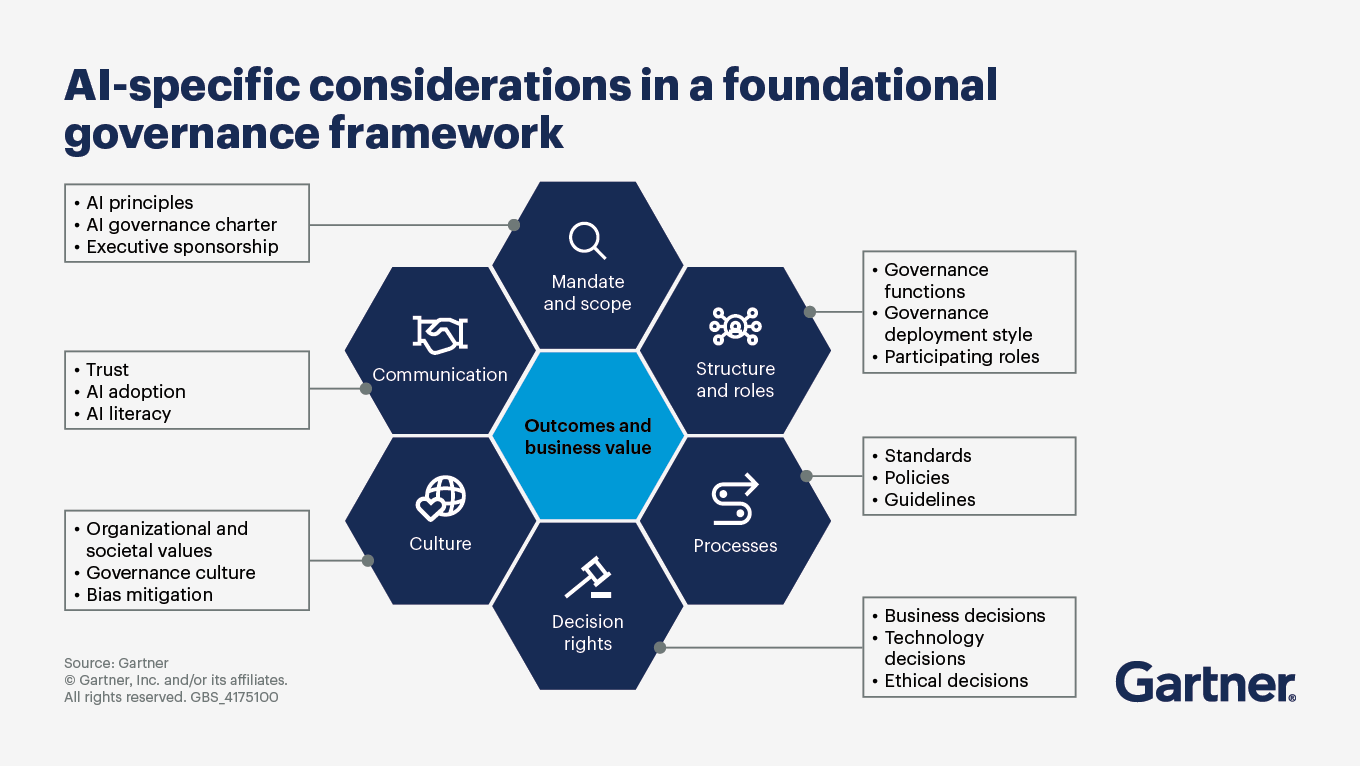
Extend existing governance frameworks (enterprise, data and analytics or risk governance) to AI.
Establish an agentic AI governance working group for autonomous systems.
Define AI-specific focus areas: strategy, investment, risks, value, performance and resources.
Adapt and iterate using familiar policies to respond to emerging challenges.
Step 3: Embed legal and compliance guardrails early.
Embedding compliance guardrails into AI processes ensures alignment with regulations such as GDPR and the Fair Lending Act.
These guardrails are essential to prevent AI systems from exposing private data when interacting with external tools or other agents. This requires:
Granular permissions
Documented vetting of tools
Close collaboration with legal and compliance teams
Gartner predicts that by 2030, fragmented AI regulation will quadruple, covering 75% of the world’s economies and driving $1 billion in compliance spend.
Step 4: Implement continuous monitoring and oversight.
Responsible AI programs require real-time visibility into system behavior.
Organizations should implement continuous monitoring through:
Testing and evaluation frameworks
Compliance dashboards
Observability frameworks
Security monitoring and anomaly detection
Compatibility protocols across AI systems
Continuous monitoring supports adaptive ethics by ensuring models can be evaluated, corrected and improved over time.
Step 5: Operationalize through integrated standards and data governance.
For sustainable AI adoption, integrate ethics, governance and compliance into day-to-day operations. Key areas include:
Consistency of standards across internal teams and external partners
Adaptive data governance to safeguard privacy and enhance transparency across the AI life cycle
Embedded security governance with CISO involvement from design through operations
Comprehensive policies that unify ethics, governance and compliance into a single strategy
Step 6: Continuously review and evolve the program.
AI responsibility is not static — it requires ongoing iteration. Organizations should:
Regularly revisit policies and governance structures
Adapt to new AI capabilities and emerging risks
Align ethics, governance and compliance as a unified system
Gartner predicts that by 2027, three out of four AI platforms will include built-in tools for responsible AI and strong oversight. Organizations that continuously evolve their programs will gain a competitive advantage.
Key take-aways: Building a responsible AI program
Adopt adaptive, case-by-case AI ethics to address evolving AI behavior.
Build governance around current AI use cases rather than hypothetical future risks.
Engage legal and compliance teams early to keep pace with global regulations.
Integrate ethics, governance and compliance into a unified operational strategy.
Implement continuous monitoring and iterative improvement.
Prepare for convergence as responsible AI capabilities become standard across platforms.
Responsible AI program FAQs
What unique challenges does a responsible AI program need to address for agentic AI?
Agentic AI introduces challenges around accountability, safety, orchestration and continuous improvement. Because these systems act autonomously, organizations must establish clear roles and chains of accountability, implement robust monitoring systems and create mechanisms to intervene when systems act outside intended constraints.
Why is cross-functional collaboration critical to a responsible AI program?
AI affects every part of the organization, requiring input from legal, IT, data science, operations and business teams. Cross-functional collaboration ensures risks and opportunities are evaluated holistically, standards remain consistent and organizations can respond effectively to emerging AI and regulatory challenges.
What are the key components of a responsible AI program?
Key components include:
Ethical principles such as fairness, transparency and accountability
Governance structures that define roles, policies and decision-making processes
Compliance guardrails aligned to regulations such as GDPR and the Fair Lending Act
Granular permissions and documented vetting of AI tools
Continuous monitoring through dashboards, observability frameworks and security controls
Organizations should also prepare for expanding global AI regulations, which are expected to cover 75% of the world’s economies by 2030.
Attend a Conference
Accelerate growth with Gartner conferences
Gain exclusive insights on the latest trends, receive one-on-one guidance from a Gartner analyst, network with a community of your peers and leave ready to tackle your mission-critical priorities.

Drive stronger performance on your mission-critical priorities.