Prioritize human connection, user value and feedback to build trust and scale adoption.
- Gartner client? Log in for personalized search results.
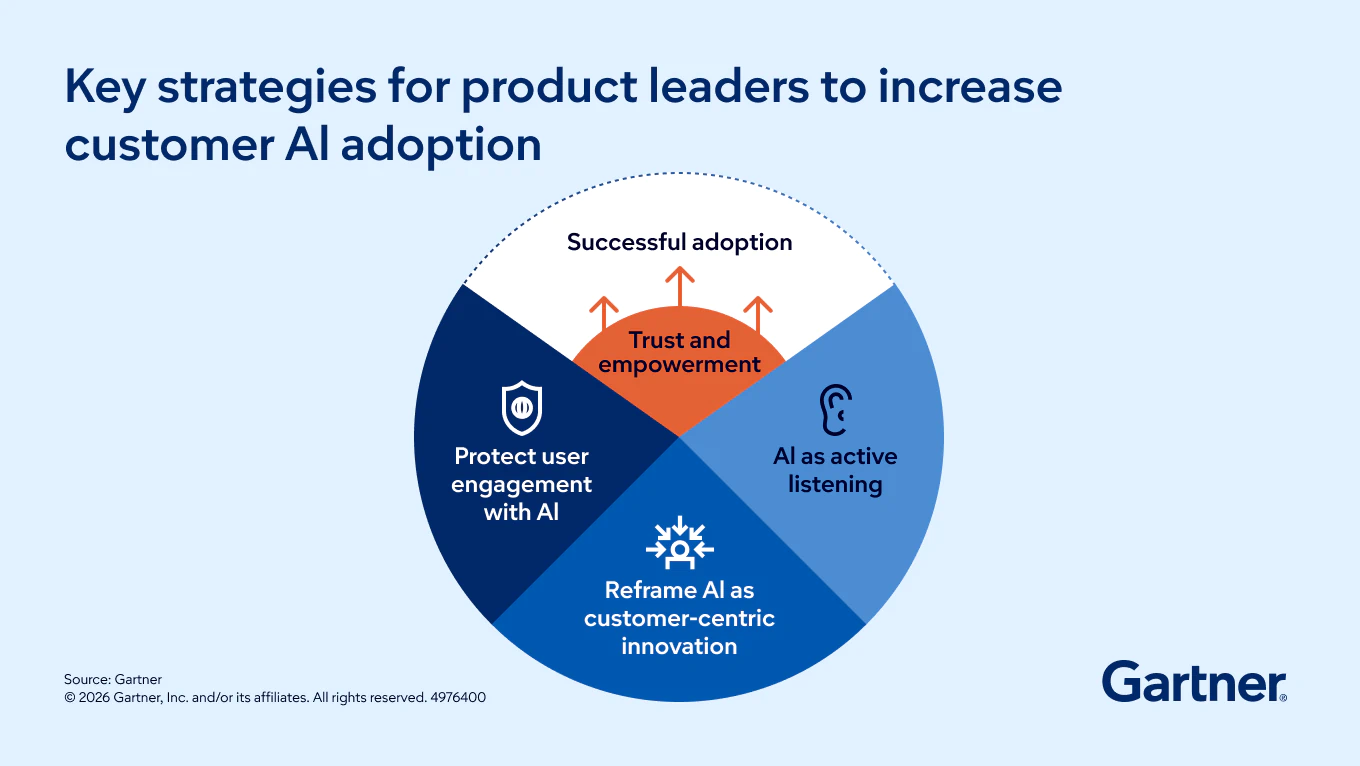
Balance AI efficiency with user trust to avoid alienating customers
AI is transforming product development, but prioritizing efficiency over user-centric principles can create a fundamental misalignment with market needs. Product leaders face increasing pressure to drive automation and scale, while ensuring that empathy, ethical judgment and customer understanding are not lost.
Customers’ primary fear is losing the human touch and not having their voices heard. Unmanaged resistance to change can damage client relationships and undermine AI initiatives. To succeed, product leaders must use AI to strengthen human connections and actively respond to user feedback.
Product leaders can turn AI fears into trust by focusing on user engagement
Customers’ primary concern is not only that AI may reduce human interaction, but that their roles and contributions may be diminished or replaced. Product leaders must balance executive demands for efficiency with user trust by actively capturing and responding to user feedback and reinforcing the value of human contribution.
Protect user engagement with AI
Customers worry AI will automate away their contributions or make interactions impersonal. While AI can support the generation of requirements and insights, human intuition, judgment and market understanding remain essential.
To address these concerns, product leaders should focus on augmenting, not replacing, human contributions:
Invest in AI that amplifies human strengths, freeing users from repetitive tasks so they can focus on higher-value work.
Prioritize empathy, ethical judgment and relationship-building — areas where humans excel.
Preserve human judgment and market intuition by ensuring teams retain strong decision-making skills.
Enforce “human-in-the-loop” controls that allow users to choose the level of AI autonomy and retain strategic control.
Delegate administrative tasks to AI, so leaders can stay focused on clients and maintain a customer-centric approach.
By highlighting and supporting user value, product leaders can reassure customers that AI is there to empower, not replace.
Reframe AI as an engine for customer-centric innovation
There is growing concern that AI will shift focus away from user needs and toward internal inefficiency. Product leaders must reinforce that AI supports customer-centric innovation by enabling teams to spend more time understanding user needs and delivering value.
When AI agents handle operational execution, enable product managers to reclaim time for high-value work and can spend more time engaging with customers and understanding their needs.
Use AI to replace operational tasks, allowing product managers to be more creative and act in a consultative research capacity directly with customers.
Frame AI as a mechanism that allows organizations to solve problems they previously could not address due to resource constraints, shifting the narrative from efficiency to unlocking new capabilities for customers.
Deploy agents that actively prove you are listening
As organizations scale, users worry their feedback will be lost or overlooked. Specialized AI agents can proactively guide users and ensure feedback is never missed.
AI agents can ingest feedback from multiple sources and extract actionable insights for product teams.
Closing the feedback loop in real time — such as rapidly building prototypes based on customer requests — shows users their input is valued.
Internal agents can cross-reference inbound customer feedback with the product roadmap, allowing teams to instantly update customers on their requests.
AI recommendation systems can suggest relevant templates and build new workflows tailored to user needs, while ensuring human support remains accessible.
What to do next to win in the AI vendor races
Maintaining a competitive position in the AI vendor landscape requires more than adding AI features to existing products. Product leaders must develop new offerings and evolve portfolios with integrated AI capabilities that prioritize customer needs, accelerate adoption and support scalable business models. Winning the AI vendor race depends on data‑driven insights, composable architectures and compelling go‑to‑market strategies that deliver superior client outcomes.
The steps in that journey include:
- Refining and implementing profitable AI use cases, connecting AI implementation strategies directly to tangible business results in order to reduce risk, accelerate value realization and maximize return on investment.
Anticipating shifts in the market, profiling buyer personas and decision‑making behaviors to tailor product strategy, packaging and go‑to‑market approaches as competitive dynamics evolve.
Understanding customer needs and revenue opportunities, using market and peer insights to uncover unmet demand, validate opportunities and prioritize AI investments that drive growth.
- Differentiating from competitors, translating customer and market insights into distinctive product capabilities, messaging and value propositions that clearly separate offerings in crowded AI markets.
AI adoption FAQs
What are the main client fears around AI adoption?
Clients worry that AI will replace the human touch, diminish their roles and make organizations less responsive to their feedback.
How can product leaders use AI to increase customer trust and adoption?
Product leaders should use AI to amplify human strengths, preserve opportunities for human interaction and visibly incorporate user feedback into product development.
What strategies help ensure user feedback is not lost as AI scales?
Deploying specialized AI agents to collect, analyze and act on feedback helps ensure users feel heard and valued even as organizations grow.
Attend a Conference
Accelerate growth with Gartner conferences
Gain exclusive insights on the latest trends, receive one-on-one guidance from a Gartner analyst, network with a community of your peers and leave ready to tackle your mission-critical priorities.

Drive stronger performance on your mission-critical priorities.