Organizations that focus on value creation rather than workforce reduction are better positioned to unlock the benefits of AI.
- Gartner client? Log in for personalized search results.
AI will force leaders to rethink work, not jobs
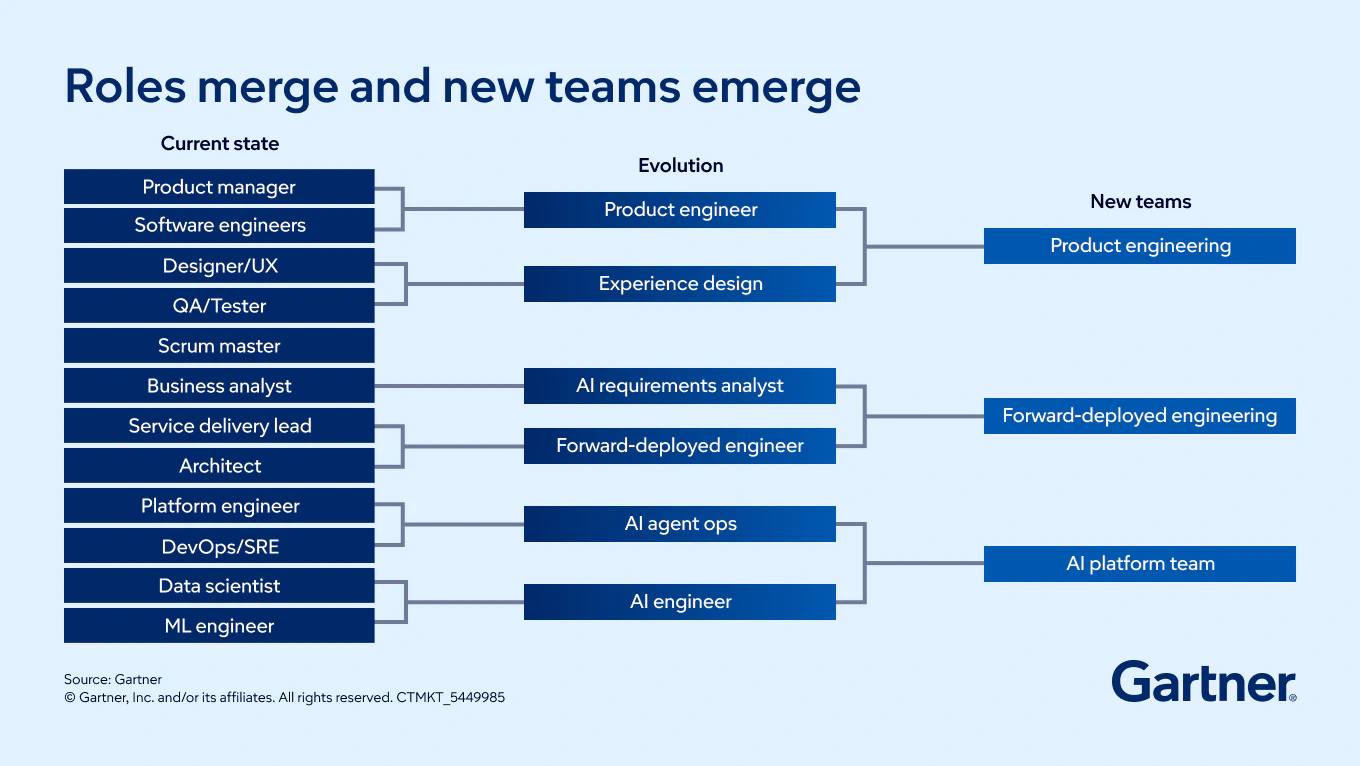
Although much of the conversation around AI has focused on which jobs will survive and which roles will disappear, the important question is not who does the work. It’s what work creates value. That distinction is becoming increasingly important as AI reshapes work across the enterprise. Roles are compressing, expanding and combining in new ways.
According to a poll conducted during Gartner Application Innovation & Business Solutions Conference 2026, 74% of respondents believe AI will result in smaller teams, while only 2% expect larger teams. While teams are getting smaller, expectations are growing.
“Don’t retrofit AI into your old structure. AI isn’t an add-on. It’s the catalyst for a more adaptable, value-driven organization,” says Anna Krasniewska Shahidi, Group Vice President at Gartner.
You might also like this webinar: How to Create a Workforce That Can Keep Up With AI


Roles are reorganizing around outcomes
As AI takes on portions of existing work, successful organizations focus on the value they need to create and then determine the skills required to produce that value. As work evolves, roles must evolve with it.
Start with value and work backward
Avoid designing future-state organizations around projected headcount or assumptions about AI’s impact. Instead, start by defining the value drivers most important to the business. Once those priorities are clear, map the workflows that support them and identify where work should be eliminated, expanded or newly created. This approach helps organizations make better decisions about how work should be distributed among employees, contingent labor and AI.
AI is changing the role of middle management; managers are becoming coaches, not intermediaries
Managers remain critical, but their responsibilities are shifting. AI can help streamline performance tracking and administrative work, allowing managers to spend more time coaching employees, helping teams navigate trade-offs and ensuring accountability for outcomes. Rather than acting as communication conduits, successful managers will instead accelerate the performance of the people around them.
“Managers as middleware” will become less effective in AI-shaped organizations. High-agency employees and smaller teams require direct access to information, faster decision making and greater ownership.
Apply AI-native lessons in your organization
AI-native startups cannot be copied wholesale, but there are several practices that incumbent organizations can adopt to improve adaptability and increase value creation. Follow these principles:
Build agile, small teams around meaningful problems. Pair AI with human direction to create the smallest effective unit.
Pair technical experts with domain specialists. Forward-deployed engineers help organizations connect technical expertise with business knowledge.
Manage technology with platform teams. Task these teams with maintaining, updating and retiring AI solutions to free up your organization for future innovation.
Most importantly, organizations should recognize that the AI-shaped organization is never finished. Managing through ongoing change, adapting roles and continuously aligning work to value creation will become a permanent leadership responsibility.
AI-shaped organization FAQs
What is an AI-shaped organization?
An AI-shaped organization shifts the focus from “who does the work” to “what work creates value.” It uses adaptable structures, smaller teams, evolving roles and AI-enabled workflows to align work with business outcomes.
How does AI reshape roles in an AI-shaped organization?
Gartner finds that AI drives role compression, role expansion and the creation of new role combinations. Organizations increasingly organize work around skills and outcomes rather than traditional job titles, resulting in more fluid responsibilities across functions.
What lessons can organizations learn from AI-native startups?
Gartner recommends adopting transferable practices such as starting with value drivers, deploying tiny teams, pairing technical experts with domain specialists and establishing platform teams that manage AI governance and ongoing maintenance. These practices can help organizations become more adaptable and value-focused.
Attend a Conference
Accelerate growth with Gartner conferences
Gain exclusive insights on the latest trends, receive one-on-one guidance from a Gartner analyst, network with a community of your peers and leave ready to tackle your mission-critical priorities.

Drive stronger performance on your mission-critical priorities.