Find out how organizations can enable managers to drive successful change communication on the frontline.
- Gartner client? Log in for personalized search results.
Managers are the missing link in change communication
Frontline employees are typically the most difficult group to reach through centralized communications. They’re frequently among the last to hear about organizational changes and left to figure out how change efforts align with broader business goals. As such, communication leaders depend on managers to reach these employees. In fact, according to Gartner, employees rate managers as their most preferred and effective communications channel. However, managers are often expected to lead change without the context, preparation or support they need, resulting in communication that actually hinders change instead of implementing it. To drive successful adoption — particularly during AI-driven transformation — organizations must take a deliberate two-step approach: First, prepare managers; then, sustain structured dialogue.
You might also like this webinar: Transforming Communications for an AI-Enabled World
Equipping managers to lead change
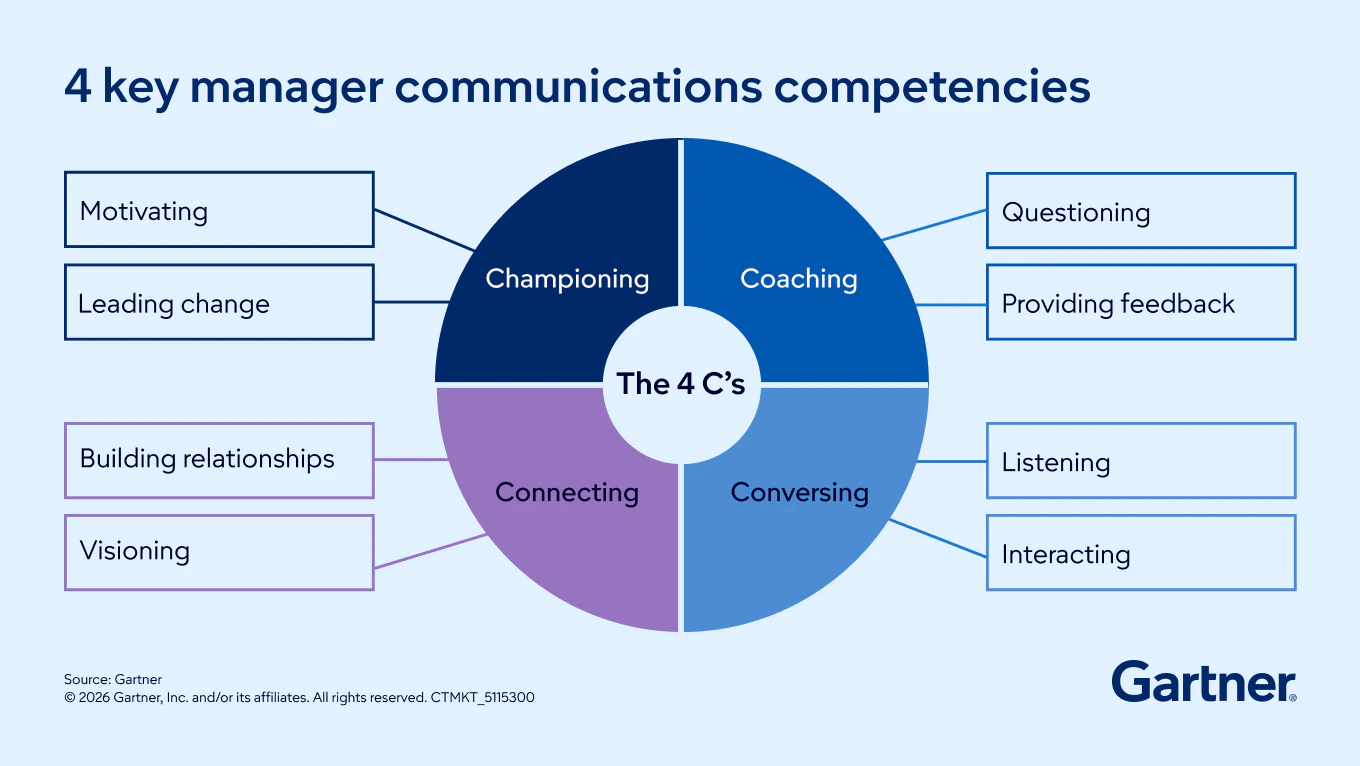
Frontline change communication relies on managers who can help employees understand, interpret and navigate change. Managers must be able to practice the 4Cs — championing, coaching, connecting and conversing — and organizations must be able to equip them to do so.
Prepare managers with context, not just content.
To help frontline employees understand and adopt change, organizations must clearly define managers’ role as communicators, not just message carriers. Leaders must make it clear that managers are there to explain the rationale behind change, connect it to employees’ day-to-day work and help employees understand what success looks like in the new environment. As bridges between leadership and frontline workers, they are meant to facilitate meaningful two-way dialogue that consists of championing, coaching, connecting and effectively conversing with their employees. Managers must be able to help them process and adapt to new ways of working.
However, to facilitate this dialogue, managers must be given more than just communication materials; they need context. Leadership should ensure that managers understand the business rationale, intent and expected outcomes of change, as well as its impact on the frontline work. Organizations should also give managers opportunities to ask questions, engage with leadership and gain clarity before communicating with their teams.
Sustain manager-employee communication.
Providing context is just the first step. Managers must also be given the tools and support needed to sustain effective change communication. Leaders should provide conversation guides, practical resources, manager forums, as well as opportunities to practice dialogue. With the right support, they can navigate employee concerns, reinforce key priorities and facilitate discussions that bring organizational messages to life.
Managers should also be encouraged to use routine meetings like team discussions and one-on-ones, to listen actively, assess employee sentiment and monitor change adoption. In these interactions, it’s crucial that managers are taught to distinguish resistance from confusion, skills gaps from motivation challenges and operational barriers from emotional concerns. This helps improve the quality of frontline feedback and provides a clearer view of how change is being experienced. From there, managers can identify recurring themes, share insights with leadership and become a valuable source of real time feedback.
What’s next in change communication?
Preparing and enabling business leaders to coordinate and communicate about change consistently, is just one step in the CCO’s mandate to support enterprise AI transformation with effective internal communications. The other steps in this journey include:
Build leadership buy-in to support stronger change leadership by crafting a clear vision, plan and benefits of cross-functional support.
Capture and incorporate employees’ perspectives of major changes by updating how employee perspectives are collected and used to inform business and communications change strategy.
Measure and demonstrate the impact of change communications by updating metrics selection, data collection, analysis and reporting practices.
Update and activate change messaging strategies by refreshing how change messages are planned and delivered.
Change communication FAQs
Why are managers critical to change communication?
Managers are often frontline employees’ most trusted source of information. They help employees understand why change is happening, what it means for their roles and how they can successfully adapt.
Why do change initiatives often struggle with frontline employees?
Frontline employees can be difficult to reach through centralized communications and are often among the last to receive organizational updates. Without manager support, they may struggle to understand how changes affect their day-to-day work.
What support do managers need during organizational change?
Managers need more than communication materials. They need clear context around the business rationale, leadership intent, expected outcomes and frontline impact of the change. They also benefit from conversation guides, peer forums and opportunities to practice dialogue.
What role does manager feedback play in change adoption?
Managers are uniquely positioned to gather frontline insights. Through team meetings and one-on-ones, they can identify recurring themes, employee concerns and adoption challenges that help leadership make informed adjustments.
Attend a Conference
Accelerate growth with Gartner conferences
Gain exclusive insights on the latest trends, receive one-on-one guidance from a Gartner analyst, network with a community of your peers and leave ready to tackle your mission-critical priorities.

Drive stronger performance on your mission-critical priorities.