Establish early wins to build momentum in a new executive role.
- Gartner client? Log in for personalized search results.
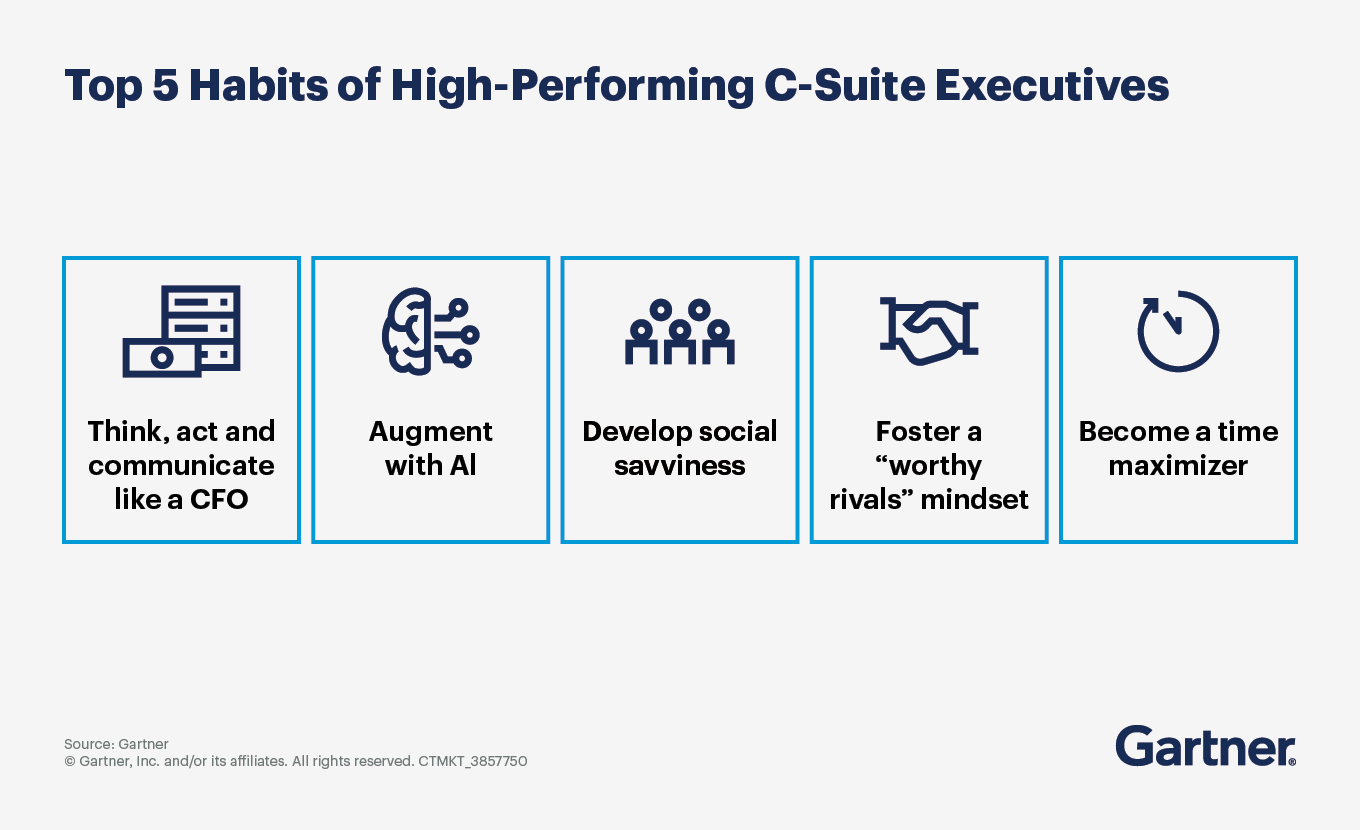

For new C-suite leaders, the pressure to perform is higher than ever
Executive leaders today face constant disruption — from economic volatility and tech advancements to talent challenges and cultural complexity. Amid these growing challenges, every function is expected to help drive company growth.
For executives eager to prove themselves in a new role, the pressure is intensified by the need to perform quickly. Success means being able to cut through the noise, build influence with the CEO, board and peers and drive immediate results.
Learn more about Gartner Executive FastStart™, which gives you full and immediate access to everything you need to make a real impact — right from the start.
To jump-start success in a new C-suite role, focus on shaping your executive presence
Build your influence and cross-functional impact by centering the following behaviors.
Success habit No. 1: Think, act and communicate like a CFO
Seventy-nine percent of C-suite respondents say the CEO is more likely to listen to the CFO than to other members of the C-suite, according to a Gartner survey.
As a New To Role executive, building trust with your CEO is key. Learn directly from your CFO by seeking opportunities to co-lead a strategic objective, or ask them the best way to earn more facetime with the CEO and board. You might also consider canvassing other CFOs from external peer networks.
Another key: Become fluent in finance. Learn to speak the board’s language: ROI, cost savings and revenue growth. Telling a compelling numbers story through balance sheets, income statements and cash flow builds fast credibility with the board and sets you apart from peers.
Success habit No. 2: Augment yourself with AI
Gartner research reveals that 97% of CEOs expect executives to combine human and machine-related capabilities to improve their performance — but only 26% of surveyed C-suite executives say they are comfortable using AI.
To leverage AI’s benefits, start a C-suite community of practice focused on GenAI. Brainstorm, pilot and review AI-driven tasks together to build comfort and collaboration. Pilot projects such as forecasting financials, setting KPIs and conducting a market analysis. Then meet monthly or biweekly to maintain momentum. This cross-functional collaboration boosts both your relationships and productivity.
Success habit No. 3: Build social savviness
As enterprises grow, they increasingly prioritize social skills in C-suite recruitment. Set a socially savvy tone by adapting your language to your peers’ styles. This requires getting to know their styles well enough to discern what type of language will be most influential.
For example: A socially savvy communicator knows when to use “hedge” phrases (e.g., “I think we might be able to …” or “Perhaps we should …”) versus “definite” words (e.g., “We will …” or “Let’s …”) to make a stronger impression. Hedge words tend to land better with amiable or analytical leaders, while definite words are more effective with driver-type leaders.
Success habit No. 4: Foster a mindset of healthy competition
Top-performing executives often act like “worthy rivals,” showing both fierce competitiveness and strong support for their C-suite peers. This healthy balance allows executives to drive each other toward achieving results for the enterprise and motivate one another.
As you become acquainted with your C-suite peers, demonstrate your openness to candid, constructive feedback by initiating 10-minute “truth sessions.” Choose a few colleagues and seek their impressions of you so far. Listen actively to the answers — then review and analyze the feedback to identify any blind spots and come up with a strategy for improvement.
This habit fosters an environment of mutual honesty, trust building and support that creates high psychological safety — a characteristic that is 20% more likely to be present in high-performing C-suites.
Success habit No. 5: Maximize time
Like athletes, executives need a balanced schedule that includes time for rest and recovery. Yet many executives express discomfort with the idea of downtime. This can be especially challenging for New To Role execs who feel pressured to show their commitment.
Maximize your time and minimize potential time-draining activities by taking control of your calendar with intent. Block recurring downtime and mark it as out of office. Unplug regularly –– and direct your leadership team and their teams to do the same. Periodically audit long-standing, serial meetings. If a meeting purpose isn’t clear, challenge and recommend removing it.
Executive presence FAQs
What is executive presence?
Executive presence is how people “experience” a leader — i.e., the hallmark personality and character traits that inspire trust, confidence and action in others. Developing a strong executive presence in a new C-suite role requires a solid understanding of your personal brand, honing your communication style and consistently demonstrating key leadership qualities.
How can executive presence impact a New To Role executive’s performance?
By combining personal brand with effective communication and storytelling, executive presence enables a leader to influence people at all levels — from their teams to senior stakeholders to the board — making it crucial for achieving strategic goals and driving organizational success.
Attend a Conference
Accelerate growth with Gartner conferences
Gain exclusive insights on the latest trends, receive one-on-one guidance from a Gartner analyst, network with a community of your peers and leave ready to tackle your mission-critical priorities.

Drive stronger performance on your mission-critical priorities.