Orchestrating physical AI at scale will deliver more value than deploying individual machines.
- Gartner client? Log in for personalized search results.
Physical AI is about more than just robots
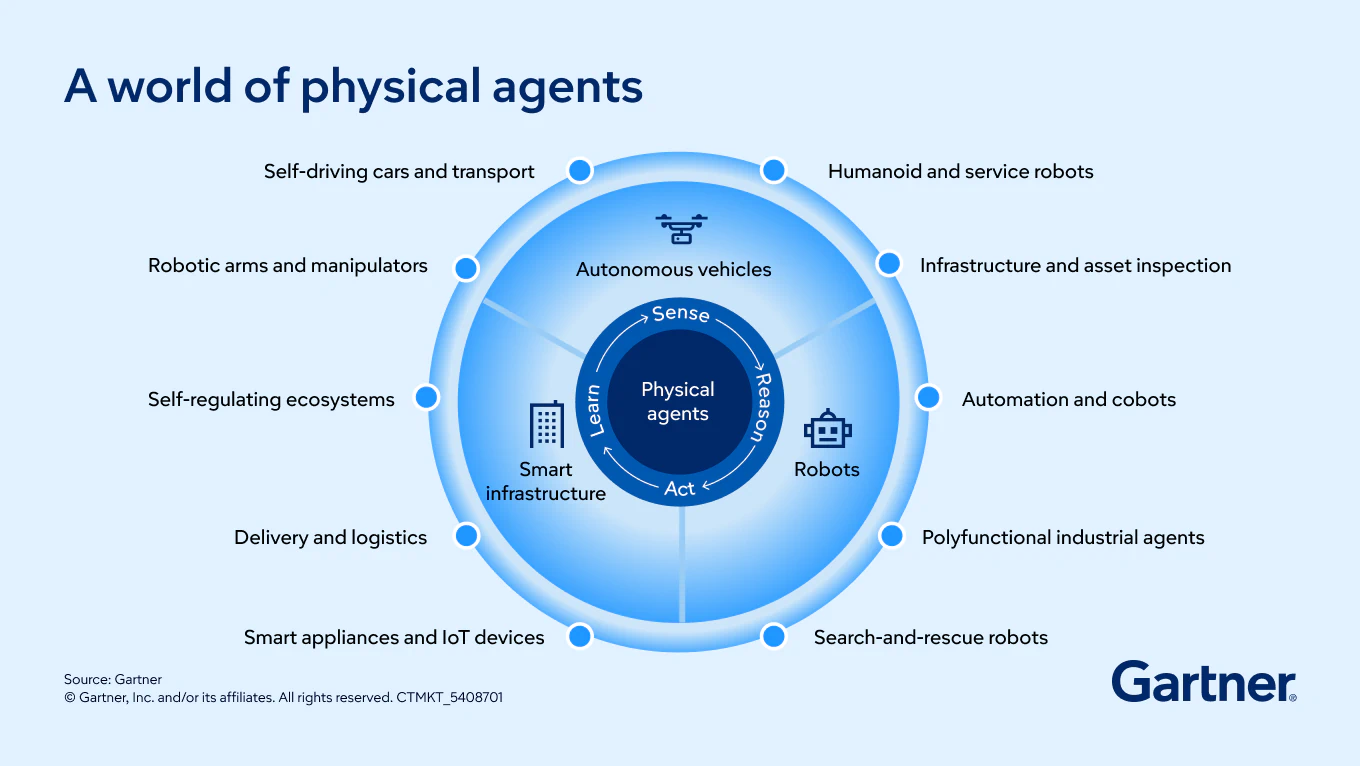
Identified as one of the Gartner Top Strategic Technology Trends for 2026, physical AI (PAI) is a transformative frontier extending AI capabilities from digital-only systems into the real world. It extends far beyond robots to include autonomous vehicles, drones and smart infrastructure. In fact, Gartner predicts that by 2035, AI that cannot physically interact with the world will be obsolete.
The challenge, and potential for value, lies in ensuring those machines act as a safe, coordinated extension of human intent. Unlike digital AI, PAI has no reset button. Failures can have real-world consequences, making governance and coordination as important as intelligence.
“The risks involved in physical AI aren’t theoretical. We’ve already seen expensive failures and injured people, where AI has been deployed without appropriate orchestration,” says Bill Ray, Distinguished Vice President Analyst at Gartner.
You might also like this webinar: Humans, Machines and the Marketing Org: How AI Rewrites Roles, Workflows and Culture


From breakthrough technology to competitive advantage
As physical AI expands into more environments, leaders must shift their attention from individual devices to the systems that coordinate them.
PAI is becoming an ecosystem, not a product
Advances in vision-language-action models, multimodal sensing and intelligent simulation are allowing autonomous systems to operate in increasingly unstructured environments without specialized infrastructure. This growing ecosystem of physical agents is capable of perceiving, reasoning and acting in the real world. Major market accelerators fueling the progress of PAI include:
Support for dynamic environments. Healthcare organizations are already deploying robots to carry laboratory samples and pharmacy medications through (and between) hospitals.
Sovereign powers. Nation-states are investing in military use cases, such as combat drones, loitering munitions and uncrewed ground vehicles (UGVs) to secure domestic infrastructure.
Regional protectionalism. Sovereign countries are also investing heavily in PAI production and programming, placing limits on foreign vendors and boosting domestic manufacturing.
Consider the true cost of PAI
For organizations looking to gain a true competitive edge in PAI, defining and measuring the enterprise value of the outcome PAI will achieve is key — not just the hardware price, but the ongoing costs of facility retrofitting and software integration. Simply investing in a single-task machine can require redesigning facilities and workflows around the technology rather than deploying it within existing operations.
The supporting architecture is the first step, but you’ll also need to define your organization’s legal liability, moral responsibility and kinetic accountability. The only way to guarantee safety at scale, and ensure every autonomous action remains a safe extension of human intent, is to fundamentally integrate those guardrails into your deployment strategy from Day 1.
Lead with orchestration
To build elastic autonomy, leaders across the organization must commit to these trade-offs:
CIOs/IT leaders:
Focus on augmenting employees, not replacing them.
Prioritize investments in modular, reusable control policies; edge processing; simulation for validation; and proactive regulatory engagement.
Diversify and track your hardware supply chain to protect against geopolitical disruption and upstream scarcity.
Business leaders:
Reject siloed purchases and mandate top-down orchestration using open standards.
Define strict business cases, exact ROI targets, failure criteria and accountability before deployment.
Deploy early-stage polyfunctional robots into existing semistructured workflows and expand autonomy, as applicable.
Tech providers:
Shift from selling capital hardware to integratable platforms.
Multisource components to overcome geopolitical roadblocks and supply chain constraints.
Deliver complete ecosystems that merge hardware with overarching intelligent governance and orchestration software.
Building elastic autonomy is an important step in the broader mission-critical priority of driving technology innovation. PAI is creating new opportunities for automation and operational improvement, but sustainable advantage will come from establishing the command-and-control foundation required to scale these technologies safely and efficiently.
Physical AI FAQs
What is elastic autonomy in physical AI?
According to Gartner, elastic autonomy refers to the ability to coordinate PAI through top-down command-and-control systems, which can scale to include hardware and systems across vendors. Organizations use this approach to ensure autonomous actions remain aligned with human intent while scaling across multiple physical agents and environments.
How should leaders approach PAI adoption?
Gartner recommends first focusing on orchestration, by building governance, accountability and command-and-control capabilities before scaling deployments. Leaders should focus on modular control policies, simulation-based validation and deploying PAI within existing workflows whenever possible.
Attend a Conference
Experience Information Technology conferences
With exclusive insights from Gartner analysts on the latest trends, sessions curated for your role and unmatched peer networking, Gartner conferences help you accelerate your priorities.
19 – 22 Oct 2026
Gartner IT Symposium/Xpo™
Orlando, FL

Drive stronger performance on your mission-critical priorities.