Learn six tech-driven capabilities to transform your approach to reputation management in a digital-first, AI-mediated world.
- Gartner client? Log in for personalized search results.
An AI world demands tech-centric reputation management
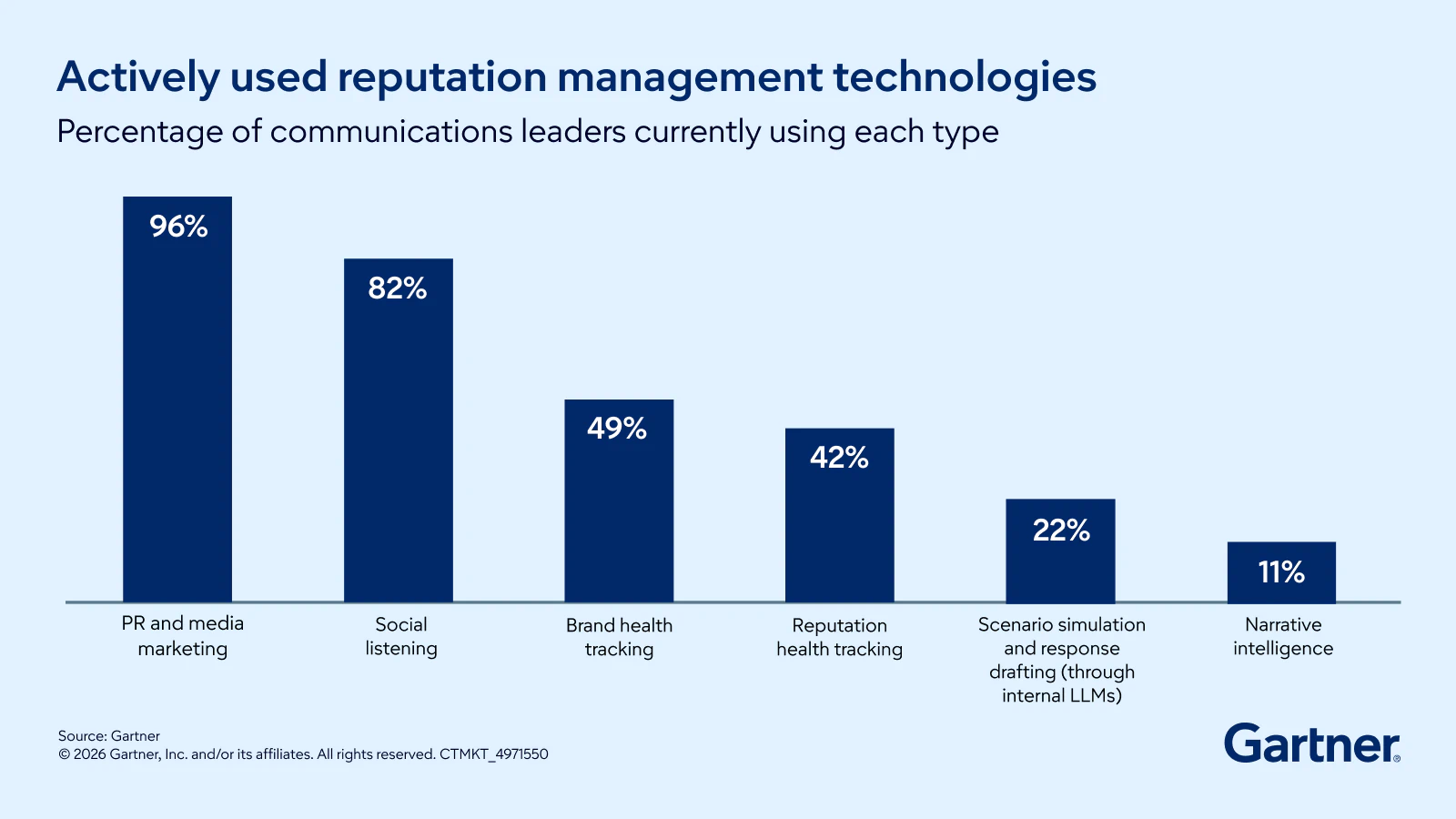
Reputation management is central to a CCO’s value. Traditionally, it has centered on strong messaging — crafting compelling narratives, placing them in the right channels, and responding quickly and consistently in a crisis. But as the information ecosystem becomes faster, more data-driven and shaped by answer engines, communications leaders must prioritize the tech dimensions of reputation management. Otherwise, even great messages risk being undiscoverable, or reaching audiences after the narrative has been shaped by others. Yet communications leaders lag in adopting tech-enabled capabilities like scenario simulation (22%) and narrative intelligence (11%). While AI is making familiar technologies like social listening dramatically more powerful, these newer capabilities are increasingly essential.
You might also like this webinar: Transforming Communications for an AI-Enabled World
Six capabilities for tech-centric reputation management
To build and protect reputation, CCOs must prioritize six newer tech-enabled capabilities that represent the new frontier of reputation management.
Answer engine presence
Answer engines — including AI search and large language models — now curate what audiences see first. Reputation management depends on shaping the signals, data and narratives these systems surface. It also depends on communications’ ability to consistently monitor how their brand is appearing in results across the major AI search platforms.
Narrative intelligence
Tracking how stories form, travel and gain traction across the digital ecosystem allows CCOs to see reputation building in real time. This positions them to actively shape reputation, rather than simply tracking it. Early signal detection helps communications leaders spot issues while they’re still manageable. It also helps amplify positive narratives as they pick up momentum and ensures proactive announcements land at the right moment. Most importantly, narrative intelligence tools also illuminate human versus bot activity.
Predictive analytics
Where narrative intelligence tells CCOs what is forming, predictive analytics reveals where things are heading. AI models can analyze patterns across both historical and real-time data to forecast how a reputational situation is likely to evolve. Work with your vendors to ensure your team can act on these forward-looking signals and not just react to what’s already happened.
Content authenticity labeling
CCOs need a strategy to label their outgoing content to make it clear to both human and machine audiences — including increasingly sophisticated deepfake detection technologies — that their content is authentic. Regulators, platforms and AI vendors are all moving toward authenticity and authenticity standards, and CCOs who move on this now are proactively managing trust while hedging against reputational, credibility and legal exposure down the line.
Synthetic audience simulation
AI models trained on real-world behavioral data can simulate audiences with an accuracy that at times outperforms actual audience response. CCOs are highly valuable to their organizations in large part due to their understanding across the full suite of audiences, and synthetic audience simulation opens access to an entirely new level of audience expertise, available at the speed of communications.
Reputation impact measurement
AI is making progress against the age-old question of how reputation impacts the business. Emerging models can continuously ingest signals to more directly connect reputation drivers to tangible business outcomes, identifying which drivers are under pressure, which direction they are moving in and how quickly.
What to do next to effectively manage reputation
Updating reputation and crisis management plans, playbooks and messaging strategies is just one of several imperatives that CCOs must navigate to fully deliver on the mission‑critical priority of managing reputation amid AI-fueled truth decay. The other steps in this journey include:
Building relationships with cross-functional partners to coordinate and manage reputation threats and opportunities
Building team reputation management capabilities to detect, assess and effectively respond to reputation threats and opportunities
Identifying the most critical reputation risks to manage through landscape analysis, risk assessments and scenario planning
Reporting to the executive leadership team and board via briefings that outline current reputation health, emerging risks and recommended strategic actions
Tech-enabled reputation management FAQs
How can CCOs use answer engines to improve reputation management?
Answer engines curate what audiences see first. Monitoring and shaping your presence on AI search and large language models helps ensure accurate, positive narratives reach stakeholders. CCOs should regularly review and report on how major AI systems describe their company, leaders and key issues.
Why is content authenticity labeling critical for CCOs?
Labeling content with credentials, watermarks and AI disclosures signals trust to both humans and machines. As regulators and platforms adopt authenticity standards, CCOs who lead coordinated labeling efforts reduce legal and reputational risk — and protect credibility with stakeholders.
How does synthetic audience simulation benefit reputation management?
Synthetic audience simulation lets CCOs test communications strategies quickly and reliably. By using AI models trained on real-world data, you can predict audience reactions, refine messaging and support leadership decisions — all at the speed of communications.
Attend a Conference
Accelerate growth with Gartner conferences
Gain exclusive insights on the latest trends, receive one-on-one guidance from a Gartner analyst, network with a community of your peers and leave ready to tackle your mission-critical priorities.

Drive stronger performance on your mission-critical priorities.