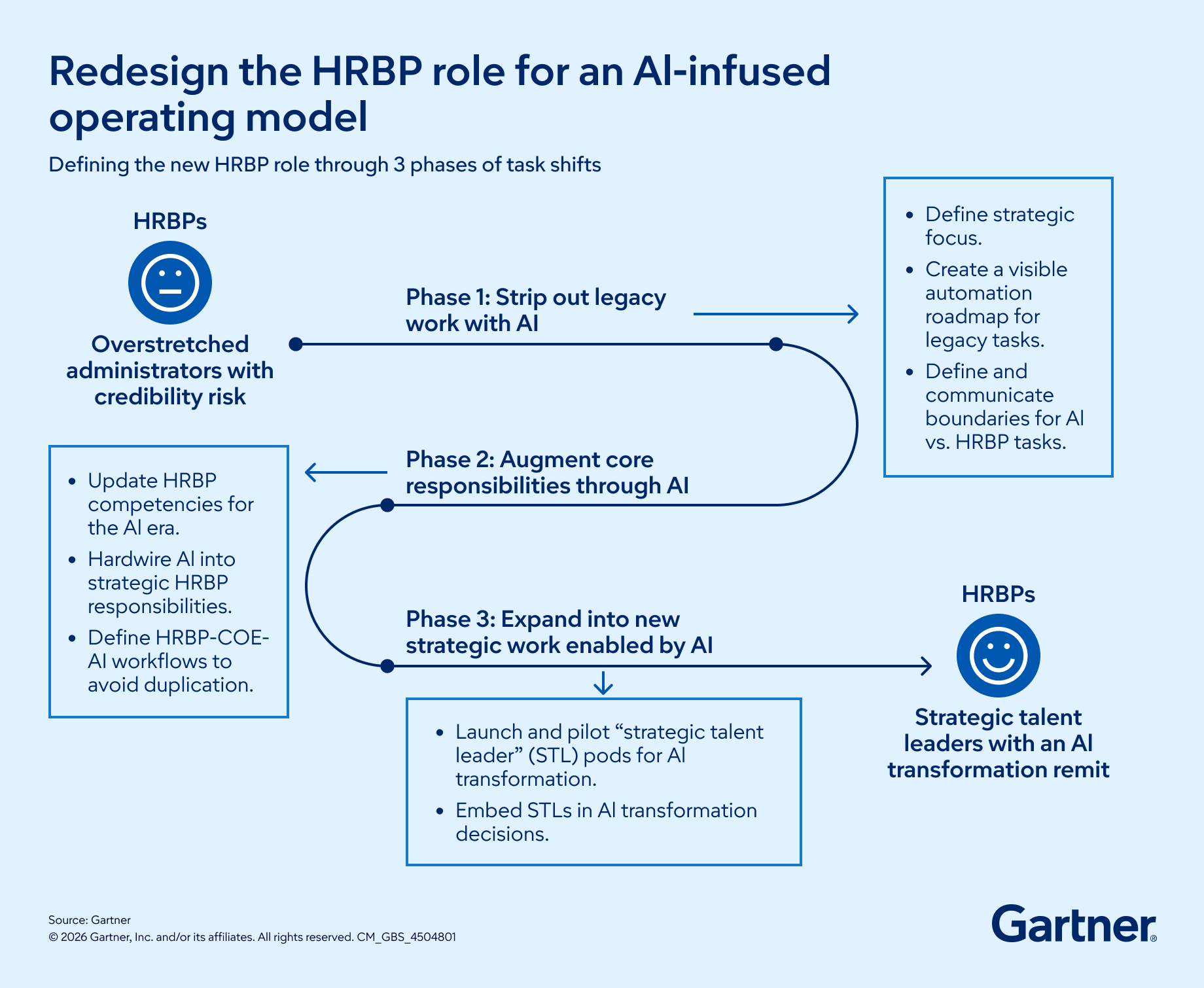
The HRBP role is at an inflection point as AI reshapes how HR delivers value to business.
Only 51% of HR and business leaders today agree that their HRBPs are involved in important strategic discussions. For the rest, HRBPs remain tied to transactional work that AI is already beginning to absorb (e.g., drafting job descriptions, summarizing engagement data, answering policy FAQs). Even the HRBPs seen as “strategic” face the risk of being underleveraged, as AI duplicates tasks they once owned, or their work no longer shapes business outcomes.
CHROs cannot afford to leave the HRBP role unchanged, as it is their most visible, business-facing role. They must redefine it to secure HR’s relevance as indispensable strategic partners in an AI-infused enterprise.
The HRBP of the future should be strategic talent leaders (STLs) with an expanded remit as “AI transformation consultants.”
HRBPs as strategic talent leaders are responsible for identifying the most pressing talent opportunities, aligning with business units, and owning the talent agenda for their business unit. With AI, this role expands into directly guiding the people side of AI-driven transformation, including:
- Guiding workforce redesign as AI transforms roles (e.g., deciding when to reskill, redeploy or phase out jobs).
- Addressing bias and ethics in AI-enabled people decisions.
- Shaping human-machine collaboration to ensure productivity gains do not come at the expense of engagement.
HRBPs already sit closest to business leaders; with AI, their remit extends from translating people strategy to actively guiding AI transformation.