Balance autonomy with reliability, accountability and governance to create more value from AI agents.
- Gartner client? Log in for personalized search results.
The push for autonomous agents is moving faster than enterprise readiness
AI agents have become the next frontier of enterprise AI, fueling expectations that they will automate decisions, orchestrate workflows and operate with minimal human involvement. Yet while more than 90% of IT leaders believe AI agents will deliver significant productivity benefits, Gartner predicts that by the end of 2027, 40% of agentic AI projects will be canceled because of escalating costs, unclear business value or inadequate risk controls.
“The challenge is not creating more capable AI agents. It’s creating agents that are reliable enough to earn greater autonomy while operating within clear accountability and governance boundaries. Organizations that move too quickly toward full autonomy risk discovering that scale amplifies cost, security exposure and unpredictable failures,” says Erick Brethenoux, Distinguished Vice President Analyst at Gartner.
You might also like this webinar: How to Scale AI Agents Without Losing Control
Why autonomy creates new risks as agents scale
AI agents can perform increasingly sophisticated work, but enterprise adoption is running into a reality that many organizations underestimate: Greater autonomy also introduces greater risk. The challenge is not whether agents can act. It’s whether organizations can trust them to act consistently, safely and accountably.
Reliability limits where agents can operate today
Most AI agents are not reliable enough to operate autonomously in complex or business-critical environments and are best suited for scenarios where several outcomes may be acceptable and the impact of errors can be contained.
This creates a narrower opportunity than many leaders expect. Currently, agents can support activities, such as ideation, software development efforts and flexible workflow automation, where human oversight can help manage mistakes. They are far less suited to situations where only one correct answer exists or where errors could create significant business, safety or legal consequences.
Accountability remains a human responsibility
As organizations expand the use of AI agents, they face a challenge that technology alone cannot solve: accountability. Agents can perform work, make recommendations and trigger actions, but they are not legal entities and cannot be held responsible for the consequences of those actions.
Without clear human accountability, the risks quickly multiply. An agent can make an incorrect decision, expose sensitive information or trigger unintended actions, but responsibility for the outcome still falls to people and organizations. This is one reason Gartner predicts that through 2028, more than 50% of AI initiatives will halt because of unresolved agentic identity challenges.
For leaders, this means human accountability cannot be removed from the process. As agents take on more work, organizations must establish stronger oversight rather than assuming technology can govern itself.
Focus on the Goldilocks zone for AI agent value
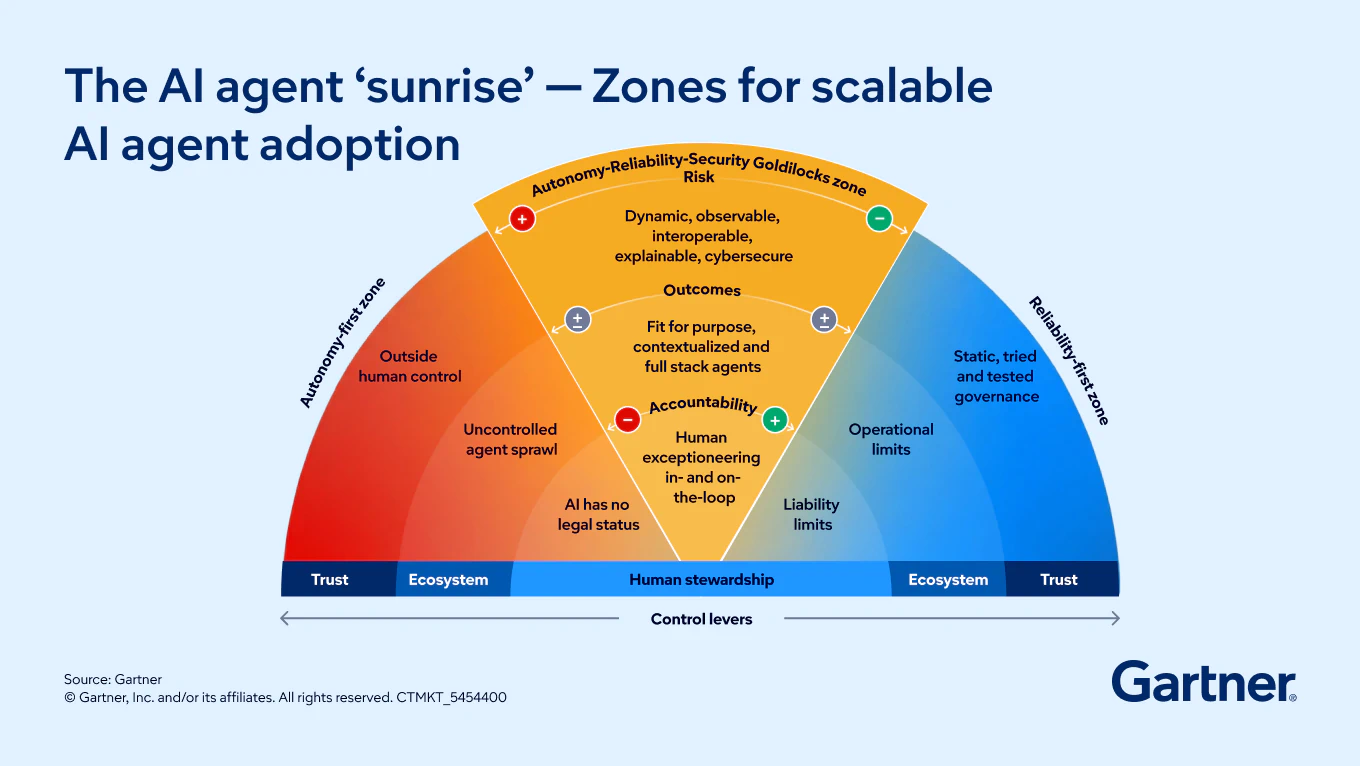
Organizations do not need to wait for fully autonomous agents to create value. Take the following steps to identify a “Goldilocks zone” where reliability and risk are appropriately balanced.
Determine the type of AI agent required based on work scope. Personal agents support individual users, while process and role agents operate across increasingly complex workflows and organizational processes.
Design for human exceptioneering. Orchestrate autonomy within strict architectural guardrails.
Plan to fail. Agentic resilience comes from mitigation and recovery, not just failure avoidance.
Prioritize full-stack foundations. AI agents built on a full-stack composite architecture will hold operational integrity far better than independently optimized agents.
Continually assess reliability. Systemically measure an agent’s ability to generate outcomes that are accurate, consistent, traceable, autonomy robust, predictable and safe.
AI agent reality check FAQs
What is the biggest risk with AI agents?
The biggest risk is deploying agents with more autonomy than their reliability supports. Gartner predicts that by the end of 2027, 40% of agentic AI projects will be canceled because of escalating costs, unclear business value or inadequate risk controls.
What is the Gartner Goldilocks zone for AI agents?
The Goldilocks zone refers to use cases where AI agents can deliver meaningful business value while keeping risk and accountability concerns manageable. These are typically scenarios with multiple acceptable outcomes and clear human oversight.
How should organizations govern AI agents?
Organizations should maintain human accountability, define supervision roles, continuously measure agent reliability and establish governance, security and oversight mechanisms that can scale as agent use grows.
Attend a Conference
Accelerate growth with Gartner conferences
Gain exclusive insights on the latest trends, receive one-on-one guidance from a Gartner analyst, network with a community of your peers and leave ready to tackle your mission-critical priorities.

Drive stronger performance on your mission-critical priorities.