Most AI initiatives don’t fail because the technology doesn’t work. They fail because no one owns the outcome.
- Gartner client? Log in for personalized search results.
How C-suite executives should use AI every day
Over 80% of organizations report no measurable ROI from AI investments, according to Gartner polling. The executives behind the enterprises getting the greatest returns are using the technology daily — in forecasting, in decision making and in how they hold their teams accountable for outcomes. Each C-suite leader, from the CEO to CIO to CFO to CHRO, has a distinct role in turning AI results into permanent organizational change.
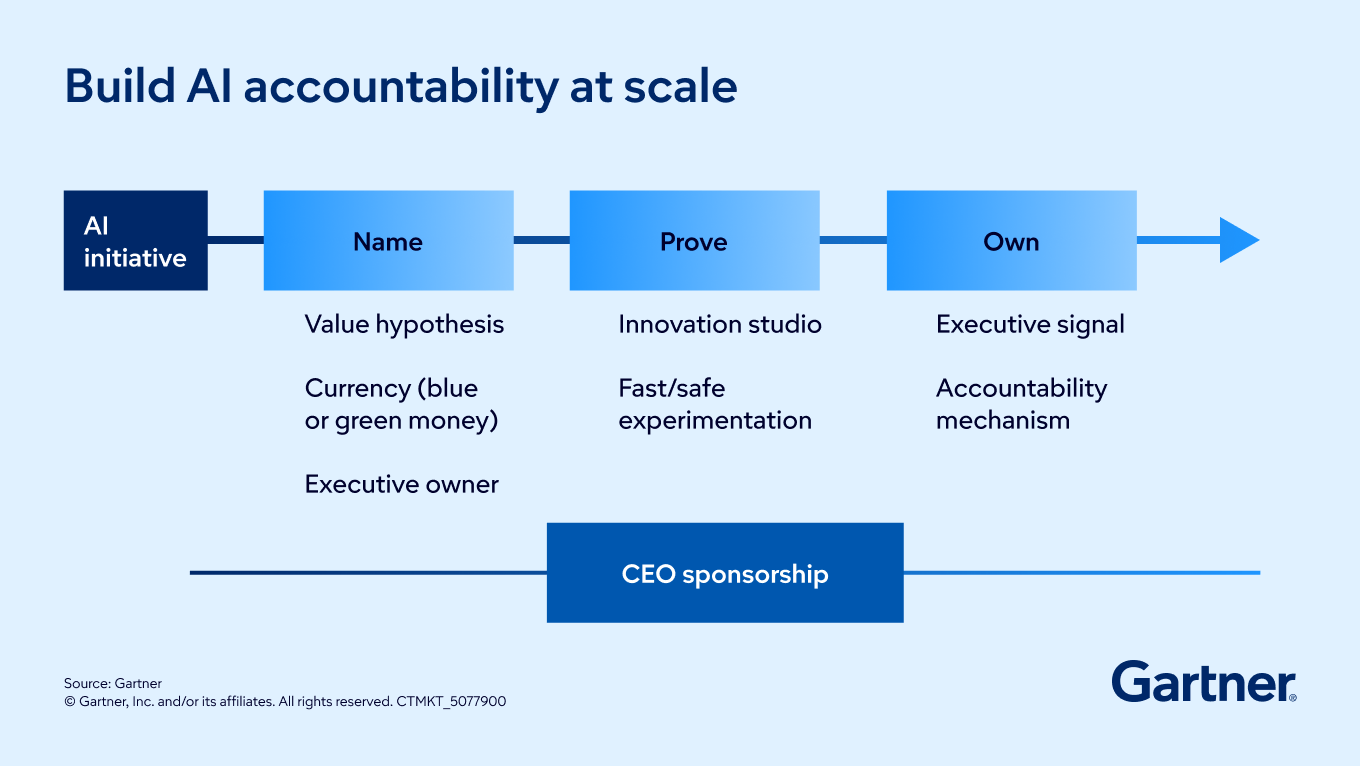
Build AI accountability at scale across the C-suite
Only 21% of C-suite executives are truly AI-savvy, yet 91% admit to overstating their AI knowledge, according to Gartner insights. Yet each C-suite leader plays a unique role in AI success. Everyday actions are an important part of this.
Start with the Name-Prove-Own framework for every AI initiative
This is a political framework that shifts AI accountability from the IT org chart into the boardroom.
Name: Identify the business value and owner before investment. AI projects with a named executive owner are more likely to deliver ROI. Before any resources move, define what success looks like — cost savings (blue money) or revenue growth (green money) — and put a specific leader’s name on it.
Prove: Test AI value in a real-world scenario. Don’t scale anything until you’ve proven it works. Build a proving ground. This means a structured environment where executives test AI against real data, with real stakes. Short pilots with clear success metrics both stop bad ideas early and give good ideas the credibility to scale.
Own: Set signals and formal accountability for outcomes. Clear accountability increases AI value realization. That means proving value is about half the job. The other piece is making sure someone remains accountable when the pilot ends.
By preagreeing on the framework, you set the rules without inheriting a mess and avoid endless blame games and zombie AI projects.
How CEOs should use AI: Champion AI value and resolve barriers
The difference between a Name-Prove-Own framework that holds and one that gets quietly abandoned is often whether the CEO is on record before the first impasse.
Operationalize this through existing one-on-one meetings and steering committee discussions rather than a new governance construct. Present the naming discipline, the proving ground and the signal logic as a standing agenda item. When an impasse occurs, it’s up to the CEO to go on record. This protects every executive involved and sets the conditions for executing a preagreed business decision based on terms the C-suite already set.
How CIOs should use AI: Build safe AI environments and enable ownership
As CIO, you create the “proving ground” for AI. Your job has grown from “keeping the lights on” to ensuring executives can experiment without blowing a fuse. Build environments where C-suite colleagues get speed, resources, access to data, support with tools and a clear path to scaling.
Think of it like this: You can’t hold leaders accountable for outcomes if you never gave them the tools to win. Accountability kills innovation when it lands too soon. Nearly two-thirds of organizations report that lack of enablement is the top barrier to AI value realization. This creates a culture of risk aversion and finger-pointing.
A proving ground sets CIOs as innovation peers who have built the table everyone wants to sit at.
How CFOs should use AI: Track real business value, not just cost
AI promises are easy. Measuring them is the CFO’s job. Focus on green money — revenue and profit — not just efficiency gains. Use AI to sharpen forecasting and surface risk before it surfaces on its own. Link AI metrics directly to financial goals, and shift the conversation from “did IT deliver?” to “did the business convert?” When other executives claim value, make them prove it.
How CHROs should use AI: Upskill leaders and embed AI in workflows
Organizations with AI-ready talent are more likely to sustain results. CHROs are in the position to close the gap between executives who know AI matters and leaders who actually use it.
Whereas a CIO sets up an AI resource technically, CHROs certify the receiving team’s workflows, roles, metrics and accountability have been redesigned to accommodate. Hold the gate on scaling enterprise deployment until you can confirm team readiness. And, in the meantime, build AI fluency into development programs and embed AI tools into day-to-day work before you ask anyone to champion them.
FAQs about executive use of AI
How should C-suite executives use AI to drive business value?
To use AI to drive business value, start with a value hypothesis tied to a named owner. Test it in a real environment before scaling. Then formalize accountability so results outlast the initiative. The executives who get the most from AI treat it like any other capital investment: named, measured and owned.
What is the best AI framework for C-suite leaders?
The Name-Prove-Own AI framework does one essential thing: It moves AI accountability off the IT org chart and into the boardroom. Each phase has a clear trigger and a clear owner. That’s what separates AI initiatives that scale from ones that stall.
How can CEOs, CIOs, CFOs and CHROs use AI daily?
Each C-suite role has a distinct lever to pull with their daily AI use. CEOs make AI a visible organizational priority and remove the friction that stalls it. CIOs build the governed environments where fast experimentation is possible. CFOs enforce the discipline that separates real value from theater. CHROs close the gap between knowing AI matters and actually using it.
Attend a Conference
Accelerate growth with Gartner conferences
Gain exclusive insights on the latest trends, receive one-on-one guidance from a Gartner analyst, network with a community of your peers and leave ready to tackle your mission-critical priorities.

Drive stronger performance on your mission-critical priorities.