Tech vendors that balance urgency with strategic clarity are better positioned to stay relevant as markets evolve.
- Gartner client? Log in for personalized search results.
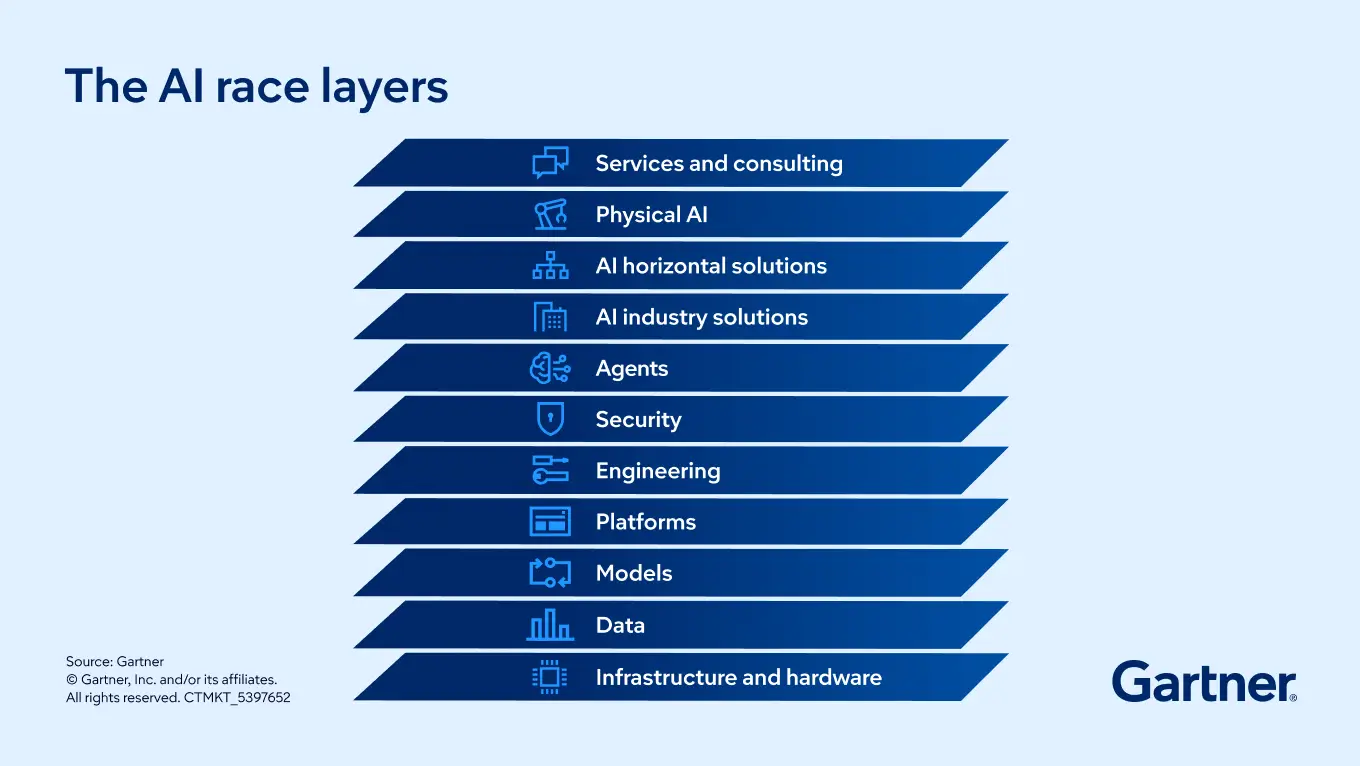
The AI race is becoming a strategy test
Product and services leaders need more than speed to pull ahead of their competitors in the AI race. As the market shifts from the digital supercycle to the intelligence supercycle, leaders face growing volatility across technology, buyer expectations, regulation and economics. In this environment, speed without direction can create more risk than opportunity.
The challenge is that organizations must respond to intense pressure to act while navigating uncertain outcomes. Gartner finds that 88% of AI value realized today by CIOs is attributed to time savings, compared to only 5% from cost savings and 6% from increased revenue. At the same time, CFO confidence in driving enterprise AI impact is reportedly as low as 36%. The result is a widening gap between expectations and measurable business outcomes.
You might also like this webinar: Domain AI Is Taking Over: How Tech Providers Capture Value Beyond Horizontal Offerings
How leaders can compete in volatile AI markets
Product leaders must balance urgency with clarity. “Prior experience in the market has limited value in the AI race — what got you here won’t get you there. To win, you need a new strategy and operating model: One that can accommodate many — and often turbulent — variables,” says Errol Rasit, Practice Vice President at Gartner. According to Gartner findings, there are several conditions that will separate long-term winners from organizations that simply follow the latest AI trend.
Understand the conditions shaping the race
The AI race is taking place in a highly dynamic environment. Success depends on understanding changing market conditions, including evolving ecosystems, competitive shifts, economic volatility, regulatory changes and unclear buyer needs.
Market landscapes are changing quickly as established vendors and AI-native newcomers compete for advantage. Leaders cannot rely on fixed assumptions about competitors or customer demand. Instead, product leaders must continuously reassess their position and monitor changes that could strengthen or weaken their competitive standing.
A strong understanding of market conditions also helps leaders make better investment decisions. As uncertainty increases, a robust data foundation provides strategic clarity and helps organizations prioritize investments that align with real business opportunities.
Avoid the trap of chasing AI hype
Customer expectations and solution capabilities are increasingly diverging as AI hype grows. Organizations that pursue AI initiatives without clear end-user demand risk wasting resources and diminishing morale. Rather than relying on industry buzz, leaders should regularly recalibrate strategy based on genuine market needs.
This is particularly important as AI market economics continue to evolve. Gartner predicts that AI spending will reach $4.7 trillion by 2029, up from $1.8 trillion in 2025. However, traditional provider-enterprise value relationships will not drive AI adoption. Simply delivering an AI feature or tool is unlikely to create sustained value. Product leaders must focus on outcomes that buyers actually want to achieve.
Build readiness for long-term relevance
The organizations most likely to succeed will be those that prepare for enterprise-scale AI adoption. To meet this challenge, providers must address readiness across infrastructure, data and human capabilities while also responding to buyers’ increasing focus on outcomes.
Leaders should also recognize obstacles that can slow progress, including technological immaturity, rising compute costs, legacy systems and rigid data architectures. These factors can hinder innovation even when AI ambitions are high. Tech vendors must also navigate evolving ethical, regulatory and compliance requirements. Organizations that fail to adapt could face costly penalties that undermine their market position.
Ultimately, the AI race is not a sprint. Leaders who combine strategic focus with adaptability will be better positioned to capture market share and remain relevant as AI reshapes technology markets.
AI vendor race FAQs
What is the biggest challenge in the AI vendor race?
According to Gartner, the biggest challenge is navigating volatile market conditions while maintaining strategic clarity. Product leaders must balance pressure to act with uncertainty around buyer needs, regulations, competitive dynamics and measurable business outcomes.
Why is speed not enough in the AI vendor race?
Success requires more than rapid execution. Leaders also need agility, clear strategic direction and the ability to adapt to changing market conditions. Chasing AI hype without customer demand can waste resources and weaken competitive positioning.
How will the AI vendor race affect technology markets?
Gartner predicts that enterprise-scale AI adoption will increase AI spending from $1.8 trillion in 2025 to $4.7 trillion by 2029. AI market economics will reshape how technology is valued and how providers create and capture business value.
Attend a Conference
Accelerate growth with Gartner conferences
Gain exclusive insights on the latest trends, receive one-on-one guidance from a Gartner analyst, network with a community of your peers and leave ready to tackle your mission-critical priorities.

Drive stronger performance on your mission-critical priorities.