An AI-native business model is a framework for embedding AI at the core of how a business creates, delivers and captures value.
- Gartner client? Log in for personalized search results.
What “AI-Native” Means for Enterprise Organizations
By Daniel Sun | July 14, 2026
What does “AI-native” mean for enterprise organizations?
An AI-native business model, which is gaining momentum within the technology vendor community, particularly among startups, puts AI at the center of an organization’s core products, services and operations. Whereas traditional organizations use AI to enhance existing operations, AI-native businesses are designed from the outset with AI at their core.
Gartner anticipates the AI-native movement will quickly extend beyond technology vendors to encompass enterprises across all industries. Start by systematically assessing AI adoption across individual elements — including channels, ecosystems and partnerships, supply chain, operations and customer engagement — to identify where AI is already delivering value and where gaps remain. This helps enable the strategic and coordinated approach an AI-native business model demands.
How enterprises can move toward AI-native business models
Enterprises can successfully advance toward AI-native business models by selecting the action items most relevant to their current situation and developing a systematic, phased approach that allocates resources, sets milestones and tracks progress over time.
Step 1: Assess and visualize the current level of AI nativeness.
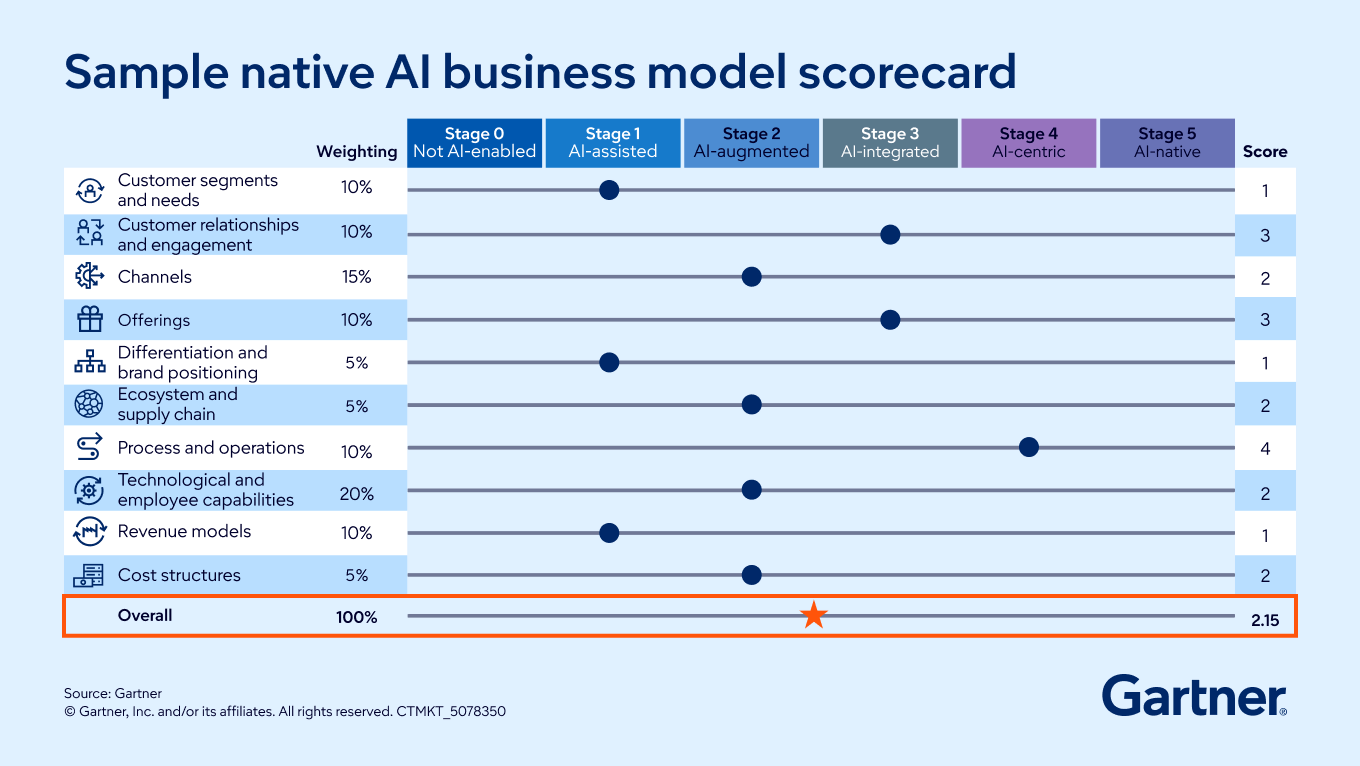
The image above shows a sample AI-native business model scorecard, which visually tracks progress across all business model components and calculates an overall AI nativeness maturity score. Importantly, the scorecard weights each component based on strategic importance, reflecting the fact that different industries have different priorities. This approach ensures that organizations advance the components most critical to their success as they progress through the stages of becoming AI-native.
Stage 0 (Not AI-enabled): Product/service delivery relies on traditional, static channels without AI.
Stage 1 (AI-assisted): AI supports isolated channel activities, such as basic website recommendations or automated order tracking. Channel selection and management are largely manual.
Stage 2 (AI-augmented): AI enhances channel operations by optimizing content delivery, suggesting channel improvements or automating some digital touchpoints. Human decision making remains central.
Stage 3 (AI-integrated): AI is integrated into channel management, enabling data-driven allocation of resources across channels and seamless customer experiences across touchpoints.
Stage 4 (AI-centric): AI is central to channel orchestration. It manages channel selection, timing and personalization in real time to ensure optimal delivery and engagement.
Stage 5 (AI-native): Channel strategy and execution are fundamentally AI-driven. AI autonomously creates, adapts and optimizes channels, blending digital and physical experiences.
Step 2: Senior business management defines AI ambition.
CIOs and other innovation leaders should share real-world examples of AI-native business models to help fellow executives understand how AI creates value beyond traditional technology. Presenting the stages of AI nativeness supports strategic discussions and clarifies the organization’s vision and ambition for AI. Leadership alignment is crucial for setting goals, securing buy-in and ensuring cross-functional support.
Step 3: Align AI-nativeness across business model components.
Move beyond overall business model evaluation by breaking down key components, such as channels, supply chain, operations and monetization. Assess the current stage of AI nativeness for each and prioritize actions where AI can deliver the most value.
Step 4: Develop a targeted roadmap for AI initiatives.
Build on assessments and leadership input to create a three to six-month roadmap with quick wins and foundational projects. Prioritize initiatives that build capabilities, deliver measurable value and support scaling. Continuously review and adapt the roadmap as AI maturity and market dynamics evolve and in service of your desired AI outcomes.
AI-native FAQs
What is an AI-native business model?
An AI-native business model is one where AI is embedded at the core of how a business creates, delivers and captures value — making AI inseparable from the company's products, operations and competitive advantage. Rather than adding AI as a tool to improve existing processes, AI-native companies are fundamentally built around AI, which is part of their foundational DNA.
How does an AI-native business model differ from AI-native business?
In an AI-native business model, AI is fundamental to the organization’s value proposition, differentiation and scalability. This is distinct from AI-native business, which refers to an actual organization that is built around and operates according to such a model. Unlike traditional organizations that use AI to enhance existing operations, AI-native businesses are designed from the outset with AI at their core.
How can businesses enable AI-native business models?
Organizations may pursue AI nativeness in a variety of ways. Some aim to transform their entire enterprise, while others begin with individual business units, launch digital spinoffs or acquire AI-native companies to bring advanced capabilities into their business models. For example, a bank might transition a business unit into a digital spinoff that functions as an autonomous platform, where AI designs financial products (such as reactivating dormant customers) and manages customer interactions — all driven by self-learning systems.
Attend a Conference
Accelerate growth with Gartner conferences
Gain exclusive insights on the latest trends, receive one-on-one guidance from a Gartner analyst, network with a community of your peers and leave ready to tackle your mission-critical priorities.

Drive stronger performance on your mission-critical priorities.