AI seasons are changing — leaders must prepare for what comes after AI spring.
- Gartner client? Log in for personalized search results.
Understanding the four AI seasons helps leaders pressure-test strategies
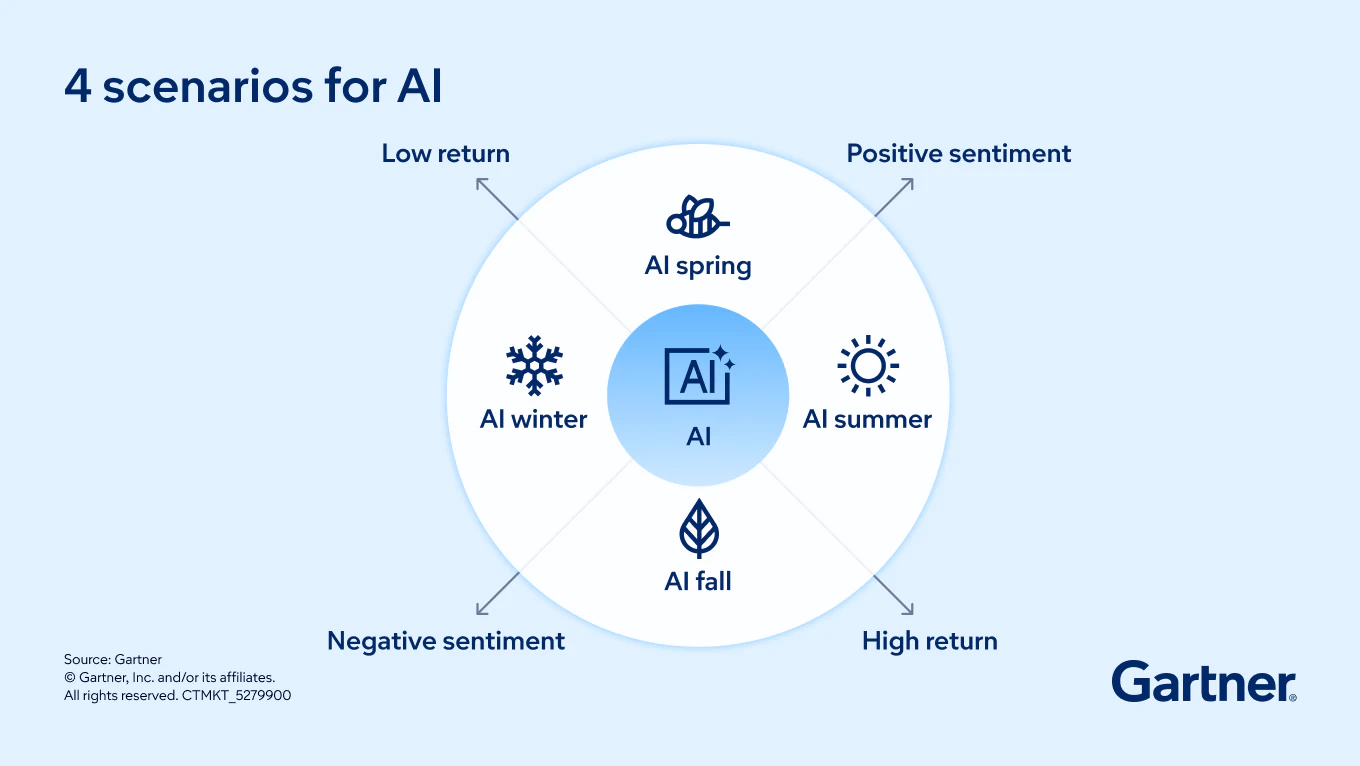
The future of AI is no longer a question of whether innovation will continue. The bigger question is: What kind of environment will organizations face as AI matures? The Gartner AI seasons framework offers executive leaders a way to pressure-test their AI strategies against multiple possible futures.
The framework evaluates AI through two variables: returns and sentiment. Returns reflect whether AI delivers meaningful business and societal value. Sentiment reflects how businesses, governments and society feel about AI’s role in the future. Together, these forces create four possible AI seasons: spring, summer, fall and winter.
AI seasons: Four scenarios to guide executive decisions
The next stage for AI is not predetermined, and organizations could experience multiple paths between periods of growth, consolidation and stagnation. Leaders who understand the four possible scenarios will be better positioned to anticipate change and shape their next moves strategically.
AI spring: Innovation blooms but ROI remains elusive
AI spring is marked by rapid innovation and optimism, but business value is often unclear. Many organizations experiment without a clear vision. According to Gartner Vice President Analyst Pieter den Hamer, “Forty percent of executives could not identify the new revenue streams AI is creating.” Meanwhile, 62% of global strategists expect the world to be worse off in a decade, signaling the end of this season.
AI summer: High returns, high impact
AI summer brings transformation, with high ROI and positive sentiment. Businesses and society benefit as further AI breakthroughs emerge. Seventy-nine percent of executives expect autonomous business to dominate by 2030 while Gartner forecasts AI software spending will reach $1.2 trillion by 2030.
AI fall: Consolidation and mistrust
AI fall is a season of consolidation and growing mistrust. Innovation continues, but a few large providers dominate, raising barriers to entry. Returns are high but concentrated and AI becomes a tool for power, and negative sentiment spreads. The goal of this season is to consolidate power, which is indicated by signals like the rise of an AI oligopoly, software stock volatility and increased use of AI in geopolitics.
AI winter: Stagnation and backlash
In AI winter, innovation slows and trust erodes. The benefits of AI no longer outweigh the costs, and society pushes back. High-profile failures and local opposition to data centers signal this season. Still, winter can be a time to regroup and prepare for renewal.
The next season of AI
There are three paths forward. The most probable is a shift from AI spring to AI fall, driven by negative sentiment and the use of AI for consolidating power. The most desirable is a direct transition to AI summer, where positive use and high returns prevail. Leaders should also prepare for a possible AI winter if the AI bubble bursts.
How executive leaders should respond to shifting AI seasons
C-suite executives must act now to navigate AI’s changing seasons.
Mitigate the risks of AI fall by uniting across the industry to support responsible AI, diversifying technology providers and accelerating in-house AI capabilities. Develop a strategy for AI sovereignty to address regional challenges.
Seize the opportunity of AI summer by committing to an AI-first business model. Identify core business processes most suitable for agentic AI and treat current technologies as stepping stones.
Prepare for a potential AI winter by staging critical investments and maintaining organizational agility.
Above all, stay ambitious but focus on tangible results. Be ready to adapt as AI seasons shift.
AI seasons FAQs
What are AI seasons?
AI seasons are the Gartner four scenarios for the future of AI through 2036. The framework uses two variables — returns and sentiment — to describe four possible outcomes: AI spring, AI summer, AI fall and AI winter. Unlike the natural seasons, these AI scenarios may occur in any order. They help organizations evaluate risks, opportunities and strategic choices in an uncertain AI landscape.
Why is AI fall considered the most probable next season?
AI fall is the most probable next step because sentiment around AI is becoming more negative while power and market influence are increasingly concentrated among a small number of providers. In this scenario, innovation remains strong, but trust declines and benefits accrue to fewer organizations.
How can leaders prepare for shifts in AI seasons?
Executive leaders should maintain flexibility in their AI strategies. Gartner recommends diversifying technology providers, strengthening internal AI capabilities, supporting responsible AI practices and implementing AI investments in stages. These actions help organizations reduce risk while remaining ready to capture opportunities if AI summer emerges.
Attend a Conference
Accelerate growth with Gartner conferences
Gain exclusive insights on the latest trends, receive one-on-one guidance from a Gartner analyst, network with a community of your peers and leave ready to tackle your mission-critical priorities.

Drive stronger performance on your mission-critical priorities.