You can’t scale AI value until you close the risks that undermine it.
- Gartner client? Log in for personalized search results.
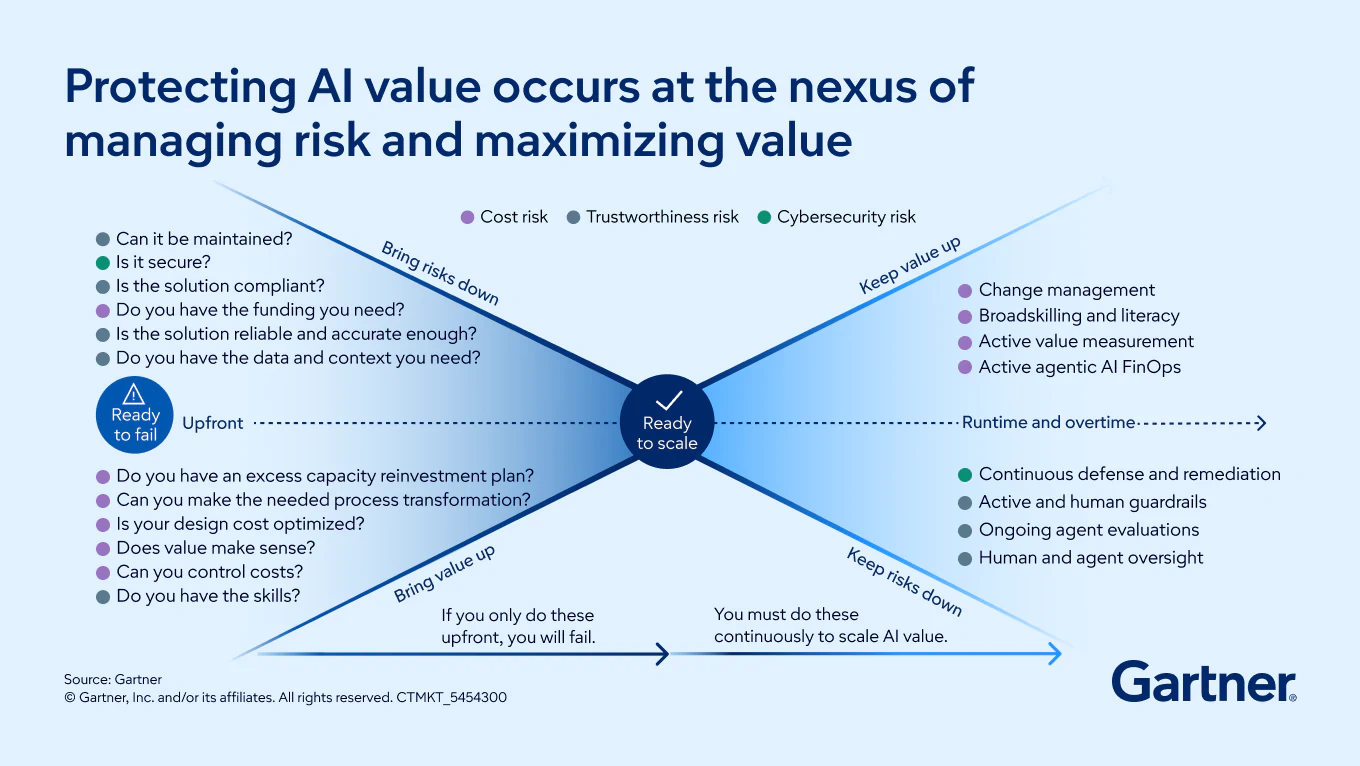
Successful AI pilots can create false confidence
Organizations continue to experiment with generative AI and agentic AI in pursuit of productivity, efficiency and growth. But the real challenge is ensuring that AI can operate reliably, consistently and safely at scale. That is where many organizations encounter an AI value gap.
As Rita Sallam, Distinguished Vice President Analyst at Gartner, notes, “Testing AI in limited, controlled scenarios creates a dangerous illusion of safety, masking the severe operational, financial and security vulnerabilities that will inevitably explode at scale.” This is because while controlled pilots often demonstrate early success, they rarely expose the operational realities that emerge in the production environment.
You might also like this webinar: Assess and Benchmark AI Cyber Risk Readiness
How to protect AI value at scale
Closing the AI value gap requires continuous value protection across three areas: cost, cybersecurity and trustworthiness. Leaders should treat these risks as interconnected because weakness in any one area can undermine the value created by the others.
Build cost controls into AI architecture from the start
Runaway costs represent the most immediate risk to scaling AI value. Although model prices continue to fall, actual costs per completed task can rise as workflows become more complex and autonomous.
Leaders should avoid treating cost management as a finance exercise that happens after deployment. Instead, cost optimization needs to be embedded directly into AI architectures and workflows. Practical steps include:
- Matching models to tasks
- Routing simpler requests to lower-cost models
- Breaking work into reusable components
- Implementing dynamic spending controls
Organizations should also budget for the investments required to support scaled AI deployments. The most successful organizations invest heavily in data and context, governance and security, and people capabilities. To protect enterprise value, allocate at least twice as much budget to these foundational capabilities as to the AI tools themselves.
Shift cybersecurity from prevention to resilience
As AI systems become more capable, threats move faster. Traditional point-in-time assessments and legacy defenses are increasingly ineffective against machine-speed attacks and exposure discovery.
Major platforms are already reporting vulnerability increases approaching 500%, significantly reducing the time available for remediation. Rather than assuming every threat can be prevented, leaders should focus on limiting impact and accelerating recovery.
The goal is operational resilience, enabling organizations to rapidly detect, contain and recover from failures as they arise.
This means:
- Engineering security controls directly into AI workflows
- Enforcing strict system boundaries
- Protecting APIs and sensitive data
- Strengthening machine identity management
- Continuously testing autonomous systems
Turn policy into code and strengthen human oversight
Governance cannot keep pace with autonomous systems if it remains trapped in policies, committees and manual reviews. As AI scales, governance controls must become executable and embedded directly into workflows.
Require your AI engineers to translate written policies into machine-executable controls and real-time guardrails. This creates greater consistency, accountability and auditability across autonomous operations.
Don’t forget about providing your unique business context. AI agents perform best when they receive precise instructions about business rules, semantic meaning, historical decisions and current conditions rather than being given large volumes of raw data. Rich context layers can reduce reasoning token consumption by two to three times while improving operational accuracy by up to 50%.
Even with stronger automation, human stewardship remains essential. To ensure human oversight remains the final defense against AI risk, organizations should:
- Establish clear accountability for AI-driven decisions
- Improve AI literacy across the workforce
- Ensure qualified decision stewards oversee critical workflows
Government leaders are exploring many of the same AI opportunities, but within a distinct environment of public accountability, regulation and mission outcomes. Discover how public sector executives are turning AI investments into measurable value while managing risk and building stakeholder trust.
AI value gap FAQs
What is the AI value gap?
The AI value gap emerges when organizations demonstrate promising results in AI pilots but struggle to realize comparable value at scale because of unmanaged cost, cybersecurity and trustworthiness risks.
Why do AI pilots often fail to predict success at scale?
Pilots typically take place in controlled environments that do not fully expose operational, financial and security challenges. Those risks often become visible only after AI systems are deployed more broadly across the enterprise.
How can leaders close the AI value gap?
Leaders should focus on continuous value protection by building cost controls into AI architectures, prioritizing operational resilience over prevention alone, embedding governance controls directly into workflows and providing AI systems with strong business context supported by human oversight.
Attend a Conference
Accelerate growth with Gartner conferences
Gain exclusive insights on the latest trends, receive one-on-one guidance from a Gartner analyst, network with a community of your peers and leave ready to tackle your mission-critical priorities.

Drive stronger performance on your mission-critical priorities.