AI is the top strategic priority for most CEOs — and investors, regulators and the public are paying close attention to how organizations use and deploy it.
- Gartner client? Log in for personalized search results.
8 Questions Boards of Directors Must Ask to Evaluate an AI Strategy
By Abbott Martin | July 16, 2026
Why board AI oversight can’t wait
AI has evolved from an IT investment into a boardroom imperative. By 2028, at least one-third of business decisions will be made autonomously or semiautonomously with AI agents — up from just 1% today, Gartner finds. Meeting fiduciary duties will require proactive board oversight of AI strategy, deployment, performance, regulation and risk.
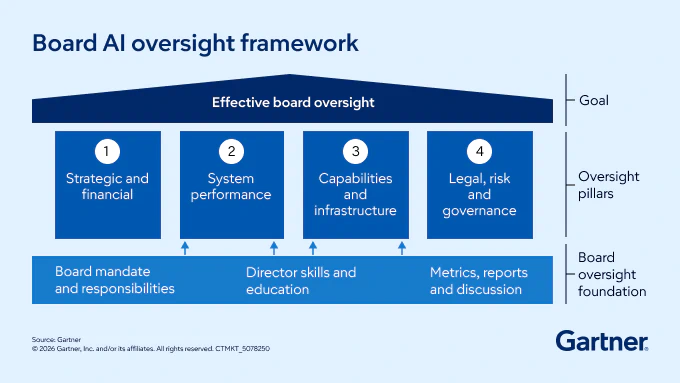
Boards of directors that want to provide effective AI oversight need a structured, repeatable framework for assessing the organization’s use of AI. The right questions, organized across four distinct oversight pillars, give boards the visibility they need to govern AI investments, manage risk and hold leadership accountable.
8 questions to assess AI strategy and structure board oversight
The eight questions below are the ones boards should require management to answer on a recurring basis, with supporting metrics.
To gain strategic and financial oversight
How is AI impacting our business, industry and competition — and what is the risk of not acting?
Why it matters: Boards can’t evaluate AI investments or AI governance without first understanding the competitive terrain.
Follow-up questions: What specific competitive advantages are we building? How will AI scale affect our costs and operating model?
Track: Competitive positioning, market share trends, customer retention and cost structure (cost per token, energy use).
How do we ensure alignment between our AI models and core business strategy and cost structure?
Why it matters: AI deployments that run ahead of business strategy risk technical capability without strategic coherence. Press management on whether AI initiatives are tied to defined business outcomes and whether procurement decisions are creating lock-in exposures that could constrain future flexibility.
Follow-up questions: Are we creating long-term strategic value or a vendor dependence? How is AI being evaluated against existing business goals and outcomes? How do we model the fully loaded costs at deployment scale?
Track: Revenue growth and margins, productivity impact, value realization rate and vendor reliance index.
To gain system performance oversight
How are AI outcomes measured, and how do we detect model accuracy and drift?
Why it matters: AI systems degrade over time. Model drift, data quality decay and bias accumulation are operational certainties without active monitoring and intervention. Don’t accept general assurances that “the AI is performing well.” You need specific, quantified measures and the trajectory behind them.
Follow-up questions: How are benchmarks established? What data quality standards govern training and inference datasets? What triggers a formal performance review?
Track: Task accuracy rate, error rate, grounded response rate, drift index and deviation from expected model accuracy benchmarks.
What safeguards exist to manage model errors, hallucinations and bias, and how are we ensuring performance improves over time?
Why it matters: Oversight means more than compliance. AI systems that produce errors and hallucinations without detection are an operational failure point and liability. Boards should understand how errors are caught, escalated and remediated, as well as whether human oversight is embedded in high-stakes decision flows.
Follow-up questions: How frequently are humans catching and overriding AI errors? Is shadow AI being identified and governed? Do we have the real-time governance and security to confidently deploy? Do we have sufficient insurance to transfer risk?
Track: Bias testing and auditing rate, human override rate, mean time to detect and remediate, anomaly detection rate, incidence cost exposure and percentage of AI systems tracking incident rates.
To gain capabilities and infrastructure oversight
Do we have the necessary capabilities in people, processes and systems to effectively scale AI?
Why it matters: The most common failure mode in enterprise AI is a capability gap. Organizations that deploy AI without AI-literate leadership or infrastructure aligned to the demands of AI at scale create compounding risk. By 2028, AI literacy will be the predominant skill set demanded in hiring and promotion criteria. Boards that are not probing this today will face a reckoning.
Follow-up questions: What is the expected impact on our talent strategy? Where are technology stack or operating model constraints limiting progress? What director and management education programs are in place?
Track: AI user adoption rates, AI/data/ML talent acquisition and retention, IT infrastructure and IT vendor management maturity.
Is our data governance sufficiently mature for effective AI use and control?
Why it matters: AI is only as trustworthy as the data it trains on and operates with. Poor data governance does not just produce poor AI outputs — it creates legal exposure, compliance risk and reputational damage. Ask management to characterize data governance maturity not just as an IT function, but as a board-level risk.
Follow-up questions: What percentage of AI use cases are supported by production-grade data? How is data governance maturity being measured and improved?
Track: Percentage of AI use cases with production-grade data, data governance maturity score and data analytics maturity score.
To gain legal, risk management and governance oversight
What ethical and responsible AI principles govern our approach, and how do we identify and respond when the organization deviates from them?
Why it matters: There is a meaningful difference between a published AI ethics policy and one that is operationally enforced. Ask management not just what principles exist, but also how those principles are translated into decision-making standards, how deviations are detected and who is accountable when violations occur.
Follow-up questions: How are ethical AI principles applied in high-risk use cases? What mechanisms exist for employees or stakeholders to flag deviations?
Track: AI explainability, transparency and fairness scores; user and stakeholder feedback on transparency, value and safety of AI use cases.
What AI risk framework governs our organization (such as ISO 42001 or the NIST AI RMF), and are there named executives responsible for AI-specific and AI-amplified risks?
Why it matters: Regulatory and operational AI impacts are evolving faster than most board charters were designed to handle. Don’t accept a general answer like, “we have an AI risk program.” Require management to identify the specific framework being used to classify, assess and mitigate AI risk — and to name the executives who own that accountability.
Follow-up questions: How often are oversight processes reviewed against the risk framework? What are the most significant legal risks AI has amplified — across IP, cybersecurity and privacy?
Track: AI process governance coverage (percentage of AI use cases with risk classifications), AI trust and security maturity, AI risk impact across IP violations, product safety, cybersecurity incidents, privacy, and third-party risk and AI liability insurance coverage.
Boards of directors and AI strategy FAQs
What is the four-pillar framework for board AI oversight?
Effective board-level AI oversight should be organized across four interconnected pillars: Strategic and financial oversight (whether AI investments are competitively positioned and financially sound), system performance oversight (whether AI systems are performing as intended and degradation is being managed), capabilities and infrastructure oversight (whether the organization has the people, processes and data maturity to scale AI responsibly), and legal, risk Management and governance oversight (whether controls and accountability structures are in place to manage AI risk within appetite).
How does vendor dependence factor into AI strategy oversight?
AI procurement decisions can create significant lock-in risk. As organizations build critical operations around specific AI vendors, switching costs rise and negotiating leverage falls. AI agents are also increasingly acting as autonomous buyers in B2B transactions, creating procurement exposures that traditional oversight was not designed to catch. Boards should ask management whether AI investments are building long-term strategic value or deepening vendor dependence, and require that vendor reliance be tracked as a board-level metric.
Why is AI literacy important for boards of directors?
By 2025, 44% of Fortune 100 companies included AI expertise in director bios, up from 26% the year before. Directors need base-level literacy: Understanding how AI is used, its risks and organizational impact. Boards should also ensure at least some directors have expert-level fluency in model governance and AI risk. Evaluate all directors against these tiers and make AI literacy a priority in education and recruitment.
Attend a Conference
Accelerate growth with Gartner conferences
Gain exclusive insights on the latest trends, receive one-on-one guidance from a Gartner analyst, network with a community of your peers and leave ready to tackle your mission-critical priorities.

Drive stronger performance on your mission-critical priorities.