AI toolmates are changing what communicators do and how they create value.
- Gartner client? Log in for personalized search results.
AI toolmates are changing what communicators do and how they create value
Communications teams have spent years building jobs around creating content, managing requests and executing communications activities. Those responsibilities shaped how teams were staffed, trained and evaluated. But AI toolmates are changing that equation. According to Gartner, nearly 50% of communications heads report using AI for tasks like data analysis, media monitoring and workflow optimization.
“As teams become more adept at applying AI within their work, more of them will find opportunities to reengineer workflows and to invent new ways of working that enhance the communications value proposition and shift the focus of communicators from creation to orchestration,” says Brianna Lux, Director Analyst at Gartner. Yet, leaders shouldn’t wait for this to happen. They need to be proactive about reevaluating communication jobs to prevent capability gaps and achieve high ROIs.
You might also like this webinar: Transforming Communications for an AI-Enabled World
Communications roles must evolve with AI
Organizations often layer AI onto existing jobs instead of redesigning work around the unique strengths of humans and AI. As a result, many teams improve efficiency without fundamentally changing how the function contributes to the business.
How AI is changing the way communication works
AI is reshaping communications through three forms of change:
Augmentation: It’s improving existing work by helping communicators deliver higher-quality outcomes more efficiently.
Reengineering: It’s redesigning workflows to reduce cost and improve, experience and impact.
Invention: It’s creating entirely new forms of work and new sources of value.
While many communications teams are already realizing gains through augmentation, the larger opportunity comes from reengineering and invention. In these areas, communicators contribute less through production and more through strategic influence.
Strategic work becomes the human advantage
As AI absorbs more repeatable production work, responsibilities such as strategic counsel, stakeholder negotiations, contextual judgment, creativity and insights generation become more valuable. Communicators increasingly spend less time producing outputs and more time shaping how work flows across people, systems and stakeholders. Communications functions create greater impact when human effort is concentrated on high-judgment work while AI increasingly supports routine execution.
From content creation to outcome orchestration
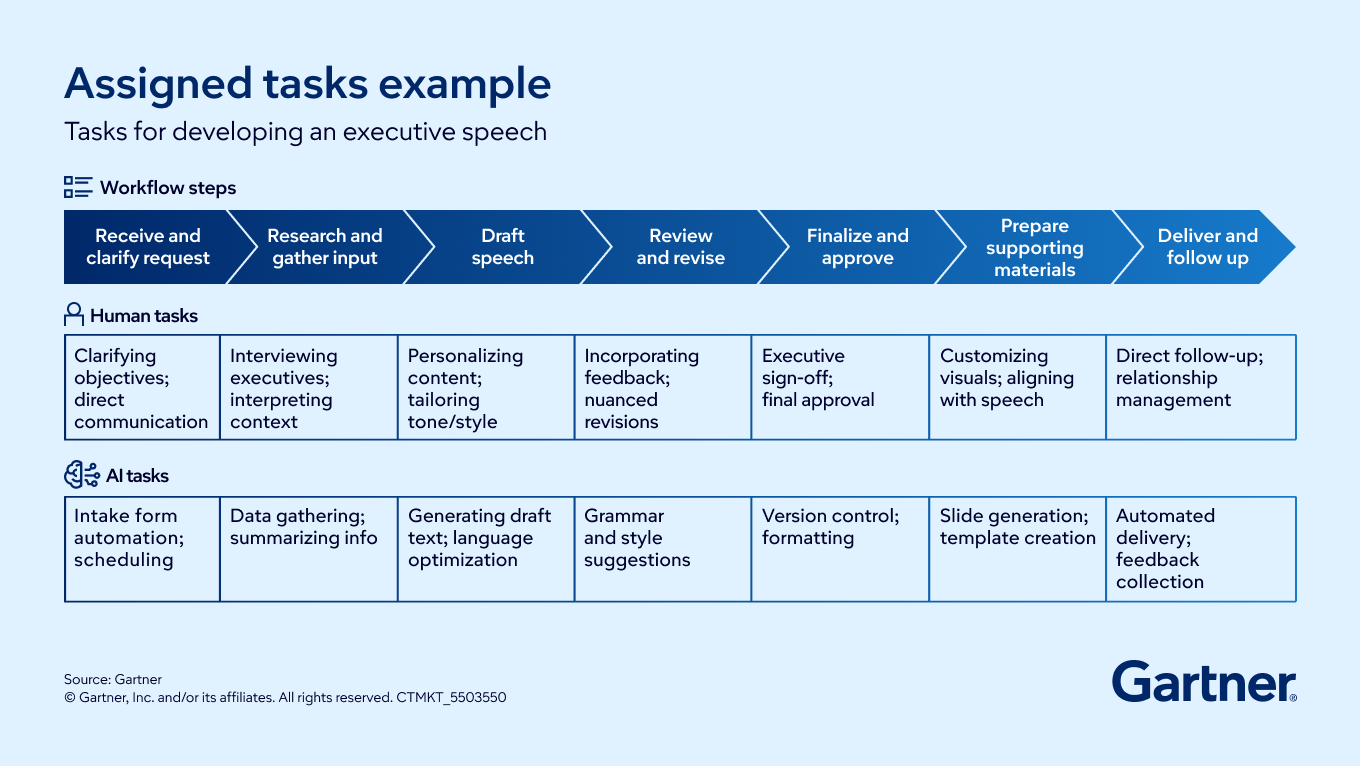
As AI takes on more production work, communicators increasingly create value through orchestration. Organizations that want to realize the full value of AI must determine:
Which work belongs to humans
Which work belongs to AI
Which activities require human-on-the-loop collaboration
Rather than spending most of their time producing communications assets, future communications teams will increasingly guide workflows, coordinate AI-enabled work, integrate insights, advise leadership and ensure communications activities support business outcomes.
Communications AI FAQs
Why do communications roles need to change for AI?
AI toolmates are augmenting existing work, enabling workflow reengineering and creating entirely new ways of working. Communications leaders must update roles, responsibilities and skills to capture AI’s full value.
How can communications leaders realize more value from AI?
Gartner recommends mapping workflows, determining which activities belong to humans versus AI and updating job descriptions to reflect evolving responsibilities in AI-enabled workflows.
What skills become more important in AI-enabled communications roles?
Judgment, strategic framing, stakeholder relationships, negotiation, contextual understanding, insight generation and strategic counsel become increasingly important as AI assumes a greater share of routine production work.
Attend a Conference
Accelerate growth with Gartner conferences
Gain exclusive insights on the latest trends, receive one-on-one guidance from a Gartner analyst, network with a community of your peers and leave ready to tackle your mission-critical priorities.

Drive stronger performance on your mission-critical priorities.