Streamline the process of creating an efficient, measurable, easy-to-communicate functional strategic plan.
- Gartner client? Log in for personalized search results.

High uncertainty requires heightened prioritization in functional strategic planning
As market pace and economic uncertainty make strategic planning more challenging, executives across the business must consider how to produce clear, effective plans more quickly. This requires clearly connecting the dots between disruptive events and their effects on a function’s strategic and operational decisions.
It’s imperative that functional leaders assess, adjust and articulate strategy at every level while remaining sensitive to employees’ and peers’ capacity to consume and grasp ongoing changes. Waste-free functional strategic planning offers an efficient way to streamline the planning process and produce a clear, measurable and communicable plan.
Sharpen functional strategic planning by stripping it back to basics
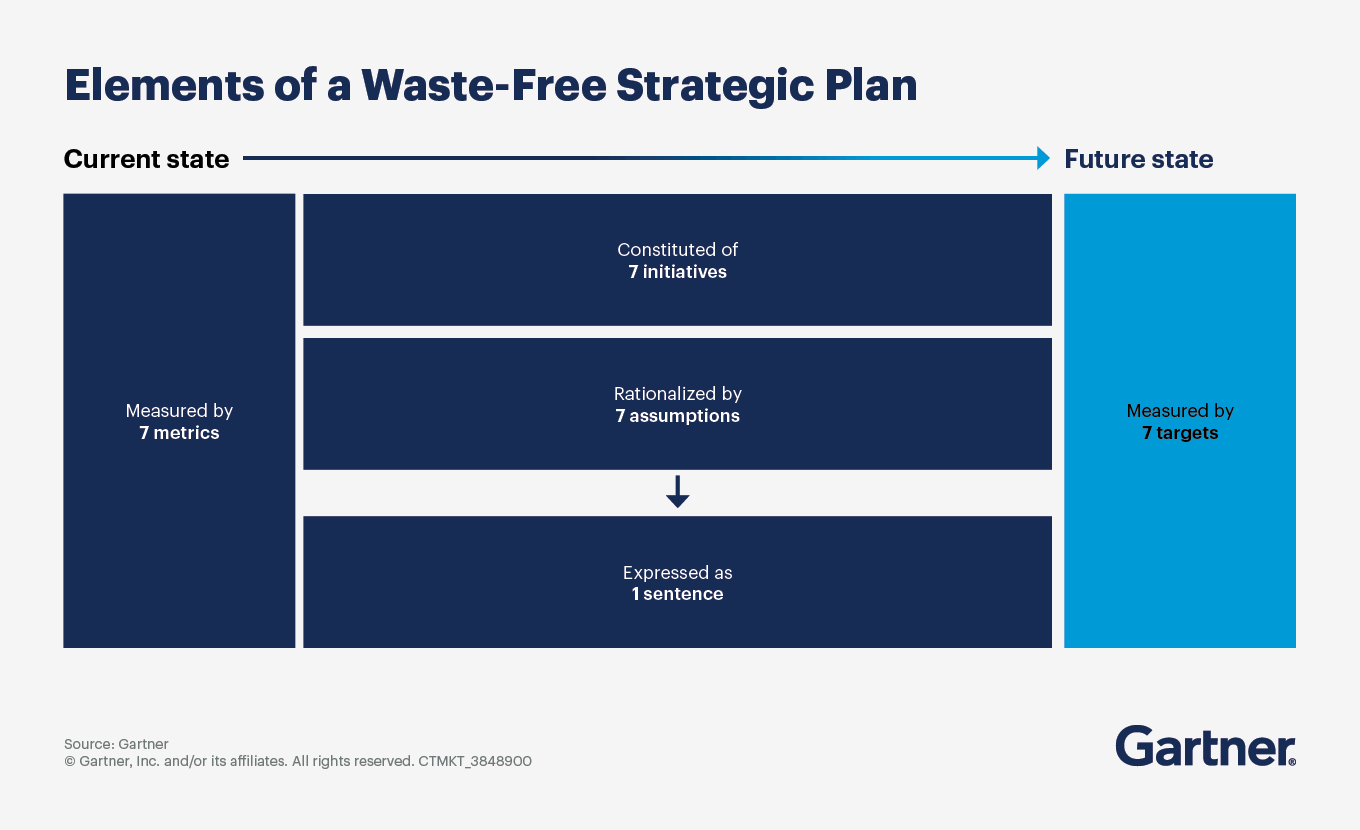
A waste-free planning approach eliminates all but what is necessary and sufficient to communicate a strategic plan: seven metrics to track progress to the target state, seven key initiatives, seven critical assumptions and one statement to capture the essence of the strategy. Follow these steps to communicate where your function is going and how it can get there.
No. 1: Shortlist metrics for current and target states
Most function-specific strategic plans are too vague, noncommittal or unwieldy. Definitively selecting and communicating metrics at the start of strategic initiatives ensure you can measure success objectively.
Clarify the target end state and brainstorm appropriate metrics by interviewing your CEO about the mission, vision and desired outcomes for your function. As your view of the target state gets clearer, choose metrics that align to those stated outcomes and that you can track from Day 1 through the end of the measurement period. Gartner recommends selecting a one- to two-year period and tracking progress at least quarterly.
No. 2: Uncover the core assumptions related to your plan
A strategy’s core assumptions clarify cause-and-effect relationships between the business, key initiatives and external driving forces. They also help lay out the rationale for the target end state and enable earlier course correction when assumptions become invalid.
Make sure critical assumptions are concrete with quantifiable thresholds for monitoring — for example, “The market value for widgets will increase 5% in our first year in the market.” Set the threshold loosely enough that you’ll have at least 90% confidence it won’t be breached. Then monitor for unlikely breaches and course-correct as needed.
No. 3: Distill initiatives required to achieve the target state
A functional strategic plan need not include initiatives that continue along the current trajectory (such as “keep providing excellent customer service”). Rather, include initiatives that reflect business change and create value beyond the status quo.
Specify up to seven initiatives that will advance your function toward its target state. Then set criteria and dates for key milestones and completion. When drafting timelines, factor in competing pressures such as team requests for more time to complete initiatives and looser assumption thresholds, or top-down requests for tighter delivery timelines.
The key initiatives you select for your function may affect important metrics outside of those you identified on your shortlist. If you aren’t confident that a given metric will stay within an allowable range, add it to the metrics list or address it with your list of critical assumptions.
No. 4: Concisely communicate your functional strategy
Once you’ve identified your metrics, assumptions and initiatives, summarize your functional strategic plan. Aim for a single, aspirational sentence — but stay focused on getting the essential elements right versus engaging in endless rounds of wordsmithing.
In practice, a compelling statement should guide more than it inspires, using the clarity and simplicity that characterize a waste-free functional strategic plan — for example: “Assuming the market value of our widgets increases by 5%, finance plans to cut supply chain costs and reach 15% ROI by end of year through smart budget planning and resource management. This will help us achieve sustainable growth.”
Functional strategic planning FAQs
What is functional strategic planning?
Functional strategic planning involves periodic resetting of mid- to long-term strategic direction and priorities. It focuses on key issues and the specific initiatives needed to ensure that a given function is aligned to the business’s strategic goals.
Why is functional strategic planning important?
Today’s disruptive conditions make it especially critical for functional strategic plans to account for a variety of scenarios and be able to change with enterprise strategy. Gartner research shows that companies whose business and functional leaders are deeply involved in strategic planning are more likely to be able to change plans fast enough to respond to disruption.
Attend a Conference
Accelerate growth with Gartner conferences
Gain exclusive insights on the latest trends, receive one-on-one guidance from a Gartner analyst, network with a community of your peers and leave ready to tackle your mission-critical priorities.

Drive stronger performance on your mission-critical priorities.