Modern GTM success depends on product marketing’s ability to unite teams around real-time insights and rapid execution.
- Gartner client? Log in for personalized search results.
The shift from static to dynamic GTM strategies
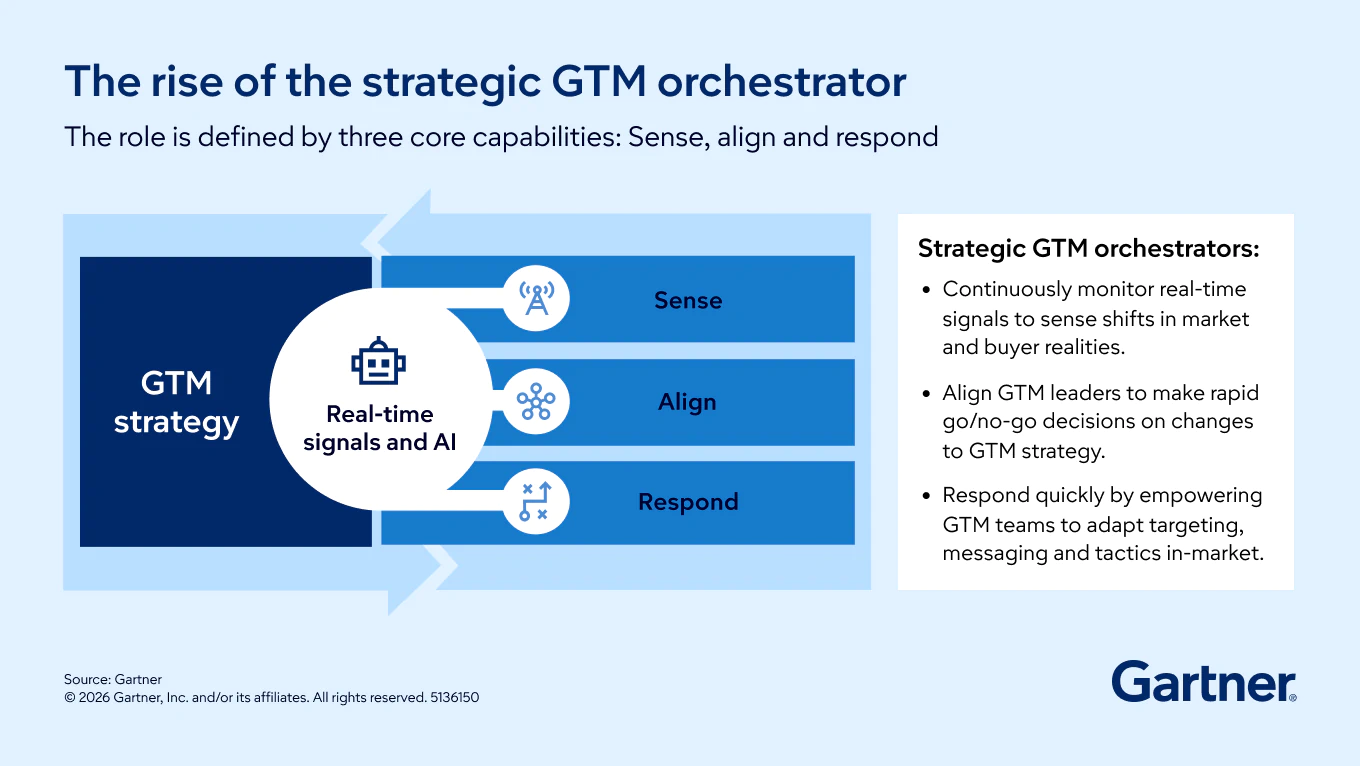
Traditional go-to-market (GTM) strategies have been linear, manual, slow and siloed, leaving organizations unable to keep pace with rapidly evolving markets. According to Gartner, product marketing leaders must now position their teams as strategic GTM orchestrators — guiding organizations to continuously sense, align and respond to changing market dynamics. This shift is driven by more complex buying behaviors, the proliferation of data and AI, and the need for coordinated execution across functions.
Today’s GTM strategy is a living system that requires ongoing adaptation. Gartner Vice President Analyst Rahim Kaba explains, “Strategic GTM orchestrators must identify which market segments, buyers and value propositions matter the most, using real-time signals to sense shifts in market and pivot rapidly as a unified front.”
The three actions of strategic GTM orchestration
To keep pace with market and customer changes, Gartner identifies three critical capabilities for product marketers. Together, these actions enable organizations to continuously adapt their GTM strategies by turning market insights into aligned decisions and agile execution.
Sense: Build always-on market awareness
Establish robust sensing capabilities that unify fragmented market signals and surface actionable insights. By using real-time data, AI and modern GTM technology stacks, product marketers can integrate signals from customer feedback, competitive intelligence, engagement data, product analytics and sales performance to identify emerging shifts early and prioritize opportunities.
Effective sensing requires more than collecting data. Product marketers should implement structured listening posts, create cross-functional feedback loops and use AI-driven analytics to uncover patterns, trends and anomalies. Gartner recommends applying a disciplined signal-to-action framework that moves from observing and synthesizing signals to interpreting, clarifying, deciding and activating appropriate GTM responses. This ensures decisions are grounded in validated insights rather than isolated observations.
Align: Enable cross-functional decision making
Sensing alone is insufficient without cross-functional alignment. Product marketers play a critical role in synchronizing GTM leaders across sales, demand generation, product management and customer success around shared goals and priorities as market realities evolve.
Gartner recommends empowering a GTM council or committee with relevant market insights and clear decision rights to make rapid go/no-go decisions on GTM strategy adjustments. This governance structure helps reduce silos and accelerates organizational response. A unified GTM scorecard, measuring outcomes such as pipeline velocity, win rates and customer retention, further ensures stakeholders remain aligned on common objectives and can make performance-based decisions across the customer life cycle. Product marketers should also provide strategic clarity by challenging assumptions and bringing the voice of the market into executive decision making.
Respond: Drive agile GTM execution
To maintain relevance in dynamic markets, enable teams to rapidly activate, adapt and optimize GTM initiatives as new insights emerge. Gartner recommends adopting modular GTM plans that can be adjusted without rebuilding the entire strategy, allowing teams to quickly pivot messaging, campaigns, sales motions and customer engagement tactics.
Continuous feedback loops, including sales debriefs, customer interviews and campaign retrospectives, ensure field insights continuously feed back into the sensing process. Regular impact briefs for executives help demonstrate business outcomes, maintain alignment and reinforce the value of GTM orchestration. This agile approach enables organizations to respond quickly to changing market conditions while minimizing risk and maximizing market relevance.
GTM orchestrator FAQs
What is a GTM orchestrator in product marketing?
According to Gartner, a GTM orchestrator guides the organization to sense, align and respond rapidly to shifting market dynamics. This evolving product marketer role involves building robust sensing capabilities, driving cross-functional alignment and enabling agile execution to adapt GTM strategies in real time.
How do GTM orchestrators help organizations adapt to market changes?
GTM orchestrators help organizations adapt by using real-time signals and AI to sense market shifts, empowering councils for rapid decision making and enabling teams to activate modular GTM plans. This unified approach allows organizations to pivot quickly and maintain alignment as conditions change.
What skills do product marketers need to succeed as GTM orchestrators?
Product marketers need advanced market sensing, cross-functional alignment and agile execution skills to succeed as GTM orchestrators. This includes the ability to leverage real-time signals and AI for market sensing, facilitate rapid decision making through empowered GTM councils, and enable teams to quickly activate and adapt modular GTM plans. These skills ensure product marketers can guide their organizations to sense, align and respond effectively to dynamic market shifts.
Attend a Conference
Accelerate growth with Gartner conferences
Gain exclusive insights on the latest trends, receive one-on-one guidance from a Gartner analyst, network with a community of your peers and leave ready to tackle your mission-critical priorities.

Drive stronger performance on your mission-critical priorities.