Stay ahead of competitors by detecting and adapting to product differentiation shifts before they erode advantage.
- Gartner client? Log in for personalized search results.
How to Defend Product Differentiation and Advance in Accelerated Markets
By Brooke Grimes | July 6, 2026
Why a product differentiation system matters more than ever
Product differentiation is now both simultaneously critical and fragile. According to Gartner, 77% of product marketing leaders at growth companies cite differentiation as one of their top priorities. In today’s fast-moving markets, differentiation is harder to sustain when competitors can close functionality gaps almost instantly.
When organizations fail to detect and respond to differentiation drift early, the result is weakened market position, buyer confusion and lower win rates. To stay competitive, product marketing leaders need a disciplined system to identify early signs of differentiation decay and act at the right speed to reinforce advantage.
How to catch and address differentiation drift
Sustaining differentiation requires more than messaging tweaks or feature comparisons. Many organizations mistakenly treat differentiation as a marketing-only exercise, which can obscure deeper strategic signals. As a result, teams often react to surface-level changes rather than identifying true erosion in competitive advantage.
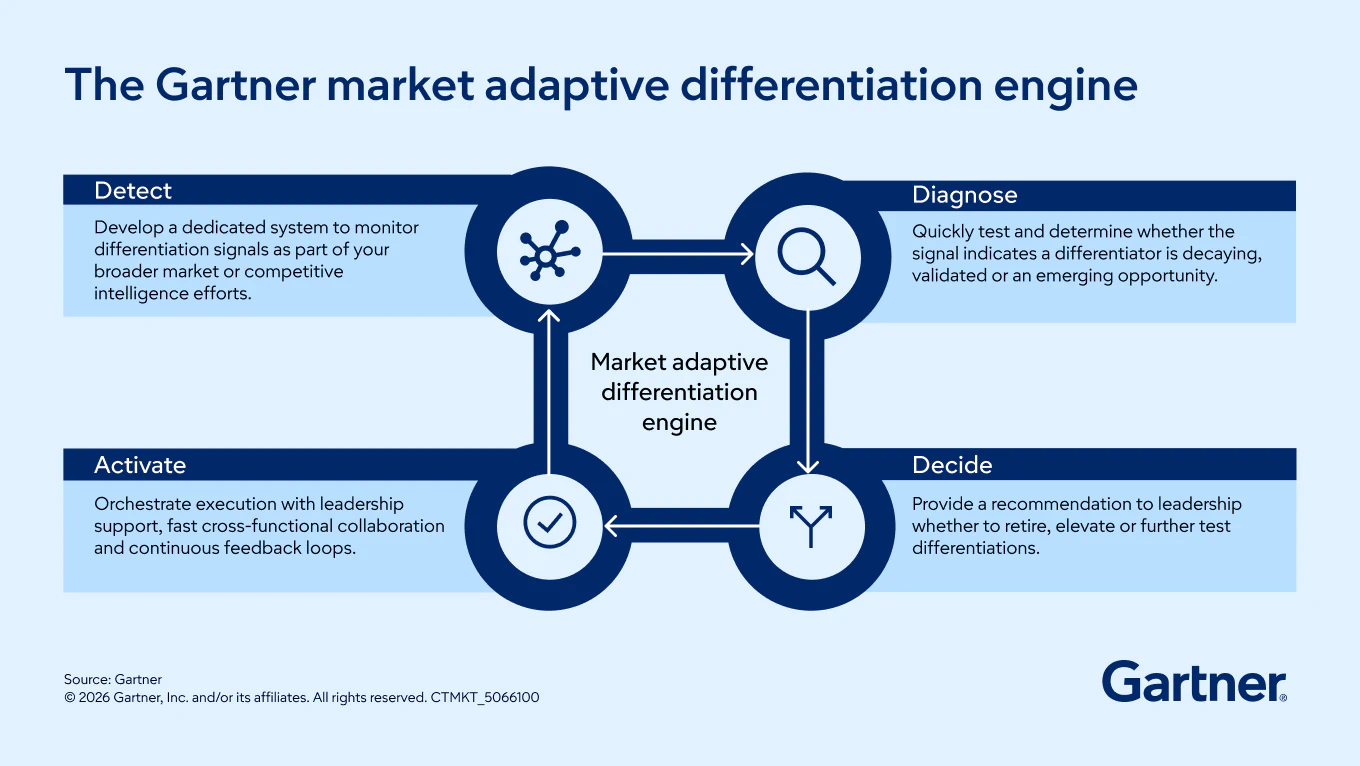
The Gartner market adaptive differentiation engine (MADE) provides a structured framework for product marketers to detect signals, assess their implications and orchestrate coordinated action across product, sales and marketing.
The Gartner MADE framework for adaptive differentiation
MADE gives product leaders a system to monitor, assess and act on differentiation shifts through a four-step cycle:
Detect: Establish dedicated monitoring for differentiation signals, not just feature gaps. This includes understanding how current differentiators are impacting pipeline health, buyer language, social sentiment, competitive win rates and user adoption trends. This enables early identification of weakening or emerging differentiators.
Diagnose: Once a signal is detected, rapidly validate it with sales, customers and synthetic customers. The goal is to determine whether a differentiator is decaying, still effective or emerging. Indicators such as declining win rates, shifts in buyer language or increased discounting can all signal weakening differentiation.
Decide: Use validated data to determine whether to retire, elevate or further test a differentiator. Structured, timely decision making helps reduce risk and maintain alignment across stakeholders.
Activate: Translate decisions into coordinated execution across product and go-to-market teams. This includes aligning on both long-term strategic pivots and short-term tactical moves.
Turning decisions into action with MADE
Activation is where differentiation strategy becomes tangible. Product marketing, as a go-to-market orchestrator, ensures that frontline teams receive clear, consistent updates to reinforce a unified narrative. Senior leadership alignment is essential for strategic changes, while smaller cross-functional teams can drive rapid execution for near-term tactical moves. Early engagement with sales, especially with early adopters, helps validate changes, generate quick wins and accelerate adoption. Ongoing communication and feedback loops are essential to reinforce changes and surface new blockers, allowing the MADE cycle to continuously repeat and adapt.
Measuring success in product differentiation
The impact of MADE is reflected in both improved market outcomes and organizational agility. Key metrics include higher win rates, stronger competitive positioning and faster deal velocity.
As differentiation shelf life continues to shrink, MADE enables organizations to pivot quickly to capture opportunities earlier and defend against emerging threats. Tracking decision speed, activation timelines and market performance provides a clear view of how effectively differentiation is being sustained.
What to do next to evolve product marketing into strategic GTM orchestrators
AI‑driven markets and rapidly shifting buyer expectations are redefining how go‑to‑market strategies are developed and executed, requiring product marketing leaders to move beyond reactive roles. To stay competitive, product marketing must evolve into a strategic orchestrator that integrates insights, aligns cross‑functional teams and continuously adapts execution to market signals.
The steps in that journey include:
Differentiating messaging in competitive AI‑driven markets, gathering and validating actionable insights about buyers, competitors and market dynamics to guide positioning and go‑to‑market decisions.
Driving cross‑functional alignment for GTM success, ensuring tight coordination across product, sales, marketing and partner teams to deliver consistent, high‑impact execution.
Innovating sales and partner enablement approaches, aligning go‑to‑market strategy with broader business and product priorities while focusing enablement efforts on the highest‑value growth opportunities.
Integrating real‑time market signals into GTM decisions, evolving go‑to‑market models in response to AI‑driven buying behaviors, competitive shifts and emerging demand patterns.
Product differentiation FAQs
What is product differentiation and why is it important?
Product differentiation is the unique value that sets a product apart from competitors in the market. It is critical because it drives strategic decisions, influences buyer choice and sustains competitive advantage in fast-changing markets.
How can organizations detect product differentiation drift?
Organizations can detect differentiation drift by monitoring real-time signals such as win rates, buyer language, social sentiment and user adoption. Dedicated systems like the Gartner MADE framework help catch early signs of weakening differentiation before they impact performance.
How does the Gartner MADE framework improve product differentiation?
The Gartner MADE framework improves product differentiation by providing a structured approach to detect, diagnose, decide and activate changes. It enables product marketers to respond quickly to market signals, align cross functional teams and maintain strong competitive positioning through continuous adaptation.
Attend a Conference
Accelerate growth with Gartner conferences
Gain exclusive insights on the latest trends, receive one-on-one guidance from a Gartner analyst, network with a community of your peers and leave ready to tackle your mission-critical priorities.

Drive stronger performance on your mission-critical priorities.