Preemptive resilience helps product leaders counter attacks that move faster than human response.
- Gartner client? Log in for personalized search results.
AI changes the economics of cyber defense
Generative AI has accelerated the volume, speed and sophistication of cyberattacks, creating a challenge that traditional detect-and-respond approaches were not designed to handle. Gartner notes that cybercriminals launched approximately 50,000 malicious scans per second in 2025, while phishing attacks have increased by 4,151% since 2022. As AI lowers the effort required to launch attacks and automate targeting, defenders face shrinking windows to detect and respond.
The result is a growing gap between the speed of attacks and the speed of human decision making. Product leaders can no longer rely on reactive approaches alone if they want their products to support enterprise resilience.
“AI shifts strategic advantage to attackers, and only preemptive cyber defense can shift it back,” says Isy Bangurah, Senior Director Analyst at Gartner.
You might also like this webinar: Planning for 2027: AI’s Impact on Tech Market Opportunities and Economics
How product leaders can build preemptive resilience
Preemptive cybersecurity is not a replacement for reactive security. Instead, it is additive and escalatory, helping organizations anticipate, disrupt and neutralize threats before they cause business harm.
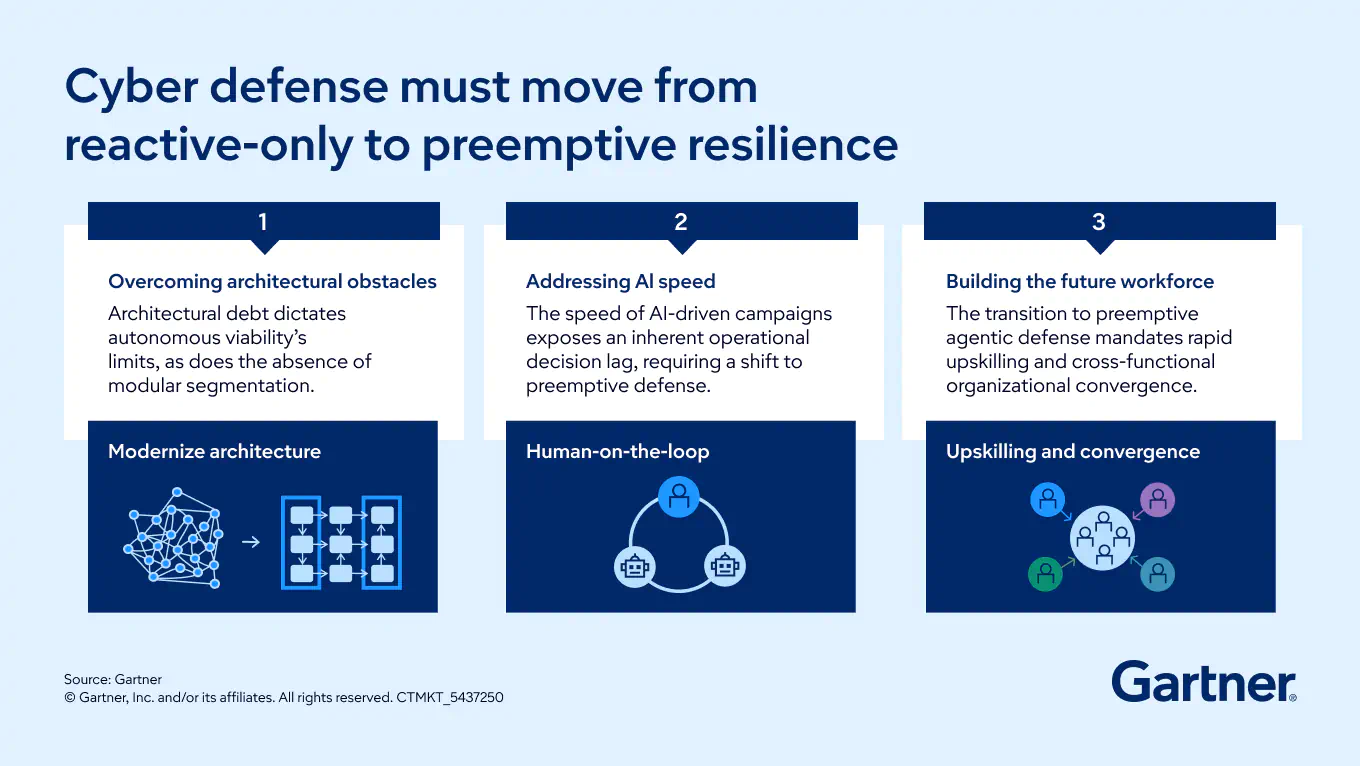
Address architectural debt before pursuing autonomy
Architectural debt is a major barrier to autonomous security operations. Legacy environments that lack modular segmentation and state isolation create systemic risks that limit the effectiveness of self-healing and autonomous response capabilities.
For product leaders, this means modernization is more than an infrastructure concern. It is a prerequisite for preemptive resilience. Leaders should develop a clear modernization strategy that uses modular architectures and systematically remediates architectural debt. Without isolation and segmentation, high-velocity response mechanisms can stall and revert to slower human-driven processes.
Organizations seeking greater automation should therefore focus first on creating environments that can safely support autonomous actions. Building preemptive capabilities on top of brittle architectures increases operational risk and limits the value of AI-enabled defenses.
Build products that can disrupt threats before damage occurs
Preemptive cybersecurity enables organizations to anticipate, deny, disrupt and deceive threats before they affect the business. This approach relies on several capabilities that actively interfere with attacker activity rather than waiting to detect compromise.
Advanced cyber deception can feed attackers misleading information and waste their resources. Automated moving target defense dynamically changes defensive postures between reconnaissance and attack execution, making successful compromise more difficult. Predictive threat intelligence and automated exposure management help organizations identify emerging threats and understand how exposures relate to their business environments.
Gartner also recommends pursuing partnerships or acquisitions that strengthen capabilities in automated moving target defense and cyber deception. For product leaders, these capabilities can help shift defensive efforts from responding to attacks toward preventing attackers from achieving their objectives in the first place.
Keep humans in command of high-stakes decisions
While AI can improve the speed and scale of cyber defense, Organizations shouldn’t employ fully autonomous security operations. AI systems operate within limited contexts and may not understand broader operational, financial or reputational consequences.
Leaders should instead utilize collaborative human-on-the-loop models. In this approach, AI handles high-volume analysis, threat triage and localized response actions, while people retain authority over critical business decisions.
Product leaders should also embed explainability into product experiences so users can understand the evidence and business rationale behind automated recommendations. It is also recommended to provide clear decision-tree visualizations that help bridge the gap between automated execution and human judgment.
As AI-driven attacks become more sophisticated, resilience will depend on combining machine-speed response with human oversight. Organizations that strike this balance will be better positioned to adopt preemptive cybersecurity without introducing new operational risks.
Looking for a government perspective? Explore how public sector cybersecurity leaders are managing AI-related risks while enabling innovation and operational resilience.
Preemptive cybersecurity FAQs
What is preemptive cybersecurity?
Preemptive cybersecurity helps organizations anticipate, deny, disrupt and deceive threats before they cause harm. It complements traditional reactive security rather than replacing it and is designed to improve business resilience against AI-driven attacks.
Why is preemptive cybersecurity important for product leaders?
AI-driven attacks operate at machine speed, compressing defenders’ decision windows and creating business risk. Product leaders should incorporate preemptive cybersecurity capabilities into products to help neutralize threats before they materially affect customers or operations.
Does preemptive cybersecurity eliminate the need for reactive security?
No. Preemptive cybersecurity is additive and escalatory to reactive security. Traditional reactive approaches remain important, but they work best when combined with preemptive capabilities that improve resilience and reduce the impact of emerging threats.
Attend a Conference
Join Gartner analysts and your peers to accelerate growth
Join the leading technology and service provider peers to get an update on accelerating tech growth in a new era of transformation and technology trends.
8 – 9 Mar 2027
Gartner Product Leadership Conference
Grapevine, TX

Drive stronger performance on your mission-critical priorities.