As AI becomes more deeply embedded in business operations, organizations face a new challenge: managing the costs, risks and complexity that emerge when AI scales across the enterprise.
- Gartner client? Log in for personalized search results.
AI is reshaping the business operating model
For the past several years, organizations have focused on adopting AI, identifying use cases and improving productivity. But as AI becomes more deeply integrated into business operations, the conversation is shifting. The challenge is no longer simply deploying AI. It’s managing the consequences of operating at AI scale.
“AI is accelerating decision making, automation and innovation. At the same time, it is introducing new cost structures, governance requirements and accountability challenges,” says Daryl Plummer, Distinguished Vice President Analyst, Gartner Fellow and Chief of Research at Gartner. “Leaders must rethink how they measure value, control spending and manage risk in an environment where AI can amplify both opportunity and uncertainty.”
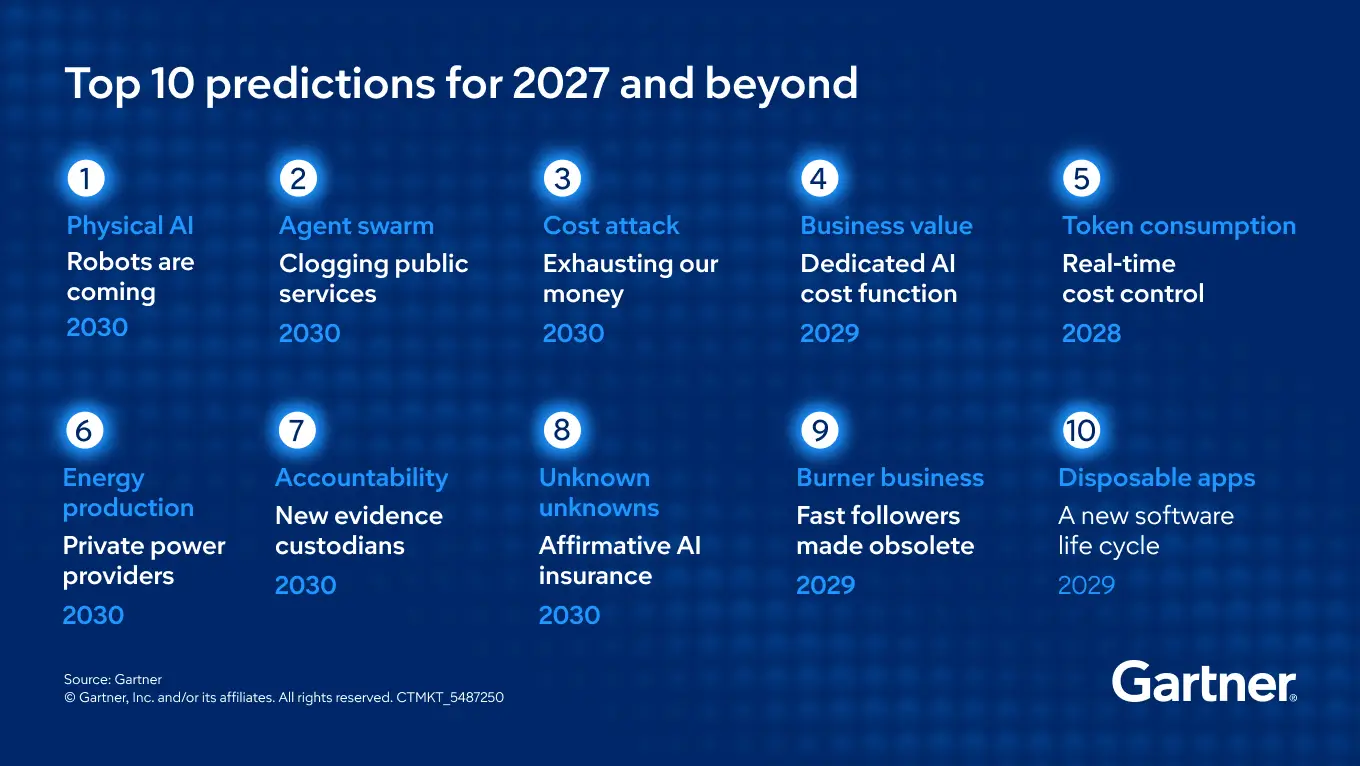
Initially presented at Gartner IT Symposium/Xpo™ 2026 conference, these 10 predictions suggest that AI’s biggest impact may not be what the technology can do, but how it is reshaping the way businesses are run.


Top strategic predictions reveal new challenges in value, governance and innovation
As AI becomes more deeply integrated into business operations, leaders face a growing number of questions that traditional management approaches were not designed to answer. How should AI investments be measured? How can organizations control costs that fluctuate in real time? Who is accountable when autonomous systems make unexpected decisions?
Gartner clients have access to insights around all 10 predictions. A sampling of five is highlighted here.
1. AI value moves beyond efficiency
Prediction: By 2029, 60% of organizations deploying AI will establish a dedicated function to map total AI compute costs directly to business value and profit margins.
Organizations are discovering that AI’s value cannot be measured through cost reduction alone. As AI spending grows, leaders will need to connect AI investments to revenue, margins, scale and business outcomes.
2. AI costs become a real-time management challenge
Prediction: By 2028, 60% of global enterprises will embed AI FinOps control at inference, shifting cost governance from reactive reporting to real-time optimization.
AI consumption can fluctuate rapidly, making traditional budgeting approaches less effective. Organizations will increasingly manage AI costs as they occur rather than relying on retrospective reporting and periodic reviews.
3. AI creates a new attack surface: Cost
Prediction: By 2030, 80% of organizations with public-facing AI will have experienced a cost-exhaustion attack, resulting in the creation of excessive AI costs.
AI introduces a new category of business risk in which attackers can create financial damage by driving model consumption and compute costs. Cost governance is becoming as important as traditional security controls.
4. Accountability becomes harder than automation
Prediction: By 2030, 80% of global enterprises will designate their CIO (or CAIO) the “evidence custodian” for responsible AI.
As AI systems become more autonomous, organizations will need verifiable evidence trails that can explain decisions, establish accountability and support governance when unexpected outcomes occur.
5. The pace of innovation becomes the advantage
Prediction: By 2029, 80% of new applications will be intentionally disposable — used for less than one year — revolutionizing the software life cycle.
AI is dramatically lowering the cost and effort required to create software. As a result, organizations may prioritize speed, experimentation and rapid adaptation over long-term application ownership.
FAQs
What are the Gartner top strategic predictions?
The Gartner annual strategic predictions identify 10 future events or actions that signal where disruption is accelerating across business, technology and operations. These trends are based on observable signals and Gartner analysts’ insights into how organizations are adapting.
Why do these predictions matter to business leaders?
The Gartner top strategic predictions highlight where business assumptions are changing as AI scales across the enterprise. From measuring AI’s value beyond efficiency gains to managing rising compute costs, strengthening accountability and adapting to faster innovation cycles, these predictions help leaders anticipate emerging risks and opportunities so they can make more informed investment, governance and operating decisions.
How should leaders use strategic predictions?
Strategic predictions are not intended to forecast a single future. Instead, they help leaders identify emerging developments that could reshape their organizations, evaluate potential business impacts and make more informed decisions about investments, priorities and risk management.
Attend a Conference
Experience Applications conferences
With exclusive insights from Gartner analysts on the latest trends, sessions curated for your role and unmatched peer networking, Gartner conferences help you accelerate your priorities.
1 – 2 Mar 2027
Gartner Digital Workplace Summit
San Diego, CA

Drive stronger performance on your mission-critical priorities.