By Stan Aronow | April 08, 2022
CSCO Outlook for 2027: Cloudy With a Chance of Moderate Growth
October 09 2026


By Stan Aronow | April 08, 2022
Quick… what’s a dirty little secret that most people would not want aired publicly? No… this is a business-related blog, try again. 😉 If you answered, “We were hacked, and it took our systems down long enough to impact our operations and those of our customers,” you’d be in good company.

At our most recent Executive Advisory Board meeting, one of our members lamented that while their team is quite advanced in terms of overall supplier relationship management, they are still frequently surprised when cyber disruptions happen at suppliers.
This week, during an event for our COO and CSCO communities, we surveyed attendees on whether they or their supply partners had been impacted by cyberattacks since the Russian invasion of Ukraine. We also asked if they are seeing a trend in this type of activity. It was an anonymous poll, but I suspect many of the leaders on the call chose not to reveal their situation. For those who did, the responses were telling.
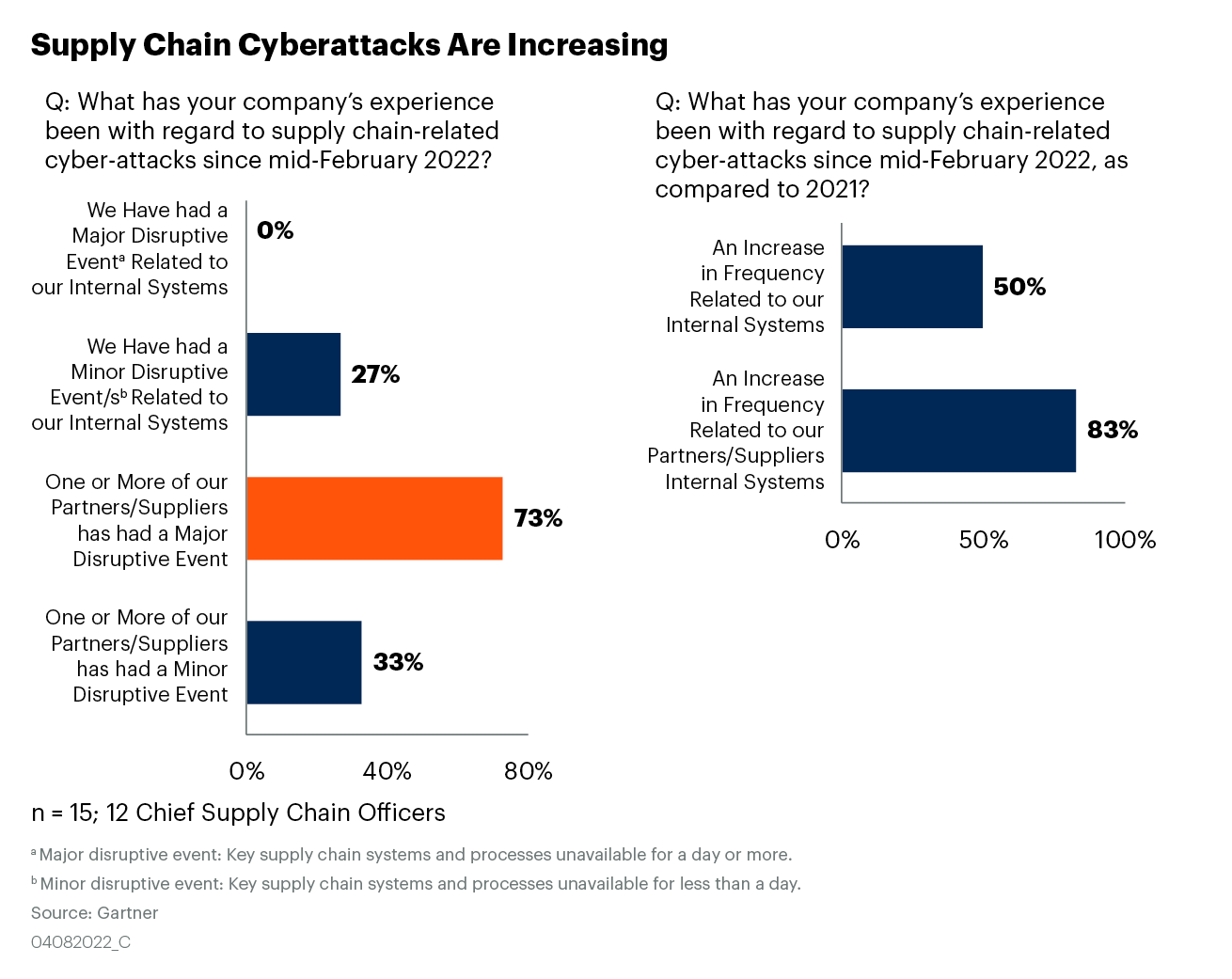
Nearly three-quarters of respondents had one or more of their suppliers experience a disruptive cyber event which took key processes and systems down for at least a day. More than a quarter had shorter-term disruptions to their internal operations. This level of cyber activity was an uptick for most when compared to the period prior to mid-February and the lead-up to the Russian invasion of Ukraine.
At many companies, supply chain leaders are only granted the authority to execute CIO or chief information security officer (CISO) directives on cybersecurity. A challenge to this model is that often the weakest cyber links exist at suppliers and other external partners. CSCOs and their teams need to engage to ensure the extended value chain is protected, along with internal systems and assets.
Beyond governance issues, there are ROI-related decisions on the required response. One way to assess the amount of focus and resources that should be placed on extended value chain security is to treat this investment like any other type of risk mitigation or insurance policy. Gartner’s well-known risk management analyst, Paul Proctor, recently published a report on this topic (Use Value and Cost to Treat Cybersecurity as a Business Decision — Gartner subscription required). Here are some of the key findings from that research:
The first step in most remediation journeys is admitting we have a problem and then moving into solution space. In line with that theme, we are excited to explore the topic of Secure Supply Chain with our global COO and CSCO community at an April 26 Leaders in Action event, co-sponsored by Mark Bakker and team at HP Enterprise.
Stan Aronow
VP Distinguished Advisor
Gartner Supply Chain
Stan.Aronow@gartner.com
Listen and subscribe to the Gartner Supply Chain Podcast on Gartner.com, Apple Podcasts, Spotify and Google Podcasts

Beyond Supply Chain
Subscribe on LinkedIn to receive the biweekly Beyond Supply Chain newsletter.