By Kevin O'Marah | August 12, 2016
CSCO Outlook for 2027: Cloudy With a Chance of Moderate Growth
October 09 2026


By Kevin O'Marah | August 12, 2016
This week’s epic fail at Delta Airlines prompted angry comments like this one from the Pittsburgh Post-Gazette: “an industry that’s happy to gouge passengers for extra bags and operate planes perennially short of pillows must undertake a comprehensive re-evaluation of its approach to customer service”.
There’s an old saying that should be kept in mind before we get too indignant: you get what you pay for. Flying is too cheap and that’s why it’s miserable. It also means the system is unreliable, unsafe and ultimately at odds with the megatrends of our time.
Airlines are bad business
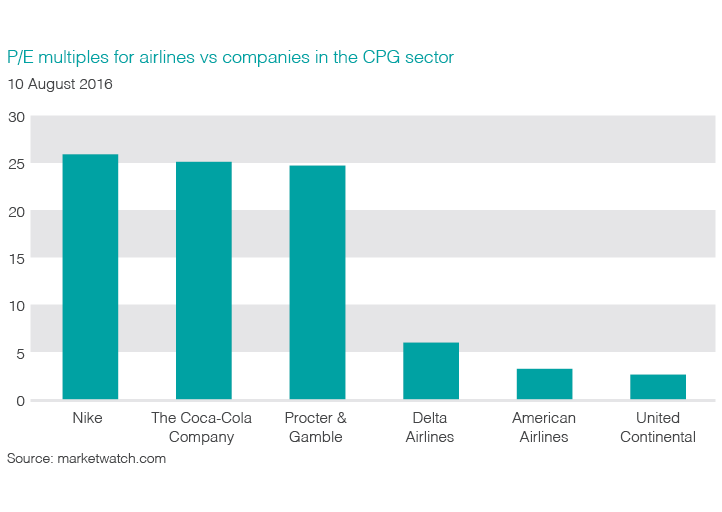
Investors know this. It’s clearly reflected in the lousy price-to-earnings (P/E) multiples commanded by airline stocks that suggest little or no expectation of growth. And yet, our economy couldn’t function without airlines. Why is it so bad?
Post-mortem analysis of the Delta issue this week pointed to a power surge in a transformer and a failure to switch over to backup infrastructure. This was a 20th-century equipment glitch that brought the biggest and best US airline to its knees. What if it had been a cyberattack? The air travel network in the United States is too important to be so fragile.
The root problem isn’t bad management, it’s consumers. We’re too ready to choose one flight over another to save a few pounds. In response, airlines have evolved a dynamic pricing system that’s tuned to fill every seat.
Airline revenue management has been successful in raising load factors and therefore asset utilisation. Unfortunately, the economics of air travel mean that all passengers end up stuck with the same problems, even though some (like business class flyers) are hugely profitable while others lose money.
Making matters worse, airlines must compete viciously for the last few ticket sales to avoid flying empty seats. This creates operational challenges with bags, boarding, deplaning and catering. The result is pervasive shared suffering with airline employees underpaid and overworked, travellers in agony and investors looking stupid.
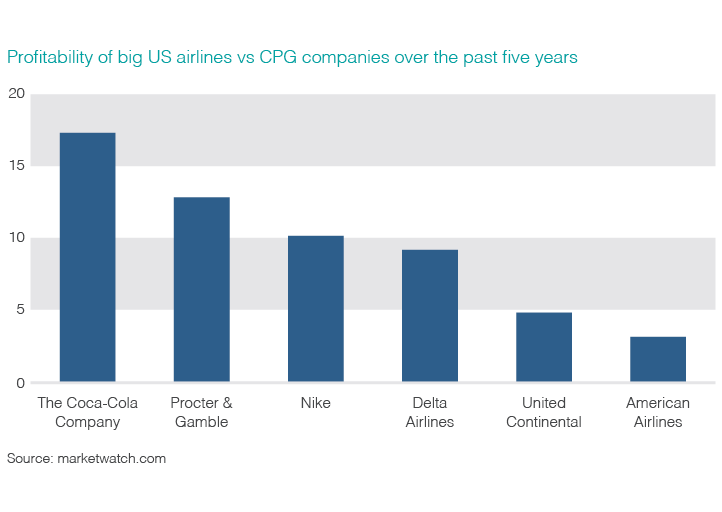
The profitability of big US airlines over the past five years (a time of very low fuel prices, by the way) is poor. This is mainly because we’re trying to get it all done on a shoestring.
How can commercial air travel be such a mess despite a century of effort?
Infrastructure, insurance and information
Airlines aren’t like normal consumer businesses, and yet we pretend they are. Free market forces may be perfect for creating a better mousetrap, washing powder or running shoe but they have limited power when one wants to get from say, Knoxville, Tennessee to Seattle. Infrastructure including aircraft, gates and runways takes years to put in place. Capacity rebalancing in response to demand shifts isn’t easy and idle infrastructure of this magnitude is very expensive.
Airlines also lack the ability to control their operating environment. Weather, equipment failure, crew absences and air traffic control all play havoc with operational effectiveness in ways that few manufacturing professionals ever experience. Stuck as they are between the rock of investor expectations and the hard place of penny-pinching consumers, airlines have discovered a free resource to buffer their operations: our time. Travellers’ time is the unmeasured inventory insurance airlines use to keep things going.
Delta’s crisis this week also flags the airline’s problem with archaic information systems. Seeing gate agents tap infinite key strokes while sharing secret workarounds in pursuit of simple rebooking is truly comical. This, unfortunately, is the tip of the iceberg. They can’t upgrade the systems because they run 24/7 and because they’re not profitable enough to run a shadow system that it can then switch over to. Considering what we’re all accustomed to these days with Uber, Google and Amazon, it seems criminal to be so out of date.
A better flying future
Flying thousands of miles in a few hours shouldn’t be cheap. It’s complex, environmentally impactful and potentially dangerous. It’s also wondrous and civilizing. Somehow, whether by collusion, regulation or business model breakthrough, airlines must start to charge us more for flying.
The system is strung too tightly. We should fly less, pay more and stop taking it all for granted.
Beyond Supply Chain
Subscribe on LinkedIn to receive the biweekly Beyond Supply Chain newsletter.