By Kevin O'Marah | August 19, 2016
CSCO Outlook for 2027: Cloudy With a Chance of Moderate Growth
October 09 2026


By Kevin O'Marah | August 19, 2016
This week, The Wall Street Journal featured a well-researched article on China’s push to shift its factory culture away from labour and towards robots. Reasons include a rise in labour costs, the flattening and impending decrease in worker population and falling costs of advanced robotics technology.
Left unsaid was whether this is part of a wider acceleration in the digital takeover of work worldwide. It is.
Exponential technologies
Supply chain professionals are fully aware of Moore’s Law, which predicts exponential performance improvements in semiconductors. Similar “laws” underlie networks, 3D printing and other digital technology.
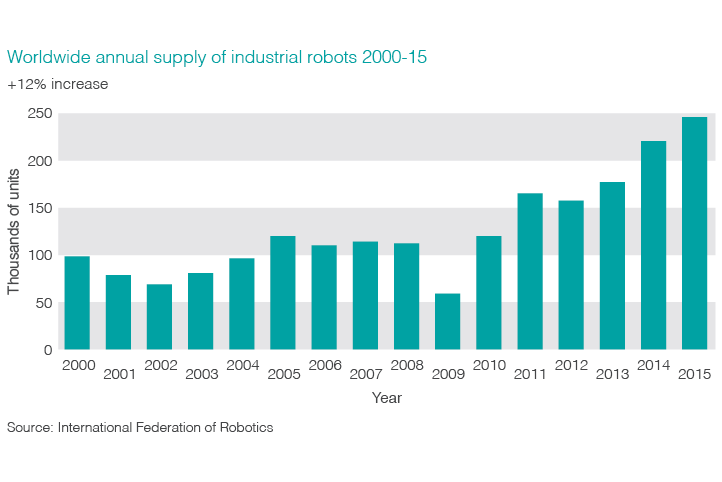
For a long time, industrial robots were left out of this dynamic, experiencing instead relatively unexciting progress in a limited set of applications, most notably in automotive assembly plants. Starting in 2009, however, growth cranked up. It’s still early – SCM World data ranks robotics behind data analytics, cloud and several other disruptive technologies – but things are accelerating.
Digitisation is moving faster than business
Last month at our Leaders Forum in Dublin, the theme was all about strategy. Presenters from Amazon, Nike, HP and Stanley Black & Decker offered strategic views on how supply chain contributes to competitive advantage. All addressed such essential ideas as visibility, innovation, customer centricity and flexibility.
In recapping the key takeaways from the event, however, it was the pervasiveness of digital disruption that really stood out. Supply chain strategists are adopting and mixing digital technologies to make business faster, more responsive and more agile. New data available from smart manufacturing systems is being crunched with new tools for simulation and matched to new sources of demand insight in ever faster iterations.
The constraint is no longer technical but commercial as business practices fail to keep up with supply chain possibility.
Robots replacing people
China’s move to robotics should raise alarm bells for any executives still doubting the speed of the transition now underway. With a workforce of around 900 million people and the still fresh memory of an economic miracle built on low-cost labour, China might seem an unlikely place for robotics to explode.
In fact, companies like Foxconn have spent several years developing and installing thousands of industrial robots. In 2015, China bought more industrial robots than all of Europe. Even faster growth was seen in Mexico, which nearly doubled units bought compared to 2014.
The robotics revolution was long thought to be mainly about Europe, Japan and the US. No longer. The whole world is on board and things are speeding up.
The move to robotics is speeding up for three main reasons:
The arrival of digital is now behind us. Its impact is just starting to be evident. Robotics is going to be huge, and soon.
Beyond Supply Chain
Subscribe on LinkedIn to receive the biweekly Beyond Supply Chain newsletter.